Resident Crews of the International Space Station (ISS)

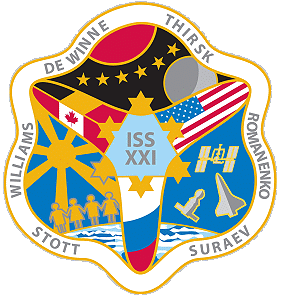
ISS: Expedition 21 |
 |
 |
 |
 |
 |
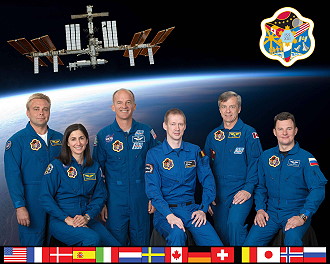
alternative crew photo |
alternative crew photo |
 |
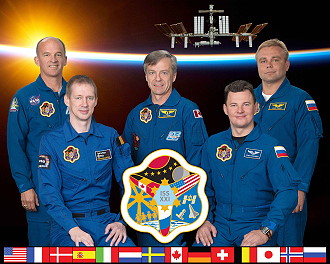 |
alternative crew photo |
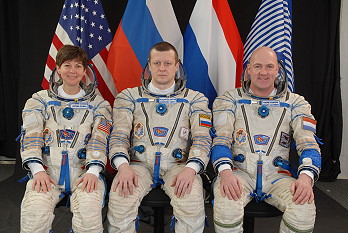
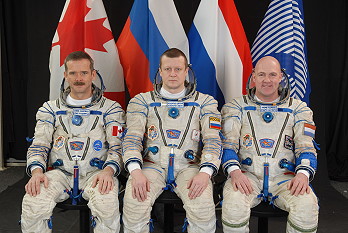
Crew, launch- and landing data
| No. | Nation | Surname | Given names | Position | Spacecraft (launch) |
Launch date |
Launch time |
Spacecraft (landing) |
Landing date |
Landing time |
Mission duration |
Orbits |
| 1 |  |
De Winne | Frank Luc | ISS-CDR | Soyuz TMA-15 | 27.05.2009 | 10:34:53.043 UTC | Soyuz TMA-15 | 01.12.2009 | 07:16:30.6 UTC | 187d 20h 41m 38s | 2961 |
| 2 |  |
Surayev | Maksim Viktorovich | Flight Engineer-1 | Soyuz TMA-16 | 30.09.2009 | 07:14:44.923 UTC | Soyuz TMA-16 | 18.03.2010 | 11:24:03.5 UTC | 169d 04h 09m 19s | 2669 |
| 3 |  |
Stott | Nicole Marie Passonno | Flight Engineer-2 | STS-128 | 29.08.2009 | 03:59:36.994 UTC | STS-129 | 27.11.2009 | 14:44:20.46 UTC | 90d 10h 44m 43s | 1423 |
| 4 | |
Romanenko | Roman Yuriyevich | Flight Engineer-3 | Soyuz TMA-15 | 27.05.2009 | 10:34:53.043 UTC | Soyuz TMA-15 | 01.12.2009 | 07:16:30.6 UTC | 187d 20h 41m 38s | 2961 |
| 5 |  |
Thirsk | Robert Brent | Flight Engineer-4 | Soyuz TMA-15 | 27.05.2009 | 10:34:53.043 UTC | Soyuz TMA-15 | 01.12.2009 | 07:16:30.6 UTC | 187d 20h 41m 38s | 2961 |
| 6 | |
Williams | Jeffrey Nels | Flight Engineer-5 | Soyuz TMA-16 | 30.09.2009 | 07:14:44.923 UTC | Soyuz TMA-16 | 18.03.2010 | 11:24:03.5 UTC | 169d 04h 09m 19s | 2669 |
unofficial Backup Crew
| No. | Nation | Surname | Given names | Position |
| 1 |  |
Kuipers | André | ISS-CDR |
| 2 | |
Skvortsov | Aleksandr Aleksandrovich Jr. | Flight Engineer |
| 3 | |
Coleman | Catherine Grace "Cady" | Flight Engineer |
| 4 | |
Kondratiyev | Dmitri Yuriyevich | Flight Engineer |
| 5 | |
Hadfield | Chris Austin | Flight Engineer |
| 6 | |
Walker | Shannon | Flight Engineer |
 |
 |
 |
Expedition Report
|
Launch from the Baikonur Cosmodrome (Jeffrey
Williams and Maksim
Surayev with
Soyuz
TMA-16). Nicole
Stott was on-board the
ISS since August 31, 2008 (arrival with
STS-128). Frank
De
Winne, Roman
Romanenko and Robert
Thirsk arrived with
Soyuz TMA-15
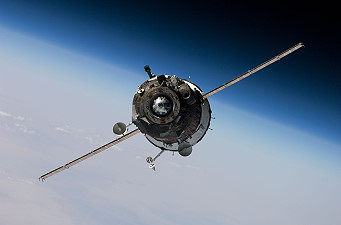
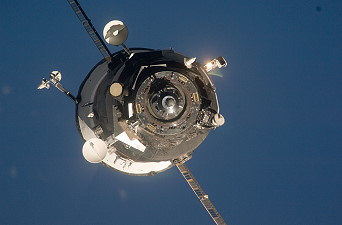
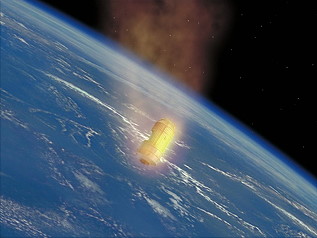
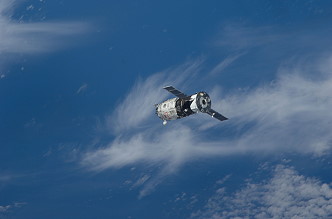
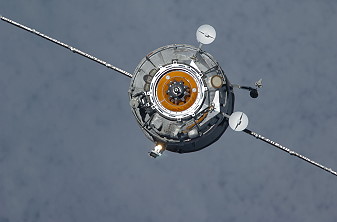
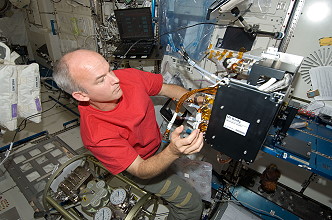
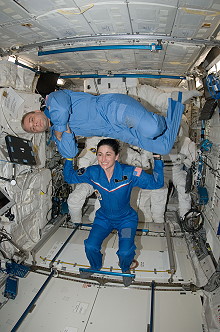
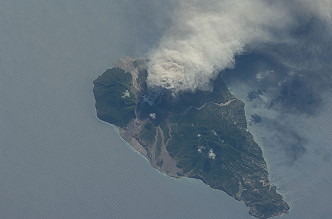
on May 29, 2009. The Expedition 21 officially began with undocking of Russian spacecraft Soyuz TMA-14 on October 11, 2009 at 01:07:16 UTC and Expedition 20 ended. Progress M-03M launched at 01:14 UTC on October 15, 2009. Docking with the Pirs module of the ISS took place on October 18, 2009 at 01:40 UTC. Progress M-03M delivered 790 kilograms (1750 lb) of dry cargo, 870 kg (1918 lb) of propellant and 420 kg (926 lb) of water. The spacecraft undocked from Pirs on April 22, 2010. Filled with trash and discarded space station items, the Progress ship was used for scientific experiments until it was deorbited, entering the Earth's atmosphere and burning up over the Pacific Ocean. The deorbit burn occurred at 18:07 UTC on April 27, 2010. The new Russian Mini-Research Module 2 (MRM2), also known as Poisk, docked to the space-facing port of the Zvezda service module of the International Space Station on November 12, 2009. Poisk is a docking module of the International Space Station. Its original name was Docking Module 2 (Stykovochniy Otsek 2 (SO-2)), as it is almost identical to the Pirs Docking Compartment. The module was launched on November 10, 2009, 14:22 UTC attached to a modified Progress spacecraft, called Progress M-MIM2. About eight minutes after launch, the three-stage Soyuz rocket delivered Poisk, to a low-altitude injection orbit. According to NASA Poisk carried about 1800 pounds (817 kg) of cargo to the ISS including new Russian Orlan spacesuits, life support equipment, medical supplies and crew hygiene items. Space Shuttle STS-129 docked with the International Space Station on November, 18, 2009. The payload bay of STS-129 (ISS ULF-3 ELC-1 ELC-2) carried two large ExPRESS Logistics Carriers holding two spare gyroscopes, two nitrogen tank assemblies, two pump modules, an ammonia tank assembly, a spare latching end effector for the station's robotic arm, a spare trailing umbilical system for the Mobile Transporter, and a high-pressure gas tank. STS-129 was the first flight of an ExPRESS Logistics Carrier. While docked to the station, Atlantis' crew conducted three spacewalks to transfer the spare parts from the shuttle's payload bay to the station's external structures and continue assembly activities. At the end of the 11-day flight, Atlantis also brought home Expedition 20 and 21 Flight Engineer Nicole Stott, the final astronaut to use a space shuttle for a lift to or from the station. The ExPRESS Logistics Carrier (ELC) is a platform designed to support external payloads mounted to the International Space Station (ISS) starboard and port trusses with either deep space or Earth-ward views. Each pallet spans the entire width of the shuttle's payload bay, carries science experiments, and serves as a parking place for spare hardware that can be replaced robotically once on-orbit. STS-129/ULF3 will mark the first flight of ELC 1 and 2. ELC 1 and 2 are grappled by the space shuttle and station robotics arms and are placed on the station's truss structure. ELC 1 is mounted on the Port 3 truss element UCCAS while ELC 2 is placed on the Starboard 3 truss upper outboard PAS. The UCCAS and PAS were deployed during the STS-128 mission. The weight of ELC 1 is approximately 13,850 pounds (6,282 kg); ELC 2 weighs 13,400 pounds (6,078 kg). Both ELC 1 and 2 measure approximately 16 feet (4.9 meters) by 14 feet (4.3 meters) (without the ORUs installed). Because of their expertise in building the Hubble Space Telescope (HST) cargo carriers, NASA Goddard Space Center served as the overall integrator and manufacturer for ELC 1 and 2. Remmele Engineering, based in Minneapolis, Minn., built the integral aluminum ELC decks for NASA. Engineers from GSFC's Carriers Development Office developed the challenging, lightweight ELC design, which incorporates elements of both the Express Pallet and the Unpressurized Logistics Carrier. The ELC is designed to be carried in the space shuttle cargo bay to the ISS, fully integrated with cargo and/or payloads. Four ELCs were delivered to ISS before the scheduled retirement of the space shuttle. Two ELCs are attached to the starboard truss 3 (S3) and two ELCs are attached to the port truss 3 (P3). By attaching at the S3/P3 sites, a variety of views such as zenith (deep space) or nadir (Earthward) direction with a combination of ram (forward) or wake (aft) pointing allows for many possible viewing opportunities. Each ELC can accommodate 12 Flight Releasable Attachment Mechanism (FRAM)-based cargos that includes two payload attached sites with full avionics accommodation. The mass capacity for an ELC is 9,800 pounds (4,445 kg) with a volume of 98 feet (30 meters) cubed. The ISS provides power to the ELCs through two 3 Kilowatt (kW), 120 Volts direct current (V dc) feeds at the ISS to ELC interface. The ELC power distribution module converts the 120 V dc power to 120 V dc and 28 V dc. Both power voltages are provided to each payload attached site by separated buses. 120 V dc power is also provided to the other cargo attached site. Upon installation of the ELCs, it may take up to 4 hours for the power to be connected. A total of 14 large Orbital Replacement Units (ORUs) are being carried on ELC 1 and 2. All of the hardware for this mission was processed by Boeing under its Checkout, Assembly and Payload Processing Services (CAPPS) contract with NASA. The STS-129 mission marks the largest number of spare ORUs processed in a single mission under the CAPPS contract. The ORUs include the Ammonia Tank Assembly (ATA), Battery Charger Discharge Unit (BCDU), Cargo Transportation Container (CTC), two Control Moment Gyroscopes (CMG), High-Pressure Gas Tank (HPGT), Canadarm2 Latching End Effector (LEE), Materials International Space Station Experiment 7 (MISSE-7), two Nitrogen Tank Assemblies (NTA), Plasma Contactor Unit (PCU), two Pump Module Assemblies (PMA) and a Trailing Umbilical System-Reel Assembly (TUS-RA). The primary function of the ATA is to store the ammonia used by the External Thermal Control System (ETCS). The major components in the ATA include two ammonia storage tanks, isolation valves, heaters, and various temperature, pressure, and quantity sensors. There is one ATA per loop located on the zenith side of the Starboard 1 (Loop A) and Port 1 (Loop B) truss segments. Each is used to fill their respective ETCS loop on startup (loops are launched with nitrogen in the lines) and to supply makeup fluid to that loop. It also assists the Pump Module (PM) accumulator with ammonia inventory management, and provides the capability to vent the PM and ATA by connection to an external nonpropulsive vent panel. The length is 57 inches by 80 inches (145 by 203 centimeters) width with a height of 45 inches (114 centimeters). A new ATA, with 600 pounds (272 kg) of Ammonia, weighs approximately 1,702 pounds (772 kg). The Battery Charge Discharge Unit (BCDU) is a bidirectional power converter that serves a dual function of charging the batteries during solar collection periods (isolation) and providing conditioned battery power to the primary power buses during eclipse periods. The BCDU has a battery charging capability of 8.4 kW and a continuous discharge capability of 6.6 kW (9.0 kW peak). The BCDU also includes provisions for battery status monitoring and protection from power circuit faults. The BCDU measures approximately 40 inches by 28 inches (71 centimeters) by 12 inches (30 centimeters) and weighs 235 pounds (107 kg). There are 24 BCDUs on orbit that are used for normal Power System operation. Both the Russian and U.S. segments can maintain attitude control. When the Russian segment is in control, attitude is maintained by thrusters, which consume propellant. When the U.S. segment is in control, Control Moment Gyroscopes, manufactured by L3 Communications Space and Navigation under contract to Boeing, are used. The set of four CMGs balance the effects of gravity gradient, aerodynamic, and other disturbance torques (i.e., robotics, venting, and plume impingement), maintaining the station at an equilibrium attitude without using propellant. The CMGs can also be used to perform attitude maneuvers. The CMGs rely on electrical power provided by the solar powered electrical subsystem. A CMG consists of a single-piece 25-inch (63 centimeters) diameter, 220-pound (100 kg) stainless steel flywheel that rotates at a constant speed of 6,600 rpm and develops an angular momentum of 3,600 ft-lb-sec (4,880 N-m-s) about its spin axis. This rotating wheel is mounted in a two-degree-of-freedom gimbal system that can position the spin axis (momentum vector) of the wheel in any direction, allowing control torque generation in any direction. The station has four working CMGs that are mounted in the Zenith 1 truss segment. Each CMG assembly weighs approximately 600 pounds (272 kg) and measures 45 inches (114 centimeters) wide, 48 inches (122 centimeters) high, and 54 inches (137 centimeters) in length. The Canadian Mobile Servicing System (MSS), a space robotics system astronauts and cosmonauts use to assemble and maintain the International Space Station, consists of the Canadian Space Station Remote Manipulator System (SSRMS) or Canadarm2, the Mobile Base System (MBS) and the Special Purpose Dexterous Manipulator (SPDM) or Dextre. The SSRMS has two identical grapple end points called LEE that enable it to reattach either end to the station as its new base. It moves in inch worm fashion around the U.S. segment by placing one end on a mounting point and disengaging its other end and using it to grapple a payload or another mounting point. Each mounting point provides power and data to the SSRMS. The NTA provides a high-pressure gaseous nitrogen supply to control the flow of ammonia out of the ATA. The ATA contains two flexible, chambers incorporated into its ammonia tanks that expand as pressurized nitrogen expels liquid ammonia out of them. Designed by Boeing's Huntington Beach facility in California, the NTA controls ammonia pressure in the ATA as a key part of the External Active Thermal Control System, an external system that circulates ammonia to cool ISS segments. As the International Space Station (ISS) travels through Low Earth Orbit (LEO), an electrical charge builds. This phenomenon can result in high voltages that may cause electrical discharges. These discharges, in turn, can damage precise electrical instruments and can also present a hazard to crew members performing EVA. The Plasma Contactor Unit (PCU) is used to disperse the electrical charge that builds up by providing an electrically conductive "ground path" to the plasma environment surrounding the ISS. This prevents the electrical discharges and provides a means of controlling crew shock hazard during EVA. There are two PCUs located on the ISS Zenith 1 Truss, both of which are operated during EVA. The PMA is part of the station's complex Active Thermal Control System (ATCS), which provides vital cooling to internal and external avionics, crew members, and payloads. The station has two independent cooling loops. The external loops use an ammonia-based coolant and the internal loops use water cooling. At the heart of the ATCS is the pump module, which pumps the ammonia through the external system to provide cooling and eventually reject the residual heat into space via the radiators. The heat is generated by the electronic boxes throughout the station. Circulation, loop pressurization, and temperature control of the ammonia is provided by the Pump Module (PM). The major components in the PM include a Pump and Control Valve Package (PCVP), an accumulator, isolation and relief valves, and various temperatures, flow, and pressure sensors. The accumulator within the PM works in concert with the ATA accumulators to compensate for expansion and contraction of ammonia caused by the temperature changes and keeps the ammonia in the liquid phase via a fixed charge of pressurized nitrogen gas on the backside of its bellows. Manufactured by Boeing, the pump module weighs 780 pounds (354 kg) and measures approximately 5.5 feet (69 inches= 167 centimeters) long by 4 feet (50 inches = 122 centimeters) wide with a height of 3 feet (36 inches = 91 centimeters). The Materials on International Space Station Experiment 7 (MISSE-7) is a test bed for advanced materials and electronics attached to the outside of the International Space Station (ISS). Results will provide a better understanding of the durability of advanced materials and electronics when they are exposed to vacuum, solar radiation, atomic oxygen, and extremes of heat and cold. These materials and electronics, including solar cells, coatings, thermal protection, optics, sensors, and computing elements, have the potential to increase the performance and useful life of the next generation of satellites and launch systems. The samples are installed in experiment trays within two Passive Experiment Containers (PECs), which are opened on-orbit. Astronauts installed the PECs, 7A and 7B, to the MISSE-7 support base during an EVA. Each PEC holds samples on both sides, with PEC 7A orientated zenith/nadir (space facing/Earth facing), and PEC 7B oriented ram/wake (forward/backward) relative to the ISS orbit. MISSE-7 also includes electronic experiments in boxes mounted directly to the MISSE-7 support base. The MISSE program has a rich history of testing advanced materials on ISS. MISSE-1 and 2 were delivered to ISS on STS-105 in August 2001 and returned on STS-114 in August 2005. MISSE-5 was deployed on STS-114 in July 2005 and returned on STS-115 in September 2006. MISSE-3 and 4 were delivered to ISS on STS-121 in July 2006 and returned on STS-118 in August 2007. MISSE-6A and 6B were delivered to the ISS on STS-123 in March 2008 and returned on STS-128 in September 2009. MISSE-7 is the latest and most advanced of the MISSE payloads, and will be the first to receive power directly from the ISS and use the ISS communication system to send commands and downlink real-time data. The Mobile Transporter (MT) is a cart-like assembly that moves up and down rails along the ISS integrated truss. It provides mobility and the structural load path for the Canadian Mobile Base System (MBS) and the Canadian robotic arm (Space Station Robotic Manipulator System). The power and data to operate the MT and the video and data provided to (and from) the MBS/SSRMS, routes through a set of redundant cables that are part of the Trailing Umbilical System (TUS). The TUS Reel Assembly (TUS-RA) is basically a large spool much like a garden hose reel that pays out cable when the MT moves away and rolls it back up as the MT returns to the center of the truss. The TUS system was equipped with blade cutter devices (one for each cable) that can remotely sever the cable. However, due to anomalous behavior with this feature of the TUS system, this capability was removed on Flight ULF1.1 (STS-121). The MT is used for assembly of large elements of the station. It must be latched down at various work sites before the robotic arm can operate. When the MT is latched down after translating, power is provided through the Umbilical Mechanism Assembly (UMA) system hardware to the SSRMS and several components on top of the MBS. At the worksites, the MT/MBS/SSRMS is much more structurally secure and the active half of the UMA on the MT mates with the passive half at the work site. NASA flight rules require both TUS cables to be intact before translating anything attached to the MT. The MBS is a base platform for the robotic arm. The platform rests atop the MT, which allows it to glide down rails on the station's trusses. When Canadarm2 is attached to the MBS, it has the ability to travel to work sites along the truss structure. The top speed of the Mobile Transporter is about 2.5 cm per second. The proper and complete name of the MBS is the "MRS Base System", where MRS stands for "Mobile Remote Servicer". It is made out of aluminum and is expected to last at least 15 years. Less than two hours after the docking, hatches opened between the two spacecraft and a combined crew of 12 began almost seven days of work between the two crews. Atlantis' crew was working with Expedition 21 Commander Frank De Winne of the European Space Agency, and NASA Flight Engineers Jeffrey Williams and Nicole Stott, Canadian Flight Engineer Robert Thirsk, and Russian Flight Engineers Roman Romanenko and Maksim Surayev. After a station safety briefing, Leland Melvin and Randolph Bresnik grappled ELC-1 using the shuttle's robotic arm and handed it off to the station's arm, operated by Jeffrey Williams and Barry Wilmore, who then installed it on an Unpressurized Cargo Carriers Attachment System (UCCAS) on the port side of the station's backbone. With hatch opening Nicole Stott became member of the STS-129 crew for returning to the Earth. She was the last ISS crewmember returning by a Space Shuttle. Robert Thirsk from CSA was originally slated to return from his stay aboard the station with STS-129, but due to flight delays, it was announced that Nicole Stott and Robert Thirsk would swap return seats, with Nicole Stott returning aboard STS-129, and Robert Thirsk returning on Soyuz TMA-15. The first EVA was performed by Michael Foreman and Robert Satcher on November 19, 2009 (6h 37m) to install a spare antenna on the station's truss, or backbone, and a bracket for ammonia lines on the Unity module. They lubricated the grapple mechanism on the Payload Orbital Replacement Unit Attachment Device on the Mobile Base System and lubricated the snares of the hand of the station's Japanese robotic arm. This work was done earlier than planned. They used this time for deploying the Payload Attach System (PAS) on the Earth-facing side of the Starboard 3 truss, the crew had difficulty loosening a bolt and removing a diagonal brace on the PAS. After hammering on a bolt and wiggling the brace, they successfully deployed the PAS and reinstalled the brace. This additional task was originally planned for EVA 2. Most of the spare parts brought up by space shuttle Atlantis was installed onto the space station's truss robotically, but a few needed spacewalker interventions. The first of those to be installed on the station was the spare S-band antenna structural assembly. Michael Foreman and Robert Satcher began the first spacewalk of the mission by moving it from the space shuttle's cargo bay to the Z1 segment of the station's truss system. For the transfer, Robert Satcher was doing the heavy lifting, with the help of the station's robotic arm. He climbed onto the robotic arm from the S1 segment of the station's truss, then had Charles Hobaugh "drive" him to the shuttle's cargo bay. There Michael Foreman was working to remove the assembly from its launch position by releasing four launch restraints, loosening two bolts and removing two caps from the antenna's connections. He then helped Robert Satcher lift it out of the cargo bay to begin the journey to the station's truss. Before meeting Robert Satcher at the Z1 truss, Michael Foreman retrieved a bundle of cables for another of the station's antennas and two ingress aids from a toolbox in the cargo bay. He installed one of the ingress aids on a workstation interface at the airlock and stowed the other inside the starboard crew and equipment translation aid - or CETA - cart. Then he continued the installation of the antenna assembly by connecting its two cables to the Z1 truss segment and driving two bolts. The two spacewalkers split up for the rest of the spacewalk. Michael Foreman installed a set of cables for the station's future space-to-ground antenna and secure its path along the Destiny laboratory with wire ties. He also removed a handrail on the Unity node and replaced it with a bracket that will be used to route an ammonia cable required for the coming Tranquility Node. Removing the handrail required Michael Foreman to unscrew two bolts, and he drive two bolts to secure the new bracket. Michael Foreman's final tasks on the spacewalk were repositioning a cable connector on the Unity node by wire-tying it into place and, at the same location, removing adjustable equipment tethers from a micrometeoroid orbital debris shield and securing it with wire ties. He also was troubleshooting the connection of a cable on an S0 panel. The previous flight, STS-128, had difficulty connecting this cable, which is needed for the activation of the Tranquility Node. Michael Foreman troubleshooted the connector and used an adaptor to mate the cable to the backside of the S0 panel. Meanwhile, Robert Satcher worked with two of the station's robotics tools. He started at the mobile base system that allows the robotic arm to move along the truss system. The base, which is similar to a railroad cart for the robotic arm, includes a tool used to attach equipment and spares to the base that is similar to the robotic arm's latching end effector. Like the latching end effector, the wires that allow the tool to grip the equipment and spares needs to be lubricated. Robert Satcher used a modified grease gun to add lubrication to those wires and the bearings they were attached to. He then did the same to the latching end effector of the Japanese robotic arm. The end effectors of the shuttle's larger robotic arm, which Robert Satcher was riding, were lubricated in spacewalks earlier in 2009. Prior to the second spacewalk Atlantis robotic arm operators Leland Melvin and Robert Satcher lifted Express Logistics Carrier 2 (ELC-2) out of the shuttle payload bay. The shuttle arm handed off the carrier to the International Space Station robotic arm, which installed it on the Starboard 3 segment of the station's truss. The nearly 14,000-pound (6,350 kg) carrier contains spare equipment that will help prolong the lifetime of the space station. The second EVA by Michael Foreman and Randolph Bresnik occurred on November 21, 2009 (6h 08m) to install the GATOR (Grappling Adaptor to On-Orbit Railing) bracket to the Columbus laboratory and an additional ham radio antenna. They installed on the truss an antenna for wireless helmet camera video. They also relocated the Floating Potential Measurement Unit that records electrical potential around the station as it orbits the Earth and deployed a bracket to attach cargo on the truss. Michael Foreman and Randolph Bresnik spent the entire second spacewalk working together. They started by installing a GATOR assembly on the Columbus module. GATOR is part of a project to demonstrate two different types of Automatic Identification System receivers, which is an existing system that's currently used by ships and United States Coast Guard's Vessel Traffic Services to exchange data such as identification of the ships, their purpose, course and speed. The assembly also includes an antenna used for HAM radio. The GATOR assembly includes two antennas, a cable harness and two clamps. To install it, Michael Foreman and Randolph Bresnik retrieved the assembly from a tool box in the shuttle's cargo bay and carried it to Columbus. Michael Foreman connected the assembly to its power source and wired tie its cables into place, while Randolph Bresnik extended the antennas and then installed them on the appropriate handrails. The antennas were secured with two bolts apiece. The next tasks on the spacewalkers' agenda were the relocation of the station's floating potential measurement unit, a tool that measures the affect the station's solar arrays have on arcing hazards and verifies that the controls that prevent arcing hazards are working. The hardware was moved from the innermost starboard truss segment to the innermost port segment. Three connections were disconnected from the S1 truss segment and reconnected to the P1, and one bolt hold the hardware in place. Michael Foreman and Randolph Bresnik then moved to the S3 segment of the truss, where they were setting up the first of two cargo attachment systems the spacewalkers were scheduled to work on during the mission. This task was originally scheduled to be completed on previous missions, but for various reasons was delayed. The STS-127 spacewalkers completed the deployment of a similar cargo attachment system on the P3 truss segment, but had to leave the set up two S3 systems for this mission. And on STS-119 a jammed detent pin on the first of the systems prevented them from doing deploying the P3 system. A special tool was built to assist with the deployment. The STS-127 spacewalkers were successful in clearing the jam. Michael Foreman and Randolph Bresnik had the same tool on hand for use; however, the STS-128 spacewalkers were able to deploy a similar cargo attachment system without any issues. The system, which will allow future missions to store spare parts, like those that Atlantis delivered to the station during this mission, on the station's truss segment for future use. To set it up, the spacewalkers first removed two truss braces blocking access to the system. That allowed them to swing the system out, replace the braces, and attach the system to the outside of the truss. In the final task of the spacewalk, Michael Foreman and Randolph Bresnik were installing a wireless video system external transceiver assembly, or WETA, on the same segment. WETAs support the transmission of video from spacewalkers' helmet cameras. To do so, Michael Foreman removed a dummy box currently in the location, and then attached the WETA to a stanchion. Randolph Bresnik connected three cables to the assembly. The third and final EVA by Robert Satcher and Randolph Bresnik was performed on November 23, 2009 (5h 42m) to install a new oxygen tank on the Quest airlock and the next set of the "Materials on International Space Station Experiment", known as MISSE-7A and 7B, on ELC-2. They worked the heater cables on a docking adapter in advance of the Tranquility node's installation on Unity's port side and deployed another cargo platform on the truss. Robert Satcher began by moving the high-pressure gas tank delivered by space shuttle Atlantis, from the external logistics carrier that it arrived on to the Quest airlock, where it will someday be used to pressurize and depressurize the airlock for spacewalks and to supplement the space station's atmosphere if needed. He prepared the airlock for its arrival by closing a valve on one of its current high-pressure gas tanks, and then moved to the logistics carrier on the S3 segment of the truss to pick up the new tank. He unlocked the two handles holding it in place removed it and, with the help of Randolph Bresnik, handed it off to the station's robotic arm to carry it to the airlock. While it was on the move, Robert Satcher made his way back to the airlock to remove two micrometeoroid orbital debris shields and store them out of the way. When the tank arrived at the airlock, both Robert Satcher and Randolph Bresnik climbed into foot restraints to be able to take the tank back from the robotic arm. Then the two moved it into place, and Randolph Bresnik rotated the handles into their locked position. While Robert Satcher put away his foot restraint, Randolph Bresnik finished installing the tank by removing some insulation and connected its gas line to the airlock. He opened the tank's valve to check its connection but closed it again before he left the site in order to perform a leak check of the tank. When Randolph Bresnik was not doing his part with the high-pressure gas tank relocation, he was installing the seventh Materials International Space Station Experiment, or MISSE 7. He retrieved it from the shuttle's cargo bay at the beginning of the spacewalk and carried it with him to the express logistics carrier, so that he could assist with the retrieval of the high-pressure gas tank. Then, while Robert Satcher and the tank were making their way to the airlock, Randolph Bresnik stayed behind and installed the experiment on the logistics carrier by connecting two cables. He also deployed the experiment by opening the two canisters it's contained in. The final task of the STS-129 spacewalks was to deploy another cargo attachment system on the S3 truss segment, this time on the zenith, inboard side of the segment. The steps involved were very similar to those of the cargo attachment system set up on the second spacewalk. On flight day 9 final internal transfers continued throughout the day. Around 1,400 lbs (635 kg) of water from Atlantis to the Space Station was handed over. During 5 days of joint work, the crews also transferred 2,100 pounds (953 kg) of to be returned experiments and items. Aboard the Destiny laboratory at 15:00 UTC shortly after a joint crew photo, Frank De Winne, the first European Space Agency commander of the Space Station handed over his command to astronaut Jeffrey Williams. The Change of Command Ceremony was the first-of-its-kind command handover during a shuttle mission on the ISS. At 17:43 UTC, Atlantis' astronauts bid farewell to the Station's crew inside the Harmony module and crossed the threshold into the shuttle. The hatches between space shuttle and the International Space Station were closed at 18:12 UTC in preparation for the Atlantis' undocking. On November 25, 2009 STS-129 undocked from the ISS and moved to a distance of about 450 feet (137.2 meters), where Barry Wilmore began to fly around the station. Barry Wilmore circled the shuttle around the station at a distance of 600 - 700 feet (182-213 meters). Once the shuttle completed 1.5 revolutions of the complex, Barry Wilmore fired Atlantis's jets to leave the area. The shuttle began to increase its distance from the station with each trip around the earth while ground teams analyzed data from the late inspection of the shuttle's heat shield. However, the distance was close enough to allow the shuttle to return to the station in the unlikely event that the heat shield is damaged, preventing the shuttle's safe re-entry. The Expeditions 21 / 22 mission marked start of the transition from assembling the International Space Station to using it for continuous scientific research in the fall of 2010. The Agricultural Camera (AgCam) will take frequent images, in visible and infrared light, of vegetated areas on the Earth, principally of growing crops, rangeland, grasslands, forests, and wetlands in the northern Great Plains and Rocky Mountain regions of the United States. Images will be delivered within 2 days directly to requesting farmers, ranchers, foresters, natural resource managers and tribal officials to help improve their environmental stewardship of the land. Images will also be shared with educators for classroom use. The Amateur Radio on the International Space Station (ARISS) uses ham radio equipment on-board the International Space Station (ISS) to connect crewmembers to groups that include general public, teachers, students, and parents. The goal of ARISS is to get students interested in mathematics and science by allowing them to talk directly with the crews living and working aboard the ISS. Ambiguous Tilt and Translation Motion Cues After Space Flight (Zag) will investigate the exposure to combined tilt and translation motion profiles. It will also examine the effects of stimulus frequency (0.15 - 0.6Hz) on adaptive changes in eye movements and motion perception, and evaluate how a tactile prosthesis can be used to improve control performance. Aquarium: Study of stability of model closed ecological system and its parts under microgravity conditions, both as microsystem components and as perspective biological systems of space crew's life support. ARIL: Effect produced by SFFs on expression of strains producing interleukins 1alpha, 1beta, "ARIL". Assessment of Endurance Capacity by Gas Exchange and Heart Rate Kinetics during Physical Training (EKE) targets the development of a diagnostic tool for the assessment of endurance capacity from respiratory and cardiovascular kinetics in response to changes in exercise intensity. It will also provide data for the development of a physiological model to explore the delay and distortion of muscle VO2 signals during their travel to the lungs. Astrovaktsina: Cultivation of E.Coli-protein Caf1 producer in zero-g. AIS/GATOR (Automatic Identification System/Grappling Adaptor to On-Orbit Railing) aims to demonstrate the space-based capability of identification of maritime vessels using the Automatic Identification System (AIS). The Grappling Adaptor to On-Orbit Railing (GATOR) demonstrates the on orbit capability of simple hardware designed to attached small passive equipment/payloads externally to the ISS Extravehicular handrails. Bakteriofag: Study of effect produced by space flight factors on bacteriophage. Bar: Testing of principles and methods for the Space Station leak area control, selection of the sensor design and configuration. BIF: Study of effect produced by space flight factors on technological and biomedical characteristics of bifid bacteria. BIMS (Onboard Information Medical System): Study of flight medical information support using onboard information medical system. Binary Colloidal Alloy Test - 3 (BCAT-3) will allow crews to photograph samples of colloidal particles (tiny nanoscale spheres suspended in liquid) to document liquid/gas phase changes, and the formation of colloidal crystals confined to a surface. Results will help scientists develop fundamental physics concepts previously hindered by the effects of gravity. Data may lead to improvements in supercritical fluids used in rocket propellants and biotechnology applications, and advancements in fiber-optics technology. Binary Colloidal Alloy Test - 4 (BCAT-4) is a follow-on experiment to BCAT-3. BCAT-4 will study ten colloidal samples. Seven of these samples will determine phase separation rates and add needed points to the phase diagram of a model critical fluid system initially studied in BCAT-3. Three of these samples will use model hardspheres to explore colloidal crystal formation, providing insight into how nature brings order out of disorder. The Binary Colloidal Alloy Test - 5 (BCAT-5) is a suite of four investigations that will photograph randomized colloidal samples onboard the International Space Station (ISS) to determine their resulting structure over time. The use of EarthKAM software and hardware will allow the scientists to capture the kinetics (evolution) of their samples, as well as the final equilibrium state of each sample. Biodegradatsiya: Assessment of the initial stages of biodegradation and biodeterioration of the surfaces of structural materials. Bioemulsiya: Study and improvement of closed-type autonomous reactor for obtaining biomass of microorganisms and bioactive substance without additional ingredients input and metabolism products removal. Hair will study the effects of long- term exposure to the space environment on gene expression space flight and mineral metabolism in human hair. Human hair is one of the most suitable biological specimens for a space experiment since there are no special requirements for handling or for use of hardware. Hair matrix cells actively divide in a hair follicle while these cell divisions sensitively reflect physical conditions. The hair shaft records the information of the astronauts' metabolic conditions. These samples give us useful physiological information to examine the effects of spaceflight on astronauts participating in long-duration spaceflight missions. In the experiment, two different analyses will be performed using the ISS crew members' hair: 1) Nucleic Acids (RNA and mitochondrial DNA) and proteins in the hair root and 2) Minerals in the hair shaft. Biorisk: Study of space flight impact on microorganisms-substrates systems state related to space technique ecological safety and planetary quarantine problem. Biotrack: Study of space radiation heavy charged particles fluxes influence on genetic properties of bioactive substances cells-producers. Bisphosphonates as a Countermeasure to Space Flight Induced Bone Loss (Bisphosphonates) will determine whether antiresorptive agents (help reduce bone loss), in conjunction with the routine inflight exercise program, will protect ISS crewmembers from the regional decreases in bone mineral density documented on previous ISS missions. Bodies in the Space Environment (BISE) will evaluate adaptation to, the effect of, and recovery from long-duration microgravity exposure on the perception of orientation using the OCHART protocol. Capillary Flow Experiment - 2 (CFE-2) is a versatile experiment to study characteristics of low-g capillary flows. CFE-2 is designed to probe capillary phenomena of fundamental and applied importance, such as: capillary flow in complex containers, critical, critical wetting in discontinuous structures and surfaces, and passive gas-liquid phase separators. Cardiac Atrophy and Diastolic Dysfunction During and After Long Duration Spaceflight: Functional Consequences for Orthostatic Intolerance, Exercise Capability and Risk for Cardiac Arrhythmias (Integrated Cardiovascular) will quantify the extent, time course and clinical significance of cardiac atrophy (decrease in the size of the heart muscle) associated with long-duration space flight. This experiment will also identify the mechanisms of this atrophy and the functional consequences for crewmembers who will spend extended periods of time in space. Cardiovascular and Cerebrovascular Control on Return from ISS (CCISS) will study the effects of long-duration space flight on crewmembers' heart functions and their blood vessels that supply the brain. Learning more about the cardiovascular and cerebrovascular systems could lead to specific countermeasures that might better protect future space travelers. This experiment is collaborative effort with the Canadian Space Agency. Cascad: Study of various types cells cultivation processes. Commercial Generic Bioprocessing Apparatus Science Insert - 03 (CSI-03) is the third set of investigations in the CSI program series. The CSI program provides the K-12 community opportunities to utilize the unique microgravity environment of the International Space Station as part of the regular classroom to encourage learning and interest in science, technology, engineering and math. CSI-03 will examine the complete life cycle of the painted lady butterfly and the ability of an orb weaving spider to spin a web, eat and remain healthy in space. A Comprehensive Characterization of Microorganisms and Allergens in Spacecraft (SWAB) will use advanced molecular techniques to comprehensively evaluate microbes on board the space station, including pathogens (organisms that may cause disease). It also will track changes in the microbial community as spacecraft visit the station and new station modules are added. This study will allow an assessment of the risk of microbes to the crew and the spacecraft. Constant: Study of the influence factor space flight on activity ferment. Constrained Vapor Bubble (CVB) consists of a remotely controlled microscope and a small, wickless heat pipe or heat exchanger operating on an evaporation/condensation cycle. The objective is to better understand the physics of evaporation and condensation as they affect heat transfer processes in a heat exchanger designed for cooling critical, high heat output, components in microgravity. Contur: Development of the methods of management through Internet robot-manipulator on ISS. Crew Earth Observations (CEO) takes advantage of the crew in space to observe and photograph natural and human-made changes on Earth. The photographs record the Earth's surface changes over time, along with dynamic events such as storms, floods, fires and volcanic eruptions. These images provide researchers on Earth with key data to better understand the planet. The Delay Tolerant Networking (DTN) will test communication protocols with the Commercial Generic Bioprocessing Apparatus (CGBA) onboard the International Space Station that can be used for exploration. The primary purpose of this activity is to rapidly mature the DTN technology for use in NASA's exploration missions and space communications architecture. DEvice for the study of Critical LIquids and Crystallization (DECLIC) is a multi-user facility consisting of three investigations, DECLIC - Alice Like Insert (DECLIC-ALI), DECLIC - High Temperature Insert (DECLIC-HTI) and DECLIC - Directional Solidification Insert (DECLIC-DSI) to study transparent media and their phase transitions in microgravity on board the International Space Station (ISS). The Dietary Intake Can Predict and Protect Against Changes in Bone Metabolism during Spaceflight and Recovery investigation (Pro K) is NASA's first evaluation of a dietary countermeasure to lessen bone loss of astronauts. Studies to date have not proven any countermeasures against bone loss to be effective during flight. Pro K investigators propose that a flight diet with a decreased ratio of animal protein to potassium will lead to decreased loss of bone mineral. This investigation will allow researchers to see how diet affects loss of bone mass and recovery of bone after landing. Pro K will have an impact on the definition of nutritional requirements and development of food systems for future exploration missions to the Moon and Mars, and could yield a method of counteracting bone loss that would have virtually no risk of side effects and require no additional launch mass or crew time. The Dose Distribution Inside ISS - Dosimetry for Biological Experiments in Space (DOSIS-DOBIES) consist of two investigations. The DOSIS portion of the experiment will provide documentation of the actual nature and distribution of the radiation field inside the spacecraft. Integral measurements of energy, charge and LET spectra of the heavy ion component will be done by the use of different nuclear track detectors. The objective of DOBIES is to develop a standard dosimetric method (as a combination of different techniques) to measure the absorbed doses and equivalent doses in biological samples. Dykhanie: Study of respiration regulation and biomechanics under space flight conditions. Early Detection of Osteoporosis in Space (EDOS) will test the ability of XtremeCT technology (developed by SCANCO Medical) to detect bone architecture changes and provide a better evaluation of the kinetics of bone loss recovery postflight. Earth Knowledge Acquired by Middle School Students (EarthKAM), an education activity, allows middle school students to program a digital camera on board the International Space Station to photograph a variety of geographical targets for study in the classroom. Photos are made available on the world wide web for viewing and study by participating schools around the world. Educators use the images for projects involving Earth Science, geography, physics, and social science. Education Payload Operation - Demonstrations (EPO-Demos) are recorded video education demonstrations performed on the International Space Station (ISS) by crewmembers using hardware already onboard the ISS. EPODemos are videotaped, edited, and used to enhance existing NASA education resources and programs for educators and students in grades K-12. EPO-Demos are designed to support the NASA mission to inspire the next generation of explorers. Effect of Gravitational Context on EEG Dynamics: A Study of Spatial Cognition, Novelty Processing and Sensorimotor Integration (Neurospat) consists of two investigational protocols. One protocol will test prefrontal brain functions and spatial cognition and the other will determine the effect of gravitational context on brain processing. Erasmus Recording Binocular-2 (ERB-2) is a three-dimensional (3-D) video camera that is used to take images of the environment onboard the International Space Station (ISS). These images are used to create an accurate three-dimensional map of the interior of ISS. Evaluation of Maximal Oxygen Uptake and Submaximal Estimates of VO2max Before, During, and After Long Duration International Space Station Missions (VO2max) will document changes in maximum oxygen uptake for crewmembers onboard the International Space Station (ISS) on long-duration missions, greater than 90 days. This investigation will establish the characteristics of VO2max during flight and assess the validity of the current methods of tracking aerobic capacity change during and following the ISS missions. Foam Casting and Utilization in Space (FOCUS) will provide nanoparticle stabilized foam generation and bubble nucleation and development in microgravity. Functional Task Test: Physiological Factors Contributing to Changes in Postflight Functional Performance (FTT) tests astronauts on an integrated suite of functional and physiological tests before and after short and long-duration space flight. The study will identify critical mission tasks that may be impacted, map physiological changes to alterations in physical performance and aid in the design of countermeasures that specifically target the physiological systems responsible for impaired functional performance. Health Consequences of Long-Duration Flight (Vascular) will provide an integrated approach to gain knowledge concerning the mechanisms responsible for changes that will occur in vascular structure with long-duration space flight and to link this with their functional and health consequences. HICO and RAIDS Experiment Payload - Hyperspectral Imager for the Coastal Ocean (HREP-HICO) will operate a visible and nearinfrared (VNIR) Maritime Hyperspectral Imaging (MHSI) system, to detect, identify and quantify coastal geophysical features from the International Space Station. The HICO and RAIDS Experiment Payload - Remote Atmospheric and Ionospheric Detection System (HREP-RAIDS) experiment will provide atmospheric scientists with a complete description of the major constituents of the thermosphere (layer of the Earth's atmosphere) and ionosphere (uppermost layer of the Earth's atmosphere), global electron density profiles at altitudes between 100 - 350 kilometers. JAXA PCG seeks to grow crystals of biological macromolecules by the counter diffusion technique. The main scientific objective of the JAXA PCG experiment is to produce fine-quality protein crystals in microgravity. The crystals will be grown in the JAXA PCG Canister using the Protein Crystallization Research Facility (PCRF) in the RYUTAI rack. The space-grown crystals will be applied to structural biology and pharmaceutical activities. This experiment is a JAXA-ROSCOSMOS science collaboration. JAXA is performing the onboard experiments, including samples from the Russian research group, and ROSCOSMOS is operating the launch and retrieval. Identifikatsiya: Identification of disturbance sources when the microgravity conditions on the ISS are disrupted. Impulse: Ionospheric sounding by pulsed plasma sources. Rad Silk will examine the effects of space radiation and microgravity on silkworm eggs. The silkworm egg is assumed to have a highly sensitive stage during radiation exposure after diapause, since white spots are observed on silkworm caterpillars when exposed to radiation during their egg stages. The eggs will be placed in egg cases. After the launch, at 4°C (39.2°F), the eggs in the egg cases will be kept cool in the MELFI at 2°C (35.6°F) for diapause. Before returning to the ground, the eggs will be incubated at 20°C (68°F) for 6 days using the CBEF, then stored in the MELFI at 2°C (35.6°F). Some eggs will be frozen at -95°C (-139°F). As the control sample, one egg case will remain at 2°C (35.6°F) without incubation. On the ground, the returned eggs will be germinated, and the effects of radiation will be analyzed with a mutation assay, a genetic assay, and biochemical assays. Investigating the Structure of Paramagnetic Aggregates from Colloidal Emulsions - 3 (InSPACE-3) will study the particle dynamics of magnetorheological fluids (fluids that change properties in response to magnetic fields) that can be used to improve or develop new brake systems and robotics. Izgib: Study of the relationship between the onboard systems operating modes and ISS flight conditions. Dewey's Forest is intended to show how gravity controls the law of nature and influences our way of thinking. After cultivating four Plant Units (Seiryu, Byakko, Suzaku, and Genbu) for 2 months, crew members create a garden and talk about it while taking video. This is a catalyst to rediscover the relationship between plants and humankind, and the history of gardening and nature. Kon'yugatsiya: Working through the process of genetic material transmission using bacteria conjugation method. Kristallizator: Biological macromolecules crystallization and obtaining biocrystal films under microgravity conditions. Laktolen: Effect produced by space flight factors on Laktolen producing strain. Space Seed will investigate the role of gravity in regulating the developmental processes of higher plants, using Arabidopsis thaliana, also known as Arabidopsis or thale cress. The seeds will be planted in the plant experiment sample chambers in the Plant Experiment Unit (PEU) before launch. On orbit, the plants in the eight PEUs will be incubated in the Cell Biology Experiment Facility (CBEF) in the SAIBO rack and will be observed using the PEU CCD camera. After about 30 days of incubation, half of the germinated samples (stems, leaves, and roots) will be harvested, fixed, and stored in the Minus Eighty-degree Laboratory Freezer for the ISS (MELFI) at 2°C (35.6°F) and -95°C (-139°F). A quarter of the other half will be harvested after an additional 30 days of incubation, then fixed and refrigerated in the MELFI. The rest of the samples, including seeds produced in microgravity, will also be refrigerated. All stored samples will be returned to the ground to be analyzed morphologically and genetically. Matryeshka-R: Study of radiation environment dynamics along the ISS RS flight path and in ISS compartments, and dose accumulation in anthropomorphous phantom, located inside and outside ISS. The purpose of the Mental Representation of Spatial Cues During Space Flight (3D-Space) experiment is to investigate the effects of exposure to microgravity on the mental representation of spatial cues by astronauts during and after space flight. The absence of the gravitational frame of reference during spaceflight could be responsible for disturbances in the mental representation of spatial cues, such as the perception of horizontal and vertical lines, the perception of objects' depth, and the perception of targets' distance. Mice Drawer System (MDS) is an Italian Space Agency investigation that will use a validated mouse model to investigate the genetic mechanisms underlying bone mass loss in microgravity. Research conducted with the MDS is an analog to the human research program, which has the objective to extend the human presence safely beyond low Earth orbit. MAXI is an external observatory operated on the JEM EF. MAXI was launched and installed on Kibo's EF during the STS-127 Mission. MAXI has been and will be monitoring X-ray variability for more than 1,000 X-ray sources covering the entire sky. MAXI consists of two types of highly sensitive X-ray slit cameras, the Gas Slit Camera (GSC) and the Solid-state Slit Camera (SSC). The GSC uses a gas proportional counter for X-ray detection, and the SSC uses Peltier-cooled CCDs for X-ray detection. MAXI is equipped with 12 GSCs and 2 SSCs. The discoveries of X-ray novae and gamma-ray bursts with MAXI are to be distributed worldwide via the Internet, so that astronomical observatories may conduct follow-up and detailed observations with telescopes or astronomical satellites. Myco1 will investigate and evaluate the risk of inhalation and adhesion of microorganisms to astronauts who are exposed to ambient air on board the ISS during long-duration missions. The ultimate goal of this experiment is to develop medically effective countermeasures to protect ISS crew members living in a closed environment of microgravity against the living environmental risks caused by microorganisms. Normal human flora is thought to be strongly affected by the living environment. The environment on board the ISS would progressively be contaminated by microorganisms since various microorganisms are brought up to the station along with commodities and or crew members themselves. Some of them are possible allergens in our living environment. To mitigate the risk of microbial contamination on board, it is necessary to take some countermeasures against microbial contaminations. Otolith Assessment During Postflight Re-adaptation (Otolith) will assess otolith (small bones of the inner ear) function in crewmembers preflight and postflight. Area PADLES surveys the space radiation environment inside Kibo using the PADLES analysis system and passive and integrating dosimeter developed by JAXA for measuring absorbed dose, LET distributions, and dose equivalents. Ultimate goals of this program are to support risk assessment and dose management for Japanese astronauts, and to update radiation assessment models for human spaceflight in the next generation. There are 17 Area PADLES dosimeters installed in Kibo's Pressurized Module (JEM PM) and Kibo's Experiment Logistics Module-Pressurized Section (ELM-PS). They are replaced during each space station expedition. This series of experiments began from Expedition 17. Plazmida: Investigation of microgravity effect on the rate of transfer and mobilization of bacteria plasmids. Poligen: Detection of genotypic features (experimental object - Drozophila midge), determining individual characteristics of resistance to the long-duration flight factors. Ram Burn Observations - 2 (RAMBO-2) is an experiment in which the Department of Defense uses a satellite to observe space shuttle orbital maneuvering system engine burns. Its purpose is to improve plume models, which predict the direction the plume, or rising column of exhaust, will move as the shuttle maneuvers on orbit. Understanding the direction in which the spacecraft engine plume, or exhaust flows could be significant to the safe arrival and departure of spacecraft on current and future exploration missions. Relaksatsiya: Study of chemiluminescent chemical reactions and atmospheric light phenomena that occur during high-velocity interaction between the exhaust products from spacecraft propulsion systems and the Earth atmosphere at orbital altitudes and during the entry of space vehicles into the Earth upper atmosphere. Seyener: Experimental methodses of the interaction of the crews to cosmic station with court Fishing in process of searching for and mastering commercial-productive region of the World ocean. Sonokard: Integrated study of physiological functions during sleep period throughout a long space flight. The Analysis of a Novel Sensory Mechanism in Root Phototropism - II (Tropi-II) investigation will study the effects of various gravity levels on the responses of plants to light. The results of this experiment can lead to information to help in food production during future long-duration space exploration missions. Thermoregulation in Humans During Long-term Space Flight (Thermolab) aims to investigate the thermoregulatory and cardiovascular adaptations during rest and exercise in the course of a long-term microgravity exposure. It is hypothesized that heat balance, thermoregulation and circadian temperature rhythms are altered in humans during long-term space flights. Since all physiological change factors are particularly cross-linked with each other in view of thermoregulation, an integrative study of the topic under microgravity conditions is mandatory. Uragan: Experimental verification of the ground and space-based system for predicting natural and manmade disasters, mitigating the damage caused, and facilitating recovery. On December 22, 2009 Russian spacecraft Soyuz TMA-17 brought the three new crewmembers of Expedition 22 to the station. Finally, the station command changed from Belgian astronaut Frank De Winne to US astronaut Jeffrey Williams. Expedition 21 officially ended with undocking of Soyuz TMA-15 on December 01, 2009 at 03:55:59 UTC. During the stay on board of the ISS the crews of Expeditions 21 / 22 carried out the following scientific experiments: 3D-Space (Mental Representation of Spatial Cues During Space Flight), AgCam (Agricultural Camera - AgCam name used historically from 2005-2010, later version known as ISAAC), ALTEA-Dosi (Anomalous Long Term Effects in Astronauts' - Dosimetry), ARISS (Amateur Radio on the International Space Station), Aryl (Influencing Factors of Space Flight on Expression of Strains of Interleukin), Astrovakcina (Cultivation in Weightless of E.coli- Producer of the Caf1 Protein), Avatar Explore (Avatar Explore: Autonomous Robotic Operations Performed from the ISS), Bacteriophage (Investigation of the Effects of Space Flight Factors on Bacteriophages), Bar (Choice and Development of Methods and Instruments to Detect the Location of a Loss of Pressurization of a Module on ISS), BCAT-5-3D-Melt (Binary Colloidal Alloy Test - 5: Three-Dimensional Melt), BCAT-5-Compete (Binary Colloidal Alloy Test - 5: Compete), BCAT-5-PhaseSep (Binary Colloidal Alloy Test-5: Phase Separation), BCAT-5-Seeded_Growth (Binary Colloidal Alloy Test - 5: Seeded Growth), Bif (Investigation of the Effects of Space Flight Factors on the Technological and Biomedical Characteristics of Bifidobacterium), BIMS (Assessment of the Efficiency of the Use of Telemedicine Technologies On-Board ISS), Biodegradation (Initial stage of Biodegradation and Biodeterioration in Space), Bioemulsia (Research and Development of a Self-Contained Reactor of the Shielded Type For Production of Biomass of Microorganisms and Biologically Active Substances), Biological Rhythms (The Effect of Long-term Microgravity Exposure on Cardiac Autonomic Function by Analyzing 24-hours Electrocardiogram), Biorisk (Influence of Factors of the Space Environment on the Condition of the System of Microorganisms-Hosts Relating to the Problem of Environmental Safety of Flight Techniques and Planetary Quarantine), BISE (Bodies In the Space Environment: Relative Contributions of Internal and External Cues to Self - Orientation, During and After Zero Gravity Exposure), Bisphosphonates (Bisphosphonates as a Countermeasure to Space Flight Induced Bone Loss), BTN-M1 (Examination of the Flow of High Speed and Thermal Neutrons), Cambium (Cambium), Card (Long Term Microgravity: A Model for Investigating Mechanisms of Heart Disease with New Portable Equipment), CCISS (Cardiovascular and Cerebrovascular Control on Return from ISS), CEO (Crew Earth Observations), CERISE (RNA Interference and Protein Phosphorylation in Space Environment Using the Nematode Caenorhabditis elegans), Conjugation (Development of Methods for Designing New Recombinants Producing Strains of Bacteria in Space Flight), CSI-03 (Commercial Generic Bioprocessing Apparatus Science Insert - 03: Spiders and Butterflies), DECLIC-DSI (DEvice for the study of Critical LIquids and Crystallization - Directional Solidification Insert), DECLIC-HTI (DEvice for the study of Critical LIquids and Crystallization - High Temperature Insert), DOSIS-DOBIES (Dose Distribution Inside ISS - Dosimetry for Biological Experiments in Space), DTN (Disruption Tolerant Networking for Space Operations), Dykhanie (Regulation and Biomechanics of Respiration in Space Flight), EarthKAM (Earth Knowledge Acquired by Middle School Students), EDOS (Early Detection of Osteoporosis in Space), EKE (Assessment of Endurance Capacity by Gas Exchange and Heart Rate Kinetics During Physical Training), Ekon (Experimental Survey on Evaluating the Possibility of Using th Russian Segment of ISS for Environmental Inspection of Work Areas of Various Facilities (Features)), Environmental Monitoring (Environmental Monitoring of the International Space Station), EPO-Demos (Education Payload Operation - Demonstrations), Expert (Investigation of Early Symptoms of Microdestruction of Structures and Instrument Modules in the Russian Segment of ISS), FLEX-2 (Flame Extinguishment Experiment - 2), Foam-Stability (Foam Optics And Mechanics - Stability), FOCUS (Foam Casting and Utilization in Space), Functional Task Test (Physiological Factors Contributing to Changes in Postflight Functional Performance), Get Fit for Space (Get Fit for Space Challenge with Robert Thirsk), Hair (Biomedical Analyses of Human Hair Exposed to a Long-term Space Flight), HREP-HICO (HICO and RAIDS Experiment Payload - Hyperspectral Imager for the Coastal Ocean), HREP-RAIDS (HICO and RAIDS Experiment Payload - Remote Atmospheric and Ionospheric Detection System (RAIDS)), Impuls (Impulse), Inflight Education Downlinks (International Space Station Inflight Education Downlinks), Integrated Cardiovascular (Cardiac Atrophy and Diastolic Dysfunction During and After Long Duration Spaceflight: Functional Consequences for Orthostatic Intolerance, Exercise Capability and Risk for Cardiac Arrhythmias), Integrated Immune (Validation of Procedures for Monitoring Crewmember Immune Function), Integrated Immune-SDBI (Validation of Procedures for Monitoring Crewmember Immune Function - Short Duration Biological Investigation), ISS Acoustics (International Space Station Acoustic Measurement Program), Izgib (Effect of Performance of Flight and Science Activities on the Function of On-Orbit Systems on ISS (Mathematical Model)), JAXA EPO 1 (Japan Aerospace Exploration Agency Education Payload Observation 1), JAXA EPO 2 (Japan Aerospace Exploration Agency Education Payload Observation 2), JAXA EPO 3 (Japan Aerospace Exploration Agency Education Payload Observation 3), JAXA EPO 4 (Japan Aerospace Exploration Agency Education Payload Observation 4), JAXA PCG (Japan Aerospace Exploration Agency Protein Crystal Growth), Kristallizator (Crystalization of Biological Macromolecules and Generation of Biocrystal Film in the Conditions of Microgravity), Lactolen (Influence of Factors of Space Flight on Lactolen Producer Strains), Lada-VPU-P3R (Validating Vegetable Production Unit (VPU) Plants, Protocols, Procedures and Requirements (P3R) Using Currently Existing Flight Resources), MAI-75 (Space Devices and Modern Technology for Personal Communication), MAUI (Maui Analysis of Upper Atmospheric Injections), MAXI (Monitor of All-sky X-ray Image), MDS (Mice Drawer System), MISSE-7 (Materials International Space Station Experiment - 7), MSL-CETSOL and MICAST (Materials Science Laboratory - Columnar-to-Equiaxed Transition in Solidification Processing and Microstructure Formation in Casting of Technical Alloys under Diffusive and Magnetically Controlled Convective Conditions), Myco (Mycological Evaluation of Crew Exposure to ISS Ambient Air), Nanoskeleton (Production of High Performance Nanomaterials in Microgravity), NLP-Cells-3 (National Laboratory Pathfinder - Cells - 3: Jatropha Biofuels), NLP-Vaccine-MRSA (National Laboratory Pathfinder - Vaccine - Methicillin-resistant Staphylococcus aureus), Nutrition (Nutritional Status Assessment), OChB (Influence of Factors of Space Flight on Superoxide Strain Producer), Otolith (Otolith Assessment During Postflight Re-adaptation), Passages (Scaling Body-Related Actions in the Absence of Gravity), Pilot (Individual Characteristics of Psychophysiological Regulatory Status and Reliaility of Professional Activities of Cosmonauts in Long Duration Space Flight), Plasma-MKS (Plasma-ISS: Examination of Plasmic Environments on the External Surface of ISS Through the Characterization of Optical Radiance), Plasma-Progress (Observation of the Reflective Characteristics of the Spacecraft Plasma Environment from On-Board Thruster Activity Using Ground-Based Instruments), Plasma Crystal (Dusty and Liquid Plasma Crystals in Conditions of Microgravity), PMT (Photocatalyst Material Test), Pneumocard (Examination of the Influencing Factors of Space Flight on Autonomic Regulation of Blood Circulation, Respiration and Cardiac Contractile Function in Long Duration Space Flight), Poligen (Revealing Genotypical Characteristics, Defining Individual Differences in Resistance of Biological Oranisms to Factors of Long Duration Space Flight), Pro K (Dietary Intake Can Predict and Protect Against Changes in Bone Metabolism during Spaceflight and Recovery), RaDI-N (RaDI-N), RadSilk (Integrated Assessment of Long-term Cosmic Radiation Through Biological Responses of the Silkworm, Bombyx mori, in Space), Reaction Self Test (Psychomotor Vigilance Self Test on the International Space Station), Relaksatia (Processes of Relaxation in the Ultraviolet Band Spectrum by High Velocity Interaction of Exhaust Products on ISS), Repository (National Aeronautics and Space Administration Biological Specimen Repository), Rusalka (Development of Methods to Determine the Carbon Dioxide and Methane (Greehouse Gases) Content in the Earths Atmosphere from On-Board ISS), SEDA-AP (Space Environment Data Acquisition Equipment - Attached Payload), SEITE (Shuttle Exhaust Ion Turbulence Experiments), SIMPLEX (Shuttle Ionospheric Modification with Pulsed Localized Exhaust Experiments), Sleep-Long (Sleep-Wake Actigraphy and Light Exposure During Spaceflight-Long), Sleep-Short (Sleep-Wake Actigraphy and Light Exposure During Spaceflight-Short), SMILES (Superconducting Submillimeter-Wave Limb-Emission Sounder), SNFM (Serial Network Flow Monitor), SOLO (SOdium LOading in Microgravity), Sonokard (Physiological Functions (cardio-respiratory) of Humans Using Contactless Methods During Sleep in Long Duration Space Flight), SpaceDRUMS (Space Dynamically Responding Ultrasonic Matrix System), SpaceSeed (Life Cycles of Higher Plants Under Microgravity Conditions), SPHERES (Synchronized Position Hold, Engage, Reorient, Experimental Satellites), SPHERES-Zero-Robotics (Synchronized Position Hold, Engage, Reorient, Experimental Satellites-Zero-Robotics), Spin (Validation of Centrifugation as a Countermeasure for Otolith Deconditioning During Spaceflight), Spinal Elongation (Spinal Elongation and its Effects on Seated Height in a Microgravity Environment), Sreda (Examination of the Features of IS as an Environment for Conducting Research), SVS (CBC: Self-Propogating Hyperthermal Synthesis in Space), SWAB (Surface, Water and Air Biocharacterization - A Comprehensive Characterization of Microorganisms and Allergens in Spacecraft Environment), TAGES (Transgenic Arabidopsis Gene Expression System), Thermolab (Thermoregulation in Humans During Long-Term Spaceflight), Tipologia (Study of the Typological Characteristis of ISS Crew Operators Activity at the Stages of Long Term Space Flight), Tropi (Analysis of a Novel Sensory Mechanism in Root Phototropism), Try Zero-G (Try Zero-Gravity), Uragan (Hurricane: Experimental Development of Groundbased System of Monitoring and Predicting the Progression of a Naturally Occurring Technogenic Catastrophe), Vascular (Cardiovascular Health Consequences of Long-Duration Space Flight), Vektor-T (Study of a High Precision System for Prediction Motion of ISS), VO2max (Evaluation of Maximal Oxygen Uptake and Submaximal Estimates of VO2max Before, During, and After Long Duration International Space Station Missions), Vsplesk (Burst: Monitoring of Seismic Effects - Bursts of High Energy Particles in Low Earth Space Region (Orbit)), Vzaimodeystviye (Interactions: Monitoring of Space Crew Interactions During Extended Space Flight), Zag (Ambiguous Tilt and Translation Motion Cues After Space Flight). |
EVA data
| Name | Start | End | Duration | Mission | Airlock | Suit | Stripes | |
| EVA | Foreman, Michael | 19.11.2009, 14:24 UTC | 19.11.2009, 21:01 UTC | 6h 37m | STS-129 | ISS - Quest | EMU No. 3018 | red |
| EVA | Satcher, Robert | 19.11.2009, 14:24 UTC | 19.11.2009, 21:01 UTC | 6h 37m | STS-129 | ISS - Quest | EMU No. 3010 | without |
| EVA | Bresnik, Randolph | 21.11.2009, 14:31 UTC | 21.11.2009, 20:39 UTC | 6h 08m | STS-129 | ISS - Quest | EMU No. 3006 | red-white linear |
| EVA | Foreman, Michael | 21.11.2009, 14:31 UTC | 21.11.2009, 20:39 UTC | 6h 08m | STS-129 | ISS - Quest | EMU No. 3018 | red |
| EVA | Satcher, Robert | 23.11.2009, 13:24 UTC | 23.11.2009, 19:06 UTC | 5h 42m | STS-129 | ISS - Quest | EMU No. 3010 | without |
| EVA | Bresnik, Randolph | 23.11.2009, 13:24 UTC | 23.11.2009, 19:06 UTC | 5h 42m | STS-129 | ISS - Quest | EMU No. 3006 | red-white linear |
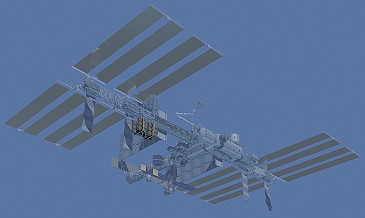
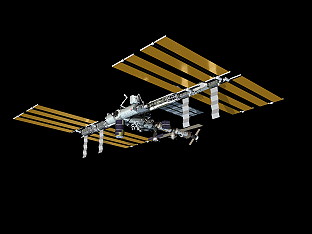
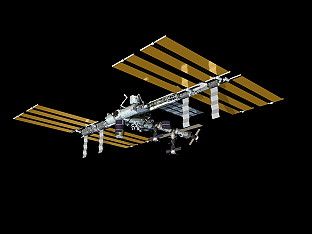
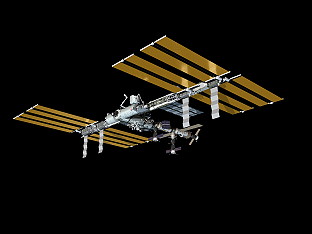
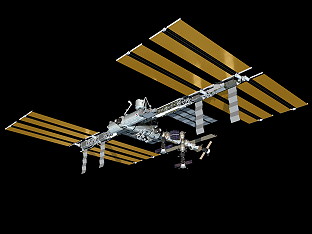
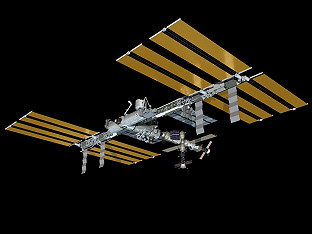
ISS Assembly
 |
 |
 |
 |
 |
 |
Photos
 |
 |
|
source of all photos is Roscosmos / NASA / JAXA |
|
 |
 |
 |
 |
 |
 |
 |
 |
 |
|
more onboard photos |
|
| © |  |
Last update on December 14, 2020.  |
 |