Human Orbital Spaceflights

International Flight No. 266STS-128Discovery (37)128th Space Shuttle missionUSA |
 |
 |
| hi res version (582 KB) | hi res version (416 KB) | |
 |
 |
Launch, orbit and landing data
walkout photo |
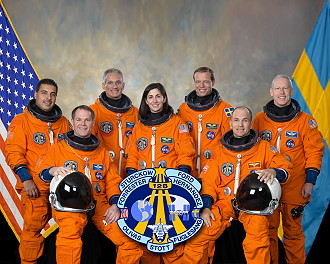 |
|||||||||||||||||||||||||||||||||
| hi res version (809 KB) | ||||||||||||||||||||||||||||||||||
alternative crew photo |
alternative crew photo |
|||||||||||||||||||||||||||||||||
alternative crew photo |
alternative crew photo |
|||||||||||||||||||||||||||||||||
alternative crew photo |
alternative crew photo |
|||||||||||||||||||||||||||||||||
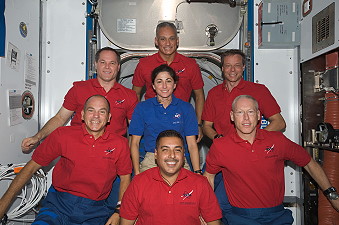
Crew
| No. | Surname | Given names | Position | Flight No. | Duration | Orbits | |
| 1 |  |
Sturckow | Frederick Wilford "Rick" | CDR | 4 | 13d 20h 53m 43s | 219 |
| 2 | |
Ford | Kevin Anthony | PLT, RMS | 1 | 13d 20h 53m 43s | 219 |
| 3 | |
Forrester | Patrick Graham | MS-1, RMS | 3 | 13d 20h 53m 43s | 219 |
| 4 | |
Hernández | José Moreno | MS-2, FE, RMS | 1 | 13d 20h 53m 43s | 219 |
| 5 | |
Olivas | John Daniel "Danny" | MS-3, EV-1 | 2 | 13d 20h 53m 43s | 219 |
| 6 |  |
Fuglesang | Arne Christer | MS-4, EV-2 | 2 | 13d 20h 53m 43s | 219 |
| 7 | |
Stott | Nicole Marie Passonno | MS-5, EV-3, RMS | 1 | 90d 10h 44m 43s | 1423 |
Crew seating arrangement
|
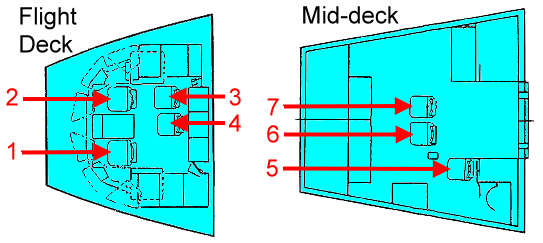 |
|
||||||||||||||||||||||||||||||||
Backup Crew
|
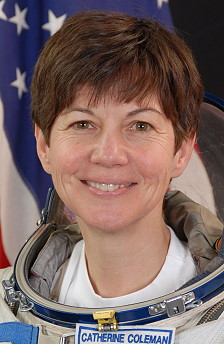 |
||||||||||
Hardware
| Orbiter : | OV-103 (37.) |
| SSME (1 / 2 / 3): | 2052-2 (8.) / 2051-2 (9.) / 2047-2 (13.) |
| SRB: | BI-139 / RSRM 107 |
| ET: | ET-132 (SLWT-36) |
| OMS Pod: | Left Pod 01 (40.) / Right Pod 03 (38.) |
| FWD RCS Pod: | FRC 3 (37.) |
| RMS: | 202 (13.) |
| EMU (launch): | EMU No. 3015 (PLSS No. 1015) / EMU No. 3009 (PLSS No. 1009) |
| EMU (landing): | EMU No. 3015 (PLSS No. 1015) / EMU No. 3005 (PLSS No. 1005) |
Flight
|
Launch from Cape Canaveral (KSC) and
landing on the Edwards
AFB, Runway
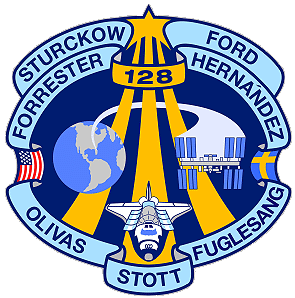
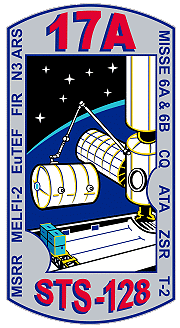
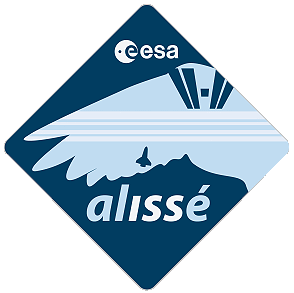
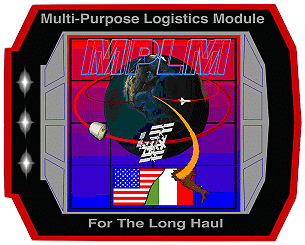
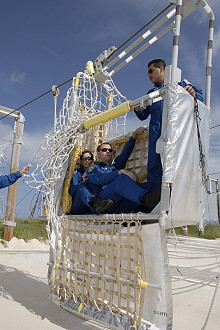
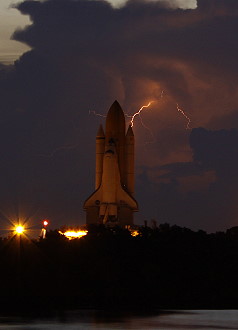
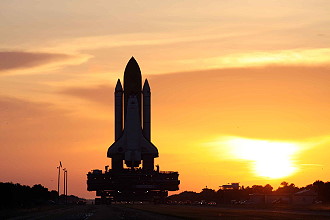
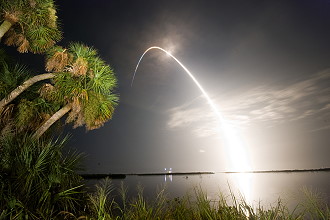
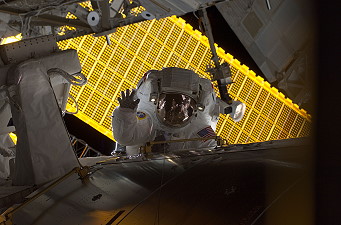
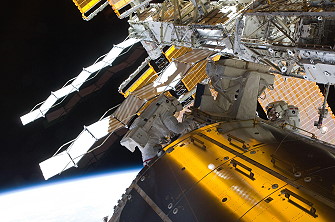
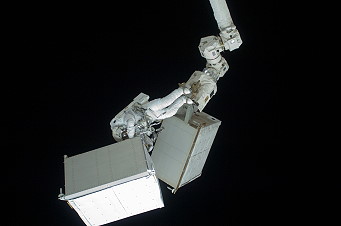
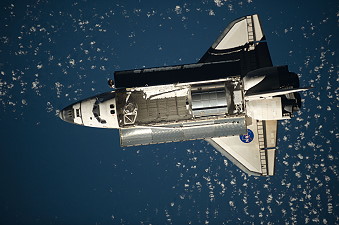
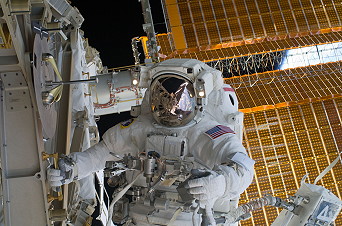
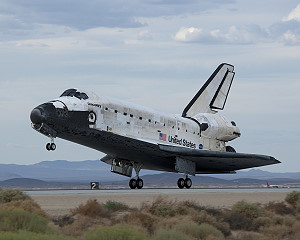
22. The mission's first launch attempt was delayed due to weather concerns, including multiple weather violations in NASA's launch rules, beginning over two hours before the scheduled launch. The second launch attempt, scheduled for August 26, 2009, was called off the previous evening due to an anomaly in one of the orbiter's fuel valves. The primary payload of STS-128 (ISS-17A MPLM Leonardo, LMC) was the Multi-Purpose Logistics Module Leonardo to assist with establishing a six-man crew capacity by bringing extra supplies and equipment to the station. The Multi-Purpose Logistics Module contained three racks for life support, a crew quarter to be installed in Kibo, a new treadmill (COLBERT) that will temporarily be placed in Node 2 and later in Node 3, and an Air Revitalization System (ARS) that will temporarily be placed in Kibo and later in Node 3. Three spacewalks were planned during the mission, which removed and replaced a materials processing experiment outside ESAs Columbus module, and to return an empty ammonia tank assembly. The mission of Christer Fuglesang was named Alissé by the European Space Agency. The name was proposed by Jürgen Modlich from Baierbrunn, Germany. The name refers to the 15th-century explorers who used the trade winds to follow Christopher Columbus across the oceans to the New World. Nicole Stott replaced NASA astronaut Timothy Kopra as a long-duration crew member on the space station and a member of the Expedition 20 and 21 crews. Nicole Stott spent three months on the complex while Timothy Kopra returned home aboard Discovery. Nicole Stott returned in November 2009 on the shuttle Atlantis as part of the STS-129 crew. Nicole Stott was originally scheduled to return aboard Soyuz TMA-15, but a change in the flight plan was made due to the possible flight delays in future shuttle missions, which may extend Canadian astronaut Robert Thirsk's mission beyond the six-month duration preferred for station crew members. The day after launch, Kevin Ford, Patrick Forrester and José Hernández took turns at Discovery's aft flight deck as they maneuvered the shuttle's robotic arm to reach over to the starboard sill of the orbiter to grapple the Orbiter Boom Sensor System (OBSS), a 50-foot-long (15 meters) crane extension. The extension is equipped with sensors and lasers that were used in the traditional daylong scan of Discovery's thermal protection heat shield and the reinforced carbon-carbon on the leading edges of the shuttle's wings. This initial inspection of the heat shield provided imagery experts on the ground a close-up look at the tiles and blankets on the shuttle's skin to determine if the shuttle is ultimately safe to re-enter the Earth's atmosphere. A follow-up inspection took place after Discovery undocked from the station. While the inspection took place, John Olivas, Christer Fuglesang and Nicole Stott prepared the spacesuits they needed for the three spacewalks to be conducted out of the Quest airlock at the station. Other pre-docking preparations occupied the remainder of the crew's workday. When Discovery launched on the STS-128 mission, it flew on a trajectory to chase the International Space Station. A series of engine firings during the first two days of the mission brought the shuttle to a point about 50,000 feet (15,240 meters) behind the station. Once there, Discovery started its final approach. About 2.5 hours before docking, the shuttle's jets were fired during what is called the terminal initiation burn. The shuttle covered the final miles to the station during the next orbit. As Discovery moved closer to the station, its rendezvous radar system and trajectory control sensor provided the crew with range and closing-rate data. Several small correction burns placed the shuttle about 1,000 feet (304.8 meters) below the station. Commander Frederick Sturckow, with help from Pilot Kevin Ford and other crew members, manually flew the shuttle for the remainder of the approach and docking. Frederick Sturckow was forced by a leaky steering jet to use Discovery's big maneuvering thrusters instead of preferred fine-control vernier engines. Frederick Sturckow stopped Discovery about 600 feet (182.9 meters) below the station. Once he determined there was proper lighting, he maneuvered the shuttle through a 9-minute backflip called the R-bar Pitch Maneuver (RPM). During this maneuver, station crew members Michael Barratt and Gennadi Padalka used digital cameras with 400 mm and 800 mm lenses to photograph Discovery's upper and bottom surfaces through windows of the Zvezda Service Module. The 400 mm lens provided up to 3-inch (7.6 centimeters) resolution and the 800 mm lens up to 1-inch (2.5 centimeters) resolution. Gennadi Padalka used the 400 mm and Michael Barratt used the 800 mm. The photography was one of several techniques used to inspect the shuttle's thermal protection system for possible damage. Areas of special interest included the thermal protection tiles, the reinforced carbon-carbon of the nose and leading edges of the wings, landing gear doors and the elevon cove. The photos were downlinked through the station's Ku-band communications system for analysis by systems engineers and mission managers. When Discovery completed its backflip, it was back where it started, with its payload bay facing the station. Frederick Sturckow then flew the shuttle through a quarter circle to a position about 400 feet (121.9 meters) directly in front of the station. From that point, he began the final approach to docking to the Pressurized Mating Adapter 2 at the forward end of the Harmony node. The shuttle crew members operated laptop computers that processed the navigational data, the laser range systems and Discovery's docking mechanism. Using a video camera mounted in the center of the Orbiter Docking System, Frederick Sturckow lined up the docking ports of the two spacecraft. He paused the shuttle 30 feet (9.14 meters) from the station to ensure proper alignment of the docking mechanisms. He maintained the shuttle's speed relative to the station at about one-tenth of a foot per second (3 centimeters per second), while both Discovery and the station were moving at about 17,500 mph (28,163 km/h). Frederick Sturckow kept the docking mechanisms aligned to a tolerance of 3 inches (7.6 centimeters). When Discovery made contact with the station on August 31, 2009, preliminary latches automatically attached the two spacecraft. The shuttle's maneuvering thrusters were deactivated to reduce the forces acting at the docking interface. Shock absorber springs in the docking mechanism dampened any relative motion between the shuttle and station. Once motion between the shuttle and the station had stopped, the docking ring was retracted to close a final set of latches between the two vehicles. Less than two hours later, hatches were opened between the two spacecraft to begin almost nine days of work between the two crews. Discovery's arrival at the station two days after launch again placed 13 crew members on the complex. The shuttle crew joined Gennadi Padalka of Russia, and Flight Engineers Michael Barratt and Timothy Kopra of NASA, Roman Romanenko of Russia, Robert Thirsk of the Canadian Space Agency and Frank De Winne of the European Space Agency. Nicole Stott and Timothy Kopra exchanged Soyuz seatliners. With this procedure Nicole Stott joined Expedition 20 and Timothy Kopra joined the STS-128 crew. During flight day 4, the MPLM Leonardo was berthed to the Nadir or earth facing port on Harmony using the Space Station Remote Manipulator System (SSRMS). Once it was berthed, the crews activated it and opened the hatch for ingress. Some more items were transferred from the shuttle mid-deck including the MDS experiment. Housed for the ride to the station in the Leonardo Multi-Purpose Logistics Module in Discovery's payload bay were the Materials Science Research Rack (MSRR-1), the Minus Eighty Degree Laboratory Freezer for ISS (MELFI) and the Fluids Integration Rack (FIR). MSRR-1 was used for basic materials research related to metals, alloys, polymers, semiconductors, ceramics, crystals and glasses in the microgravity environment. MELFI was used for long-term storage of experiment samples that are to be returned to Earth for detailed analysis. The FIR is a fluid physics research facility designed to host investigations in areas such as colloids, gels, bubbles, wetting and capillary action, and phase changes, including boiling and cooling. Leonardo, which served as a large moving van for supplies and equipment back and forth from the station, also was carrying a new crew quarters to provide more sleeping space for the expanded station crew members and a new exercise device called the Combined Operational Load Bearing External Resistance Treadmill, or COLBERT, coined after late-night cable entertainment personality Stephen Colbert. COLBERT was transferred to a temporary location in the Harmony node, but will ultimately reside in the new Node 3 module - Tranquility - that will be launched to the station in 2010 as a final connecting point for other modules on the U.S. segment of the complex, including the Cupola, a multi-windowed module to provide a vista-like view of the universe. COLBERT will not be checked out and activated until later in 2009. In addition to the new treadmill, also referred to as "T2", the crew transferred a new Air Revitalization System (ARS) rack to the station for use in Tranquility to maintain a pristine environment for the expanded six-person crew on the outpost. The system includes another carbon dioxide removal system bed similar to the Carbon Dioxide Removal Assembly (CDRA) that resides in the U.S. Destiny laboratory. The rack was temporarily stowed in the Japanese segment of the station until Tranquility is in place to accept it on a permanent basis. The first EVA by John Olivas and Nicole Stott occurred on September 01, 2009 (6h 35m) to prepare for the replacement of an empty ammonia tank on the station's port truss, or backbone, by releasing its bolts. They also retrieved a materials processing experiment (MISSE) and a European science experiment (EuTEF) mounted outside the Columbus laboratory and stowed them in Discovery's cargo bay for their return to Earth. The work to replace the ammonia tank assembly on the first port segment of the station's truss - P1 - began on the first spacewalk of the mission. John Olivas and Nicole Stott removed the depleted tank from the truss, so that it was picked up by the station's robotic arm for storage until after the second spacewalk. To remove it from the station's truss, John Olivas and Nicole Stott disconnected two lines used to transfer its ammonia, two lines which provide nitrogen for pressurization, and two electrical connections and released four bolts. They then worked together to lift the tank away from the truss and maneuvered it into position for the robotic arm to latch onto. While the arm was still holding the tank assembly, Nicole Stott installed a foot restraint on it as well, which she then climbed into for the removal of the European Technology Exposure Facility, or EuTEF. While Nicole Stott got into place, John Olivas documented the experiment's condition by taking some photographs. John Olivas then detached the experiment by releasing one bolt, and Nicole Stott lifted it away from its place on the Columbus laboratory. From there, Kevin Ford and Robert Thirsk drove her via the robotic arm to the shuttle's cargo bay, where she worked with John Olivas to store it on a cargo carrier for transport back to Earth. One bolt was used to attach it to the carrier. The spacewalkers' final task was the removal of the sixth Materials International Space Station Experiment - or MISSE. Nicole Stott climbed out of the robotic arm's foot restraint and met John Olivas back at Columbus. (Although MISSE is a NASA experiment, it is located on the exterior of the Columbus laboratory.) While he waited for Nicole Stott to arrive, John Olivas closed the passive experiment containers in which the two parts of the MISSE experiment were housed, and disconnected two cables. John Olivas then removed the first of the containers and passed it on to Nicole Stott for installation in a storage location. The second was removed and stowed by John Olivas. While the spacewalk was going on crew members inside were transferring the Crew Quarters, C.O.L.B.E.R.T treadmill and the Node 3 Air Revitalization System rack (ARS). The treadmill and ARS were temporarily stowed, while the crew Quarters was installed in the Kibo Module where setup and activation was begun. During flight day 6 the joint crews continued the activation of the new crew quarters. The last of the major transfer items, the Fluids Integrated Rack (FIR), Materials Science Research Rack and the Minus Eighty Laboratory Freezer ISS 2 (MELFI-2) were transferred from the Multi-Purpose Logistics Module (MPLM) Leonardo. The second EVA was performed by John Olivas and Christer Fuglesang on September 03, 2009 (6h 39m) to remove the new ammonia tank from the shuttle's payload bay and replacing it with the used tank on the station. The new tank, weighing about 1,800 pounds, was the most mass ever moved around by spacewalking astronauts. After the new tank was installed, the old one was stowed in the shuttle for its return to Earth. On Earth the tank will be refueled and delivered again to the ISS during the mission of STS-131. The entire second spacewalk of the mission focused on completing the ammonia tank assembly swap. John Olivas began by removing insulation on the new ammonia tank while Christer Fuglesang got into position in the robotic arm's foot restraint. He and John Olivas then worked together to release the four bolts securing the assembly to the cargo carrier inside the shuttle's cargo bay. Kevin Ford and Nicole Stott then drove the robotic arm - carrying Christer Fuglesang and both ammonia tanks - to the installation site on the P1 truss segment. John Olivas met Christer Fuglesang there, and together they drove the four bolts that held it in place. John Olivas then connected two electrical cables and four fluid lines. With the new tank assembly installed, John Olivas and Christer Fuglesang prepared for the storage of the old tank assembly, still latched to the robotic arm. John Olivas tethered the old tank assembly to himself and then gave Kevin Ford and Nicole Stott the OK to command the robotic arm to release it. Then Christer Fuglesang attached his tether to the assembly and John Olivas removed his tether, allowing Christer Fuglesang and the old tank to make their way back to the shuttle's cargo bay via robotic arm. Once there, John Olivas and Christer Fuglesang installed it on the cargo carrier with four bolts. On flight day 8 more transfer was completed by both crews. The space station crew calibrated the Oxygen Generation System (OGS) H2 sensor. Timothy Kopra and Nicole Stott continued their hand over activities, helping Nicole Stott who was taking over from Timothy Kopra. The third and final EVA by John Olivas and Christer Fuglesang was conducted on September 05, 2009 (7h 01m) to prepare for the arrival of the Tranquility node by attaching two 18m long cables between the starboard truss and the Unity node, the area where Tranquility will be installed. Tranquility is targeted to arrive to the station on STS-130 in February 2010. The spacewalkers also replaced a communications sensor device, installed two new GPS antennas and a new circuit breaker. The first tasks of the final spacewalk of the mission were finish work left by the previous space shuttle mission. The STS-127 spacewalkers completed the deployment of the one cargo attachment system on the P1 truss segment, but had to leave the set up of similar systems on S3 for future missions. On STS-119 a jammed detent pin on the first of the systems prevented them from deploying the P1 system. A special tool was built to assist with the deployment. The STS-127 spacewalkers were successful in clearing the jam. John Olivas and Christer Fuglesang had the same tool on hand for use if needed. If the detent pin did not jam, however, the cargo attachment system was set up by removing brackets and pins holding it in place, moving it into its correct position and then reinstalling the brackets and pins. Once that was complete, John Olivas and Christer Fuglesang worked together to remove and replace a failed rate gyro assembly in the center of the station's truss. To remove the failed assembly, John Olivas disconnected two cables and removed two bolts. Christer Fuglesang removed the final two holding the assembly in place, and then John Olivas removed it and temporarily stored it nearby. To install the new one, John Olivas and Christer Fuglesang each had to drive four bolts, and John Olivas then connected its two cables before moving on to the next task. At this point in the spacewalk, John Olivas and Christer Fuglesang split up. John Olivas set up heater cables that will be used to keep the PMA 3 berthing port between the Unity and the coming Tranquility node warm so it can be pressurized. This will allow the station crew to prepare the vestibule for Tranquility node's arrival. That involved disconnecting four cables and wire-tying them into place along the handrails on the Unity node. One of them was connected to an outlet on Unity, the rest had caps installed on them. Meanwhile, Christer Fuglesang replaced a failed remote power control module on the center segment of the station's truss. To remove the failed module, he simply released one bolt. To install the new unit, he slided it into place on a guide rail and then secured it using one bolt. He followed that up by installing an insulation sleeve on a cable inside the truss. With those tasks done, Christer Fuglesang and John Olivas came together again in the center of the truss to route avionics systems cables. They were using wire ties to secure two cable bundles to handrails along the truss system and the Unity node, and then a panel on the truss. John Olivas wrapped up the spacewalk by removing a damaged slidewire from a stanchion on Unity, while Christer Fuglesang installed a lens cover on a camera and light assembly on the space station's robotic arm. Flight day 10 saw the joint crews transfer samples from the space station to the shuttle freezer known as Glacier. The samples will be returned to earth for examination by scientists who will develop ways to prevent bone and muscle loss in space as well as cures for other illnesses on earth. The crews also completed some close outs of the Multi-Purpose Logistics Module Leonardo. The last portion of the crew day was spent off duty. On flight day 11 the joint ISS/shuttle crews completed transfers and closed the hatches with the MPLM. Once the hatches were closed, the MPLM was deactivated, demated and berthed back in the payload bay of the space shuttle. During this process José Hernández and Nicole Stott took part in a PAO event. The end of the crews work days saw the two crews say goodbye in a farewell ceremony and close the hatches between the shuttle and ISS. Once the hatches were closed, the Pressurized Mating Adapter 2 was depressurized, in advance of undocking. The shuttle crew setup and checked out the rendezvous tools before going to bed. At undocking time, the hooks and latches were opened and springs pushed the shuttle away from the station. Discovery's maneuvering thrusters were shut off to avoid any inadvertent firings during the initial separation. Once the shuttle was about 2 feet (61 centimeters) from the station and the docking devices were clear of one another, Kevin Ford turned the maneuvering thrusters back on and manually controlled Discovery within a tight corridor as the shuttle separated from the station. Discovery moved to a distance of about 450 feet (137.2 meters), where Kevin Ford began to fly around the station. Kevin Ford circled the shuttle around the station at a distance of 600-700 feet (182-213 meters). Once the shuttle completed 1.5 revolutions of the complex, Kevin Ford fired Discovery's maneuvering thrusters to leave the area. The shuttle began to increase its distance from the station with each trip around the Earth, while ground teams analyzed data from the late inspection of the shuttle's heat shield. However, the distance was close enough to allow the shuttle to return to the station in the unlikely event that the heat shield is damaged, preventing the shuttle's safe re-entry. The STS-128 mission (as did STS-125 and STS-127) took part in crew seat vibration tests that will help engineers on the ground understand how astronauts experience launch. They will then use the information to help design the crew seats that will be used in future NASA spacecraft. STS-128 repeated the Boundary Layer Transition (BLT) Detailed Test Objective (DTO) experiment that was done by the same shuttle during STS-119. In this experiment, one of the thermal protection systems was raised to create a boundary layer transition in which the air flow becomes turbulent beyond a certain speed. During STS-119 the tile was raised 0.25 inches (6.4 mm) above the others, tripping the flow at Mach 15 during reentry. In the modification being done, the tile has been raised 0.35 inches (8.9 mm) to trip at Mach 18 producing more heat. Discovery undertook the testing of a catalytic coating which was meant to be used by the Orion (spacecraft). Two TPS tiles located in the protuberance downstream from the BLT tile had been fully coated with the catalytic material in order to understand the entry heating performance. The tiles were instrumented to collect a wide variety of data The first two landing opportunities were postponed for one day due to weather conditions. After weather didn't got better in Florida, Discovery had to land on the Edwards AFB. |
EVA data
| Name | Start | End | Duration | Mission | Airlock | Suit | Stripes | |
| EVA | Olivas, John | 01.09.2009, 21:49 UTC | 02.09.2009, 04:24 UTC | 6h 35m | STS-128 | ISS - Quest | EMU No. 3015 | red |
| EVA | Stott, Nicole | 01.09.2009, 21:49 UTC | 02.09.2009, 04:24 UTC | 6h 35m | STS-128 | ISS - Quest | EMU No. 3005 | red-white linear |
| EVA | Olivas, John | 03.09.2009, 22:12 UTC | 04.09.2009, 04:51 UTC | 6h 39m | STS-128 | ISS - Quest | EMU No. 3015 | red |
| EVA | Fuglesang, Christer | 03.09.2009, 22:12 UTC | 04.09.2009, 04:51 UTC | 6h 39m | STS-128 | ISS - Quest | EMU No. 3009 | without |
| EVA | Olivas, John | 05.09.2009, 20:39 UTC | 06.09.2009, 03:40 UTC | 7h 01m | STS-128 | ISS - Quest | EMU No. 3015 | red |
| EVA | Fuglesang, Christer | 05.09.2009, 20:39 UTC | 06.09.2009, 03:40 UTC | 7h 01m | STS-128 | ISS - Quest | EMU No. 3009 | without |
Note
Photos / Graphics
 |
 |
|
source of all photos is NASA |
|
 |
 |
 |
 |
 |
 |
 |
 |
 |
 |
 |
 |
 |
 |
 |
|
more EVA photos |
|
| © |  |
Last update on March 27, 2020.  |
 |