Human Orbital Spaceflights

International Flight No. 255STS-123Endeavour (21)122nd Space Shuttle missionUSA |
 |
 |
 |
 |
|
| Source: Canadian Space Agency |
Launch, orbit and landing data
walkout photo |
 |
|||||||||||||||||||||||||||||||||
alternative crew photo |
alternative crew photo |
|||||||||||||||||||||||||||||||||
alternative crew photo |
alternative crew photo |
|||||||||||||||||||||||||||||||||
alternative crew photo |
||||||||||||||||||||||||||||||||||
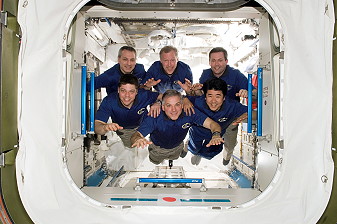
Crew
| No. | Surname | Given names | Position | Flight No. | Duration | Orbits | |
| 1 |  |
Gorie | Dominic Lee Pudwill | CDR | 4 | 15d 18h 10m 52s | 249 |
| 2 | |
Johnson | Gregory Harold "Box" | PLT | 1 | 15d 18h 10m 52s | 249 |
| 3 | |
Behnken | Robert Louis | MS-1, IV, EV-2 | 1 | 15d 18h 10m 52s | 249 |
| 4 | |
Foreman | Michael James | MS-2, IV, FE, EV-3 | 1 | 15d 18h 10m 52s | 249 |
| 5 |  |
Doi | Takao | MS-3 | 2 | 15d 18h 10m 52s | 249 |
| 6 | |
Linnehan | Richard Michael | MS-4, EV-1, IV | 4 | 15d 18h 10m 52s | 249 |
| 7 | |
Reisman | Garrett Erin "Big G" | MS-5, EV-4 | 1 | 95d 08h 47m 03s | 1501 |
Crew seating arrangement
|
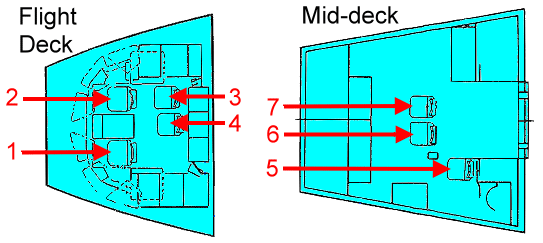 |
|
||||||||||||||||||||||||||||||||
Backup Crew
|
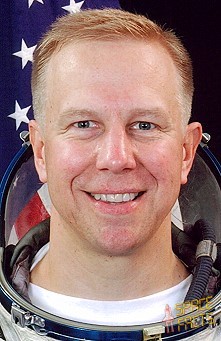 |
Hardware
| Orbiter : | OV-105 (21.) |
| SSME (1 / 2 / 3): | 2047-2 (11.) / 2044-2 (10.) / 2054-2 (7.) |
| SRB: | BI-133 / RSRM 101 |
| ET: | ET-126 (SLWT-30) |
| OMS Pod: | Left Pod 03 (32.) / Right Pod 04 (28.) |
| FWD RCS Pod: | FRC 5 (21.) |
| RMS: | 201 (19.) |
| EMU (launch): | EMU No. 3004 (PLSS No. 1004) / EMU No. 3003 (PLSS No. 1003) |
| EMU (landing): | EMU No. 3006 (PLSS No. 1006) / EMU No. 3008 (PLSS No. 1008) |
Flight
|
Launch from Cape Canaveral (KSC) and
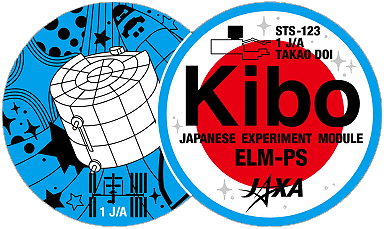
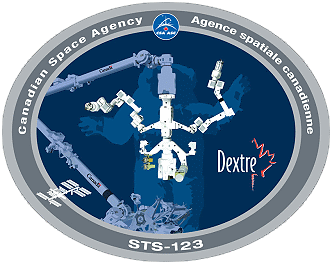
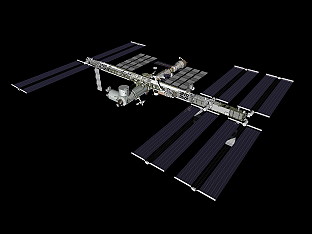
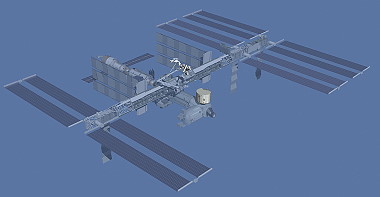
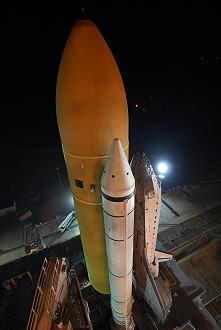
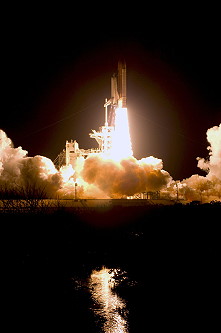
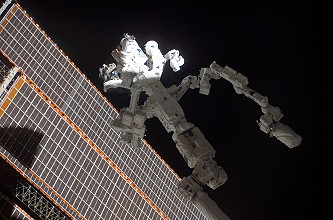
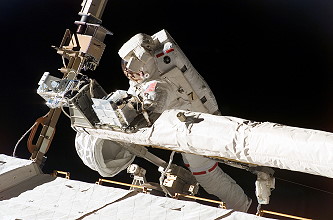
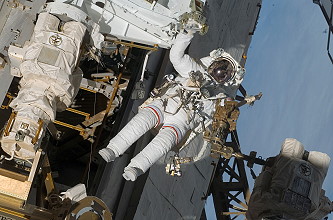
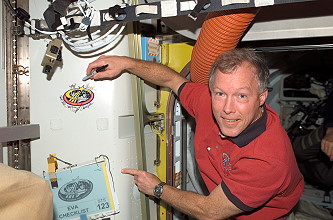
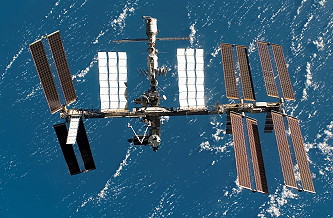
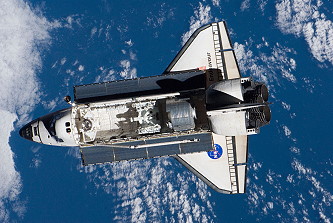
landing on Cape Canaveral (KSC), Runway 15. STS-123 (ISS-1J/A JEM ELM PS / SLP-D1) delivered the first module of the Japanese laboratory, Japanese Experiment Module (Kibo), and the Canadian Special Purpose Dexterous Manipulator, (SPDM) Dextre robotics system to the station. The mission duration was 16 days and 14 hours, and it was the first mission to fully utilize the Station-to-Shuttle Power Transfer System (SSPTS), allowing space station power to augment the shuttle power systems. The mission set a record for a shuttle's longest stay at the ISS. Expedition 16 Flight Engineer Léopold Eyharts, who traveled to the space station on the STS-122 mission, returned home with the STS-123 crew. Garrett Reisman joined the Expedition 16 crew, serving with Commander Peggy Whitson and Flight Engineer Yuri Malenchenko. Garrett Reisman returned home with STS-124. The first component of the Japanese experiment module, Kibo, flew to the International Space Station (ISS) after 23 years of development efforts by the Japan Aerospace Exploration Agency - JAXA. Japan's role in the space station program is to develop and contribute the Japanese Experiment Module (JEM), logistics vehicles, and the H-II Transfer Vehicle (HTV), using accumulated Japanese technologies. Kibo's contributions are not strictly limited to space utilizations. The actual development and operation of Kibo has great significance in the continued expansion of Japan's accumulated technologies. Acquisition of advanced technologies required to support human life in space enhances both the level of Japan's scientific and technological skill, and contributes to other worldwide space development activities in the future exploration. Kibo means "hope". It is Japan's first human-rated space facility. Kibo will be the largest experiment module on the space station, accommodating 31 racks in its pressurized section, including experiment, stowage, and system racks. Kibo is equipped with external facilities that can accommodate 10 exposed experiment payloads. Kibo is a complex facility that enables several kinds of specialized functions. In total, Kibo consists of: Pressurized Module (JEM PM) and Exposed Facility (JEM EF), a logistics module attached to both the JEM PM and JEM EF and a Remote Manipulator System - Japanese Experiment Module Remote Manipulator System (JEM RMS). The Kibo elements will be delivered to the space station by three space shuttle flights. STS-123 will deliver the JEM ELM PS, STS-124 will deliver the JEM PM and JEM RMS, and STS-127 will deliver the JEM EF and the Experiment Logistics Module-Exposed Section (JEM ELM-ES). For each of the three missions, a JAXA astronaut will fly to the station to assist with the assembly, activation, and checkout of the Kibo component. Astronaut Takao Doi is assigned as a NASA mission specialist for the STS-123 mission, astronaut Akihiko Hoshide is assigned as a mission specialist for the STS-124 mission, and astronaut Koichi Wakata is assigned as a space station Flight Engineer for Expedition 18. Kibo's JEM ELM PS will be launched to the space station aboard the space shuttle Endeavour on the STS-123/1J/A mission, which is the first of the three Kibo-related ISS assembly flights. The JEM ELM PS is a Kibo storage facility that provides stowage space for experiment payloads, samples, and spare items. The pressurized interior of the JEM ELM PS is maintained at one atmosphere, thus providing a shirt-sleeve working environment. The crew will be able to freely move between the JEM ELM PS and the main experiment module, called the Pressurized Module. On the space station, Kibo is the only experiment facility with its own dedicated storage facility. When the JEM ELM PS is launched aboard the space shuttle, it will be used as a logistics module for transporting eight Kibo subsystems and experiment racks to the space station. Once the JEM ELM PS is on orbit, it will be used as a Kibo stowage compartment. Maintenance tools, experiment samples, and other spare items will all be stored inside the JEM ELM PS. The volume of the JEM ELM PS is less than that of the JEM PM, and up to eight racks can be housed in the JEM ELM PS. The JEM ELM PS will be attached to the zenith port on top of the Harmony Node 2 module on STS-123's fourth flight day. The JEM ELM PS will remain attached to the Harmony module until the Kibo JEM PM is delivered to the ISS on the following space shuttle mission, STS-124. The final location of the JEM ELM PS will be on the top port of the JEM PM. Dextre is the third and final component of the Mobile Servicing System developed by Canada for the ISS. The two-armed Special Purpose Dexterous Manipulator, known as "Dextre", complements the mobile base and the robotic arm Canadarm2 already installed and operating on the station. These make the MSS a vital tool for external station maintenance. With advanced stabilization and handling capabilities, Dextre can perform delicate human-scale tasks such as removing and replacing small exterior components. Operated by crew members inside the station or by flight controllers on the ground, it also is equipped with lights, video equipment, a stowage platform, and three robotic tools. On flight day 2 the crew used a 50 ft (15 m) laser-tipped boom to inspect its wings and nose for any sign of launch damage. The inspection has been standard procedure ever since the 2003 Columbia accident. Flight director Mike Moses said a quick look at the images the astronauts beamed down to Earth revealed no signs of trouble. Rendezvous began with a precisely timed launch of the shuttle on the correct trajectory for its chase of the International Space Station. A series of engine firings over the next two days brought Endeavour to a point about 50,000 feet (15,240 meters) behind the station. Once there, Endeavour started its final approach. About 2.5 hours before docking, the shuttle's jets were fired during what is called the terminal initiation burn. Endeavour covered the final miles to the station during the next orbit. As Endeavour moved closer to the station, the shuttle's rendezvous radar system and trajectory control sensor gave the crew range and closing-rate data. Several small correction burns placed Endeavour about 1,000 feet (304.8 meters) below the station. Commander Dominic Gorie, with help from Pilot Gregory H. Johnson and other crew members, manually flew the shuttle for the remainder of the approach and docking. Dominic Gorie stopped Endeavour about 600 feet (182.9 meters) below the station. Once he determined there is proper lighting, he maneuvered the shuttle through a nine-minute back flip called the Rendezvous Pitch Maneuver or R-bar Pitch Maneuver (RPM). That allowed the station crew to take as many as 300 digital pictures of the shuttle's heat shield. Station crew members will use digital cameras with 400 mm and 800 mm lenses to photograph Endeavour's upper and bottom surfaces through windows of the Zvezda Service Module. The 400 mm lens provided up to 3-inch (7.6 centimeters) resolution and the 800 mm lens up to 1 inch (2.5 centimeters) resolution. The photography was one of several techniques used to inspect the shuttle's thermal protection system for possible damage. Areas of special interest include the tiles, the reinforced carbon-carbon of the nose and leading edges of the wings, landing gear doors and the elevon cove. The photos were downlinked through the station's Ku-band communications system for analysis by systems engineers and mission managers. When Endeavour completed its back flip, it was back where it started, with its payload bay facing the station. Dominic Gorie then flew Endeavour through a quarter circle to a position about 400 feet (121.9 meters) directly in front of the station. From that point he began the final approach to dock at the Pressurized Mating Adaptor 2 at the forward end of the Harmony module. The shuttle crew members operate laptop computers processing the navigational data, the laser range systems and Endeavour's docking mechanism. Using a video camera mounted in the center of the Orbiter Docking System, Dominic Gorie lined up the docking ports of the two spacecraft. He paused 30 feet (9.14 meters) from the station to ensure proper alignment of the docking mechanisms. He maintained the shuttle's speed relative to the station at about one-tenth of a foot per second (3 centimeters per second), while both Endeavour and the station were moving at about 17,500 mph (28,163 km/h). He kept the docking mechanisms aligned to a tolerance of three inches (7.6 centimeters). When Endeavour made contact with the station on March 13, 2008, preliminary latches automatically attached the two spacecraft. The shuttle's steering jets were deactivated to reduce the forces acting at the docking interface. Shock absorber springs in the docking mechanism dampened any relative motion between the shuttle and station. Once motion between the shuttle and the station had stopped, the docking ring was retracted to close a final set of latches between the two vehicles. Docking occurred at 03:49 UTC and the hatches between the two spacecraft were opened at 05:36 UTC on. Garrett Reisman became a station crew member with the exchange of his custom Soyuz seatliner with that of Léopold Eyharts, who joined the shuttle crew for his flight home. The first EVA by Richard Linnehan and Garrett Reisman occurred on March 14, 2008 (7h 01m) to prepare the JEM ELM PS for its removal from the shuttle's payload bay. Later that day, the Japanese facility was installed on top of the Harmony module. However, the Spacelab pallet carrying the SPDM would not power up. Engineers on the ground tried a software patch, though later suspected a design flaw in Dextre's temporary power cable caused the issue. Crew members on board Endeavour used a robotic arm to remove the Japanese Logistics Module - Pressurized Section (JLP) from Endeavour's cargo bay and attach it to the space station. The JLP was attached to its interim location on the Harmony module at 08:06 UTC. On March 15, 2008 the crew spent time outfitting the Japanese Logistics Module, transferring supplies and equipment into it from space shuttle Endeavour. The station’s arm operators grappled the Canadian-built Dextre Friday at 01:59 UTC. Canadarm2 successfully powered up Dextre 11 minutes later. Mission Specialists Richard Linnehan and Michael Foreman spent the night in the station’s Quest Airlock in preparation for the second spacewalk of the mission. The second EVA by Richard Linnehan and Michael Foreman was performed on March 16, 2008 (7h 09m) to assemble Special Purpose Dexterous Manipulator (SPDM), named Dextre by removing covers and installing arm components on its main body. The spacewalk focused on Dextre and included installation of its two arms. Robert Behnken provided intravehicular support while Gregory Johnson and Garrett Reisman operated Canadarm2. On flight day 7 the crews continued outfitting the Japanese Logistics Module – Pressurized Section, transferring supplies and equipment into it from Endeavour, as well as configuring racks inside the module. The crews tested the brakes in the robotic system’s arms. One of the joints in the arm seemed to be operating right on the required margin. Engineers expressed confidence that this issue would be resolved. The third EVA was conducted by Richard Linnehan and Robert Behnken on March 17, 2008 (6h 53m) to complete Dextre assembly by installing a tool platform and tool holster assembly. Gregory Johnson and Garrett Reisman ran Canadarm2 to help the spacewalkers stow replacement gear and install a materials experiment and a Dextre platform for spare parts. On March 18, 2008 Dextre was attached to a power and data grapple fixture located on the U.S. laboratory Destiny. Canadarm2 grabbed the pallet that secured Dextre during its journey to the orbital outpost and returned the pallet to space shuttle Endeavour’s payload bay for the trip back to Earth. The fourth EVA by Robert Behnken and Michael Foreman occurred on March 20, 2008 (6h 24m) to evaluate the Shuttle Tile Ablator-54, or STA-54, material and a tile repair ablator dispenser for use as a shuttle thermal protection system repair technique. The Tile Repair Ablator Dispenser, or T-RAD, is similar to a caulk gun. They used TRAD to mix and squirt out the STA-54 material into holes in several demonstration tiles. The repaired samples were returned to Earth for extensive testing. The fifth and final EVA was performed by Robert Behnken and Michael Foreman on March 22, 2008 (6h 02m) to move the Orbiter Boom Sensor System, the 50 ft. (15 meters) extension of the shuttle's robotic arm, to a temporary location on the station's main truss or backbone. The OBSS was left on the station because shuttle Discovery doesn't have enough room in its cargo bay to carry both the boom and the large Japanese pressurized module on the STS-124 mission. The spacewalkers also installed a new trundle bearing assembly in the starboard Solar Alpha Rotary Joint to allow the joint to rotate a little bit more if necessary. That SARJ has had limited ability for several months, and metallic debris has been found inside it. Additional spacewalk tasks included inspecting the SARJ and collecting debris samples. At undocking, hooks and latches were opened and springs pushed Endeavour away from the station. The shuttle's steering jets were shut off to avoid any inadvertent firings during the initial separation. Once Endeavour was about two feet (61 centimeters) from the station and the docking devices were clear of one another, Gregory Johnson turned the steering jets on and manually flew Endeavour in a tight corridor as the shuttle moved away from the station. Endeavour moved away about 450 feet (137.2 meters). Then Gregory Johnson began to fly the shuttle around the station and its new laboratory. Once Endeavour completed 1.5 revolutions of the station, Gregory Johnson fired Endeavour's jets to leave the area. Flight controllers gave a no-go on de-orbit for the first landing opportunity at 23:05 UTC (19:05 EDT), due to unfavorable weather conditions at the Shuttle Landing Facility at Kennedy Space Center. Weather conditions were acceptable for the second landing opportunity, planned for 00:39 UTC March 27, 2008 (20:39 EDT March 26, 2008). The landing occurred at the Shuttle Landing Facility, and was the sixteenth night landing of the Space Shuttle at KSC, 22nd Shuttle night landing overall. Coincidentally, this mission also began with a night launch. |
EVA data
| Name | Start | End | Duration | Mission | Airlock | Suit | Stripes | |
| EVA | Linnehan, Richard | 14.03.2008, 01:18 UTC | 14.03.2008, 08:19 UTC | 7h 01m | STS-123 | ISS - Quest | EMU No. 3004 | red |
| EVA | Reisman, Garrett | 14.03.2008, 01:18 UTC | 14.03.2008, 08:19 UTC | 7h 01m | STS-123 | ISS - Quest | EMU No. 3006 | red-white diagonal |
| EVA | Linnehan, Richard | 15.03.2008, 23:4? UTC | 16.03.2008, 06:5? UTC | 7h 09m | STS-123 | ISS - Quest | EMU No. 3004 | red |
| EVA | Foreman, Michael | 15.03.2008, 23:4? UTC | 16.03.2008, 06:5? UTC | 7h 09m | STS-123 | ISS - Quest | EMU No. 3003 | red-white linear |
| EVA | Behnken, Robert | 17.03.2008, 22:51 UTC | 18.03.2008, 05:44 UTC | 6h 53m | STS-123 | ISS - Quest | EMU No. 3008 | without |
| EVA | Linnehan, Richard | 17.03.2008, 22:51 UTC | 18.03.2008, 05:44 UTC | 6h 53m | STS-123 | ISS - Quest | EMU No. 3004 | red |
| EVA | Behnken, Robert | 20.03.2008, 22:04 UTC | 21.03.2008, 04:28 UTC | 6h 24m | STS-123 | ISS - Quest | EMU No. 3003 | without |
| EVA | Foreman, Michael | 20.03.2008, 22:04 UTC | 21.03.2008, 04:28 UTC | 6h 24m | STS-123 | ISS - Quest | EMU No. 3008 | red-white linear |
| EVA | Foreman, Michael | 22.03.2008, 20:34 UTC | 23.03.2008, 02:36 UTC | 6h 02m | STS-123 | ISS - Quest | EMU No. 3008 | red-white linear |
| EVA | Behnken, Robert | 22.03.2008, 20:34 UTC | 23.03.2008, 02:36 UTC | 6h 02m | STS-123 | ISS - Quest | EMU No. 3003 | without |
Note
Photos / Graphics
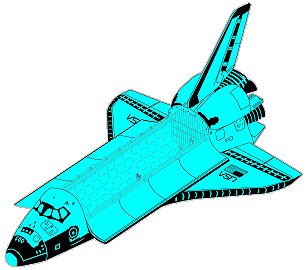 |
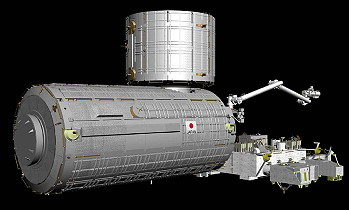 |
|
source of all photos is NASA |
|
 |
 |
 |
 |
 |
 |
 |
 |
 |
 |
 |
 |
 |
 |
 |
 |
more EVA photos |
|
| © |  |
Last update on September 05, 2021.  |
 |