Human Orbital Spaceflights

International Flight No. 265STS-127Endeavour (23)127th Space Shuttle missionUSA |
 |
 |
 |
||
Launch, orbit and landing data
walkout photo |
 |
|||||||||||||||||||||||||||||||||
| hi res version (835 KB) | ||||||||||||||||||||||||||||||||||
alternative crew photo |
alternative crew photo |
|||||||||||||||||||||||||||||||||
alternative crew photo |
alternative crew photo |
|||||||||||||||||||||||||||||||||
alternative crew photo |
alternative crew photo |
|||||||||||||||||||||||||||||||||
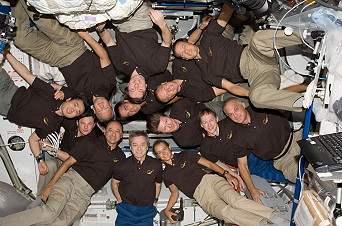
Crew
| No. | Surname | Given names | Position | Flight No. | Duration | Orbits | |
| 1 |  |
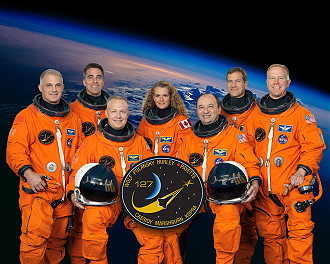
Polansky | Mark Lewis "Roman" | CDR | 3 | 15d 16h 44m 57s | 248 |
| 2 | |
Hurley | Douglas Gerald | PLT | 1 | 15d 16h 44m 57s | 248 |
| 3 | |
Wolf | David Alexander "Bluto" | MS-1, EV-1 | 4 | 15d 16h 44m 57s | 248 |
| 4 | |
Cassidy | Christopher John "Chris" | MS-2, EV-4 | 1 | 15d 16h 44m 57s | 248 |
| 5 |  |
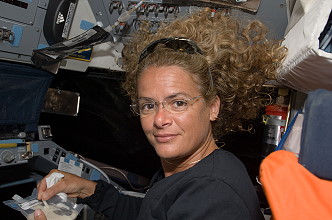
Payette | Julie | MS-3, FE, RMS | 2 | 15d 16h 44m 57s | 248 |
| 6 | |
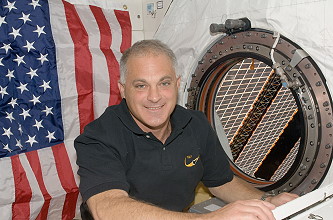
Marshburn | Thomas Henry "Tom" | MS-4, EV-3 | 1 | 15d 16h 44m 57s | 248 |
| 7 | |
Kopra | Timothy Lennart | MS-5, EV-2 | 1 | 58d 02h 50m 10s | 920 |
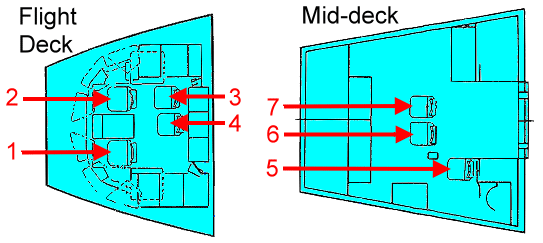
Crew seating arrangement
|
 |
|
||||||||||||||||||||||||||||||||
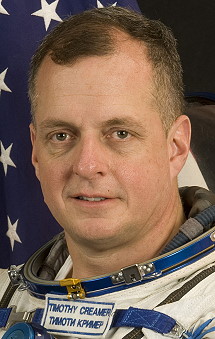
Backup Crew
|
 |
||||||||||
| hi res version (617 KB) |
Hardware
| Orbiter : | OV-105 (23.) |
| SSME (1 / 2 / 3): | 2045-2 (10.) / 2060-2 (1.) / 2054-2 (9.) |
| SRB: | BI-138 / RSRM 106 |
| ET: | ET-131 (SLWT-35) |
| OMS Pod: | Left Pod 03 (34.) / Right Pod 04 (30.) |
| FWD RCS Pod: | FRC 5 (23.) |
| RMS: | 201 (21.) |
| EMU: | EMU No. 3003 (PLSS No. 1003) / EMU No. 3018 (PLSS No. 1018) |
Flight
|
Launch from Cape Canaveral (KSC) and
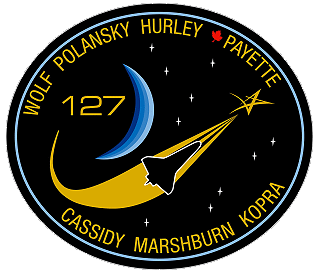
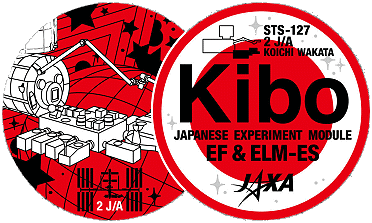
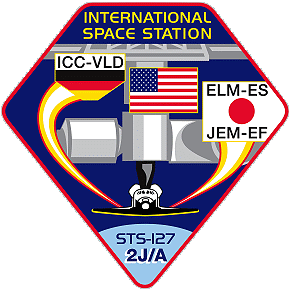
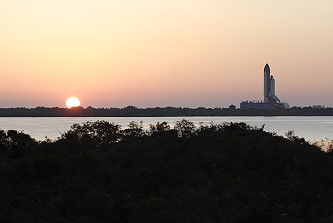
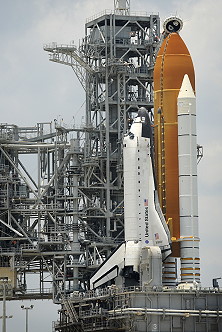
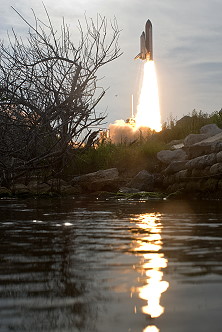
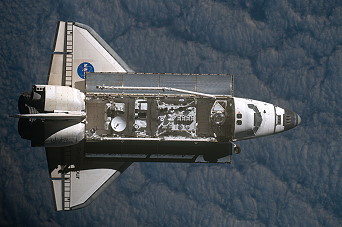
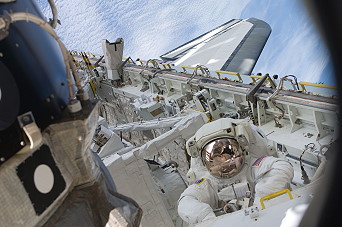
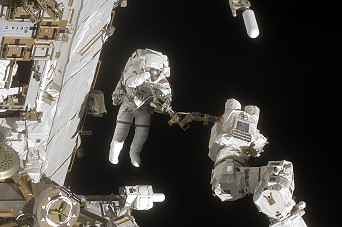
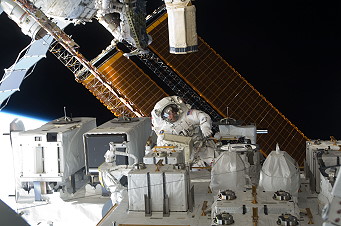
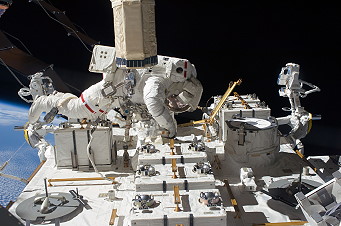
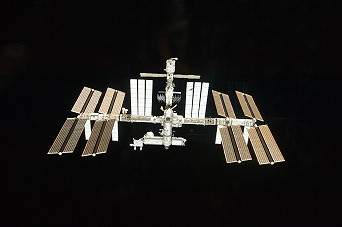
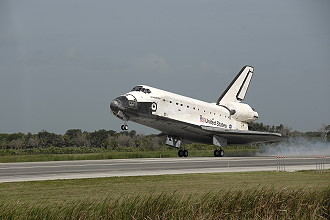
landing on Cape Canaveral (KSC), Runway 15. Originally the launch was planned for June 13, 2009. NASA cancelled the launch attempt of the Endeavour because of a leak in the gaseous hydrogen vent system. The same problem forced to scrub a second launch attempt on June 17, 2009. Due to conflicts with the launch of the LRO, and due to a beta angle constraint, the next available launch opportunity was scheduled for July 11, 2009. A successful tanking test for leak checks was performed on July 01, 2009, with modified GUCP seals allowing launch preparations to proceed as scheduled. Because of lightning strikes near the launch pad during the evening of July 10, 2009, NASA scrubbed the launch for the third time and rescheduled for July 12, 2009. Due to a Return To Launch Site (RTLS) weather violation, NASA scrubbed the launch for the fourth time on the evening of July 12, 2009. STS-127's fifth launch attempt, on July 13, 2009, was also scrubbed due to anvil clouds and lightning within 10 nautical miles (19 km) of the launch site, which violated launch safety rules. Running a month late because of hydrogen leaks and stormy weather, the shuttle Endeavour finally blasted off on its sixth try. The main goal of STS-127 (ISS-2J/A JEM EF, JEM ELM-ES) was to deliver and install the third and the last piece the Japanese Exposed Facility (JEM EF) to Kibo and the Kibo Japanese Experiment Logistics Module - Exposed Section (JEM ELM-ES). The exposed facility (a kind of "porch") is a part of Kibo that will allow astronauts to perform science experiments that are exposed to the vacuum of space. The exposed section is similar to the logistics module on the Kibo laboratory, but is not pressurized. Once its payloads are transferred to the JEM EF, the JEM ELM-ES will be returned to the payload bay. Also. inside the payload bay was an Integrated Cargo Carrier-Vertical Light Deployable (ICC-VLD), containing a variety of equipment and spare components for the station. The carrier contained six new batteries for installation on the P6 truss, that was installed during two of the mission's spacewalks, as well as a spare space-to-ground antenna and a spare linear drive unit and pump module which was stored on an external stowage platform on the station's truss during one of the spacewalks. The shuttle also delivered a new Flight Engineer - Timothy Kopra - to join the Expedition 20 crew, and return Expedition 20 Flight Engineer Koichi Wakata of the Japan Aerospace Exploration Agency to Earth. The final components of Kibo will flew to the space station on STS-127. The STS-127 (2J/A) mission concluded the Kibo assembly, paving the way for the full utilization stage of Kibo. On this third and last Kibo-designated assembly mission, Kibo's final components, the Exposed Facility (JEM EF) and the Experiment Logistics Module - Exposed Section (JEM ELM-ES), was delivered to the International Space Station. Installation of these components concluded assembly of the Japanese complex facility on the station. The JEM EF is a multipurpose experiment platform on which various scientific experiments can be performed using the microgravity and vacuum environment of space. The JEM ELM-ES is a logistics carrier which was launched and returned on the STS-127 mission. On this flight, the JEM ELM-ES carried three JEM EF payloads to the station. The JEM EF became operational during the STS-127 mission. Kibo's scientific capability was doubled when the platform for space-exposed experiment activities was ready. The day after Endeavour's launch was spent inspecting the shuttle's heat shield, using the 50-foot (15 meters) Orbiter Boom Sensor System, or OBSS, extension on the shuttle's robotic arm. The OBSS used laser devices and cameras to map the shuttle's wings and nose cap. Experts on the ground analyzed the images obtained during the inspection. Rendezvous began with a precisely timed launch that puts the space shuttle on a trajectory to chase the International Space Station. A series of engine firings over the next two days brought Endeavour to a point about 50,000 feet (15,240 meters) behind the station. Once there, Endeavour started its final approach. About 2.5 hours before docking, the shuttle's jets were fired during what is called the terminal initiation burn. The shuttle covered the final miles to the station during the next orbit. As Endeavour moved closer to the station, its rendezvous radar system and trajectory control sensor provided the crew with range and closing-rate data. Several small correction burns placed Endeavour about 1,000 feet (304.8 meters) below the station. Commander Mark Polansky, with help from Pilot Douglas Hurley and other crew members, manually flew the shuttle for the remainder of the approach and docking. Mark Polansky stopped Endeavour about 600 feet below the station. Once he determined there was proper lighting, he maneuvered Endeavour through a nine-minute backflip called the Rendezvous Pitch Maneuver known as R-bar Pitch Maneuver (RPM). That allowed the station crew to take as many as 300 digital pictures of the shuttle's heat shield. Station crew members Michael Barratt and Gennadi Padalka used digital cameras with 400 mm and 800 mm lenses to photograph Endeavour's upper and bottom surfaces through windows of the Zvezda Service Module. The 400 mm lens provided up to three-inch (7.6 centimeters) resolution and the 800 mm lens up to one-inch (2.5 centimeters) resolution. Gennadi Padalka used the 400 mm and Michael Barratt used the 800. The photography was one of several techniques used to inspect the shuttle's thermal protection system for possible damage. Areas of special interest included the thermal protection tiles, the reinforced carbon-carbon of the nose and leading edges of the wings, landing gear doors and the elevon cove. The photos were downlinked through the station's Ku-band communications system for analysis by systems engineers and mission managers. When Endeavour completed its backflip, it was back where it started, with its payload bay facing the station. Mark Polansky then flew Endeavour through a quarter circle to a position about 400 feet (121.9 meters) directly in front of the station. From that point he began the final approach to docking to the Pressurized Mating Adapter 2 at the forward end of the Harmony node. The shuttle crew members operated laptop computers that process the navigational data, the laser range systems and Endeavour's docking mechanism. Using a video camera mounted in the center of the Orbiter Docking System, Mark Polansky lined up the docking ports of the two spacecraft. Mark Polansky paused Endeavour 30 feet from the station to ensure proper alignment of the docking mechanisms. He maintained the shuttle's speed relative to the station at about one-tenth of a foot per second (3 centimeters per second), while both Endeavour and the station were moving at about 17,500 mph (28,163 km/h). Mark Polansky kept the docking mechanisms aligned to a tolerance of three inches (7.6 centimeters). When Endeavour made contact with the station on July 17, 2009, preliminary latches automatically attached the two spacecraft. The shuttle's steering jets were deactivated to reduce the forces acting at the docking interface. Shock absorber springs in the docking mechanism dampened any relative motion between the shuttle and station. Once motion between the shuttle and the station had stopped, the docking ring was retracted to close a final set of latches between the two vehicles. A few hours after Endeavour's docking on the third day of the flight, Timothy Kopra and Koichi Wakata exchanged custom-made Russian Soyuz spacecraft seat liners. With that exchange, Koichi Wakata became part of Endeavour's crew. Timothy Kopra, meanwhile, joined the Expedition 20 crew - the first space station crew with a full complement of six astronauts. The commander, Russian cosmonaut Gennadi Padalka, and NASA Flight Engineer Michael Barratt launched to the station in the Russian Soyuz TMA-14 in March 2009. The second half of the crew - European Space Agency astronaut Frank De Winne, Russian cosmonaut Roman Romanenko, and Canadian Space Agency astronaut Robert Thirsk - took Soyuz TMA-15 to the station in May 2009. Koichi Wakata arrived aboard space shuttle Discovery during the STS-119 mission in March 2009. In September 2009, Timothy Kopra returned to Earth on shuttle mission STS-128, and Nicole Stott took his place. A set of experiments to be deployed on the ISS were carried by STS-127, namely Dosimetry for Biological Experiments in Space (ESA), Validation of Procedures for Monitoring Crew Member Immune Function, the student-made Image Reversal in Space (CSA/ISU), Nutritional Status Assessment (NASA), NASA Biological Specimen Repository and Tomatosphere-II (CSA). The first EVA by David Wolf and Timothy Kopra occurred on July 18, 2009 (5h 32m) to prepare connecting mechanisms for Kibo and the exposed facility, which the station's robotic arm installed later in the day. They also released bolts on an ammonia tank assembly as get-ahead work for the next shuttle mission, STS-128. Then, both worked to deploy the unpressurized cargo carrier attachment system (UCCAS) on the Port 3 truss that was jammed and couldn't be done on STS-119. The UCCAS will be used in the future to store equipment and supplies on the outside of the station. Although the actual installation of Kibo's exposed facility was done robotically, David Wolf and Timothy Kopra began the first spacewalk by making preparations for that installation at both ends. David Wolf made his way to the laboratory to remove some insulation currently covering its berthing mechanism that the exposed facility was attached to. To do so, he released four fasteners and jettisoned the insulation. While he was in the area, he also tucked two grounding tabs on the Japanese robotic arm out of the way of the arm's camera - they're currently interfering with the view. At the same time, Timothy Kopra was working inside the shuttle's cargo bay on the exposed facility end of that preparation. He started by removing insulation from its berthing mechanism where it will attach to the Kibo laboratory, by releasing four fasteners and storing the insulation. He then disconnected the power cable that keeps the exposed facility running while it's in the cargo bay. The shuttle's robotic arm had already latched onto the exposed facility before the spacewalk started, and after the power cable was disconnected, the spacewalkers had done their part in the preparations for its installation. Afterward, the station robotic arm maneuvered into place, and the shuttle robotic arm picked up the facility from the shuttle's cargo bay and handed it off to the station robotic arm. The station arm then flew it to the Kibo laboratory for installation. Meanwhile, David Wolf and Timothy Kopra continued on with their spacewalk activities. Already in the shuttle's cargo bay, Timothy Kopra went ahead and disconnected the power cables providing electricity to the integrated cargo carrier to which the spare station equipment that Endeavour is carrying are attached. And he removed a contamination cover on one of the experiments the exposed facility's experiment carrier is carrying - MAXI, or Monitor of All-sky X-ray Image. After that, Timothy Kopra moved to the top of the Harmony node to secure a cover on its common berthing mechanism. He moved farther aft on station to pick up some tools on the station's zenith truss segment, and then to the left side of the Unity node to open another cover on its common berthing mechanism. David Wolf moved from the Kibo laboratory to the station's port, or left, truss. He paused at the innermost section of the truss to loosen four bolts on the grapple bar of an ammonia tank assembly to speed up another task during the second spacewalk, then continued on to the port crew equipment and translation aid, or CETA, cart. There he was moving and restraining a foot restraint and brake handles out of the way to prevent them from interfering with the rotating solar alpha rotary joint. For the rest of the spacewalk, David Wolf and Timothy Kopra worked together to set-up two systems for attaching cargo to the station's truss - an unpressurized cargo carrier attachment system, or UCCAS, and a payload attachment system, or PAS. Though they have different names, the two systems are almost identical. During the last shuttle mission to the space station, spacewalkers ran into problems when they tried to set up the UCCAS on the port 3, or P3, segment of the station's truss. A jammed detent pin kept it from unfolding as it was supposed to. So, David Wolf and Timothy Kopra came back for another try during their spacewalk. They used a specially built detent release tool to help clear the jam and allow them to fully install the UCCAS. After getting the UCCAS into place, David Wolf and Timothy Kopra moved to the starboard side of the truss to set up a PAS on the S3 truss segment. The spacewalkers first removed brackets and pins holding the latch in place, moved the latch into position and then reinstalled the brackets and pins. On July 19, 2009 a malfunction in a new toilet in the Destiny laboratory caused the crew to use the one in the Russian segment while attempts were made to identify the fault. Meanwhile the shuttle was cleared for reentry. The second EVA was performed by David Wolf and Thomas Marshburn on July 20, 2009 (6h 53m) to transport of spare parts from a cargo carrier to a stowage platform on the station's truss. These parts include: an antenna, a pump module and a rail mechanism that allows a transporter to move up and down the truss. They also relocated a grapple bar onto an ammonia tank assembly as a get-ahead for the STS-129 mission, targeted for November 2009. A planned installation of a camera on the Japanese Experiment Facility was postponed to a future EVA for want of time. The second spacewalk focused primarily on transferring the spare equipment brought up by the shuttle to a storage location on the station's truss segment. Between the first and second spacewalk, Mark Polansky and Douglas Hurley used the shuttle robotic arm to unpack the integrated cargo carrier that held all the spare equipment the shuttle was delivering to the space station. On flight day 6, before the second spacewalk started, Julie Payette and Koichi Wakata took over using the station robotic arm and maneuvered the carrier to be installed temporarily on the truss. This had to be done before the spacewalk started, because David Wolf's first task was to climb into a foot restraint on the station's robotic arm so that he could transfer the equipment from the carrier to an external stowage platform. Together, David Wolf and Thomas Marshburn detached first the spare space-to-ground antenna from the cargo carrier. David Wolf then carried it via the robotic arm to the stowage platform, where he and Thomas Marshburn installed it. They then repeated the process with the spare pump module and the spare linear drive unit. They spent their remaining time outside adding vision equipment on the newly installed exposed facility, which helped with the installation of the exposed facility's experiment carrier the following day. For launch, it was locked into a temporary spot on the exposed facility, and David Wolf and Thomas Marshburn needed to release six bolts, removed some insulation and disconnected a power cable to retrieve it. To install it in its permanent location on the forward end of the exposed facility, they used two bolts to secure it and then reconnect its power cable. The third EVA by David Wolf and Christopher Cassidy was conducted on July 22, 2009 (5h 59m) to prepare the exposed facility for experiment transfers and replace two out of the six batteries (four were planned) on the port side truss where they are housed to provide power for the truss. This EVA was shortened by NASA managers when astronaut Christopher Cassidy's carbon dioxide levels showed an upward trend due to a problem with his spacesuit's CO2 removal system. The calling off the spacewalk was simply a precaution. David Wolf relocated a worksite interface and a handrail from their current location on the Harmony node to a new site on the Columbus laboratory. Christopher Cassidy, meanwhile, prepared the experiments and equipment brought up inside the exposed facility's experiment carrier to be transferred to the exposed facility itself by removing insulation. The carrier will have been installed on flight day 7 by Mark Polansky and Julie Payette at the shuttle's robotic arm and Douglas Hurley and Koichi Wakata at the station's. Christopher Cassidy started with the interorbit communication system, which had two covers for Christopher Cassidy to remove and jettison and one to bring back inside. He also needed to release the equipment's antenna holding mechanism, which required removing two bolts. Christopher Cassidy then moved on to the space environment data acquisition equipment - attached payload. From there, both spacewalkers moved to the end of the port side of the station's truss for the battery work. Before the spacewalk started, Douglas Hurley and Julie Payette used the station's robotic arm to maneuver the integrated cargo carrier, to which the new batteries for the P6 solar array were attached, as close to David Wolf and Christopher Cassidy's worksite as possible - almost as far out as the arm can reach. David Wolf and Christopher Cassidy replaced two of the six batteries during this spacewalk. The new batteries were designated by letters A through F, and the old batteries numbered one through six. Christopher Cassidy removed an old battery from the solar array's integrated electrical assembly by installing two "scoops" that was used by the spacewalkers to maneuver the batteries, and then removing two bolts. He then handed it off, got out of the foot restraint he was working in, moved closer to David Wolf and took hold of the battery. David Wolf released the battery, moved slightly further down the truss and positioned himself to take hold of the battery. Christopher Cassidy handed the battery to David Wolf and then moved himself closer to once again take hold and control the battery. The process was called "shepherding", and might appear as "inch-worming" the battery along except that one person is always holding a 367-pound (167 kg) battery. To install the battery in a temporary storage location on the integrated electrical assembly, David Wolf used one of the scoops to attach it to a multi-use tether, or ball-stack, and end effectors. The spacewalkers then removed battery A from the integrated cargo carrier and shepherd it back to the integrated electrical assembly for installation in slot 1. The next step was to remove battery 4, shepherd it to the cargo carrier to be installed in slot A, and remove battery B to be installed in slot 4. The process continued until two batteries were installed, then the first battery was removed from its temporary storage location and installed in the vacant spot on the cargo carrier. The fourth EVA was performed by Thomas Marshburn and Christopher Cassidy on July 24, 2009 (7h 12m) to replace the final four batteries on the port truss. Thomas Marshburn and Christopher Cassidy spent the first half of spacewalk four finishing up the battery swap work that David Wolf and Christopher Cassidy started. They used the same procedure. The spacewalkers wrapped up their work by installing the exposed facility's aft vision equipment, in a process similar to that performed by Thomas Marshburn and David Wolf during the second spacewalk. The fifth and final EVA by Thomas Marshburn and Christopher Cassidy occurred on July 27, 2009 (4h 54m) to remove covers from the Dextre robotic arm, reconfigure cables on a panel for some circuit breakers and deploy two additional payload attachment systems. They also installed a second camera that will provide video of experiments on the aft end of the exposed facility, a work, which was originally scheduled for EVA 4. Finally, they replaced an aging camera system on the starboard truss. Instead some get ahead tasks were completed which included installation of handrails and a portable foot restraint. The last spacewalk of the mission was devoted primarily to get-ahead tasks that were not able to be finished during the last shuttle mission to the space station. Thomas Marshburn's first job took him to the station's special purpose dexterous manipulator - also known as Dextre - on the exterior of the Destiny laboratory. He was resecuring two thermal covers on Dextre's orbital replacement unit tool changeout mechanisms - in other words, one of the robot's wrist joints. While he did so, Christopher Cassidy swapped two connectors on a patch panel on the station's zenith truss segment. The two then worked together to first set up two more payload attachment systems - on the inboard and outboard sides of the nadir portion of the S3 truss - following the procedure that David Wolf and Timothy Kopra used during the first spacewalk, and installed a wireless video system external transceiver assembly, or WETA, on the same segment. WETAs support the transmission of video from spacewalkers' helmet cameras. To do so, Thomas Marshburn removed a dummy box currently in the location, and then attached the WETA to a stanchion. Christopher Cassidy connected three cables to the assembly. At undocking time, the hooks and latches were opened and springs pushed the shuttle away from the station. Endeavour's steering jets were shut off to avoid any inadvertent firings during the initial separation. Once Endeavour was about two feet (61 centimeters) from the station and the docking devices were clear of one another, Douglas Hurley turned the steering jets back on and manually controlled Endeavour within a tight corridor as the shuttle separated from the station. Endeavour moved to a distance of about 450 feet (137.2 meters), where Douglas Hurley began to fly around the station. Once Endeavour completed 1.5 revolutions of the complex, Douglas Hurley fired Endeavour's jets to leave the area. The shuttle moved about 46 miles (74 km) from the station and remained there while ground teams analyzed data from the late inspection of the shuttle's heat shield. The distance was close enough to allow the shuttle to return to the station in the unlikely event that the heat shield is damaged, preventing the shuttle's safe re-entry. Two satellites were also carried by the orbiter, for deployment when the mission ended. The Dual Autonomous Global Positioning System On-Orbit Navigator Satellite, called DRAGONSAT, gathered data on autonomous spacecraft rendezvous and docking capabilities, and consists of two picosatellites, the AggieSat2, and PARADIGM (BEVO-1), which acquire GPS data from a device at NASA and send it to ground stations at Texas A&M University and the University of Texas at Austin. After release, the two picosatellites remained attached for two orbits to collect GPS data, and separate during the third orbit. A second satellite, the Atmospheric Neutral Density Experiment (ANDE-2), is part of a United States Department of Defense project flown by the Naval Research Laboratory to provide high-quality satellites, and will measure the density and composition of the low Earth orbit atmosphere while being tracked from the ground, to better predict the movement and decay of objects in orbit. ANDE-2 consists of two spherical microsatellites, ANDE Active spacecraft (Castor) and the ANDE Passive spacecraft (Pollux), and will be tracked by the International Laser Ranging Service (ILRS) network as well as the Space Surveillance Network (SSN).One of the satellites, Pollux, is running Arduino libraries, with its payload programmed and built by students. |
EVA data
| Name | Start | End | Duration | Mission | Airlock | Suit | Stripes | |
| EVA | Kopra, Timothy | 18.07.2009, 16:19 UTC | 18.07.2009, 21:51 UTC | 5h 32m | STS-127 | ISS - Quest | EMU No. 3005 | without |
| EVA | Wolf, David | 18.07.2009, 16:19 UTC | 18.07.2009, 21:51 UTC | 5h 32m | STS-127 | ISS - Quest | EMU No. 3003 | red |
| EVA | Marshburn, Thomas | 20.07.2009, 15:27 UTC | 20.07.2009, 22:20 UTC | 6h 53m | STS-127 | ISS - Quest | EMU No. 3005 | red-white linear |
| EVA | Wolf, David | 20.07.2009, 15:27 UTC | 20.07.2009, 22:20 UTC | 6h 53m | STS-127 | ISS - Quest | EMU No. 3003 | red |
| EVA | Cassidy, Christopher | 22.07.2009, 14:32 UTC | 22.07.2009, 20:31 UTC | 5h 59m | STS-127 | ISS - Quest | EMU No. 3018 | red-white diagonal |
| EVA | Wolf, David | 22.07.2009, 14:32 UTC | 22.07.2009, 20:31 UTC | 5h 59m | STS-127 | ISS - Quest | EMU No. 3003 | red |
| EVA | Marshburn, Thomas | 24.07.2009, 13:54 UTC | 24.07.2009, 21:06 UTC | 7h 12m | STS-127 | ISS - Quest | EMU No. 3005 | red-white linear |
| EVA | Cassidy, Christopher | 24.07.2009, 13:54 UTC | 24.07.2009, 21:06 UTC | 7h 12m | STS-127 | ISS - Quest | EMU No. 3018 | red-white diagonal |
| EVA | Cassidy, Christopher | 27.07.2009, 11:33 UTC | 27.07.2009, 16:27 UTC | 4h 54m | STS-127 | ISS - Quest | EMU No. 3018 | |
| EVA | Marshburn, Thomas | 27.07.2009, 11:33 UTC | 27.07.2009, 16:27 UTC | 4h 54m | STS-127 | ISS - Quest | EMU No. 3005 | red-white linear |
Note
Photos / Graphics
 |
 |
|
source of all photos is NASA |
|
 |
 |
 |
 |
 |
 |
 |
 |
 |
 |
 |
 |
 |
 |
 |
|
more EVA photos |
|
| © |  |
Last update on June 26, 2023.  |
 |