Besatzungen der ISS

ISS: Expedition 18 |
 |
 |
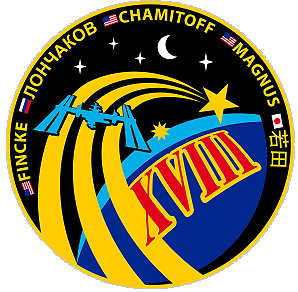 |
|
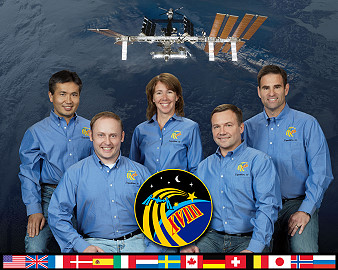
hochauflösende Version (1,03 MB) alternatives Crewfoto |
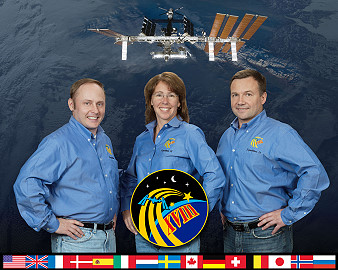
hochauflösende Version (0,98 MB) alternatives Crewfoto |
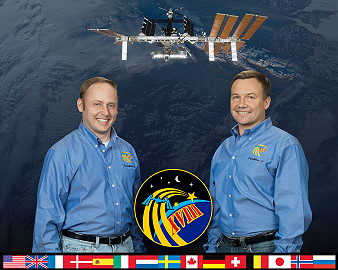
hochauflösende Version (1,02 MB) alternatives Crewfoto |
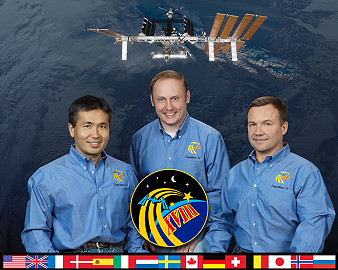
|
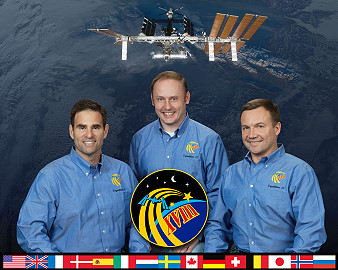
|
alternatives Crewfoto |
|
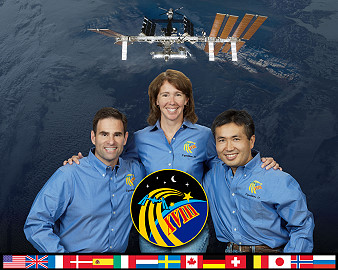
|
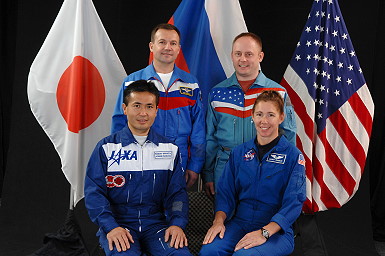
|
Besatzung, Start- und Landedaten
| Nr. | Nation | Name | Vorname | Position | Raumschiff (Start) |
Startdatum | Startzeit | Raumschiff (Landung) |
Landedatum | Landezeit | Flugdauer | Erdorbits |
| 1 |  |
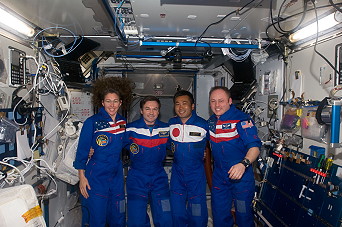
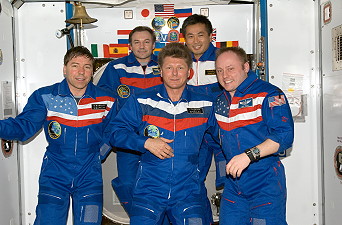
Fincke | Edward Michael "Mike" | ISS-CDR | Sojus TMA-13 | 12.10.2008 | 07:01:33,243 UTC | Sojus TMA-13 | 08.04.2009 | 07:15:09,8 UTC | 178d 00h 13m 38s | 2803 |
| 2 |  |
Lontschakow | Juri Walentinowitsch | Bordingenieur-1 | Sojus TMA-13 | 12.10.2008 | 07:01:33,243 UTC | Sojus TMA-13 | 08.04.2009 | 07:15:09,8 UTC | 178d 00h 13m 38s | 2803 |
| 3 | |
Chamitoff | Gregory Errol | Flugingenieur-2 | STS-124 | 31.05.2008 | 21:02:12,006 UTC | STS-126 | 30.11.2008 | 21:25:05,599 UTC | 183d 00h 22m 54s | 2879 |
| 4 | |
Magnus | Sandra Hall | Flugingenieurin-2 | STS-126 | 15.11.2008 | 00:55:38,996 UTC | STS-119 | 28.03.2009 | 19:13:25,022 UTC | 133d 18h 17m 47s | 2105 |
| 5 |  |
Wakata | Koichi | Flugingenieur-2 | STS-119 | 15.03.2009 | 23:43:44,019 UTC | STS-127 | 31.07.2009 | 14:48:07 UTC | 137d 15h 04m 23s | 2166 |
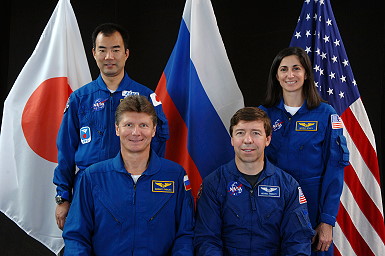
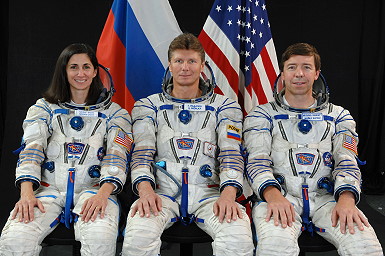
Ersatzmannschaft bzw. Double Crew
| Nr. | Nation | Name | Vorname | Position |
| 1 | |
Barratt | Michael Reed | ISS-CDR |
| 2 | |
Padalka | Gennadi Iwanowitsch | Bordingenieur |
| 3 | |
Kopra | Timothy Lennart | Flugingenieur |
| 4 | |
Stott | Nicole Marie Passonno | Flugingenieurin |
| 5 | |
Noguchi | Soichi | Flugingenieur |
 |
 |
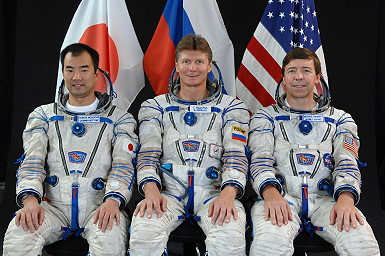 |
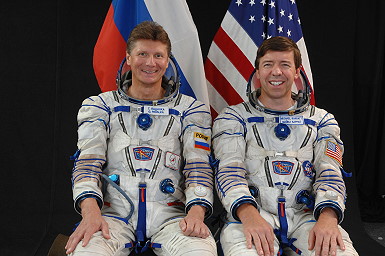 |
 |
Expeditionsverlauf
|
Start vom Kosmodrom Baikonur (Michael
Fincke und Juri
Lontschakow mit
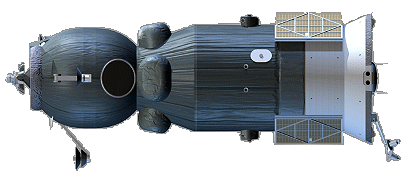
Sojus
TMA-13). Sandra
Magnus kam mit
STS-126 auf der
Raumstation an (16. November 2008). Sie wurde am 17. März 2009 durch
Koichi
Wakata ersetzt, der die
ISS mit
STS-119
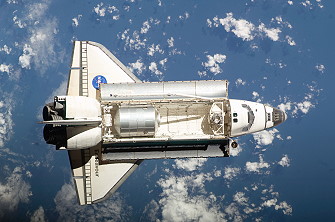
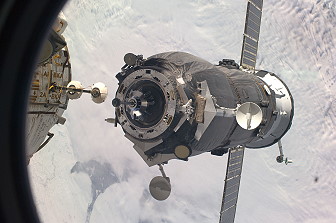
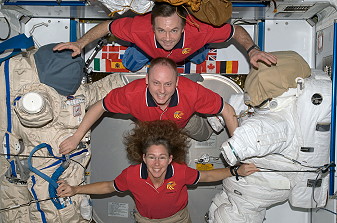
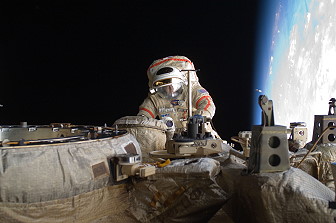
erreichte. Offiziell begann die Expedition 18 mit der Abkopplung des russischen Raumschiffs Sojus TMA-12 am 24. Oktober 2008 um 00:16:18 UTC. Gleichzeitig war damit die Expedition 17 beendet. Am 16. November 2008 erreichte STS-126 die Internationale Raumstation. Bei der Mission STS-126 (ISS-ULF-2 MPLM Leonardo) wurde das Logistikmodul (MPLM) Leonardo genutzt, um Fracht zur ISS zu bringen. Das Hauptaugenmerk lag hierbei darin, die Station für die Unterstützung einer Langzeitbesatzung von sechs statt wie bisher drei Personen auszurüsten. Dazu wurden unter anderem zwei weitere Schlafplätze, eine zusätzliche Galley, eine weitere Toilette und ein Trainingsgerät installiert. Des Weiteren wurde mit Hilfe eines speziellen Frachtträgers (LMC) eine Schlauchdrehkupplung zur ISS gebracht und ein leerer Stickstofftank zurück zur Erde transportiert. Außerdem wurde ein Kleinsatellit zum Test zweier neuer Typen von Solarzellen ausgesetzt. Weiteres wesentliches Missionsziel war der Austausch eines Besatzungsmitgliedes der ISS. Sandra Magnus sollte Gregory Chamitoff als Bordingenieur der ISS Expedition 18 ablösen. Das Multi-Purpose Logistics Module (MPLM) Leonardo, (Deutsch Mehrzwecklogistikmodul), wurde verwendet, um bei Space-Shuttle-Missionen Frachten zu und von der Internationalen Raumstation (ISS) in einem unter Luftdruck stehenden Raum zu transportieren. Das Modul wurde während des Transportes mit dem Shuttle in dessen Ladebucht befestigt. Nach dem Andocken an die ISS wurde das MPLM mit Hilfe des Roboterarmes Canadarm2 aus der Ladebucht gehoben und am Harmony-Modul angekoppelt. Anschließend wurde die Luke des Moduls geöffnet und die Astronauten erhielten Zugang zum MPLM, um es zu entladen sowie mit den zur Erde zu bringenden Frachten zu beladen. Bevor das Shuttle von der Station ablegte, wurde das Modul wieder in der Ladebucht befestigt und kehrte anschließend zusammen mit der Raumfähre zur Erde zurück. Der wesentliche Vorteil dieses Verfahrens lag darin, dass Transportgüter, insbesondere die sogenannten International Standard Payload Racks, direkt vom MPLM in den amerikanischen Teil der Station verladen werden konnten. Kopplungsadapter vom APAS-Typ russischer Bauart, die auch zum Andocken des Space Shuttles benutzt werden, haben einen wesentlich geringeren Durchmesser und lassen kein Verladen sperriger Gegenstände zu. Weiterhin ermöglichte der Einsatz des MPLM, nicht mehr benötigte Ausrüstung und beendete Experimente zurück zur Erde zu transportieren. Andere Transportschiffe wie die unbemannten Progress- und ATV-Frachter verglühen beim Wiedereintritt und transportieren daher ausschließlich Müll von der Station ab. In der Nähe der Station führte Christopher Ferguson ein spektakuläres 360°-Manöver - das Rendezvous Pitch Maneuver (RPM) - durch, wobei er die Raumfähre innerhalb weniger Minuten um ihre Querachse drehen ließ. Die Besatzung der Raumstation fertigte währenddessen hochauflösende Aufnahmen des Shuttle-Hitzeschildes an. Die Aufnahmen wurden später zur Erde übertragen und von Fachleuten ausgewertet. Mit einer direkt vor der ISS reduzierten Annäherungsgeschwindigkeit auf zuletzt nur noch 3 Zentimeter pro Sekunde flog der Orbiter auf den Ankopplungsstutzen der Internationalen Raumstation zu. Wie die Kommandanten bei allen Kopplungsmissionen steuerte er den Raumgleiter von der hinteren Konsole im Flugdeck aus, weil er von dort freie Sicht auf die Raumstation hatte. Ohne Probleme konnte er sein Raumschiff an die ISS ankoppeln. Noch am selben Tag löste Missionsspezialistin Sandra Magnus ISS-Bordingenieur Gregory Chamitoff ab, indem die Sojus-Sitze ausgetauscht wurden. Sandra Magnus baute ihren im Space Shuttle mitgebrachten Schalensitz in das angedockte Raumschiff Sojus TMA-13 ein. Dies geschah nur als Vorsichtsmaßnahme für den Fall einer überhasteten Rückkehr vor Abholung durch das nächste Space Shuttle. Damit gehörte sie offiziell zur 18. Besatzung der Raumstation. Im Gegenzug baute Gregory Chamitoff seinen Schalensitz aus dem Sojus-Raumschiff aus und wurde damit Mannschaftsmitglied von STS-126. Im Mitteldeck der Endeavour war ein Liegesitz für ihn eingebaut, um ihm bei der Landung die Anpassung an die Schwerkraft zu erleichtern. Der vierte Flugtag diente hauptsächlich den vorbereitenden Aufgaben für die Hauptaufgaben der Gesamtmission. So wurde das MPLM aus der Ladebucht des Shuttles am zur Erde weisenden Kopplungsadapter von Harmony befestigt und erstmals geöffnet. Das Ausladen des Moduls begann erst am Folgetag. In Vorbereitung auf die Weltraumausstiege wurden neben den Raumanzügen auch Ersatzteile für den Steuerbord-SARJ von der Luftschleuse bzw. dem Mitteldeck des Shuttles zur ISS-Luftschleuse Quest transferiert. Dort verbrachten auch Heidemarie Stefanyshyn-Piper und Stephen Bowen die Nachtruhe. Während dieses Campouts atmeten sie reinen Sauerstoff unter reduziertem Luftdruck, um dem Auftreten der Dekompressionskrankheit während des Ausstiegs am fünften Flugtag vorzubeugen Die erste EVA durch Heidemarie Stefanyshyn-Piper und Stephen Bowen wurde am 18. November 2008 (6h 52m) unternommen. Die beiden Astronauten befassten sich zunächst mit dem Transport eines Stickstofftanks zum Frachtträger am hinteren Ende der Nutzlastbucht der Endeavour. Von dort wurde ein Ersatzteil für die Station mitgenommen, welches auf der ESP-3 verstaut wurde. Dieses Ersatzteil, eine Schlauchdrehkupplung (Flex Hose Rotary Coupler), wurde zur Verbindung der Kühlmittelleitungen der drehbaren Radiatoren an den Gitterstrukturen P1 und S1 mit der Station benötigt. Nachdem Stephen Bowen allein den Kopplungsadapter für die Außenmodule Kibos geprüft hatte, sollte er zusammen mit Heidemarie Stefanyshyn-Piper die Arbeiten am Steuerbord-SARJ aufnehmen. Diese Aufgaben beinhalteten den Austausch eines Zahnradmotors sowie die Einfettung des Laufrings des SARJ. In Vorfeld jedoch ereignete sich eine Panne. Gegen 20:33 UTC meldete Heidemarie Stefanyshyn-Piper, dass aus ihrer Spritzpistole Schmierfett in die Transporttasche ausgelaufen sei. Während sie mit der Säuberung der Werkzeuge beschäftigt war, schwebte die Tasche mit allen darin befindlichen Werkzeugen (zwei Fettpressen, Bürsten, Tücher, Gurte und Dosen) davon. Heidemarie Stefanyshyn-Piper und Stephen Bowen mussten daraufhin mit nur einem Werkzeugsatz auskommen, welcher jedoch für den Rest des Ausstiegs genügte. Für spätere Ausstiege waren genug Ersatzteile vorhanden. Am sechsten Flugtag wurden zunächst Wohn- und Schlafracks für ein Besatzungsmitglied auf der Backbordseite des Harmony-Moduls eingebaut. Ein baugleiches Modell wurde im Verlauf des Tages auf der Steuerbordseite montiert. Insgesamt wurden an diesem Tag alle verbleibenden Racks des MPLMs (Leonardo) auf die ISS transferiert. Außerdem wurde die dazugehörige Toilette in Destiny eingebaut und ein Staurack in Leonardo montiert. Anschließend lag das Hauptaugenmerk auf einem sich über zwei Racks erstreckenden Wasserrecyclingsystem (WRS), welches im Destiny-Modul eingebaut wurde und aus Wasserabfällen und Urin Wasser generieren soll. Dieses soll sowohl zum Trinken, als auch für die elektrolytische Sauerstoffherstellung auf der Station verwendet werden können. Bevor das Wasser zum Trinken freigegeben wird, muss eine Probe auf der Erde analysiert werden. Diese wurde noch während der Mission genommen und zur Erde gebracht. Diese beiden, sowie ein Experimentenrack wurden im Destiny-Modul eingebaut. Allerdings wies das Wasserrecyclingsystem am nächsten Morgen eine Fehlfunktion auf. Die zweite EVA durch Heidemarie Stefanyshyn-Piper und Robert Kimbrough erfolgte am 20. November 2008 (6h 45m). Ihre erste Aufgabe war die Verlegung zweier Ausrüstungstransporter von der Steuerbord- zur Backbordseite des Mobile Base Systems, um es für die Installation des S6-Segments während STS-119 vorzubereiten. Während Heidemarie Stefanyshyn-Piper die Arbeiten am Steuerbord-SARJ fortsetzte, säuberte und fettete Robert Kimbrough den Greifpunkt des Roboterarms der Station. Anschließend begab er sich ebenfalls zum SARJ und half ihr bei den weiteren Arbeiten. Am achten Flugtag, kurz nachdem die Endeavour die Station um etwa 1,8 Kilometer angehoben hat, konnte endlich das Problem in der Wasserrecyclinganlage gefunden werden. Im UPA (Urine Processing Assembly) gab es einen mechanischen Defekt an einer zum Destillationssystem zugehörigen Zentrifuge. Diese kam nach etwa zwei Stunden Betrieb in Kontakt mit einem Geschwindigkeitssensor, welcher die sofortige Abschaltung des Geräts herbeiführte. Da erst ein Reparaturplan ausgearbeitet werden musste, wurden den restlichen Tag über die Transferaktivitäten fortgeführt. Darunter war der Total Organic Carbon Analyzer (TOCA), mit welchem in den Folgetagen erste Wasserproben aus dem Wasserrecyclingsystem untersucht wurden. Die dritte EVA erfolgte durch Heidemarie Stefanyshyn-Piper und Stephen Bowen am 22. November 2008 (6h 57m) zur Fortsetzung der bisherigen Arbeiten (Wartung SARJ und Austausch der Drehgelenkslager). Die vierte und letzte EVA wurde durch Stephen Bowen und Robert Kimbrough am 24. November 2008 (6h 07m) ausgeführt. Zunächst wurden mehrere Abdeckungen vom Backbord-SARJ entfernt. Robert Kimbrough unternahm dann Wartungsarbeiten an diesem SARJ, während Stephen Bowen die im Verlauf der ersten EVA abgenommenen Schutzabdeckungen am Kibo-Modul wieder anbrachte. Danach wurden noch 2 GPS-Antennen am Kibo-Modul montiert, während Robert Kimbrough eine neue Fernsehkamera am P1-Gitterelement anbrachte. Zwischenzeitlich hatte die Bodenkontrolle entschieden, die Mission von Endeavour um einen Tag zu verlängern, um nach diversen vergeblichen Versuchen, das Wasserrecyclingsystem an Bord der Station endlich zu reparieren, was letztendlich dann auch gelang. Über Nacht wurde das Steuerbord-SARJ für drei Stunden auf Automatik gestellt. Es arbeitete weitaus besser als erwartet, sollte jedoch noch weiter getestet werden, bevor es wieder den Regelbetrieb aufnimmt. Auch der Urinverarbeiter hatte drei komplette Arbeitszyklen hinter sich gebracht und funktionierte nun einwandfrei, wurde jedoch wesentlich lauter. Weiterhin wurden Vorbereitungen zum Abdocken des für den Rückflug beladenen MPLMs getroffen, in dem es am 13. Flugtag von Harmony entfernt und um 10:52 UTC in Endeavours Nutzlastbucht für den Heimflug zur Erde sicher befestigt wurde. Am 28. November 2008 um 14:47 UTC koppelte die STS-126-Besatzung mittels Federkraft wieder von der ISS ab. Dadurch wurden Beschädigungen oder Verunreinigungen der Station vermieden. Erst danach wurden die Steuerungstriebwerke aktiviert und die Raumfähre entfernte sich von ihr bis zu einer Distanz von etwa 150 Meter. Von dort aus umflog Eric Boe die Orbitalstation eineinhalb Mal, ehe die Triebwerke der Endeavour erneut gezündet wurden und der Raumgleiter seine Distanz vergrößerte. Der Orbiter stoppte dann in einer Entfernung von etwa 75 Kilometer. Mit Hilfe des OBSS wurde eine letzte Überprüfung des Hitzeschutzschildes vorgenommen. Im Notfall hätte das Space Shuttle zur Internationalen Raumstation zurückkehren können. Der unbemannte russische Frachter Progress M-01M legte am 30. November 2008 um 12:28 UTC an der Internationalen Raumstation an. Er war am 26. November 2008 um 12:38 UTC vom Kosmodrom Baikonur gestartet. Das Transport-Raumschiff brachte 2.423 Kilogramm Fracht, bestehend aus 820 Kilogramm Treibstoffe, 210 Kilogramm Wasser und 1.343 Kilogramm sonstige Fracht wie z.B. Lebensmittel. zur Stammbesatzung. Darunter befand sich auch japanisches Essen für Koichi Wakata. Am 06. Februar 2009 um 04:10 UTC koppelte Progress M-01M wieder ab und verblieb für zwei Tage im Freiflug. Der Frachter wurde danach kontrolliert zum Absturz gebracht und verglühte am 08. Februar 2009 über dem Pazifischen Ozean. Die erste EVA durch Michael Fincke und Juri Lontschakow erfolgte am 23. Dezember 2008 (5h 38m) zum Anbringen und Bergen verschiedener russischer Experimente an bzw. von der Außenwand der Raumstation. Außerdem wurde eine Einheit zum Messen elektromagnetischer Kräfte, die auf die Station einwirken, wenn der Komplex sich in einer niedrigen Umlaufbahn um die Erde bewegt, angebracht. Der unbemannte russische Frachter Progress M-66 legte am 13. Februar 2009 um 07:18 UTC an der Internationalen Raumstation an. Er war am 10. Februar 2009 um 05:49 UTC vom Kosmodrom Baikonur gestartet. Das Transport-Raumschiff brachte Ausrüstungsgegenstände wie Lebensmittel, Kleidung, aber auch Wasser, Sauerstoff und Treibstoff zur Stammbesatzung. Außerdem befand sich ein neuer Orlan-Raumanzug an Bord, der ein bisher benutztes Modell ersetzen soll. Am 06. Mai 2009 um 15:18 UTC koppelte Progress M-66 wieder ab und wurde danach für Experimente im Rahmen des Programms Plasma-Progress verwendet. Der Frachter wurde kontrolliert zum Absturz gebracht und verglühte am 18. Mai 2009 über dem Pazifischen Ozean. Die zweite und letzte EVA dieser Expedition unternahmen Michael Fincke und Juri Lontschakow am 10. März 2009 (4h 49m). Es wurde Klebeband von der Pirs-Schleuse entfernt, um einen reibungslosen Ablauf zukünftiger Ankopplungsmanöver zu garantieren. Des Weiteren wurde das Experiment Expose-R installiert, das die Auswirkungen des Weltalls auf Organismen und biologische Materialien untersuchen soll. Zum Schluss wurde der Zustand der Raumstation fotografisch dokumentiert. Am 12. März 2009 wurde ein sich der Station annäherndes Trümmerteil zu spät entdeckt, um ein Ausweichmanöver durchzuführen. Die Besatzung bereitete daraufhin die Evakuierung der ISS vor. Um 16:35 UTC begaben sie sich in die Sojus, um im Notfall die Station innerhalb kürzester Zeit verlassen zu können. Ein Zusammenstoß fand jedoch nicht statt und die Raumfahrer konnten um 16:45 UTC ihre Arbeit wieder aufnehmen. Mit STS-119 erreichte am 17. März 2009 eine zweite Raumfähre während der Expedition 18 die Internationale Raumstation. Die Mission STS-119 (ISS 15A ITS-S6) brachte das S6-Gitterelement zur Internationalen Raumstation. Dieses Gitterelement war das letzte von vier Solarmodulen, das montiert wurde. Eine weitere Aufgabe der Mannschaft war der Anschluss des Solarmoduls und der Batterien. Weiteres wesentliches Missionsziel war der Austausch eines Besatzungsmitgliedes der ISS. Koichi Wakata sollte Sandra Magnus als Bordingenieur der ISS Expedition 18 ablösen. Die Integrated Truss Structure (ITS; dt.: Integrierte Gitterstruktur) ist die tragende Gitterstruktur der Internationalen Raumstation (ISS). Sie bildet deren Rückgrat und ist senkrecht zur Flugrichtung ausgerichtet. Die ITS ist wie die gesamte Raumstation modular aufgebaut. Die einzelnen Elemente tragen Bezeichnungen aus einer Buchstaben-/Zahlenkombination ("P" steht für Port, von engl. Backbord; "S" steht für Starboard, von engl. Steuerbord): P1, P3/P4, P5 und P6 sind in Flugrichtung links angeordnet, während auf der rechten Seite die Elemente S1, S3/S4, S5 und S6 montiert sind. Das Element S0 liegt in der Mitte und ist über das Destiny Labor mit dem bewohnten Teil der Station verbunden. Die Integrated Truss Structure ist eine im Querschnitt trapezförmige, starre Leichtmetallstruktur mit zusätzlichen Querstreben. Für die Verbindung der einzelnen Segmente der Gitterstruktur existiert ein spezielles "Module-to-Truss Segment Attachment System". Für jede Verbindung gibt es einen fernbedienbaren Fangriegel, der beide Elemente zunächst locker verbindet und danach festgezogen wird. Außerdem greifen dann vier motorgetriebene Bolzen, die zusätzlich gesichert werden. P6 und S6 sind die äußersten Segmente der Integrated Truss Structure. Beide bestehen sowohl aus einer Gitterstruktur als auch aus Solarzellenflächen. P6 wurde während der STS-97-Mission ins All gebracht und am 03. Dezember 2000 zunächst am Sockel Z1 befestigt. Es wurde während der STS-120-Mission am 30. Oktober 2007 an seinen endgültigen Platz am backbordseitigen (in Flugrichtung linken) Teil der ISS, dem P5-Element verlagert. Mit dem S6-Element wurde das letzte Element der Integrated Truss Structure mit der Mission STS-119 ins All gebracht. Damit war der Aufbau der Integrated Truss Structure abgeschlossen. In der Nähe der Station führte Lee Archambault ein spektakuläres 360°-Manöver - das Rendezvous Pitch Maneuver (RPM) - durch, wobei er die Raumfähre innerhalb weniger Minuten um ihre Querachse drehen ließ. Die Besatzung der Raumstation fertigte währenddessen hochauflösende Aufnahmen des Shuttle-Hitzeschildes an. Der Beginn dieses Manövers verzögerte sich um mehrere Minuten, als unerwartet die Kommunikation mit der Station verloren ging. Dies wurde auf fehlerhafte Headsets zurückgeführt. Nachdem die ISS wieder Rufe empfangen, jedoch nicht senden konnte, begann man mit dem Rendezvous Pitch Maneuver (RPM), jedoch ging die Kommunikation erneut verloren, sodass die ISS-Besatzung nicht über den offiziellen Beginn der Foto-Session informiert wurde. Sie begannen daher eigenständig mit dem Fotografieren des Hitzeschildes. Die Aufnahmen wurden später zur Erde übertragen und von Fachleuten ausgewertet. Mit einer direkt vor der ISS reduzierten Annäherungsgeschwindigkeit auf zuletzt nur noch 3 Zentimeter pro Sekunde flog der Orbiter auf den Ankopplungsstutzen der Internationalen Raumstation zu. Wie die Kommandanten bei allen Kopplungsmissionen steuerte er den Raumgleiter von der hinteren Konsole im Flugdeck aus, weil er von dort freie Sicht auf die Raumstation hatte. Ohne Probleme konnte er sein Raumschiff an die ISS ankoppeln. Eine Stunde und 49 Minuten nach der Kopplung wurden die Luken zwischen den Raumfahrzeugen geöffnet und die Transferarbeiten begannen. Noch am selben Tag löste Missionsspezialist Koichi Wakata ISS-Bordingenieurin Sandra Magnus ab, indem die Sojus-Sitze ausgetauscht wurden. Koichi Wakata baute seinen im Space Shuttle mitgebrachten Schalensitz in das angedockte Raumschiff Sojus TMA-13 ein. Dies geschah nur als Vorsichtsmaßnahme für den Fall einer überhasteten Rückkehr vor Abholung durch das nächste Space Shuttle. Damit gehörte er offiziell zur 18. Besatzung der Raumstation. Im Gegenzug baute Sandra Magnus ihren Schalensitz aus dem Sojus-Raumschiff aus und wurde damit Mannschaftsmitglied von STS-119. Im Mitteldeck der Discovery war ein Liegesitz für sie eingebaut, um ihr bei der Landung die Anpassung an die Schwerkraft zu erleichtern. Am 18. März 2009 begannen die Arbeiten zur Installation des S6-Segments. Dazu wurden mehrere Manöver mit den Greifarmen des Shuttles sowie der Station durchgeführt. Zunächst ergriff Canadarm2, kontrolliert durch John Phillips und Sandra Magnus, S6 und entnahm das Segment aus der Nutzlastbucht. Anschließend wurde S6 an den Greifarm des Shuttles weitergegeben, sodass Canadarm2 ohne Risiken für das Gleichgewicht der Station oder eine beschleunigte Abnutzung der Gyroskope zum Steuerbordende der Station bewegt werden konnte. Dort wurde S6 erneut übergeben und in eine Parkposition gebracht, in der es bis zum Beginn des Ausstieges am nächsten Tag belassen wurde. Im Stationsinneren standen neben Transferaktivitäten und der Bedienung der Roboterarme Vorbereitungen für den Ausstieg an, der von Steven Swanson und Richard Arnold durchgeführt wird. Es wurden die Raumanzüge zur Stationsluftschleuse Quest überführt, montiert und mit Sauerstoff betankt. Weiterhin wurden die Werkzeugtaschen vorbereitet. Nach einem vorbereitenden Briefing begaben sich Steven Swanson und Richard Arnold in die Luftschleuse, um über Nacht unter reduziertem Luftdruck reinen Sauerstoff zu atmen. Dieses sogenannte Campout reduziert den Gehalt des im Körpergewebe gelösten Stickstoffs und beugt so der Dekompressionskrankheit vor. Die erste EVA durch Steven Swanson und Richard Arnold wurde am 19. März 2009 (6h 07m) unternommen. Bevor die Astronauten die Quest-Luftschleuse verließen, bewegten John Phillips und Koichi Wakata den Stationsarm so, dass S6 anschließend nur etwa 1,6 Meter von seiner Endposition entfernt war. Während der Außenbordarbeiten wurde das S6-Segment befestigt und verkabelt. Auch wurden diverse Starthalterungen und Wärmematten entfernt und der segmenteigene Radiator sowie die Boxen, in denen die Kollektoren gelagert sind, ausgefahren. Die vier entfernten thermischen Abdeckungen wurden als Weltraummüll entsorgt. Diese Arbeiten wurden teilweise gegenüber dem bisherigen Flugplan vorgezogen, weil keine Inspektion des Hitzeschutzschildes durchgeführt werden musste. So entschied man kurzerhand, die Solarflächen schon am sechsten Flugtag auszufahren, statt erst am achten Flugtag. Sowohl der vordere (3B) als auch der hintere (1B) Kollektor wurden um eine sogenannte Bucht, die Länge zweier aneinanderhängender Zellen, ausgefahren, sodass sich die Kollektoren an die Weltraumumgebung anpassen konnten. Unter den Augen beider Besatzungen wurde dann 1B zu 49 % ausgefahren und während eines orbitalen Tages (etwa 40 Minuten) in dieser Stellung der Sonnenstrahlung ausgesetzt. Dies sollte den Kollektor erwärmen und so eventuelle Verklebungen zwischen den Paneelen lösen. Anschließend wurde der Kollektor vollständig ausgefahren. Das Ausfahren von 3B verlief nach demselben Verfahren. Zwischendurch stellte man an dem Kollektor eine Deformierung fest, die das vollständige Ausfahren schließlich jedoch nicht behindern sollte. Zwischenzeitlich standen an Bord der Raumstation weitere Arbeiten an. Darunter war auch die Reparatur des Ergometers des Shuttles, in welchem sich eine Komponente verhakt hatte. Weiterhin wurden Reparaturen am Urinverarbeitungssystem, einem Teil des US-Wasserrecyclingsystems, durchgeführt. Dort wurde nach der ersten Inbetriebnahme während der STS-126-Mission ein Defekt an einer Zentrifuge festgestellt, weshalb das System nicht korrekt arbeitete. Die zweite EVA führten Steven Swanson und Joseph Acaba am 21. März 2009 (6h 30m) aus. Zu den ersten Aufgaben gehörten Vorbereitungsarbeiten für den Austausch von Batterien, die während der STS-127-Mission ausgetauscht werden sollen. Dabei wurden auch Werkzeuge getestet, die anschließend vor Ort verstaut wurden. Während dieser Arbeiten fiel jedoch eines der drei verbliebenen Gyroskope aus, wodurch die Mindestanforderungen für die Lagekontrolle unterschritten wurden und diese Aufgabe während des restlichen Ausstiegs von der Discovery übernommen wurde. Anschließend begaben Steven Swanson und Joseph Acaba sich zum P3-Segment um einen Andockpunkt für externe Nutzlasten (UCCAS) auszufahren. Das vollständige Ausfahren war jedoch trotz mehrerer Versuche nicht möglich. Dies wurde auf einen blockierenden Halterungsbolzen zurückgeführt. Steven Swanson installierte anschließend die noch fehlende zweite GPS-Antenne an das Kibo-Modul, während Joseph Acaba mit dem Fotografieren der S1- und P1-Radiatoren im sichtbaren und infraroten Lichtspektrum begann. Dies war erforderlich, um ermessen zu können, wie sich ein Riss in einem der Steuerbordpaneele auf die Gesamtleistung auswirkt. Der achte Flugtag war für die Erholung der Crew eingeplant. Allerdings wurden weitere Arbeiten am Urinverarbeitungssystem vorgenommen. Außerdem wurde ein Ausweichmanöver gestartet, um einem Wrackteil eines chinesischen Satelliten mit einem Durchmesser von etwa 10 cm auszuweichen. Es hatte dieselbe Bahnhöhe wie die Station, jedoch statt 51,6° eine Bahnneigung von 98° und wäre so der Station während des kommenden Ausstiegs und der folgenden Tage zweimal pro Orbit gefährlich nahegekommen. Zwischen 20:00 UTC und 20:30 UTC führte die Discovery ein Manöver durch, das die Station um 180° drehte und sie in die Abdockposition brachte. Diese Position behielt sie drei Stunden bei und reduzierte so die Geschwindigkeit des Komplexes genug, um dem Wrackteil auszuweichen. Da genauere Daten zur Flugbahn des Wrackteils erst später vorlagen, derlei Manöver jedoch aufgrund der auftretenden Beschleunigungen nicht gleichzeitig mit einem Weltraumausstieg erfolgen können, entschloss sich die NASA dazu, das Manöver präventiv vor dem Ausstieg durchzuführen. Nach dem Manöver drehte die Discovery den Komplex wieder in Flugposition und es wurden die Vorbereitungen für den letzten Ausstieg aufgenommen. Die dritte und letzte EVA der Mission wurde durch Richard Arnold und Joseph Acaba am 23. März 2009 (6h 27m) unternommen. Zu Beginn manövrierten John Phillips und Koichi Wakata die CETA-Plattform von P1 zu S1, wo es anschließend von Richard Arnold und Joseph Acaba eingerastet wurde. Dann versuchten sie sich erneut an dem UCCAS-Adapter. Der herausragende Bolzen war nicht Grund für die Blockade gewesen, doch auch unter größerem Kraftaufwand ließ sich der Fehler nicht beheben. Die beiden Astronauten fixierten daraufhin den Adapter in seiner halb ausgefahrenen Position mit Seilen, die für längere Zeiträume den Weltraumbedingungen standhalten. Da die Ursache der Probleme noch unklar war, wurde auch die Montage des S1-Gegenstücks abgesagt. Anschließend begab sich Joseph Acaba zurück zu den CETAs, um einen Verbinder anzubringen. Richard Arnold begab sich zum B-Ende des Roboterarms, um diesen zu schmieren. Nach einigen Zusatzaufgaben endete der Ausstieg. Die Flugtage 10 und 11 dienten dann hauptsächlich zur Durchführung von Transfers von der Discovery zur ISS. Es fanden aber auch Fragestunden mit Präsident Obama, einer Schulklasse und einem Kongressabgeordneten statt. Zudem wurde das System zur Wassergewinnung aus Urin erfolgreich mit Flüssigkeit getestet und das gewonnene Wasser von der Discovery für labortechnische Untersuchungen mit zur Erde gebracht. Am 25. März 2009 koppelte die STS-119-Besatzung mittels Federkraft wieder von der ISS ab. Dadurch wurden Beschädigungen oder Verunreinigungen der Station vermieden. Erst danach wurden die Steuerungstriebwerke aktiviert und die Raumfähre entfernte sich von ihr bis zu einer Distanz von etwa 150 Meter. Von dort aus umflog Anthony Antonelli die Orbitalstation eineinhalb Mal, ehe die Triebwerke der Discovery erneut gezündet wurden und der Raumgleiter seine Distanz vergrößerte. Der Orbiter stoppte dann in einer Entfernung von etwa 75 Kilometer. Mit Hilfe des OBSS wurde eine letzte Überprüfung des Hitzeschutzschildes vorgenommen. Im Notfall hätte das Space Shuttle zur Internationalen Raumstation zurückkehren können. Am 28. März 2009 brachte das russische Raumschiff Sojus TMA-14 zwei neue Crewmitglieder der Expedition 19 zur ISS. Gegen Ende der Mission übertrug der amerikanische Astronaut Michael Fincke das Kommando über die Station an den russischen Kosmonauten Gennadi Padalka. Mit der Abkopplung von Sojus TMA-13 am 08. April 2009 um 02:55:30 UTC endete offiziell die Expedition 18 und die ISS Expedition 19 begann. Während ihres Aufenthaltes an Bord der ISS führte die Crew der Expedition 18 folgende wissenschaftliche Experimente durch (vollständige Auflistung): 3D-Space (Mental Representation of Spatial Cues During Space Flight), ALTEA-Dosi (Anomalous Long Term Effects in Astronauts' - Dosimetry), Antigen (Optimization of Heterological Expresssion in Yeasts-True Yeasts in Microgravity for Example Synthesis of the HBS Antigen of the Virus Hepatitis B), ARISS (Amateur Radio on the International Space Station), Aryl (Influencing Factors of Space Flight on Expression of Strains of Interleukin), Bar (Choice and Development of Methods and Instruments to Detect the Location of a Loss of Pressurization of a Module on ISS), BCAT-3-4-CP (Binary Colloidal Alloy Test - 3 and 4: Critical Point), BCAT-4-Poly (Binodal Colloidal Aggregation Test - 4: Polydispersion), Biodegradation (Initial stage of Biodegradation and Biodeterioration in Space), Bioemulsia (Research and Development of a Self-Contained Reactor of the Shielded Type For Production of Biomass of Microorganisms and Biologically Active Substances), Biorisk (Influence of Factors of the Space Environment on the Condition of the System of Microorganisms-Hosts Relating to the Problem of Environmental Safety of Flight Techniques and Planetary Quarantine), Biotrek (Influence of the Flow of Heavily Charged Particles of Space Radiation on Gentic Properties of Cell Production), Bisphosphonates (Bisphosphonates as a Countermeasure to Space Flight Induced Bone Loss), BLT (Boundary Layer Transition, Detailed Test Objective 854), BONEMAC (Differentiation of Bone Marrow Macrophages in Space), Braslet (Validation of On-Orbit Methodology for the Assessment of Cardiac Function and Changes in the Circulating Volume Using Ultrasound and Braslet-M Occlusion Cuffs, SDTO 17011 U/R), BTN-M1 (Examination of the Flow of High Speed and Thermal Neutrons), Buzz Lightyear (Buzz Lightyear), Caf (Crystalization of th Protein Caf1M and its Combination with the Terminal Peptide Caf1 as the Elements for the Development of a New Generation of Antimicrobial Medicinal Preparations and Components of Vaccines from Yeasts), CCISS (Cardiovascular and Cerebrovascular Control on Return from ISS), CEO (Crew Earth Observations), CEO-IPY (Crew Earth Observations - International Polar Year), Conjugation (Development of Methods for Designing New Recombinants Producing Strains of Bacteria in Space Flight), CRE-1 (Component Repair Experiment - 1, SDTO 17012U), CSI-02 (Commercial Generic Bioprocessing Apparatus Science Insert - 02: Silicate Garden, Seed Germination, Plant Cell Culture and Yeast), CSI-03 (Commercial Generic Bioprocessing Apparatus Science Insert - 03: Spiders and Butterflies), Diatomeya (Stability of Geographical Position and Configuration of Borders of Bioproductive Water Zones of the World Oceans, Observations by Orbition Station Crews), DomeGene (Dome Gene Experiment), DOSTEL (DOSimetry TELescopes), Dykhanie (Regulation and Biomechanics of Respiration in Space Flight), EarthKAM (Earth Knowledge Acquired by Middle School Students), EDOS (Early Detection of Osteoporosis in Space), Ekon (Experimental Survey on Evaluating the Possibility of Using th Russian Segment of ISS for Environmental Inspection of Work Areas of Various Facilities (Features)), ENose (JPL Electronic Nose), Environmental Monitoring (Environmental Monitoring of the International Space Station), EPO-Demos (Education Payload Operation - Demonstrations), Expert (Investigation of Early Symptoms of Microdestruction of Structures and Instrument Modules in the Russian Segment of ISS), Fizika-Obrazovanie (Educational Demonstration of Basic Physics Laws of Motion), FLEX (Flame Extinguishment Experiment), Geoflow-1 (Simulation of Geophysical Fluid Flow Under Microgravity-1), Glidoproteid (Extraction and Investigation of surface glycoproteins E1-E2 Alphavirises on Earth and in Space), Holter ECG (Digital Holter ECG), Ice Crystal (Pattern Formation during Ice Crystal Growth), Identifikatsia (Identification of the Sources of Dynamic Loads on ISS), Impuls (Impulse), Inflight Education Downlinks (International Space Station Inflight Education Downlinks), InSPACE-2 (Investigating the Structure of Paramagnetic Aggregates from Colloidal Emulsions - 2), Integrated Immune (Validation of Procedures for Monitoring Crewmember Immune Function), Integrated Immune-SDBI (Validation of Procedures for Monitoring Crewmember Immune Function - Short Duration Biological Investigation), Interleukin-K (Production of Hight Quality Crystals of Interleukin -1Alpha, -1Beta and Receptor of Antagonist of Interleukin-1), ISS Acoustics (International Space Station Acoustic Measurement Program), Izgib (Effect of Performance of Flight and Science Activities on the Function of On-Orbit Systems on ISS (Mathematical Model)), JAXA-HDTV (Activation and Test Downlink of HDTV System), JAXA EPO 1 (Japan Aerospace Exploration Agency Education Payload Observation 1), Journals (Behavioral Issues Associated with isolation and Confinement: Review and Analysis of Astronaut Journals), Kristallizator (Crystalization of Biological Macromolecules and Generation of Biocrystal Film in the Conditions of Microgravity), Lactolen (Influence of Factors of Space Flight on Lactolen Producer Strains), Lada-VPU-P3R (Validating Vegetable Production Unit (VPU) Plants, Protocols, Procedures and Requirements (P3R) Using Currently Existing Flight Resources), LOCAD-PTS (Lab-on-a-Chip Application Development-Portable Test System), LOCAD-PTS-Exploration (Lab-on-a-Chip Application Development-Portable Test System - Exploration), MAI-75 (Space Devices and Modern Technology for Personal Communication), Marangoni-Exp (Chaos, Turbulence and its Transition Process in Marangoni Convection-Exp), MATI-75 (Educational Demonstration of the Effects of Shape and Size on the Recovery of Precompressed Plastic Material), Mimetik-K (Crystalization of antigen Binding Fragment of Monoclonalical Antibody to Glucosaminilmuramildepeptide), MISSE-6A and 6B (Materials International Space Station Experiment - 6A and 6B), MOP (Motion Perception: Vestibular Adaptation to G-Transitions), Muscle (Study of Low Back Pain in Crewmembers During Space Flight), NLP-Cells (National Laboratory Pathfinder - Cells), NLP-Vaccine-Salmonella (National Laboratory Pathfinder - Vaccine - Salmonella), Nutrition (Nutritional Status Assessment), OChB (Influence of Factors of Space Flight on Superoxide Strain Producer), ORZS (The Optimization of Root Zone Substrates (ORZS) for Reduced Gravity Experiments Program), Otolith (Otolith Assessment During Postflight Re-adaptation), Photosynth (Photosynth™ Three-Dimensional Modeling of ISS Interior and Exterior), Pilot (Individual Characteristics of Psychophysiological Regulatory Status and Reliaility of Professional Activities of Cosmonauts in Long Duration Space Flight), Plasma-MKS (Plasma-ISS: Examination of Plasmic Environments on the External Surface of ISS Through the Characterization of Optical Radiance), Plasma-Progress (Observation of the Reflective Characteristics of the Spacecraft Plasma Environment from On-Board Thruster Activity Using Ground-Based Instruments), Plasma Crystal (Dusty and Liquid Plasma Crystals in Conditions of Microgravity), Pneumocard (Examination of the Influencing Factors of Space Flight on Autonomic Regulation of Blood Circulation, Respiration and Cardiac Contractile Function in Long Duration Space Flight), Polca (), PSSC (Pico-Satellite Solar Cell Experiment), Rastenia (Growth and Development of Higher Plants through Multiple Generations), Relaksatia (Processes of Relaxation in the Ultraviolet Band Spectrum by High Velocity Interaction of Exhaust Products on ISS), Repository (National Aeronautics and Space Administration Biological Specimen Repository), ROALD (ROle of Apoptosis in Lymphocyte Depression), Rusalka (Development of Methods to Determine the Carbon Dioxide and Methane (Greehouse Gases) Content in the Earths Atmosphere from On-Board ISS), SEITE (Shuttle Exhaust Ion Turbulence Experiments), SHERE (Shear History Extensional Rheology Experiment), SIMPLEX (Shuttle Ionospheric Modification with Pulsed Localized Exhaust Experiments), Sleep-Long (Sleep-Wake Actigraphy and Light Exposure During Spaceflight-Long), Sleep-Short (Sleep-Wake Actigraphy and Light Exposure During Spaceflight-Short), SOLO (SOdium LOading in Microgravity), Sonokard (Physiological Functions (cardio-respiratory) of Humans Using Contactless Methods During Sleep in Long Duration Space Flight), SPHERES (Synchronized Position Hold, Engage, Reorient, Experimental Satellites), SPICE (Smoke Point In Co-flow Experiment), Sreda (Examination of the Features of IS as an Environment for Conducting Research), SSLM (Solid State Lighting Module, SDTO 15008U), Stability (Stability of Pharmacotherapeutic and Nutritional Compounds), SVS (CBC: Self-Propogating Hyperthermal Synthesis in Space), Ten'-Mayak (Study of Transmit/Receive Radio Signal Conditions in the Russian Segment of ISS Using the World-Wide Ham Radio Network), Tipologia (Study of the Typological Characteristis of ISS Crew Operators Activity at the Stages of Long Term Space Flight), Uragan (Hurricane: Experimental Development of Groundbased System of Monitoring and Predicting the Progression of a Naturally Occurring Technogenic Catastrophe), Vaktsina-K (Structural Study of Protein Candidats in a Vaccine for AIDS on Earth and in Space), Vektor-T (Study of a High Precision System for Prediction Motion of ISS), Visual Performance (Human Factors Assessment of Vibration Effects on Visual Performance During Launch), Vsplesk (Burst: Monitoring of Seismic Effects - Bursts of High Energy Particles in Low Earth Space Region (Orbit)), Zag (Ambiguous Tilt and Translation Motion Cues After Space Flight), Zhenshen-2 (Study of the Development of Cell Cultures to Evaluate the Possibily of Increasing Biological Activity). |
EVA-Daten
| Name | Beginn | Ende | Dauer | Mission | Schleuse | Anzug | |
| EVA | Stefanyshyn-Piper, Heidemarie | 18.11.2008, 18:09 UTC | 19.11.2008, 01:01 UTC | 6h 52m | STS-126 | ISS - Quest | EMU Nr. 3005 |
| EVA | Bowen, Stephen | 18.11.2008, 18:09 UTC | 19.11.2008, 01:01 UTC | 6h 52m | STS-126 | ISS - Quest | EMU Nr. 3003 |
| EVA | Stefanyshyn-Piper, Heidemarie | 20.11.2008, 17:58 UTC | 21.11.2008, 00:43 UTC | 6h 45m | STS-126 | ISS - Quest | EMU Nr. 3005 |
| EVA | Kimbrough, Shane | 20.11.2008, 17:58 UTC | 21.11.2008, 00:43 UTC | 6h 45m | STS-126 | ISS - Quest | EMU Nr. 3018 |
| EVA | Bowen, Stephen | 22.11.2008, 18:01 UTC | 23.11.2008, 00:58 UTC | 6h 57m | STS-126 | ISS - Quest | EMU Nr. 3003 |
| EVA | Stefanyshyn-Piper, Heidemarie | 22.11.2008, 18:01 UTC | 23.11.2008, 00:58 UTC | 6h 57m | STS-126 | ISS - Quest | EMU Nr. 3005 |
| EVA | Kimbrough, Shane | 24.11.2008, 18:24 UTC | 25.11.2008, 00:31 UTC | 6h 07m | STS-126 | ISS - Quest | EMU Nr. 3018 |
| EVA | Bowen, Stephen | 24.11.2008, 18:24 UTC | 25.11.2008, 00:31 UTC | 6h 07m | STS-126 | ISS - Quest | EMU Nr. 3003 |
| Name | Beginn | Ende | Dauer | Mission | Schleuse | Anzug | |
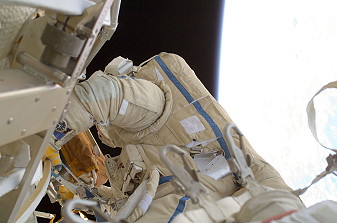
| EVA | Fincke, Michael | 23.12.2008, 00:5? UTC | 23.12.2008, 06:2? UTC | 5h 38m | ISS-18 | ISS - Pirs | Orlan-M Nr. 27 |
| EVA | Lontschakow, Juri | 23.12.2008, 00:5? UTC | 23.12.2008, 06:2? UTC | 5h 38m | ISS-18 | ISS - Pirs | Orlan-M Nr. 26 |
| EVA | Fincke, Michael | 10.03.2009, 16:2? UTC | 10.03.2009, 21:1? UTC | 4h 49m | ISS-18 | ISS - Pirs | Orlan-M Nr. 27 |
| EVA | Lontschakow, Juri | 10.03.2009, 16:2? UTC | 10.03.2009, 21:1? UTC | 4h 49m | ISS-18 | ISS - Pirs | Orlan-M Nr. 26 |
| Name | Beginn | Ende | Dauer | Mission | Schleuse | Anzug | |
| EVA | Swanson, Steven | 19.03.2009, 17:16 UTC | 19.03.2009, 23:23 UTC | 6h 07m | STS-119 | ISS - Quest | EMU Nr. 3017 |
| EVA | Arnold, Richard | 19.03.2009, 17:16 UTC | 19.03.2009, 23:23 UTC | 6h 07m | STS-119 | ISS - Quest | EMU Nr. 3006 |
| EVA | Swanson, Steven | 21.03.2009, 16:51 UTC | 21.03.2009, 23:21 UTC | 6h 30m | STS-119 | ISS - Quest | EMU Nr. 3017 |
| EVA | Acaba, Joseph | 21.03.2009, 16:51 UTC | 21.03.2009, 23:21 UTC | 6h 30m | STS-119 | ISS - Quest | EMU Nr. 3005 |
| EVA | Arnold, Richard | 23.03.2009, 15:37 UTC | 23.03.2009, 22:04 UTC | 6h 27m | STS-119 | ISS - Quest | EMU Nr. 3006 |
| EVA | Acaba, Joseph | 23.03.2009, 15:37 UTC | 23.03.2009, 22:04 UTC | 6h 27m | STS-119 | ISS - Quest | EMU Nr. 3005 |
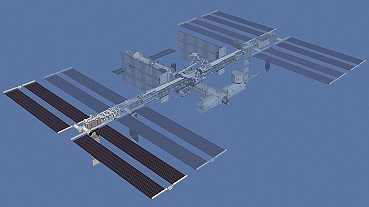
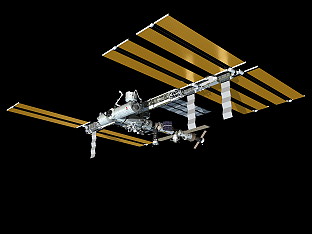
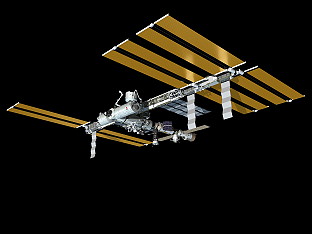
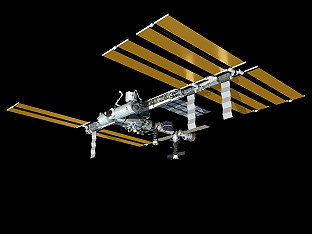
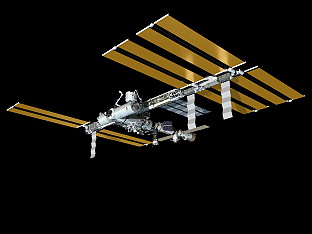
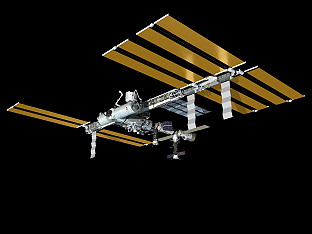
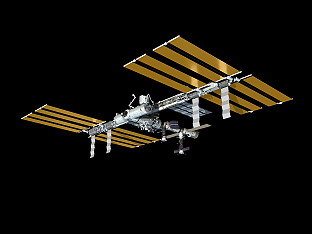
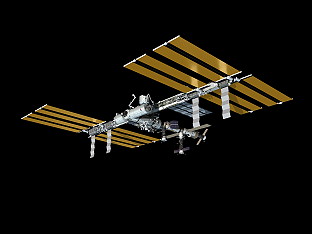
Aufbau der ISS
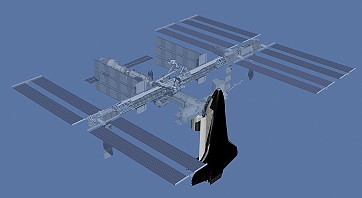 |
 |
 |
 |
 |
 |
 |
 |
 |
Fotos / Grafiken
 |
 |
 |
 |
 |
 |
 |
 |
 |
 |
 |
 |
mehr EVA-Fotos |
|
mehr Fotos von Bord der ISS |
|
| © |  |
Letztes Update am 10. November 2023.  |
 |