Human Orbital Spaceflights

International Flight No. 182STS-72Endeavour (10)74th Space Shuttle missionUSA |
 |
 |
 |
 |
|
 |
||
Launch, orbit and landing data
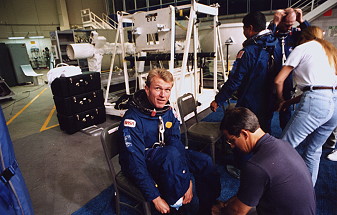
walkout photo |
 |
||||||||||||||||||||||||||||
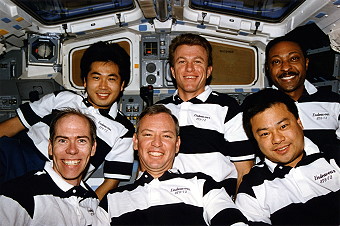
alternative crew photo |
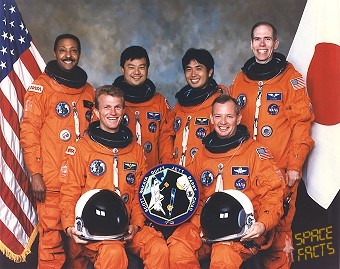
Crew
| No. | Surname | Given names | Position | Flight No. | Duration | Orbits | |
| 1 |  |
Duffy | Brian | CDR | 3 | 8d 22h 00m 40s | 142 |
| 2 | |
Jett | Brent Ward, Jr. | PLT | 1 | 8d 22h 00m 40s | 142 |
| 3 | |
Chiao | Leroy | MS-1, EV-1 | 2 | 8d 22h 00m 40s | 142 |
| 4 | |
Scott | Winston Elliott | MS-2, EV-3, FE | 1 | 8d 22h 00m 40s | 142 |
| 5 |  |
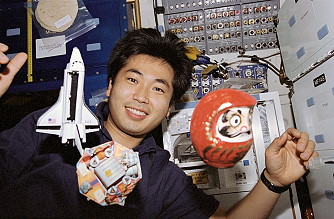
Wakata | Koichi | MS-3, RMS | 1 | 8d 22h 00m 40s | 142 |
| 6 | |
Barry | Daniel Thomas | MS-4, EV-2 | 1 | 8d 22h 00m 40s | 142 |
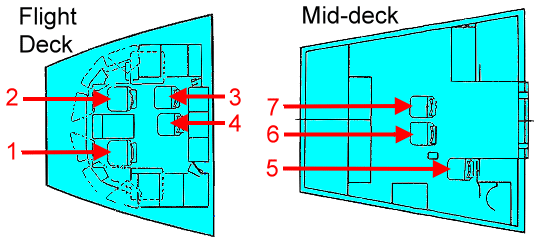
Crew seating arrangement
|
 |
|
||||||||||||||||||||||||||||
Hardware
| Orbiter : | OV-105 (10.) |
| SSME (1 / 2 / 3): | 2028 (11.) / 2039 (1.) / 2036 (2.) |
| SRB: | BI-077 / RSRM 52 |
| ET: | ET-75 (LWT-68) |
| OMS Pod: | Left Pod 04 (17.) / Right Pod 05 (8.) |
| FWD RCS Pod: | FRC 5 (10.) |
| RMS: | 303 (11.) |
| EMU: | EMU No. 2042 (PLSS No. 1009) / EMU No. 2041 (PLSS No. 1010) / EMU No. 2043 (PLSS No. 1006) |
Flight
|
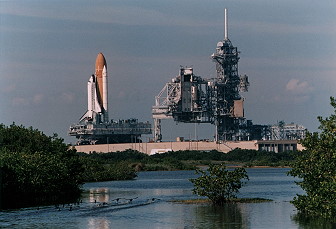
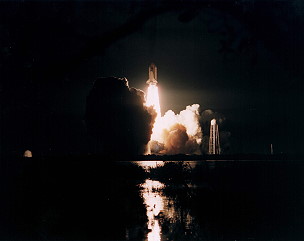
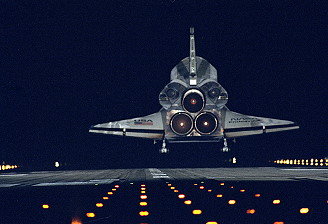
Launch from Cape Canaveral (KSC) and
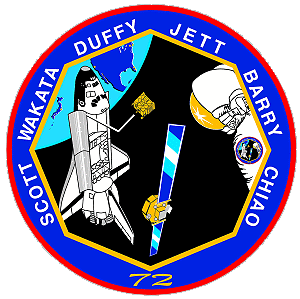
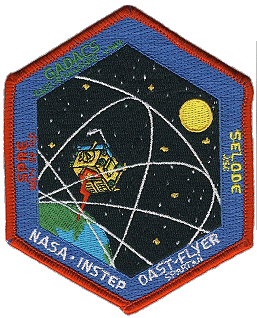
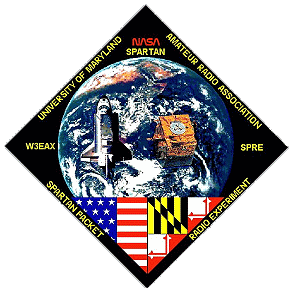
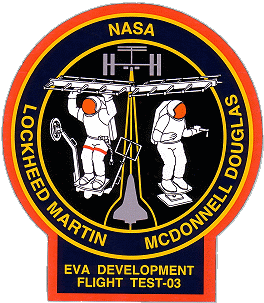
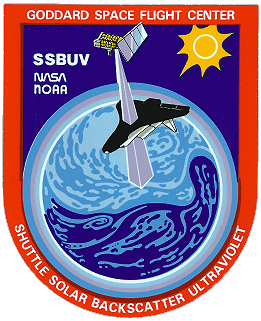
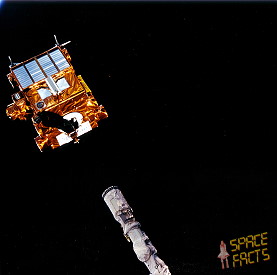
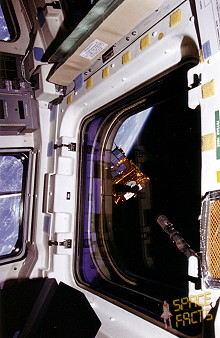
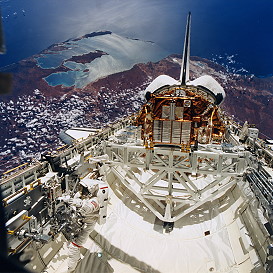
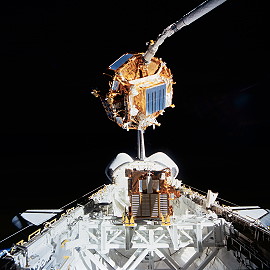
landing on Cape Canaveral (KSC), Runway 15. The primary objective of the STS-72 mission was to capture and return to Earth a Japanese microgravity research spacecraft known as Space Flyer Unit (SFU). The 7,885 lb (3,577 kg) SFU spacecraft was launched by Japan's National Space Development Agency (NASDA) from Tanegashima Space Center in Japan at 08:01 UTC on March 18, 1995 aboard a Japanese H-II rocket (HII-3). The deployment of the SPARTAN 206 satellite for two days was a main objective, too. Several secondary payloads were flown in the payload bay and the mid-deck. The Space Flyer Unit from Japan was captured and brought to Earth. The 3,577 kilograms (7,890 lb) SFU was launched by Japan's National Space Development Agency (NASDA) from Tanegashima Space Center in Japan on March 18, 1995 aboard a Japanese H-II rocket (HII-3), and spent ten months in orbit conducting automated research in materials science, biology, engineering, and astronomy. Mission Specialist Koichi Wakata operated the orbiter's remote manipulator system arm on flight day three to pluck SFU from orbit. Both of the satellite's solar arrays had to be jettisoned prior to retrieval when sensors indicated improper latching following their retraction. This jettison procedure had been incorporated in preflight training as a contingency in the event of such an occurrence. The canisters housing the arrays were jettisoned 12 minutes apart as Endeavour and the SFU traveled across Africa on the thirtieth orbit of the mission. The contingency procedure delayed the capture of the satellite by about an hour and half. Once in Endeavour's payload bay, the satellite's internal batteries were bypassed following connection of a remotely operated electrical cable to the side of the satellite. Endeavour's rendezvous and retrieval of the Space Flyer Unit satellite began with the Shuttle's precisely timed launch, putting the orbiter on a course that continually closed in on the Japanese satellite during the following 48 hours. Almost immediately after reaching orbit, Mission Specialist Koichi Wakata performed a checkout of Endeavour's mechanical arm to ensure it is ready for the capture of the SFU. During the next two days, periodic engine firings by Endeavour adjusted the rate at which the Shuttle was closing in on the SFU, aiming to reach a point about eight nautical miles (14.8 km) behind the satellite on Flight Day 3, the starting point for the final phase of rendezvous. About three hours before the planned capture of SFU, Commander Brian Duffy fired Endeavour's engines, performing a Terminal Initiation (TI) burn that brought Endeavour the final distance to the SFU during the next orbit of Earth. As Endeavour traversed the final eight nautical miles (14.8 km) to the satellite, the Shuttle enabled its rendezvous radar system to lock onto the spacecraft. The radar provided Endeavour with constant updates of the range to SFU and the rate at which the Shuttle was closing in on the satellite. Also, just after the TI burn was completed, Koichi Wakata again powered up the mechanical arm and extended it above Endeavour's payload bay in a position ready for the capture. Endeavour had the opportunity to perform four, small Mid-Course Correction (MCC) engine firings as it approached the SFU, although some or all of the firings may not were necessary depending on the accuracy of the Shuttle's navigation. The Shuttle performed what flight controllers refer to as an R- Bar approach to the SFU, approaching from underneath the satellite. When Endeavour reached a point almost a half mile (900 meters) directly below the spacecraft, about one and a half hours before the planned capture, Brian Duffy took over manual control of the Shuttle to fly the final distance to the satellite. Brian Duffy stopped Endeavour's approach toward the SFU using jets that fired in the direction of the satellite until reaching a point about 600 feet (182.9 meters) below the spacecraft. At that point, Brian Duffy switched the Shuttle's steering jet system to a mode called Low Z, a mode that uses offset jets on the nose and tail to brake Endeavour's approach rather than those pointing directly at the SFU. The Low-Z mode guarded against inadvertently contaminating the SFU with exhaust from the Shuttle jets. During the manual approach, information on the distance to SFU and closing rate of Endeavour provided by the rendezvous radar, were supplemented by a handheld ranging device operated by Mission Specialist Leroy Chiao. In addition, graphics and data from the payload bay laser were provided to Brian Duffy on a laptop computer display, called the Rendezvous and Proximity Operations Program (RPOP), to aid with the approach. Brian Duffy continued to slow Endeavour and align the Shuttle and SFU until reaching a point about 150 feet (45.7 meters) below the satellite, where he stationkeept. As Brian Duffy approach the stationkeeping point, Japanese flight controllers for the SFU sent commands to retract the solar arrays in preparation for the retrieval, but this failed. Mission Specialist Koichi Wakata operated the orbiter's remote manipulator system arm on flight day three to pluck SFU from orbit. Both of the satellite's solar arrays had to be jettisoned prior to retrieval when sensors indicated improper latching following their retraction. Then, as Endeavour remained stationary, the SFU was commanded to the proper orientation for retrieval. The satellite's reaction control system thrusters were turned off as the Shuttle begins its final approach. Brian Duffy continued the approach to SFU after about 45 minutes of stationkeeping, when the SFU commanding and safing was successfully completed. As Endeavour approached the final feet toward SFU, Brian Duffy performed a small yaw maneuver to align with the satellite. Using views from a camera mounted at the end of the mechanical arm, Brian Duffy and Koichi Wakata refined Endeavour's orientation with the grapple fixture mounted on the SFU. Koichi Wakata then moved the mechanical arm to grab the fixture and lock onto the satellite. Once captured, Koichi Wakata used the arm to lower the SFU into Endeavour's middle rear cargo bay, eventually locking it in place by closing four payload retention latches. The crew also deployed and retrieved the OAST-Flyer 50 hours later. OAST-Flyer was the seventh in a series of missions aboard the reusable free-flying SPARTAN carrier spacecraft series. It consisted of four experiments: Return Flux Experiment (REFLEX) to test accuracy of computer models predicting spacecraft exposure to contamination; Global Positioning System Attitude Determination and Control Experiment (GADACS) to demonstrate GPS technology in space; Solar Exposure to Laser Ordnance Device (SELODE) to test laser ordnance devices; SPARTAN Packet Radio Experiment (SPRE) and the Amateur Radio Association at the University of Maryland (W3EAX) amateur radio communications experiment. SPARTAN. The SPARTAN spacecraft was a small, rectangular, free- flying vehicle, measuring roughly 3.2 feet (1 meter) x 4.1 feet (1.25 meter) x 4.9 feet (1.5 meters). It was released from the Shuttle and picked up after several days of conducting its experiments. With the reusable carrier's flexibility, an unprecedented five SPARTAN missions were manifested to launch in a 22-month period beginning in September 1994 and ending in June 1996. REFLEX was a technology experiment designed to determine if the computer-generated models, which help determine how much contamination a spacecraft might get, are accurate. The main objective of REFLEX was to investigate molecular backscattering or "return flux", associated with on-orbit spacecraft. This phenomenon occurs when spacecraft give off the tiny particles of dirt into the atmosphere which then collide with other particles and bounce back to the spacecraft. Return flux was believed to be one of the factors that scientists have been unable to calculate into their computer-generated models. REFLEX also studied the erosion of spacecraft surface coatings as a result of particles chemically reacting with the atmosphere. The primary objective of the GADACS experiment was to demonstrate the use of the Global Positioning System (GPS) technology in space. During the flight, this experiment used GPS to determine the attitude of the SPARTAN, the location and velocity of the spacecraft, and provided accurate timing for one portion of the SPARTAN mission. GADACS used the GPS data to calculate the SPARTAN orientation and fire thrusters to point the spacecraft in different directions. This was the first time a spacecraft was controlled using GPS. SELODE was developed to test the safety and reliability of five different types of laser ordnance devices. The primary investigation centers on the effects of direct and concentrated sunlight in the space environment on different explosives and design methods. Flight testing evaluated accidental firing levels, and post-flight testing will examine the effects of exposure on the chemical stability of the explosives. The primary mission of SPRE was to relay ground station positions and transmit telemetry containing the GPS location of the spacecraft and housekeeping data. This type of technology has many applications in both the amateur radio and commercial world. The Office of Aeronautics and Space Technology-Flyer (OAST-Flyer) satellite was deployed by Endeavour on the fourth day of the mission and spent about 50 hours flying free from the Shuttle before it was retrieved on Flight Day 6. Following a thorough in-bay checkout of the experiments aboard the OAST-Flyer, three latches holding the satellite in Endeavour's cargo bay, two on either side and one underneath, were released. While Brent Jett temporarily turned off Endeavour's steering jets to avoid any disturbances, Koichi Wakata lifted the OAST-Flyer from the bay using the mechanical arm. With the robot arm extended high above the bay, Koichi Wakata released the satellite. Following release, the SPARTAN platform performed a small maneuver to confirm its health before Brent Jett backed Endeavour away. Endeavour performed a rendezvous and approach to the OAST-Flyer on Flight Day 6 similar to the one for the SFU retrieval. At the conclusion of its science operations, SPARTAN was automatically maneuvered into the proper orientation for retrieval and await the Shuttle's arrival. The final phase of the OAST-Flyer rendezvous began from a point about eight nautical miles (14.8 km) behind the satellite, when Endeavour's engines were fired in the Terminal Initiation (TI) burn about two hours before the planned capture. The TI burn put Endeavour on a course to intercept the OAST-Flyer over about one orbit of Earth, performing an R-Bar approach from underneath the satellite. Endeavour's rendezvous radar system and a handheld laser were used during the approach to provide information on the distance and closing rate between the Shuttle and the satellite. Brian Duffy took over manual control of the approach when Endeavour reached a point almost one-half mile (900 meters) directly below the OAST-Flyer, about 45 minutes before the planned capture. Brian Duffy fired Endeavour's thrusters facing toward the OAST-Flyer to brake the Shuttle's approach until reaching a distance of about 200 feet (61 meters) from the satellite. At that point, Brian Duffy switched the thrusters to a Low-Z mode, firing thrusters offset to the OAST-Flyer to slow Endeavour and avoid contaminating the satellite with exhaust from the Shuttle steering jets. As Endeavour moved to within 35 feet (10.7 meters) of the OAST-Flyer, Koichi Wakata aligned the arm with the grapple fixture on the SPARTAN platform, lock onto the satellite, reberthed it in the cargo bay and latched it in place for its return to Earth. Two EVAs were performed by Leroy Chiao and Daniel Barry on January 15, 1996 (6h 09m) and by Leroy Chiao and Winston Scott on January 17, 1996 (6h 54m) to test tools and hardware that will be used in the assembly of the ISS. During the first EVA Leroy Chiao and Daniel Barry attached a Portable Work Platform (PWP) to the end of the robot arm, operated by Pilot Brent Jett and Mission Specialist Koichi Wakata. Brent Jett used the arm to grapple various pieces of hardware designed to hold large modular components, mimicking the way equipment boxes and avionics gear will be moved back and forth in assembling the Space Station. Leroy Chiao and Daniel Barry unfolded a cable tray diagonally across the forward portion of the cargo bay housing simulated electrical and fluid lines similar to those which would later connect modules and nodes of the Space Station. The rigid umbilical, as it is known, was tested for its ease of handling and the ability of the astronauts to hook up the lines to connectors on the side of Endeavour's bay. The Rigid Umbilical (RU), which weighed almost 250 pounds, also was used for evaluations of the handling of large masses while spacewalking. While Leroy Chiao unraveled various lengths of cable from a caddy device, Daniel Barry spent time practicing the hookup of the various cables in the rigid umbilical to connectors in the bay, testing his ability to manipulate tiny bolts and screws in weightlessness. He reported that most tasks could be accomplished with little difficulty. Leroy Chiao and Daniel Barry then traded places, as Daniel Barry mounted the portable work platform to evaluate its worth. While the second spacewalk Leroy Chiao and Winston Scott worked with utility boxes, slidewires and a portable work stanchion affixed to Endeavour's robot arm to gather additional data on methods and procedures which would be incorporated in the techniques used to assemble the International Space Station. The spacewalk consisted mainly of evaluations of a space station Utility Box, a box designed to hold avionics and fluid line connections on the station; an on-orbit installed slidewire, a type of wire to which EVA tethers can be connected that is planned to be installed on the exterior of the space station in orbit; measurements of forces induced by various spacewalking work such as replacing station components and manipulating massive objects. Later in the spacewalk, Winston Scott climbed into foot restraints on the OAST-Flyer satellite platform for a thermal evaluation exercise. Endeavour was maneuvered to the coldest position possible, with its payload bay facing out toward deep space and allowing temperatures to dip to about 104 degrees below zero at the point where Winston Scott was positioned to test the ability of his spacesuit to repel the bitter cold temperature of space, In addition, an Electronic Cuff Checklist (ECC), a wrist-mounted portable computer planned to supplement written checklists for spacewalks, was evaluated. Other experiments onboard STS-72 included the Shuttle Solar Backscatter Ultraviolet Experiment (SSBUV-8) (previously flown on STS-34, STS-41, STS-43, STS-45, STS-56, STS-62 and STS-66), Shuttle Laser Altimeter Payload (SLA-01/GAS(5)), VDA-2, National Institutes of Health NIH-R3 Experiment, Space Tissue Loss Experiment (STL/NIH-C), Pool Boiling Experiment (PBE) (hardware previously flown on STS-47, STS-57 and STS-60) and the Thermal Energy Storage (TES-2) experiment (previously flown on STS-69). Get Away Special payloads included the United States Air Force Academy G-342 Flexible Beam Experiment (FLEXBEAM-2), Society of Japanese Aerospace Companies' G-459 – Protein Crystal Growth Experiment and the Jet Propulsion Laboratory GAS Ballast Can with Sample Return Experiment. The SSBUV instrument was designed to measure ozone concentrations by comparing solar ultraviolet radiation with radiation scattered back from the Earth's atmosphere. SSBUV results were compared with the observations of several ozone measuring instruments, both past and present, aboard NASA's Nimbus-7 and the National Oceanic and Atmospheric Administration's (NOAA) NOAA-9, NOAA-11 and NOAA-14 satellites, the Russian Meteor-3/TOMS satellite, NASA's Upper Atmosphere Research Satellite (UARS), and the European Space Agency's ERS- 2 satellite, which was launched in April 1995. The SSBUV data are used to calibrate the instruments to ensure the most accurate readings possible for the detection of atmospheric ozone trends. The SLA-01 flight had two primary objectives: [1] acquire samples of land topography and vegetation data; and [2] provide an in-space engineering testbed for future space flight laser sensors. The SLA-01 distance measurements were combined with Space Shuttle orbit and pointing angle analysis electronics, and power conditioning modules for SLA-01. Both payload canisters were filled with inert nitrogen gas and remained pressurized throughout the flight. For NIH-R3, rats experienced weightlessness at three ages, postnatal days 5 to 14, 8 to 17 and 15 to 24. This allowed evaluation of three overlapping periods of development; two groups of rats experienced their "sensitive" period and the eldest group experienced the final period of vestibular system development in the near weightlessness of microgravity. STS-72 introduced an enhanced version of the Protein Crystal Growth Vapor Diffusion Apparatus. The original apparatus has been used for over 20 Shuttle experiments and has been successful in producing highly ordered crystals of selected proteins for analysis on Earth. The second-generation apparatus was designed to improve the mixing of experiment solutions, especially certain solutions which are too viscous to be adequately mixed in the original hardware. Better mixing was expected to result in the formation of larger, higher quality protein crystals. |
EVA data
| Name | Start | End | Duration | Mission | Airlock | Suit | Stripes | |
| EVA | Chiao, Leroy | 15.01.1996, 05:34 UTC | 15.01.1996, 11:43 UTC | 6h 09m | STS-72 | Endeavour | EMU No. 2041 | red |
| EVA | Barry, Daniel | 15.01.1996, 05:34 UTC | 15.01.1996, 11:43 UTC | 6h 09m | STS-72 | Endeavour | EMU No. 2042 | without |
| EVA | Chiao, Leroy | 17.01.1996, 05:40 UTC | 17.01.1996, 12:33 UTC | 6h 54m | STS-72 | Endeavour | EMU No. 2041 | red |
| EVA | Scott, Winston | 17.01.1996, 05:40 UTC | 17.01.1996, 12:33 UTC | 6h 54m | STS-72 | Endeavour | EMU No. 2043 | red-white linear |
Photos / Graphics
 |
 |
|
source of all photos is NASA |
|
 |
 |
 |
 |
 |
 |
 |
 |
 |
 |
 |
|
more EVA photos |
|
| © |  |
Last update on March 27, 2020.  |
 |