Human Orbital Spaceflights

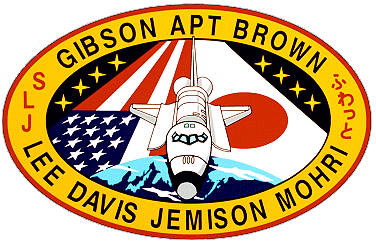
International Flight No. 151STS-47Endeavour (2)50th Space Shuttle missionUSA |
 |
 |
 |
||
Launch, orbit and landing data
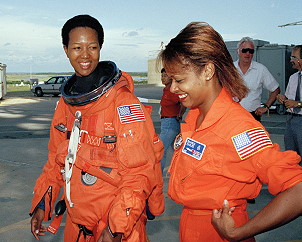
walkout photo |
 |
||||||||||||||||||||||||||||
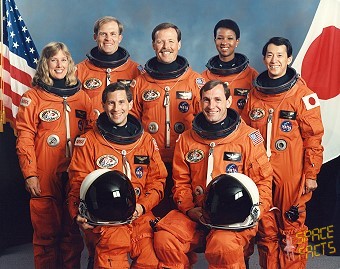
alternative crew photo |
Crew
| No. | Surname | Given names | Position | Flight No. | Duration | Orbits | |
| 1 |  |
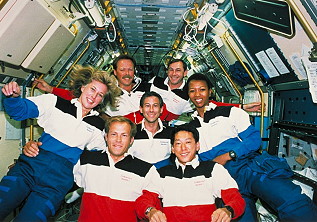
Gibson | Robert Lee "Hoot" | CDR | 4 | 7d 22h 30m 22s | 126 |
| 2 | |
Brown | Curtis Lee, Jr. "Curt" | PLT | 1 | 7d 22h 30m 22s | 126 |
| 3 | |
Lee | Mark Charles | MS-1, PLC | 2 | 7d 22h 30m 22s | 126 |
| 4 | |
Apt | Jerome "Jay" | MS-2, EV-1, FE | 2 | 7d 22h 30m 22s | 126 |
| 5 | |
Davis | Nancy Jan | MS-3, EV-2 | 1 | 7d 22h 30m 22s | 126 |
| 6 | |
Jemison | Mae Carol | MS-4 (Science MS) | 1 | 7d 22h 30m 22s | 126 |
| 7 |  |
Mohri | Mamoru | PS-1 | 1 | 7d 22h 30m 22s | 126 |
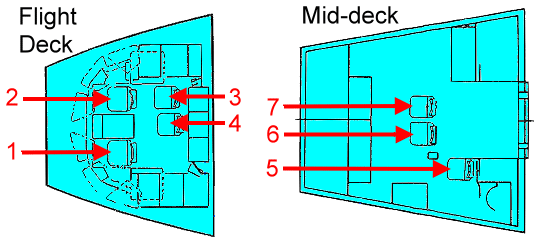
Crew seating arrangement
|
 |
|
||||||||||||||||||||||||||||||||
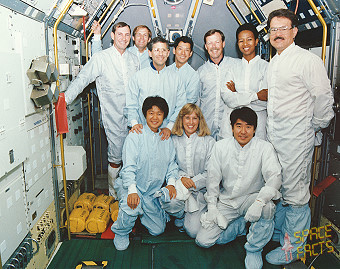
Backup Crew
|
 |
||||||||||||||||||||
Hardware
| Orbiter : | OV-105 (2.) |
| SSME (1 / 2 / 3): | 2026 (3.) / 2022 (8.) / 2029 (6.) |
| SRB: | BI-053 / RSRM 26W |
| ET: | ET-45 (LWT-38) |
| OMS Pod: | Left Pod 03 (13.) / Right Pod 04 (9.) |
| FWD RCS Pod: | FRC 5 (2.) |
| RMS: | 303 (4.) |
| EMU: | EMU No. 2022 (PLSS No. 1009) / EMU No. 2016 (PLSS No. 1015) |
Flight
|
Launch from Cape Canaveral (KSC) and
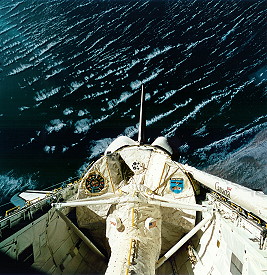
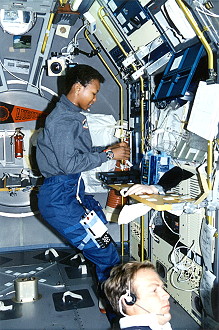
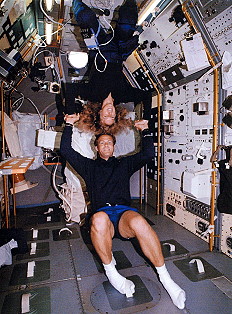
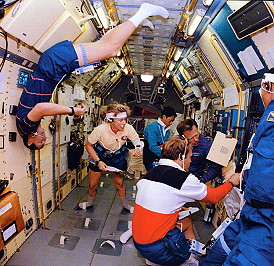
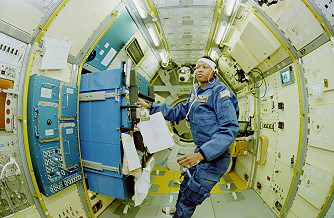
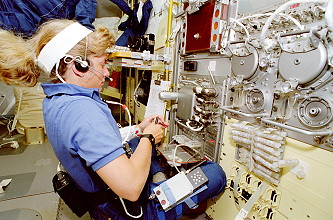
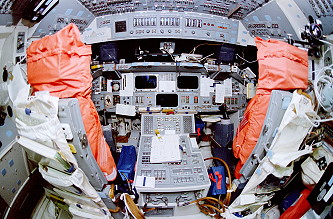
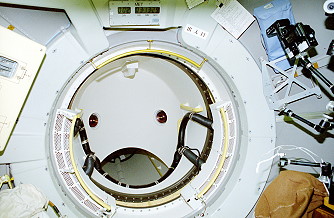
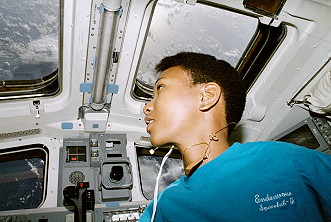
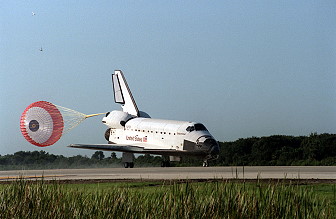
landing on Cape Canaveral (KSC), Runway 33. Spacelab-J - a joint NASA and National Space Development Agency of Japan (NASDA) mission using a manned Spacelab module - conducted microgravity investigations in materials and life sciences. The international crew, consisting of the first Japanese astronaut (Mamoru Mohri) to fly aboard the Shuttle, the first African-American woman (Mae Jemison) to fly in space and, contrary to normal NASA policy, the first married couple to fly on the same space mission (Mark Lee and Jan Davis), was divided into red (Curtis Brown, Mark Lee and Mamoru Mohri) and blue (Jerome Apt, Jan Davis and Mae Jemison) teams for around the clock operations. Spacelab-J included 24 materials science and 20 life sciences experiments, of which 35 were sponsored by NASDA, 7 by NASA and 2 collaborative efforts. Spacelab was a 23-foot (7.0 meters) long pressurized laboratory build by the European Space Agency specifically for conducting experiments in a shirt-sleeve environment aboard the Space Shuttle. For Spacelab-J, the long module was used. It contained a series of equipment racks that hold furnaces, computer and biological workstations, biological incubators, storage lockers and other equipment to perform experiments in space. Additional storage space and experiments was located in the orbiter crew cabin's mid-deck area. Materials science investigations covered such fields as biotechnology, electronic materials, fluid dynamics and transport phenomena, glasses and ceramics, metals and alloys, and acceleration measurements. Protein Crystal Growth: This research field seeks to develop higher quality protein crystals than those developed on Earth and understand their internal crystalline order. Protein crystals on the Spacelab-J mission were grown in two scientific instruments, each relying on a different technique to promote crystallization: vapor diffusion and liquid/liquid diffusion. Proteins are complex amino-acid compounds present in all life forms. They perform numerous, critical roles in biochemical processes. If scientists can determine how proteins work, new and improved medicines may be developed. The functions of most organic molecules are determined by their three-dimensional structure. If scientists can determine the structure of a protein, this knowledge may allow the development of new and improved medicine and synthetic products. In the electronic materials experiments, five kinds of semiconductor crystals were grown using four specialized furnaces - the gradient heating furnace, the image furnace, the crystal growth furnace and the continuous heating furnace. Semiconductors were melted and solidified slowly to obtain high quality crystal. The resulting crystals were returned to Earth for in-depth study and may lead to a better understanding of manufacturing similar crystals on Earth. This eventually may lead to improved semiconductors and superconductors, and more efficient electronic components. Fluid dynamics and transport phenomena experiments were studied the underlying physics at work when fluids were subjected to different conditions under microgravity conditions. Liquid drops were levitated and manipulated using sound waves in the Drop Dynamics in Space and Interference with Acoustic Field experiment. Two other experiments - the Study of Bubble Behavior and Marangoni-Induced Convection in Materials Processing Under Microgravity - were studied Marangoni convection, fluid movement caused by surface tension variations between regions of different temperatures. On Earth, liquids are affected by buoyancy-driven convection. When a fluid is heated, lighter fluids rise and heavier fluids fall. In microgravity, this is much weaker, allowing Marangoni or surface tension driven convection to be studied. Marangoni convection is one of many phenomena that must be better understood for materials processing techniques to become more effective. New types of glasses and ceramics also may be developed through containerless processing methods. The Preparation of Optical Materials Used in Non-Visible Region experiment was created a non-silicone-based glass like that used in infrared-detecting devices such as telescope lenses. This was accomplished in an acoustic levitation furnace. This furnace used sound waves to suspend, combine and melt ingredients in microgravity. It formed a glass after cooling. Containerless processing eliminates the possibility of introducing impurities, perhaps leading to glasses that will transmit more light. The image furnace also was used for two glass and ceramics experiments. The High Temperature Behavior of Glass experiment collected data on the physical processes behind glass melting. The Growth of Samarskite Crystal in Microgravity produced a rare mineral compound to better understand its properties and possible usefulness. A series of ten metals and alloys experiments studied the ways that ingredients may be combined to form new, improved materials. The large isothermal furnace heated elements to a liquid state under various levels of pressure and cool them from the molten state to a useable solid. On Earth, these processes are affected by gravity's pull. In space, substances can be mixed with much more control as they float in a weightless condition. The result is a more uniformly combined material with fewer impurities. The understanding of such processing may lead to lighter, more stress-resistant metals, as well as more uniform semiconductors and superconductors. Such materials may have a broad range of uses - from cars to computers to construction. The Casting of Superconducting Filamentary Composite Materials and the Preparation of Nickel-Base Dispersion Strengthened Alloys experiments contributed to this field of study. The Space Acceleration Measurement System was used for the fourth time in Spacelab to collect data about acceleration forces experienced during the mission. This system of three sensor heads was located in the Spacelab-J module. Such information will assist planners in developing scientific equipment and in placing sensitive experiments where they are least likely to be disturbed. Life sciences included experiments on human health, cell separation and biology, developmental biology, animal and human physiology and behavior, space radiation, and biological rhythms. Test subjects included the crew, Japanese koi fish (carp) and their vestibular system, cultured animal and plant cells, chicken embryos, fruit flies, fungi and plant seeds, and frogs and frog eggs. Two biological experiments separated biological sample mixtures, composed of several types of cells or proteins, into individual purified fractions consisting of a particular protein or cell-type using electrical fields. Three cell culturing experiments grow plant and animal cells to test the influence of gravity on development and function at the cellular level. One such test was the production of antibodies in space. Other experiments in the life sciences studied how gravity affects the development of animals. An experiment entitled Effects of Weightlessness on the Development of Amphibian Eggs Fertilized in Space studied the role of gravity in fertilization and development. Female frogs were carried aboard Spacelab-J. Their eggs were fertilized during the flight and developed in a microgravity environment. Some eggs were fixed at a certain point in their development, while others were allowed to develop into tadpoles and adult frogs. Another experiment to study the role of gravity on the early development of animals was The Effect of Low Gravity on Calcium Metabolism and Bone Formation. This study examined how microgravity affects calcium metabolism and bone formation in chick embryos. Several experiments examined the physiology of living organisms on this mission. These experiments revealed more about how organisms function in the space environment. Several experiments focused on the physiology of the vestibular-ocular system. One experiment, The Comparative Measurement of Visual Stability in Earth and Cosmic Space, studied the effects of microgravity on visual stability. This experiment examined head and eye movements while the crew member visually tracked a flickering light target. Another experiment designed to study the vestibular-ocular system was The Neurophysiological Study on Visuo-vestibular Control of Posture and Movement in Fish During Adaptation to Weightlessness. In this experiment, two Japanese koi fish (carp) were exposed to a varying light stimulus. One fish had its otolith structure removed. The otolith is a gravity-sensing structure in the inner ear. This fish's response was compared to the other fish to identify differences in how each reacts to the same stimulus. Three crew members participated in experiments on physical adaptation to space. While awake, each was wearing a special suit fitted with various sensors that monitor and record various physical responses. Urine collection will gauge the intake and output of fluids, which shift toward the upper body in microgravity. Space motion sickness is an element of general Space Adaptation Syndrome that affects many space travelers. A possible countermeasure for this was studied in an experiment entitled The Autogenic Feedback Training Experiment: A Preventative Method for Space Motion Sickness; Autogenic Feedback Training for Vestibular Symptomology. This two-part experiment was a continuation from an experiment that flew on the Spacelab-3 mission (STS-51B). On Spacelab-J two crew members were participants in this experiment. One crew member used biofeedback, a technique where one becomes aware of unconscious or involuntary bodily processes (such as heartbeat and skin temperature), in order to consciously control them. The goal is to train astronauts to overcome the effects of space motion sickness without using artificial means, such as drugs. The second participant, the control, had not been trained in biofeedback techniques. But that participant's responses to similar circumstances were recorded. Data collected from the sensor suits they will wear also may help predict the likelihood of space motion sickness in future candidates for space travel. In space, muscles do not have to work as hard as they do under gravity's influence. Bones do not receive the same stress that they do when under a gravitational field. As a result, crew members from previous missions have lost calcium from bones and protein from muscles during flight. These losses could become a serious problem if crews spend many months or years in a microgravity environment. Several experiments being flown aboard Spacelab-J were designed to study this problem. These experiments gathered information about the process and extent of bone and muscle loss after exposure to space. Two experiments specifically studied bone loss. Fertilized chicken eggs and rat bone cells were examined after the mission for cartilage growth and bone formation. To study how muscle mass is lost while in space, the Magnetic Resonance Imaging (MRI) After Exposure to Microgravity experiment employed MRI to examine muscle and bone in selected crew members before and after the mission. MRI used a magnetic field and radio waves to produce an image of the inside of the body, much better than conventional x-rays, but unlike conventional x-rays, it has no known health hazards. The MRI allowed investigators to examine calf and thigh muscles and to look for changes in spinal bone marrow and discs (vertebrae). An understanding of the radiation environment in space and the effects of radiation on life forms is critical before long-term space journeys are undertaken. To examine the biological effects of space radiation, fruit fly larvae were flown in special incubators exposed to the cosmic ray environment. When the flies hatch, they were examined for radiation-induced mutations. When intravenous (IV) fluids are administered to a patient on Earth, gravity aids in their delivery and flow. The absence of gravity presents a problem should such medical treatment be needed during a space mission. Therefore, the Fluid Therapy System was tested on Spacelab-J. The tests had examined the production of medicines and the administration of IV fluids in the absence of gravity. Twelve Get Away Special (GAS) canisters (10 with experiments, 2 with ballast) were carried in the payload bay. The Israeli Space Agency Investigation About Hornets (ISAIAH) experiment was carried on Endeavour's middeck to research the effect of weightlessness on combs built by oriental hornets. The oriental hornet has a unique ability to build combs in the direction of gravity. Terrestrial studies using centrifugal force to simulate different directions of gravity other than Earth's gravity have shown that such forces are the only factor that determines the direction a comb is built. ISAIAH was designed to obtain insight into this unique trait of the oriental hornet by testing the hornets' ability to orient their combs when in weightlessness. ISAIAH fitted into one middeck locker and consisted of two compartments. A front compartment contained electronics, a blower, two tape recorders and front panel controls for the experiment. A back compartment contained 18 test chambers of various shapes and a metronome. Each of the nine top side chambers had a lamp to simulate day and night, an audio sensor and a food and water container. Each of the bottom side chambers remained in constant darkness when the experiment is inside the locker. Two Lexan windows, one on the top and another on the bottom, allowed the crew to view and photograph the progress of the experiment. The ISAIAH experiments revealed that hornets were unable to built honeycombs in weightlessness. The Shuttle Amateur Radio Experiment (SAREX) was designed to demonstrate the feasibility of amateur short-wave radio contacts between the Space Shuttle crew and ground amateur radio operators, often called ham radio operators. SAREX also served as an educational opportunity for schools around the world to learn about space first hand by speaking directly to astronauts aboard the Shuttle via ham radio. Contacts with certain schools were included in planning the mission. STS-47 crew members Jerome Apt, call sign N5QWL, and Mamoru Mohri, call sign 7L2NJY, operated SAREX. Ham operators communicated with the Shuttle using VHF FM voice transmissions and digital packet. The Solid Surface Combustion Experiment (SSCE) was a study of how flames spread in microgravity. Comparing data on how flames spread in microgravity with knowledge of how flames spread on Earth may contribute to improvements in fire safety and control equipment. In the SSCE planned for STS-47/SL-J, scientists tested how flames spread along an instrumented filter paper sample in a test chamber containing 35% oxygen and 65% nitrogen at 1.5 atmospheric pressure. The Space Acceleration Measurement System (SAMS) was designed to measure and record low-level acceleration that the Spacelab experiences during typical on-orbit activities. The three SAMS sensor heads were mounted on or near experiments to measure the acceleration environment experienced by the research package. The signals from these sensors were amplified, filtered and converted to digital data before it was stored on optical disks. For the first SL-J mission, the main unit of the Space Acceleration Measurement System was mounted in the SMIDEX Rack of the Spacelab module, near the aft end of the module. Its three remote sensor heads were mounted on the First Material Processing Test Modular Electronic Levitator, Life Science and Rack #9. The Ultraviolet Plume Experiment (UVPI) was an instrument on the Low-Power Atmospheric Compensation Experiment (LACE) satellite launched by the Strategic Defense Initiative Organization in February 1990. LACE was in a 43-degree inclination orbit of 290 n.m. (537 km). Imagery of Columbia's engine firings or attitude control system firings were taken on a non-interference basis by the UVPI whenever an opportunity was available during the STS-47 mission. The Air Force Maui Optical Site (AMOS) tests allowed ground- based electro-optical sensors located on Mt. Haleakala, Maui, Hawaii, to collect imagery and signature data of the orbiter during cooperative overflights. The scientific observations made of the orbiter, while performing reaction control system thruster firings, water dumps or payload bay light activation, and were used to support the calibration of the AMOS sensors and the validation of spacecraft contamination models. The AMOS tests had no payload unique flight hardware and only required that the orbiter be in predefined attitude operations and lighting conditions. Among the GAS Canisters was G-102, sponsored by the Boy Scouts of America's Exploring Division in cooperation with the TRW Systems Integration Group, Fairfax, VA. The project was named Project POSTAR and was the first space experiment created entirely by members of the Boy Scouts of America. Also, on board were two experiments prepared by Ashford School in Kent, United Kingdom, which, at the time, was a girls-only school. The school had won a competition run by Independent Television News. The experiments were contained in G-520. The first one injected a few grams of cobalt nitrate crystals to a sodium silicate to create a chemical garden in weightless condition. The growths, which were photographed 66 times as they developed, spread out in random directions, twisted, and, in some cases, formed spirals. A second experiment to investigate how Liesegang rings formed in space failed to operate correctly due to friction in parts of the mechanism. On its return, the experiment was exhibited in the London Science Museum. The mission duration was extended for one day, to complete all planned experiments. |
Photos / Graphics
 |
 |
 |
 |
 |
 |
 |
 |
 |
 |
 |
 |
 |
 |
 |
 |
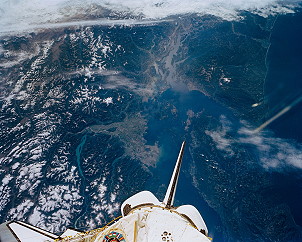
Earth observation photos |
|
| © |  |
Last update on September 09, 2020.  |
 |