Human Orbital Spaceflights

International Flight No. 146STS-45Atlantis (11)46th Space Shuttle missionUSA |
 |
 |
 |
||
Launch, orbit and landing data
walkout photo |
 |
||||||||||||||||||||||||||||
alternative crew photo |
Crew
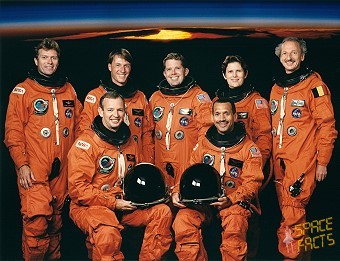
| No. | Surname | Given names | Position | Flight No. | Duration | Orbits | |
| 1 |  |
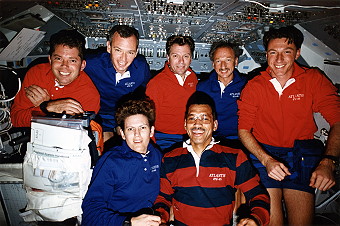
Bolden | Charles Frank, Jr. "Charlie" | CDR | 3 | 8d 22h 09m 25s | 143 |
| 2 | |
Duffy | Brian | PLT | 1 | 8d 22h 09m 25s | 143 |
| 3 | |
Sullivan | Kathryn Dwyer | MS-1, PLC, EV-1 | 3 | 8d 22h 09m 25s | 143 |
| 4 | |
Leestma | David Cornell | MS-2, IV-1, FE | 3 | 8d 22h 09m 25s | 143 |
| 5 | |
Foale | Colin Michael | MS-3, EV-2 | 1 | 8d 22h 09m 25s | 143 |
| 6 |  |
Frimout | Dirk Dries David Damiaan | PS-1 | 1 | 8d 22h 09m 25s | 143 |
| 7 | |
Lichtenberg | Byron Kurt | PS-2 | 2 | 8d 22h 09m 25s | 143 |
Crew seating arrangement
|
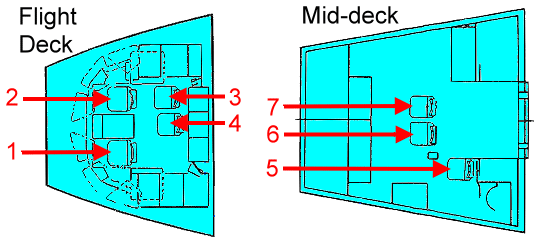 |
|
||||||||||||||||||||||||||||||||
Backup Crew
|
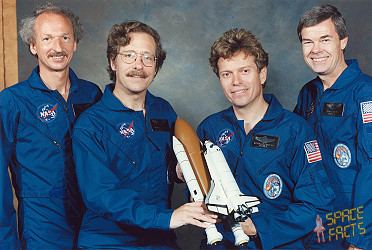 |
|||||||||||||||
Hardware
| Orbiter : | OV-104 (11.) |
| SSME (1 / 2 / 3): | 2024 (4.) / 2012 (13.) / 2028 (7.) |
| SRB: | BI-049 / RSRM 21W |
| ET: | ET-44 (LWT-37) |
| OMS Pod: | Left Pod 01 (17.) / Right Pod 01 (17.) |
| FWD RCS Pod: | FRC 4 (11.) |
| RMS: | - |
| EMU: | EMU No. 2022 (PLSS No. 1009) / EMU No. 2018 (PLSS No. 1014) |
Flight
|
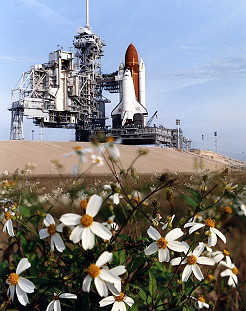
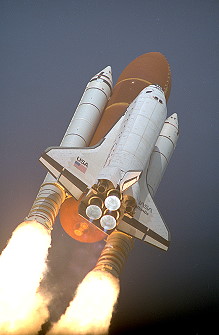
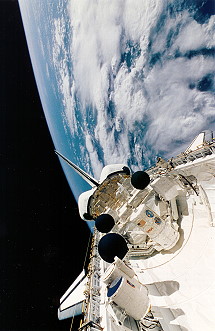
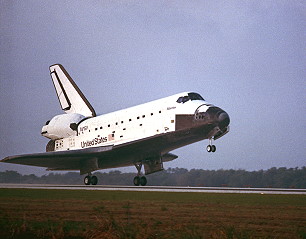
Launch from Cape Canaveral (KSC) and
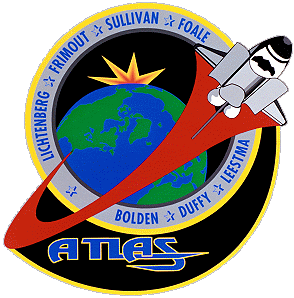
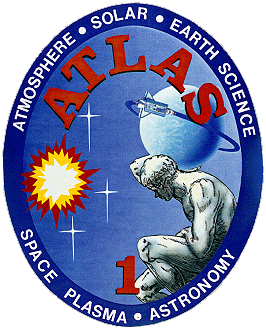
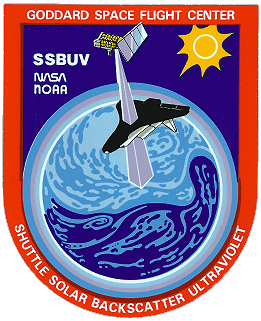
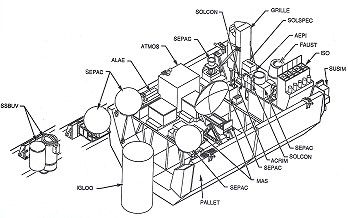
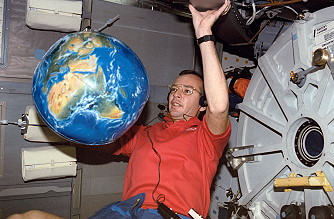
landing on Cape Canaveral (KSC), Runway 33. The launch was originally scheduled for March 23, 1992 but was delayed one day because of higher-than-allowable concentrations of liquid hydrogen and liquid oxygen in the orbiter's aft compartment during tanking operations. During troubleshooting, the leaks could not be reproduced, leading engineers to believe that they were the result of plumbing in the main propulsion system not thermally conditioned to the supercold propellants. Launch was rescheduled for March 24, 1992. Atlantis carried the first Atmospheric Laboratory for Applications and Science (ATLAS-01) on Spacelab pallets mounted in orbiter's cargo bay. The non-deployable payload, equipped with 12 instruments from the United States, France, Germany, Belgium, Switzerland, The Netherlands and Japan, conducted studies in atmospheric chemistry, solar radiation, space plasma physics and ultraviolet astronomy. ATLAS-01 instruments were: Atmospheric Trace Molecule Spectroscopy (ATMOS); Grille Spectrometer; Millimeter Wave Atmospheric Sounder (MAS); Imaging Spectrometric Observatory (ISO); Atmospheric Lyman-Alpha Emissions (ALAE); Atmospheric Emissions Photometric Imager (AEPI); Space Experiments with Particle Accelerators (SEPAC); Active Cavity Radiometer (ACR); Measurement of Solar Constant (SOLCON); Solar Spectrum (SOLSPEC); Solar Ultraviolet Spectral Irradiance Monitor (SUSIM); and Far Ultraviolet Space Telescope (FAUST). Other payloads included Shuttle Solar Backscatter Ultraviolet (SSBUV) experiment, one Get Away Special (GAS) experiment and six mid-deck experiments. Again, the international crew was divided into Red (David Leestma, Michael Foale and Byron Lichtenberg) and Blue (Charles Bolden, Brian Duffy, Kathryn Sullivan and Dirk Frimout) teams to conduct the work in two shifts. ATLAS-1 was the first of up to 10 ATLAS missions to be undertaken throughout one solar cycle, which lasted 11 years. During that period, a cycle of solar flares, sunspots and other magnetic activity moves from intense activity to relative calm. ATLAS missions were part of Phase I of NASA's Mission to Planet Earth, a large-scale, unified study of planet Earth as a single, dynamic system. Throughout the ATLAS series, scientists gathered new information to gain a better understanding of how the atmosphere reacts to natural and human- induced atmospheric changes. That knowledge helped identify measures that kept the planet suitable for life for future generations. ATLAS-1 performed 14 experiments using 12 instruments to investigate the interactions of the Earth's atmosphere and the sun. The experiments studied the chemistry, physics and movement of the middle and upper atmosphere by measuring the sun's energy and the distribution of trace chemicals in the atmosphere. By studying these factors throughout a solar cycle, scientists formed a more detailed picture of Earth's atmosphere and its response to changes in the sun. The ATLAS-1 instruments also observed the links between magnetic fields and electrified gases, called plasma, that lie between the sun and Earth. Also, an astronomical telescope examined sources of ultraviolet radiation in the Milky Way and other galaxies to learn more about the stages in the life of a star. The Space Shuttle Atlantis carried the ATLAS-1 Spacelab on an 8-day flight, during which its crew gathered information to be used by scientists on the ground. The European Space Agency provided the reusable Spacelab platform in 1981 as its contribution to the Space Shuttle program. The versatile Spacelab facility is comprised of pressurized modules that provide laboratory work space and open U-shaped platforms, called pallets, that hold instruments requiring direct exposure to space, such as telescopes. On missions such as ATLAS, which use open pallets alone, the instruments' power supply, command and data handling system and the temperature control system are housed in a pressurized container called an igloo. Spacelab elements were arranged in the Space Shuttle cargo bay to meet the unique needs of each flight. For the ATLAS-1 mission, the scientific instruments were mounted on two Spacelab pallets in the Shuttle cargo bay. All of the instruments flew on earlier Spacelab missions and others will fly on future ATLAS missions, reducing the cost of this space-based research. Reuse of these facilities also allowed scientists to expand their base of knowledge to provide a more accurate, long-term picture of planet Earth and its environment. From Atlantis' 160-nautical-mile (296 km) orbit, these instruments were exposed directly to space when the Shuttle bay doors were open. During the mission, the orbiter's position was changed frequently to point the scientific instruments toward their targets - the sun, the Earth and space. Without the atmosphere, life as humans know it could not survive. Proper atmospheric pressure, temperature and oxygen levels are critical to maintaining life. Energy is absorbed and cycled when radiation from the sun interacts with atmospheric chemicals Q mainly nitrogen and oxygen, with traces of carbon dioxide, water vapor and other gases. Additionally, energy is absorbed and cycled when charged particles (ions and electrons) interact with the magnetic field generated by the Earth's core. Earth's atmosphere comprises five layers: troposphere, stratosphere, mesosphere, thermosphere and exosphere. These are classified by temperature, pressure and chemical composition. Imbedded in the mesosphere and thermosphere is an electrically charged area called the ionosphere. Beyond the ionosphere is the magnetosphere, which separates Earth's magnetic field from interplanetary space. The solar wind Q a high-speed stream of charged particles from the sun Q gives the magnetosphere a comet-like shape with a tail extending for vast distances from the planet's night side. The instruments aboard ATLAS-1 collected information about the composition of Earth's atmosphere, investigated how Earth's electric and magnetic fields and atmosphere influence one another, examined sources of ultraviolet light in the universe and measured the energy contained in sunlight and how that energy varies during the mission. The ATLAS-1 investigations were divided into four broad areas - atmospheric science, solar science, space plasma physics and astronomy. Six atmospheric science investigations on ATLAS-1 studied the middle and upper atmosphere with a variety of instruments that helped correlate atmospheric composition, temperature and pressure with altitude, latitude, longitude and changes in solar radiation. The types of environmental phenomena to be examined included global distribution of atmospheric components and temperatures, as well as atmospheric reaction to external influences such as solar input and geomagnetic storms. The Imaging Spectrometric Observatory (ISO) measured spectral features to determine the composition of the atmosphere, down to trace amounts of chemicals measured in parts-per-trillion. This investigation, which previously flew on Spacelab 1 (STS-9), added to data about the varied reactions and energy transfer processes that occur in Earth's environment. The Atmospheric Trace Molecule Spectroscopy (ATMOS) and the Grille Spectrometer (Grille) experiments mapped trace molecules, including carbon dioxide and ozone, in the middle atmosphere. This mapping was accomplished at orbital sunrise and sunset by measuring the infrared radiation that these molecules absorb. An orbital "day" consisted of a sunrise and sunset occurring approximately every 90 minutes during flight. These data were compared with information gathered during other missions to note worldwide, seasonal and long-term atmospheric changes. Both instruments have flown previously, ATMOS on Spacelab 3 (STS-51B) in 1985 and Grille on Spacelab 1 (STS-9) in 1983. The Atmospheric Lyman-Alpha Emissions (ALAE) experiment measured the abundance of two forms of hydrogen - common hydrogen and deuterium or heavy hydrogen. ALAE observed ultraviolet light, called Lyman-Alpha, which hydrogen and deuterium radiate at slightly different wavelengths. Deuterium's relative abundance compared to hydrogen at the altitude's ALAE studied is an indication of atmospheric turbulence in the lower thermosphere. After determining the hydrogen/deuterium ratio, scientists can better study the rate of water evolution in Earth's atmosphere. ALAE flew on Spacelab 1 (STS-9). The Millimeter-Wave Atmospheric Sounder (MAS) measured the strength of millimeter-waves radiating at the specific frequencies of water vapor, chlorine monoxide and ozone. Observations of these gases enabled scientists to better understand their distribution through the upper atmosphere. MAS data was particularly valuable because they should be unaffected by the presence of aerosols, the concentrations of which have increased by the eruption of Mount Pinatubo in June 1991. An earlier version of MAS flew on Spacelab 1 (STS-9). The Shuttle Solar Backscatter Ultraviolet (SSBUV), which measured atmospheric ozone levels, was a calibrating experiment co-manifested with ATLAS-1. Its measurements were compared to those from ozone observing instruments aboard the National Oceanic and Atmospheric Administrations NOAA-9 and NOAA-11 satellites and NASA's NIMBUS-7 satellite to ensure the most accurate readings possible of atmospheric ozone trends. The SSBUV assesses instrument performance by directly comparing data from identical instruments aboard the NOAA spacecraft and NIMBUS-7 as the Shuttle and satellite pass over the same Earth location. SSBUV data also could compare to data obtained by the Upper Atmosphere Research Satellite launched in September 1991 to study the processes that lead to ozone depletion. The solar data taken by SSBUV also were compared with data from the four solar instruments. SSBUV was physically separate from the ATLAS-1 payload, housed in two Get Away Special canisters mounted in the Shuttle's payload bay. The instrument canister holds the SSBUV, its aspect sensors and inflight calibration system. The support canister contained the avionics, including power, data and command systems. Four solar science investigations measured the sun's energy output to determine its variations and spectrum. Such information is important for understanding the effect of solar radiation on the composition of the Earth's atmosphere and ionosphere. Scientists studying Earth's climate and the physical processes of the sun also use the information. Because the sun is Earth's major source of heat, it drives atmospheric circulation and affects the weather. A change of only a few degrees in the temperature of Earth's atmosphere might cause dramatic changes in the ocean levels, ice caps and climate. There is evidence that the solar constant, the amount of heat normally received at the outer layer of Earth's atmosphere, fluctuates. Therefore, it is important to determine its range and variability. The Active Cavity Radiometer (ACR) and the Measurement of Solar Constant (SOLCON) experiments measured the total amount of light and energy emitted by the sun, which is especially important in climate studies. The Solar Spectrum Measurement (SOLSPEC), the Solar Ultraviolet Spectral Irradiance Monitor (SUSIM) and SSBUV investigations will add to scientists' understanding of how variations in the sun's energy output affect the chemistry of the atmosphere. Spectral information is needed to study atmospheric reactions because different atmospheric components at different altitudes absorb different wavelength ranges. These four instruments have flown on previous Space Shuttle missions. Two space plasma physics instruments, the Atmospheric Emissions Photometric Imaging (AEPI) and Space Experiments with Particle Accelerators (SEPAC), studied the charged particle and plasma environment. A third investigation, Energetic Neutral Atom Precipitation (ENAP), was conducted using data from the ISO instrument. Active and passive probing techniques investigated key cause-and-effect relationships that link the Earth's magnetosphere, ionosphere and upper atmosphere. Electron and plasma beams was injected into the surrounding space plasma to study phenomena such as aurora Q visible signatures of magnetic storms that can disrupt telecommunications, power transmissions and spacecraft electronics Q and spacecraft glow. Spacecraft glow was a recently discovered phenomenon. On Shuttle missions, surfaces facing into the direction of travel were covered with a faintly glowing, thin orange layer. Understanding spacecraft glow is very important because of its impact on experiments in the cargo bay and on other satellites. This emission of light could interfere with sensitive data- collecting instruments. Much remains to be learned about the stages and the rate of star formation in other galaxies. Young stars reach very high temperatures and emit intense ultraviolet radiation, which cannot be detected by ground-based astronomers. However, this radiation can be detected by an ultraviolet sensor, such as the Far Ultraviolet Space Telescope (FAUST), placed outside Earth's atmosphere. FAUST, which flew on Spacelab 1 (STS-9), studied astronomical radiation sources at ultraviolet wavelengths inaccessible to observers on Earth. Better knowledge of ultraviolet emission sources will lead to improved understanding of the life cycle of stars and galaxies throughout the universe. FAUST has flown on Spacelab 1 (STS-9). The Investigations into Polymer Membrane Processing (IPMP), a middeck payload, made its fifth Space Shuttle flight. The objective of the IPMP was to investigate the physical and chemical processes that occur during the formation of polymer membranes in microgravity such that the improved knowledge base can be applied to commercial membrane processing techniques. Supporting the overall program objective, the STS-45 mission provided additional data on the polymer precipitation process. Polymer membranes have been used by industry in separations processes for many years. Typical applications include enriching the oxygen content of air, desalination of water and kidney dialysis. Polymer membranes frequently are made using a two-step process. A sample mixture of polymer and solvents is applied to a casting surface. The first step involves the evaporation of solvents from the mixture. In the second step, a non-solvent (typically water) is introduced and the desired membrane is precipitated, completing the process. Previous flights of IPMP have involved the complete process (STS-41, STS-43, STS-48 and STS-42) and the evaporation step alone (STS-31). On the STS-45 mission, only the precipitation step was performed. The Shuttle Amateur Radio Experiment was designed to demonstrate the feasibility of amateur short-wave radio contacts between the Space Shuttle and ground amateur radio operators, often called ham radio operators. SAREX also served as an educational opportunity for schools around the world to learn about space first hand by speaking directly to astronauts aboard the Shuttle via ham radio. Contacts with certain schools were included in planning the mission. Four of the STS-45 crew members were licensed amateur radio operators: Mission Specialists David Leestma, call sign N5WQC; Kathryn Sullivan, call sign N5YVV; Pilot Brian Duffy, call sign N5WQW; and Payload Specialist Dirk Frimout, call sign ON1AFD. Dirk Frimout and Kathryn Sullivan are fluent in several European languages and hoped to make contacts in that part of the world. However, STS-45's 57-degree inclination placed the spacecraft in an orbit that allowed worldwide contact possibilities, including high latitude areas not normally on the Shuttle's ground track. SAREX has flown previously on Shuttle missions STS-9, STS-51F, STS-35 and STS-37. The equipment aboard Atlantis for STS-45 included a low-power, hand-held FM transceiver, spare batteries, a headset, an antenna designed to fit in the Shuttle's window, an interface module and an equipment cabinet. The Radiation Monitoring Equipment-III measured ionizing radiation exposure to the crew within the orbiter cabin. RME-III measured gamma ray, electron, neutron and proton radiation and calculates in real time exposure in RADS-tissue equivalent. The information was stored in memory modules for post-flight analysis. The hand-held instrument was stored in a middeck locker during flight except for activation and memory module replacement, done every 2 days. RME-III was activated by the crew as soon as possible after reaching orbit and operated throughout the mission. A crew member entered the correct mission elapsed time upon activation. The objective of the Visual Function Tester-II experiment was to measure changes in a number of vision parameters in the vision of subjects exposed to microgravity. VFT-II consisted of a hand-held battery-powered testing device which incorporates a binocular eyepiece and used controlled illumination to present a variety of visual targets for subject testing. The device measured changes in the contrast ratio threshold in the vision of subjects exposed to prolonged microgravity. Test results were read on a display and recorded on data sheets. VFT-II has flown previously on Shuttle missions STS-27, STS-28 and STS-36. The overall objective of the CLOUDS-1A program was to quantify the variation in apparent cloud cover as a function of the angle at which clouds of various types are viewed and to develop meteorological observation models for various cloud formations. The CLOUDS-1A experiment was stowed in a middeck locker and consists of a Nikon F3/T camera assembly and film. On-orbit, a crew member took a series of high-resolution photographs of individual cloud scenes, preferably severe weather and high "wispy" cirrus clouds, over a wide range of viewing angles. Space Tissue Loss was a life sciences experiment that studies cell growth during spaceflight. The hardware developed for this experiment allowed drugs to be added and the response tested at any preprogrammed time during the mission. The objective of the experiment was to study the response of muscle, bone and endothelial cells by evaluating various parameters including shape, cytoskeleton, membrane integrity and metabolism, activity of enzymes that inactivate proteins and the effects or change of response to various drugs on these parameters. The payload consisted of a large tray assembly which could be refurbished and replaced. The tray fitted inside a standard middeck locker. All fluids and cells within the tray had three levels of containment to assure that nothing escapes from the package into the middeck. The self-contained computer system was preprogrammed for medium and gas delivery to the cells, environmental monitoring of temperature and other important parameters, timed collection of medium and/or cells and cell fixation. Charles Bolden and Brian Duffy had to fly more than 250 maneuvers to bring Atlantis in the right position for the different experiments. The mission was extended one day to continue science experiments. |
Photos / Graphics
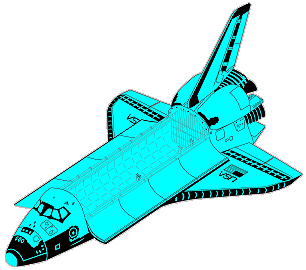 |
 |
 |
 |
 |
 |
 |
 |
 |
 |
 |
 |
| © |  |
Last update on June 19, 2023.  |
 |