Human Orbital Spaceflights

International Flight No. 130STS-31Discovery (10)35th Space Shuttle missionUSA |
 |
 |
|
Source: www.spacepatches.nl |
||
 |
 |
Launch, orbit and landing data
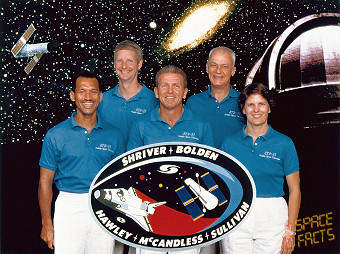
walkout photo |
 |
||||||||||||||||||||||||||||
alternative crew photo |
Crew
| No. | Surname | Given names | Position | Flight No. | Duration | Orbits | |
| 1 |  |
Shriver | Loren James | CDR | 2 | 5d 01h 16m 05s | 76 |
| 2 | |
Bolden | Charles Frank, Jr. "Charlie" | PLT | 2 | 5d 01h 16m 05s | 76 |
| 3 | |
McCandless | Bruce II | MS-1, EV-1 | 2 | 5d 01h 16m 05s | 76 |
| 4 | |
Hawley | Steven Alan | MS-2, FE, RMS | 3 | 5d 01h 16m 05s | 76 |
| 5 | |
Sullivan | Kathryn Dwyer | MS-3, EV-2 | 2 | 5d 01h 16m 05s | 76 |
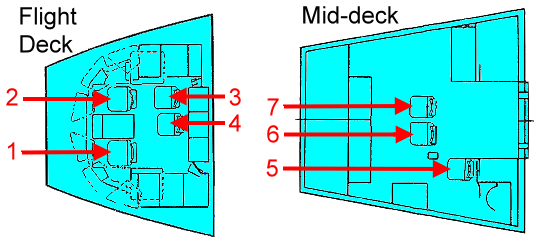
Crew seating arrangement
|
 |
|
||||||||||||||||||||||||
Hardware
| Orbiter : | OV-103 (10.) |
| SSME (1 / 2 / 3): | 2011 (5.) / 2031 (3.) / 2107 (2.) |
| SRB: | BI-037 / RSRM 10 |
| ET: | ET-34 (LWT-27) |
| OMS Pod: | Left Pod 04 (7.) / Right Pod 01 (12.) |
| FWD RCS Pod: | FRC 3 (10.) |
| RMS: | 301 (7.) |
| EMU: | EMU No. 2010 (PLSS No. 1009) / EMU No. 2012 (PLSS No. 1003) / EMU No. 2011 (PLSS No. 1013) |
Flight
|
Launch from Cape Canaveral (KSC) and
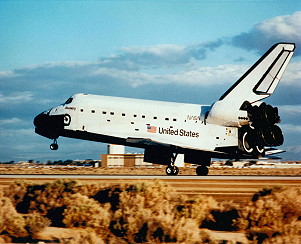
landing on the Edwards
AFB, Runway 22.
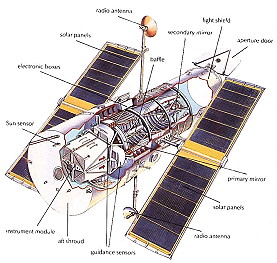
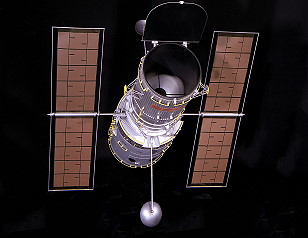
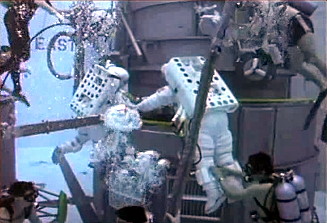
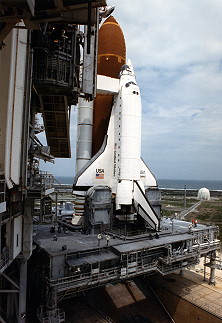
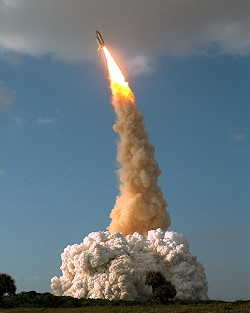
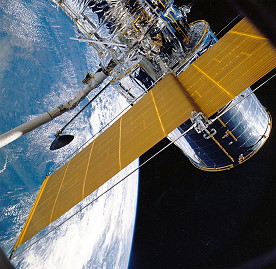
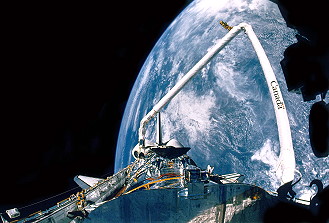
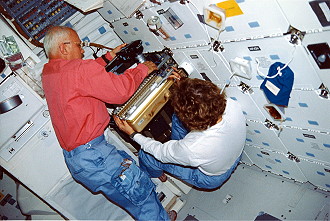
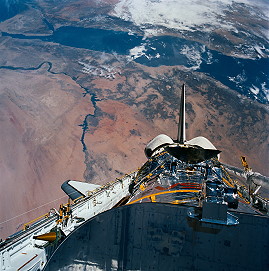
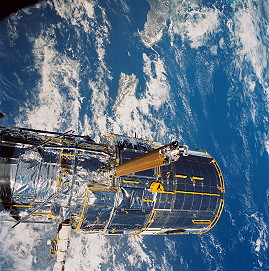
Initially, this mission was to be flown in August 1986 as STS-61J using Atlantis, but was postponed due to the Challenger disaster. John Young was originally assigned to command this mission, which would have been his seventh spaceflight, but was reassigned to an administrative position and was replaced by Loren Shriver in 1988. The launch was scheduled for April 18, 1990, then April 12, then April 10, 1990, following Flight Readiness Review (FRR). The first-time date set at FRR was earlier than that shown on previous planning schedules. The launch on April 10, 1990 was scrubbed at T-4 minutes due to faulty valve in auxiliary power unit (APU) number one. The APU was replaced and the payload batteries recharged. The countdown briefly halted at T-31 seconds when computer software failed to shut down a fuel valve line on ground support equipment. Engineers ordered to shut the valve and countdown continued. The primary payload Hubble Space Telescope, was deployed in a 380 statute-mile (611.5 km) orbit. The HST weighs approximately 24,000 pounds (10,886 kg), is 43 feet (13.11 meters) long, and 14 feet (4.27 meters) in diameter at its widest point. Roughly the size of a railroad tank car, it looks more like two huge cylinders joined together and wrapped in aluminum foil. Wing-like solar arrays extend horizontally from each side of these cylinders, and dish-shaped antennas stretch out on rods above and below the body of the telescope. Many of the telescope's components are of modular design so they may be removed and replaced in orbit by astronauts. Though other spacecraft have received emergency repairs from Shuttle crews, the HST is the first specifically designed for on-orbit servicing. The HST is made up of three major elements: the support systems module, the optical telescope assembly, and the scientific instruments. The support systems module consists of the exterior structure of the HST and the various systems that make it possible for the optical telescope assembly and the scientific instruments to do their job. The foil-like material with which the telescope is wrapped is actually multi-layer insulation, part of the telescope's thermal control system. The metallic silver surface reflects much of the direct sunlight which strikes the telescope to keep it from overheating. Tiny heaters are attached to many telescope components to warm them during the "eclipse" phase of orbit, when in the Earth's shadow. Electrical power for the HST is collected from the sun by the European Space Agency's solar arrays. These two "wings" contain 48,000 solar cells. They convert the sun's energy to electricity during the portion of orbit that it is exposed to sunlight. The power is stored in six Nickel Hydrogen batteries to support the telescope during eclipse. When conducting an observation, the space telescope is rotated into the proper orientation, then pointed to the star it is to view and locked in place, by the pointing control system. This system is made up of a complex series of gyroscopes, star trackers, reaction wheels and electromagnets. The gyroscopes and reaction wheels are used to produce a coarse pointing toward the star. That pointing is fine-tuned by star trackers called fine guidance sensors. These sensors can locate and lock on to a position in the sky to within 0.01 arc second and can hold that pointing without varying more than 0.007 arc second for as long as 24 hours. Also included in the support systems module are the computer which controls the overall spacecraft; high gain antennas which receive ground commands and transmit data back to Earth; the electrical power system; the structure of the telescope itself and its mechanical parts; and the safing system, designed to take over control of the telescope to protect it from damage in case of serious computer problems or loss of communication with ground controllers. The optical telescope assembly contains the two mirrors which collect and focus light from the celestial objects being studied. The 94-inch (2.39 meters) primary mirror is located near the center of the HST. Made of precision ground glass with an aluminum reflecting surface, it is the smoothest large mirror ever made. To reduce weight, the front and back plates are fused to a honeycomb core. The 13-inch (0.33 meter) secondary mirror is located 16 feet (4.88 meters) in front of the primary mirror. It is set far enough inside the open end of the telescope to assure that stray light does not interfere with the image being studied. In addition, three black cylinders called baffles surround the path of light to block out unwanted rays. The two mirrors must remain in precise alignment for the images they collect to be in focus. But the space environment is a hostile one. The space telescope will experience wide variations in temperature as it passes from the sun to shade portions of its orbit. Expansion and contraction from the temperature extremes could easily cause the mirrors to go out of focus. Therefore, the mirrors are made of a special kind of glass formulated to resist that expansion and contraction. The telescope's insulation blankets and solar-powered heaters will maintain them at 70 degrees Fahrenheit (21.7 °C). In addition, the mirrors are held a precise distance from one another by an extremely strong but lightweight truss structure. The truss is made from graphite epoxy, a material also chosen for its resistance to expansion and contraction in temperature extremes. During observations, light from a celestial source travels through the tube of the telescope to the large primary mirror. It is then reflected from the primary mirror back to the secondary mirror. From there, the beam narrows and intensifies, then passes through a hole in the center of the primary mirror to a focal plane where the scientific instruments are located. The Hubble Space Telescope's scientific instruments are the Wide Field/Planetary Camera, the Faint Object Camera, the Goddard High-Resolution Spectrograph, the Faint Object Spectrograph, and the High-Speed Photometer. The fine guidance system, in addition to being used for pointing, also performs scientific measurements and is sometimes called the sixth scientific instrument. Mounted on a focal plane almost five feet behind the primary mirror, these scientific instruments will furnish astronomers with a wide range of information about the stars and galaxies they study. Each instrument is contained in a separate module and operates on only 110 to 150 watts of power. The Shuttle crew opened Discovery's cargo bay doors shortly after entering orbit. Then they waited several hours to allow the air inside the telescope to vent into space, reducing the possibility of electrical arcing in some components when the main power is supplied to HST. After the air has had time to escape, the DOV gave the go-ahead for astronauts to switch on the main power from Discovery's aft flight deck. During the morning of the second day, Discovery's crew switched on HST's internal power and deactivated the Orbiter-supplied power system. The shuttle robot arm (Remote Manipulator System) operated by Steven Hawley lifted the Hubble Space Telescope from the bay and suspend it above the crew cabin, with its door pointed away from the sun. The verification team will then send the signal to unfurl HST's solar arrays almost immediately, so the telescope's six batteries should start recharging. One of the observatory's solar arrays stopped as it unfurled. While ground controllers searched for a way to command HST to unreel the solar array, Mission Specialists Bruce McCandless and Kathryn Sullivan began preparing for a contingency spacewalk in the event that the array could not be deployed through ground control. The array eventually came free and unfurled through ground control, while Bruce McCandless and Kathryn Sullivan were pre-breathing inside the partially depressurized airlock. Next, the two high gain Tracking and Data Relay Satellite System (TDRSS) antennas on the HST were deployed. Pointing systems were activated to control the telescope's orientation. Then, the remote manipulator arm operated by Steven Hawley release its hold, and the HST floated free in orbit. Following the telescope's release, the Shuttle back away into a parallel orbit to stand by for approximately two days in case problems occur requiring corrective action by the astronauts. Finally, Discovery moved away. HST was designed to operate above the Earth's turbulent and obscuring atmosphere to observe celestial objects at ultraviolet, visible and near-infrared wavelengths. This was a joint NASA-ESA effort. The later very successful Hubble Telescope did not work well, because of mirror problems. To correct them a repair mission was planned (STS-61). Several secondary payloads were flown onboard STS-31. The Protein Crystal Growth (PCG) payload aboard STS-31 was a continuing series of experiments that may prove a major benefit to medical technology. These experiments could improve food production and lead to innovative new drugs to combat cancer, AIDS, high blood pressure, organ transplant rejection, rheumatoid arthritis and many other diseases. Protein crystals, like inorganic crystals such as snowflakes, are structured in a regular pattern. With a good crystal, roughly the size of a grain of table salt, scientists are able to study the protein's molecular architecture. Determining a protein crystal's molecular shape is an essential step in several phases of medical research. Once the three-dimensional structure of a protein is known, it may be possible to design drugs that will either block or enhance the protein's normal function within the body. Though crystallographic techniques can be used to determine a protein's structure, this powerful technique has been limited by problems encountered in obtaining high-quality crystals well-ordered and large enough to yield precise structural information. Protein crystals grown on Earth are often small and flawed. The problem associated with growing these crystals is analogous to filling a sports stadium with fans who all have reserved seats. Once the gate opens, people flock to their seats and in the confusion, often sit in someone else's place. On Earth, gravity-driven convection keeps the molecules crowded around the "seats" as they attempt to order themselves. Unfortunately, protein molecules are not as particular as many of the smaller molecules and are often content to take the wrong places in the structure. During the STS-31 mission, 60 different PCG experiments were conducted simultaneously using as many as 12 different proteins. Though there are three processes used to grow crystals on Earth, vapor diffusion, liquid diffusion and dialysis, only vapor diffusion will be used in this set of experiments. Shortly after achieving orbit, a crew member combined each of the protein solutions with other solutions containing a precipitation agent to form small droplets on the ends of double-barreled syringes positioned in small chambers. Water vapor diffused from each droplet to a solution absorbed in a porous reservoir that lines each chamber. The loss of water by this vapor diffusion process produced conditions in the droplets that cause protein crystals to grow. In three of the 20-chambered, 15-by-10-by-1.5-inch (0.38-by-0.25-by-0.04 meter) trays, crystals were grown at room temperature (22 degrees Centigrade); the other three trays were refrigerated (4 degrees C) during crystal growth. STS-32 was the first mission, during which PCG experiments ran at 4 degrees C, making it possible to crystallize a wider selection of proteins. The STS-26 and STS-29 experiments were the first scientific attempts to grow useful crystals by vapor diffusion in microgravity. The main differences between the STS-26 and STS-29 payloads and those on previous flights were the introduction of temperature control and the automation of some of the processes to improve accuracy and reduce the crew time required. The Investigations into Polymer Membrane Processing (IPMP) was a middeck payload developed by the Battelle Advanced Materials Center for the Commercial Development of Space (CCDS), Columbus, Ohio. Sponsored by NASA's Office of Commercial Programs, the Battelle CCDS was formed in November 1985 to conduct research into commercially important advanced materials such as polymers, catalysts, electronic materials and superconductors. The IPMP marks the beginning of the center's work in microgravity polymer membrane processing. Polymer membranes have been used in the separations industry for many years for such applications as desalination of water, filtration during the processing of food products, atmospheric purification, medicinal purification and dialysis of kidneys and blood. The IPMP payload on STS-31 consisted of two experimental units and their contents. Each IPMP unit consisted of two sample cylinders connected to each other by a valve. The larger of the two cylinders was 8 inches (20.3 centimeters) long and 4 in. (10.2 centimeters) in diameter, with the smaller cylinder measuring 4.5 by 2 in. (11.4 by 5.1 centimeters). The overall dimensions of each IPMP unit were 18.6 by 3.5 by 4.41 in. (0.47 by 0.09 by 0.11 meter). The total weight of the flight hardware (both units) was approximately 17 pounds (7.7 kg). A thin-film polymer membrane was swelled in a solvent solution. (In this first flight experiment, the polymer - polysulfone -- was swollen with a mixture of dimethylacetamide and acetone.) The resultant swollen gel (viscous fluid) was measured and inserted into a sample tube, which was inserted into the smaller of the two cylinders. This cylinder was sealed at ambient pressure (-14.7 psia) and attached to the other side of the valve. The procedure is repeated for the second unit. Once Discovery's on-orbit activities allow it, a crewmember released and opened the valve on each unit. Opening the valve caused the solvents in the smaller cylinder to flash-evaporate into the vacuum of the larger cylinder. The remaining thin-film polymer membrane had a porosity related to the evaporation of the solution. The system reached an equilibrium state, which was maintained for the remainder of the flight. The minimum duration needed for adequate results were 24 hours. The Ascent Particle Monitor was an automatic system mounted in Discovery's payload bay to measure particle contamination or particle detachment during the immediate prelaunch period and during ascent. The payload consisted of a small box with a fixed door and a moving door mounted in a clamshell arrangement atop an aluminum housing. Each door contained six sample coupons. The doors were closed together preflight to protect the coupons from the environment. At a preselected time, the doors opened exposing the coupons for a selected period of time. They were then closed to seal the coupons for later analysis. A motor/gearbox assembly, two battery packs and launch detection and door opening circuitry are contained within the aluminum housing. The Radiation Monitoring Experiment (RME) recorded both the rate and total dosage of all types of ionizing radiation (gamma ray, neutron and proton radiation). The experiment consisted of a single handheld instrument with replaceable memory modules. It contained a liquid crystal display for real-time data display and a keyboard for controlling its functions. The experiment was self-contained with two zinc-air and five AA batteries contained in each memory module and two zinc-air batteries in the main module. RME-III was activated as soon as possible after orbit was achieved and was programmed to operate throughout the entire mission. A crew member entered the correct mission elapsed time upon activation and changed the memory module every 2 days. All data stored in the memory modules were analyzed at the completion of the mission. The IMAX project is a collaboration between NASA and the Smithsonian Institution's National Air and Space Museum to document significant space activities using the IMAX film medium. This system, developed by the IMAX Systems Corp., Toronto, Canada, uses specially designed 70 mm film cameras and projectors to record and display very high definition large-screen color motion pictures. IMAX cameras previously have flown on Space Shuttle missions STS-41C, STS-41D and STS-41G to document crew operations in the payload bay and the orbiter's middeck and flight deck along with spectacular views of Earth. Film from those missions form the basis for the IMAX production, "The Dream is Alive". The IMAX camera flew on STS-29 in March 1989, STS-34 in October 1989 and most recently STS-32 in January 1990. During those missions, the camera was used to gather material for an upcoming IMAX production entitled "The Blue Planet". During Shuttle Mission STS-31, an IMAX Cargo Bay Camera (ICBC) was carried in the payload bay of Discovery and used to document activities associated with the deployment of the Hubble Space Telescope. The camera was mounted in the in a pressure-sealed container with a viewing window. The window had a sliding door which opened when the camera was in operation. The camera was controlled from the aft-flight deck, exposing the film through a 30 mm fisheye lens. A second IMAX camera was flown in the mid-deck of the orbiter and was used by the crew to collect additional material for upcoming IMAX productions. The Air Force Maui Optical Site (AMOS) tests allowed ground- based electro-optical sensors located on Mt. Haleakala, Maui, Hawaii, to collect imagery and signature data of the orbiter during cooperative overflights. The scientific observations made of the orbiter, while performing reaction control system thruster firings, water dumps or payload bay light activation, and were used to support the calibration of the AMOS sensors and the validation of spacecraft contamination models. The AMOS tests had no payload unique flight hardware and only required that the orbiter be in predefined attitude operations and lighting conditions. As part of the Shuttle Student Involvement Program (SSIP) an experiment to study effects of near-weightlessness on electrical arcs was flown. To observe the effects of free fall on an arc and to study the effects of a magnetic field on an arc without convection, an experimental apparatus consisted of a sealed aluminum arc chamber box within a sealed aluminum outer box. Both boxes had a window in which a wire screen was embedded to prevent the escape of electromagnetic interference while allowing viewing and photography. Both boxes were filled with a mixture of 67% argon and 33% nitrogen to prevent the formation of ozone. Experiment results could have possible applications to materials processing in space. |
Photos / Graphics
 |
 |
 |
 |
 |
 |
 |
 |
 |
 |
 |
 |
 |
 |
 |
 |
 |
 |
 |
| © |  |
Last update on March 26, 2020.  |
 |