Human Orbital Spaceflights

International Flight No. 134STS-35Columbia (10)38th Space Shuttle missionUSA |
 |
 |
 |
 |
|
Launch, orbit and landing data
walkout photo |
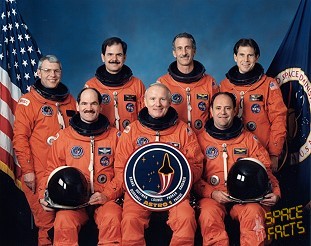 |
||||||||||||||||||||||||||||
alternative crew photo |
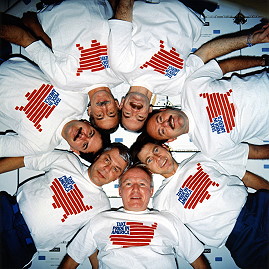
Crew
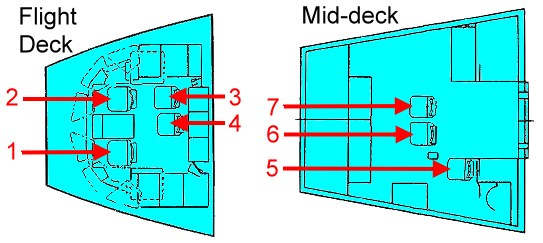
| No. | Surname | Given names | Position | Flight No. | Duration | Orbits | |
| 1 |  |
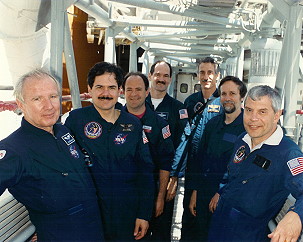
Brand | Vance DeVoe | CDR | 4 | 8d 23h 05m 07s | 144 |
| 2 | |
Gardner | Guy Spence | PLT | 2 | 8d 23h 05m 07s | 144 |
| 3 | |
Hoffman | Jeffrey Alan | MS-1, EV-1 | 2 | 8d 23h 05m 07s | 144 |
| 4 | |
Lounge | John Michael | MS-2, EV-2, FE | 3 | 8d 23h 05m 07s | 144 |
| 5 | |
Parker | Robert Alan Ridley | MS-3 | 2 | 8d 23h 05m 07s | 144 |
| 6 | |
Durrance | Samuel Thornton | PS-1 | 1 | 8d 23h 05m 07s | 144 |
| 7 | |
Parise | Ronald Anthony | PS-2 | 1 | 8d 23h 05m 07s | 144 |
Crew seating arrangement
|
 |
|
||||||||||||||||||||||||||||||||
Backup Crew
|
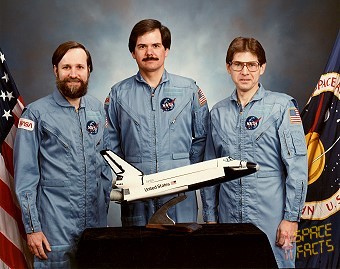 |
|||||||||||||||
Hardware
| Orbiter : | OV-102 (10.) |
| SSME (1 / 2 / 3): | 2024 (2.) / 2012 (11.) / 2028 (5.) |
| SRB: | BI-038 / RSRM 11 |
| ET: | ET-35 (LWT-27) |
| OMS Pod: | Left Pod 03 (10.) / Right Pod 04 (6.) |
| FWD RCS Pod: | FRC 2 (10.) |
| RMS: | - |
| EMU: | EMU No. 2007 (PLSS No. 1014) / EMU No. 2009 (PLSS No. 1006) |
Flight
|
Launch from Cape Canaveral (KSC) and
landing on the Edwards
AFB, Runway
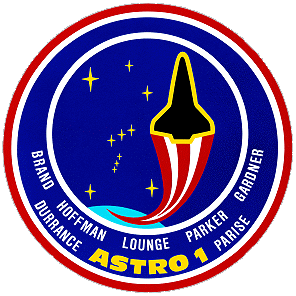
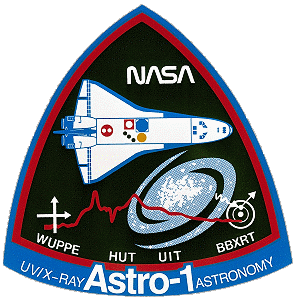
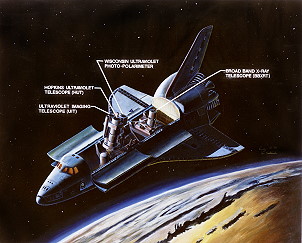
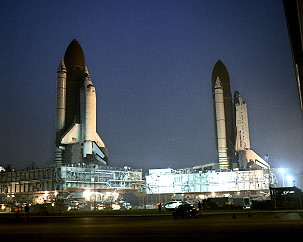
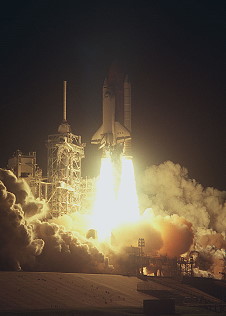
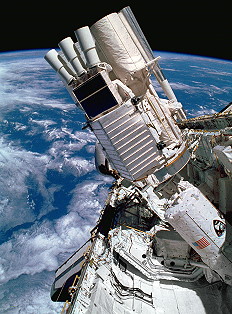
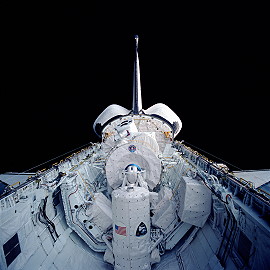
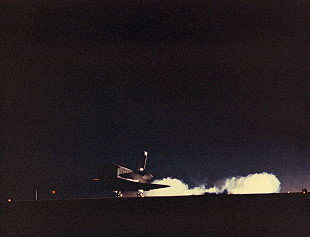
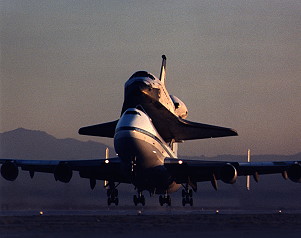
22. Prior to the Challenger disaster, this mission was slated to launch in March 1986 as STS-61E. Jon McBride was originally assigned to command this mission, which would have been his second spaceflight. He chose to retire from NASA in May 1989 and was replaced as mission commander by Vance Brand. In addition, Richard Richards (as pilot) and David Leestma (as mission specialist), were replaced by Guy Gardner and John Lounge respectively. The launch was first scheduled for May 16, 1990. Following Flight Readiness Review (FRR), announcement of firm launch date delayed to change out a faulty freon coolant loop proportional valve in orbiter's coolant system. At subsequent Delta FRR, date set for May 30. Launch on May 30, 1990 scrubbed during tanking due to minor hydrogen leak in tail service mast on mobile launcher platform and major leak in external tank/orbiter 17 inch (432 mm) quick disconnect assembly. Hydrogen also detected in orbiter's aft compartment believed associated with leak involving 17 inch (432 mm) umbilical assembly. Launch rescheduled for September 06, 1990. During tanking, high concentrations of hydrogen detected in orbiter's aft compartment, forcing another postponement. NASA managers concluded that Columbia had experienced separate hydrogen leaks from beginning: one of umbilical assembly (now replaced) and one or more in aft compartment which had resurfaced. Suspicion focused on package of three hydrogen recirculation pumps in aft compartment. Columbia transferred to Pad 39-B October 08, 1990 to make room for Atlantis on Mission STS-38. Tropical storm Klaus forced rollback to VAB October 09, 1990. Vehicle transferred to Pad 39-B again October 14, 1990. Mini-tanking test conducted October 30, 1990, using special sensors and video cameras and employing a see-through Plexiglas aft compartment door. Liftoff December 02, 1990 was delayed 21 minutes to allow the Air Force range time to observe low-level clouds that might impede tracking of Shuttle ascent. Vance Brand became the oldest astronaut to fly into space until Story Musgrave, 61 on STS-80 in 1996, and U.S. Senator John Glenn, 77 when he flew on STS-95 in 1998. Primary objectives were round-the-clock observations of celestial sphere in ultraviolet and X-ray astronomy with ASTRO-1 observatory consisting of four telescopes: Hopkins Ultraviolet Telescope (HUT); Wisconsin Ultraviolet Photo-Polarimeter Experiment (WUPPE); Ultraviolet Imaging Telescope (UIT); and Broad Band X-Ray Telescope (BBXRT). Ultraviolet telescopes mounted on Spacelab elements in cargo bay were to be operated in shifts by flight crew. The crew split into shifts after reaching orbit, with Guy Gardner, Robert Parker, and Ronald Parise comprising the Red Team; the Blue team consisted of Jeffrey Hoffman, Samuel Durrance, and John Lounge. Commander Vance Brand was unassigned to either team and helped coordinate mission activities. The telescopes were powered up and raised from their stowed position by the Red Team 11 hours into the flight. Observations began under the Blue Team 16 hours into the mission after the instruments were checked out. ASTRO-1 was the first Spacelab mission devoted to a single scientific discipline - astrophysics. The observatory operated from within the cargo bay of Space Shuttle Columbia on the STS-35 mission. Together, four telescopes dissected ultraviolet light and X-rays from stars and galaxies, revealing the secrets of processes that emitted the radiation from thousands to even billions of years ago. Wherever it points, ASTRO promised to reveal an array of information. The ASTRO-1 telescopes were constructed to add some of these "colors" to scientists' view of stars and galaxies. The telescopes' perch above the veil of Earth's atmosphere in Columbia's cargo bay allowed scientists to view radiation that is invisible on the ground. Three of ASTRO-1's telescopes operated in the ultraviolet portion of the spectrum and one in the X-ray portion. One took photographs; two analyzed the chemical composition, density and temperature of objects with a spectrograph; and the other studied the relative brightness and polarization (the study of light wavelength orientation) of celestial objects. Some sources were among the faintest known, as faint as the glow of sunlight reflected back from interplanetary dust. By studying ultraviolet and X-rays, astronomers can see emissions from extremely hot gases, intense magnetic fields and other high-energy phenomena that are much fainter in visible and infrared light or in radio waves - and which are crucial to a deeper understanding of the universe. The ASTRO-1 observatory was a compliment of four telescopes. Though each instrument was uniquely designed to address specific questions in ultraviolet and X-ray astronomy, when used in concert, the capability of each was enhanced. The synergistic use of ASTRO-1's instruments for joint observations served to make ASTRO-1 an exceptionally powerful facility. The ASTRO-1 observatory had three ultraviolet-sensitive instruments: The Hopkins Ultraviolet Telescope (HUT) was the first major telescope capable of studying far ultraviolet (FUV) and extreme ultraviolet (EUV) radiation from a wide variety of objects in space. HUT's observations provided new information on the evolution of galaxies and quasars, the physical properties of extremely hot stars and the characteristics of accretion disks (hot, swirling matter transferred from one star to another) around white dwarfs, neutron stars and black holes. HUT made the first observations of a wide variety of astronomical objects in the far ultraviolet region below 1,200 Angstroms (A) and will pioneer the detailed study of stars in the extreme ultraviolet band. Ultraviolet radiation at wavelengths shorter than 912 A is absorbed by hydrogen, the most abundant element in the universe. HUT allowed astronomers, in some instances along unobserved lines of sight, to see beyond this cutoff, called the Lyman limit, because the radiation from the most distant and rapidly receding objects, such as very bright quasars, was shifted toward longer wavelengths. The Wisconsin Ultraviolet Photo-Polarimeter Experiment (WUPPE), developed by the Space Astronomy Lab at the University of Wisconsin-Madison, was designed to measure polarization and intensity of ultraviolet radiation from celestial objects. WUPPE was a 20-inch (0.51 meter) telescope with a 5.5-arc-minute field of view. WUPPE was fitted with a spectropolarimeter, an instrument that recorded both the spectrum and the polarization of the ultraviolet light gathered by the telescope. Light passed through sophisticated filters, akin to Polaroid sunglasses, before reaching the detector. Measurements then were transmitted electronically to the ground. Photometry is the measurement of the intensity (brightness) of the light, while polarization is the measurement of the orientation (direction) of the oscillating light wave. Usually waves of light move randomly - up, down, back, forward and diagonally. When light is polarized, all the waves oscillate in a single plane. Light that is scattered, like sunlight reflecting off water, is often polarized. ASTRO-1 astronomers expect to learn about ultraviolet light that is scattered by dust strewn among stars and galaxies. They also can learn about the geometry of stars and other objects by studying their polarization. To date, virtually no observations of polarization of astronomical sources in the ultraviolet have been carried out. WUPPE measured the polarization by splitting a beam of radiation into two perpendicular planes of polarization, passing the beams through a spectrometer and focusing the beams on two separate array detectors. In the ultraviolet spectrum, both photometry and polarization are extremely difficult measurements to achieve with the high degree of precision required for astronomical studies. To develop an instrument that could make these delicate measurements required an unusually innovative and advanced technical effort. Thus, the WUPPE investigation was a pioneering foray with a new technique. The targets of WUPPE investigations were primarily in the Milky Way galaxy and beyond, for which comparative data exist in other wavelengths. Like the Hopkins Ultraviolet Telescope, WUPPE also made spectroscopic observations of hot stars, galactic nuclei and quasars. Operating at ultraviolet wavelengths that are mostly longer than those observed by HUT (but with some useful overlap), WUPPE provided chemical composition and physical information on celestial targets that give off a significant amount of radiation in the 1,400 to 3,200 A range. The Ultraviolet Imaging Telescope (UIT) was a powerful combination of telescope, image intensifier and camera. It was a 15.2-inch (0.31 meter) Ritchey Chretien telescope with two selectable cameras mounted behind the primary mirror. Each camera had a six- position filter wheel, a two-stage magnetically focused image tube and a 70-mm film transport, fiber optically coupled to each image tube. One camera was designed to operate in the 1200 - 1700 Angstrom region and the other in the 1250-3200 Angstrom region. Unlike data from the other ASTRO instruments, which were electronically transmitted to the ground, UIT images were recorded directly onto a very sensitive astronomical film for later development after Columbia landed. UIT had enough film to make 2,000 exposures. A series of 11 different filters allowed specific regions of the ultraviolet spectrum to be isolated for energy-distribution studies. After development, each image frame was electronically digitized to form 2,048 x 2,048 picture elements, or pixels, then analyzed further with computers. UIT had a 15-inch (0.38 meter) diameter mirror with a 40-arc-minute field of view - about 25 percent wider than the apparent diameter of the full moon. UIT had the largest field of view of any sensitive UV imaging instrument planned for flight in the 1990s. It photographed nearby galaxies, large clusters of stars and distant clusters of galaxies. The instrument favored the detection of hot objects which emit most of their energy in the ultraviolet. Common examples span the evolutionary history of stars - massive stars and stars in the final stages of stellar evolution (white dwarfs). Images of numerous relatively cool stars that do not radiate much in the ultraviolet were suppressed, and UV sources stand out clearly. The UIT's field of view was wide enough to encompass entire galaxies, star clusters and distant clusters of galaxies. This deep survey mode revealed many new, exciting objects to be studied further by NASA's Hubble Space Telescope. Although the Hubble Space Telescope has a much higher magnification and record much fainter stars, the UIT will photograph much larger regions all at once. In addition, the UIT suffered much less interference from visible light, since it is provided with "solar blind" detectors. For certain classes of targets, such as diffuse, ultraviolet-emitting or ultraviolet-scattering nebulae, UIT was a more sensitive imager. The Broad Band X-Ray Telescope (BBXRT) provided astronomers with the first high-quality spectra of many of the X-ray sources discovered with the High Energy Astronomy Observatory 2, better known as the Einstein Observatory, launched in the late 1970s. BBXRT, developed at NASA's Goddard Space Flight Center in Greenbelt, MD, used mirrors and advanced solid-state detectors as spectrometers to measure the energy of individual X-ray photons. These energies produced a spectrum that reveals the chemistry, structure and dynamics of a source. BBXRT was actually two 8-inch (0.2 meter) telescopes each with a 17 arc-minute field of view (more than half the angular width of the moon). The two identical telescopes were used to focus X-rays onto solid-state spectrometers which measured photon energy in electron volts in the "soft" X-ray region, from 380 to 12,000 eV. The use of two telescopes doubled the number of photons that are detected and also provides redundancy in case of a failure. The telescope provided information on the chemistry, temperature and structure of some of the most unusual and interesting objects in the universe. BBXRT could see fainter and more energetic objects than any yet studied. It looked for signs of heavy elements such as iron, oxygen, silicon and calcium. These elements usually are formed in exploding stars and during mysterious events occurring at the core of galaxies and other exotic objects. BBXRT was used to study a variety of sources, but a major goal was to increase our understanding of active galactic nuclei and quasars. Many astronomers believe that the two are very similar objects that contain an extremely luminous source at the nucleus of an otherwise relatively normal galaxy. The central source in quasars is so luminous that the host galaxy is difficult to detect. X-rays are expected to be emitted near the central engine of these objects, and astronomers will examine X-ray spectra and their variations to understand the phenomena at the heart of quasars. The ASTRO observatory was made up of three co-aligned ultraviolet telescopes carried by Spacelab and one X-ray telescope mounted on the Two-Axis Pointing System (TAPS) and a special structure. The ultraviolet telescopes and the Instrument Pointing System were mounted on two Spacelab pallets - large, uncovered, unpressurized platforms designed to support scientific instruments that require direct exposure to space. Each individual pallet was 10 feet (3.05 meters) long and 13 feet (3.96 meters) wide. The basic pallet structure was made up of five parallel U-shaped frames. Twenty-four inner and 24 outer panels, made of aluminum alloy honeycomb, covered the frame. The inner panels were equipped with threaded inserts so that payload and subsystem equipment can be attached. Twenty-four standard hard points, made of chromium-plated titanium casting, were provided for payloads which exceed acceptable loading of the inner pallets. Normally Spacelab subsystem equipment was housed in the core segment of the pressurized laboratory module. However, in "pallet only" configurations such as ASTRO, the subsystems were located in a supply module called the igloo. It provided a pressurized compartment in which Spacelab subsystem equipment could be mounted in a dry-air environment at normal Earth atmospheric pressure, as required by their design. The subsystems provided such services as cooling, electrical power and connections for commanding and acquiring data from the instruments. The igloo consisted of two parts. The primary structure - an exterior canister - was a cylindrical, locally stiffened shell made of forged aluminum alloy rings and closed at one end. The other end had a mounting flange for the cover. A seal was inserted when the two structures are joined together mechanically to form a pressure-tight assembly. Telescopes such as those aboard ASTRO-1 must be pointed with very high accuracy and stability at the objects which they are to view. The Spacelab Instrument Pointing System (IPS) provided precision pointing for a wide range of payloads, including large single instruments or clusters of instruments. The pointing mechanism could accommodate instruments weighing up to 15,432 pounds (7,000 kg) and could point them to within 2 arc seconds and hold them on target to within 1.2 arc seconds. The combined weight of the ultraviolet telescopes and the structure which holds them together was 9,131 pounds (4,142 kg). The Instrument Pointing System consisted of a three-axis gimbal system mounted on a gimbal support structure connected to the pallet at one end and the aft end of the payload at the other, a payload clamping system for support of the mounted experiment during launch and landing and a control system based on the inertial reference of a three-axis gyro package and operated by a gimbal-mounted microcomputer. Three bearing-drive units on the gimbal system allowed the payload to be pointed on three axes: elevation (back and forth), cross-elevation (side to side) and azimuth (roll), allowing it to point in a 22-degree circle around a its straight-up position. The pointing system may be maneuvered at a rate of up to one degree per second, which is five times as fast as the Shuttle orbiter's maneuvering rate. The operating modes of the different scientific investigations vary considerably. Some require manual control capability, others slow scan mapping, still others high angular rates and accelerations. Performance in all these modes requires flexibility achieved with computer software. An image motion compensation system was developed by the Marshall Space Flight Center to provide additional pointing stability for two of the ultraviolet instruments. When the Shuttle thrusters fired to control orbiter attitude, there was a noticeable disturbance of the pointing system. The telescopes were also affected by crew motion in the orbiter. A gyro stabilizer sensed the motion of the cruciform which could disrupt UIT and WUPPE pointing stability. It sent information to the image motion compensation electronics system where pointing commands were computed and sent to the telescopes' secondary mirrors which made automatic adjustments to improve stability to less than 1 arc second. Developed at the NASA Goddard Space Flight Center, these pointing systems were designed to be flown together on multiple missions. This payload was anchored in a support structure placed just behind the ultraviolet telescopes in the Shuttle payload bay. BBXRT was attached directly to the TAPS inner gimbal frame. The TAPS moved BBXRT in a forward/aft direction (pitch) relative to the cargo bay or from side to side (roll) relative to the cargo bay. A star tracker used bright stars as a reference to position the TAPS for an observation, and gyros keep the TAPS on a target. As the gyros drift, the star tracker periodically recalculates and resets the TAPS position. The ASTRO science crew operated the ultraviolet telescopes and Instrument Pointing System from the Shuttle orbiter's aft flight deck, located to the rear of the cockpit. Windows overlooking the cargo bay allowed the payload specialist and mission specialist to keep an eye on the instruments as they command them into precise position. The aft flight deck was equipped with two Spacelab keyboard and display units, one for controlling the pointing system and the other for operating the scientific instruments. To aid in target identification, this work area also included two closed-circuit television monitors. With the monitors, crew members were able to see the star fields being viewed by HUT and WUPPE and monitor the data being transmitted from the instruments. In a typical ASTRO-1 ultraviolet observation, the flight crew member on duty maneuvered the Shuttle to point the cargo bay in the general direction of the astronomical object to be observed. The mission specialist commanded the pointing system to aim the telescopes toward the target. He also locked on to guide stars to help the pointing system remain stable despite orbiter thruster firings. The payload specialist set up each instrument for the upcoming observation, identifies the celestial target on the guide television and provides any necessary pointing corrections for placing the object precisely in the telescope's field of view. He then started the instrument observation sequences and monitored the data being recorded. Because the many observations planned create a heavy workload, the payload and mission specialists worked together to perform these complicated operations and evaluate the quality of observations. Each observation took between 10 minutes to a little over an hour. Issues with the pointing precision of the IPS and the sequential overheating failures of both data display units (used for pointing telescopes and operating experiments) during the mission impacted crew-aiming procedures and forced ground teams at Marshall Space Flight Center (MSFC) to aim the telescopes with fine-tuning by the flight crew. BBXRT was directed from outset by ground-based operators at Goddard Space Flight Center and was not affected. The X-ray telescope required little attention from the crew. A crew member would turn on the BBXRT and the TAPS at the beginning of operations and then turn them off when the operations concluded. After the telescope was activated, researchers at Goddard could "talk" to the telescope via computer. Before science operations begun, stored commands were loaded into the BBXRT computer system. Then, when the astronauts positioned the Shuttle in the general direction of the source, the TAPS automatically pointed the BBXRT at the object. Since the Shuttle could be oriented in only one direction at a time, X-ray observations had to be coordinated carefully with ultraviolet observations. Despite the pointing problems, the full suite of telescopes obtained 231 observations of 130 celestial objects over a combined span of 143 hours. Science teams at MSFC and Goddard estimated that 70% of the mission objectives were completed. ASTRO-1 was the first shuttle mission controlled in part from the Spacelab Mission Operations Control facility at MSFC in Huntsville, Alabama. Conducting short-wave radio transmissions between ground-based amateur radio operators and a Shuttle-based amateur radio operator was the basis for the Shuttle Amateur Radio Experiment (SAREX). SAREX communicated with amateur stations in line-of-sight of the orbiter in one of four transmission modes: voice, slow scan television (SSTV), data or (uplink only) fast scan television (FSTV). During the mission, SAREX was operated by Payload Specialist Ronald Parise, a licensed operator (WA4SIR), during periods when he was not scheduled for orbiter or other payload activities. At least four transmissions were made to test each transmission mode. Another part of the SAREX was the "robot", providing an automated operation which could proceed with little human intervention. The robot generally was activated during one of the crew-tended windows and deactivated during the next one. This gave approximately 12 hours on and 12 hours off for the robot, with the operational period chosen to cover all of the U.S. passes. SAREX has previously flown on missions STS-9 and STS-51F in different configurations, including the following hardware: a low-power hand-held FM transceiver, a spare battery set, an interface (I/F) module, a headset assembly, an equipment assembly cabinet, a television camera and monitor, a payload general support computer (PGSC) and an antenna which will be mounted in a forward flight window with a fast scan television (FSTV) module added to the assembly. "Space Classroom" was a new NASA educational effort designed to involve students and teachers in the excitement of Space Shuttle science missions. This new program joined more than 160 other educational programs being conducted by NASA that used the agency's missions and unique facilities to help educators prepare students to meet the nation's growing need for a globally competitive work force of skilled scientists and engineers. The first Space Classroom project, called Assignment: The Stars, capitalized on the December 1990 flight of ASTRO-1, a Space Shuttle astronomy mission. It was designed to spark the interest of middle school students, encouraging them to pursue studies in mathematics, science and technology. It offered educators an alternative approach to teaching their students about the electromagnetic spectrum - a science concept that is required instruction in many classrooms in the United States. Mission Specialist Jeffrey Hoffman conducted the first classroom lesson taught from space on December 07, 1990 in support of this objective, covering material on the electromagnetic spectrum and the ASTRO-1 observatory. A supporting lesson was taught from the ASTRO-1 control center in Huntsville. Six Orbiter Experiments (OEX) Program experiments were flown on STS-35. Included among this group were five experiments which were intended to operate together as a complementary set of entry research instrumentation. This flight marked the first time since the September 1988 return-to-flight that the Langley experiments will fly as a complementary set. The Shuttle Entry Air Data System (SEADS) nosecap on the orbiter Columbia contains 14 penetration assemblies, each containing a small hole through which the surface air pressure is sensed. Measurement of the pressure levels and distribution allowed postflight determination of vehicle attitude and atmospheric density during entry. SEADS, which has flown on three previous flights of Columbia, operated in an altitude range of 300,000 feet to landing. The Shuttle Upper Atmosphere Mass Spectrometer (SUMS) experiment complemented SEADS by enabling measurement of atmospheric density above 300,000 feet (91,440 km). SUMS sampled air through a small hole on the lower surface of the vehicle just aft of the nosecap. It utilized a mass spectrometer operating as a pressure sensing device to measure atmospheric density in the high altitude, rarefied flow regime where the pressure is too low for the use of ordinary pressure sensors. The mass spectrometer incorporated in the SUMS experiment was spare equipment originally developed for the Viking Mars Lander. This was the first opportunity for SUMS to fly since STS-61C in January 1986. The Aerodynamic Coefficient Identification Package (ACIP) instrumentation included triaxial sets of linear accelerometers, angular accelerometers and angular rate gyros, which sensed the orbiter's motions during flight. ACIP provided the vehicle motion data which is used in conjunction with the SEADS environmental information for determination of aerodynamic characteristics below about 300,000 feet (91,440 km) altitude. The High-Resolution Accelerometer Package (HiRAP) instrument was a triaxial, orthogonal set of highly sensitive accelerometers which sense vehicle motions during the high-altitude portion (above 300,000 feet = 91,440 km) of entry. This instrument provided the companion vehicle motion data to be used with the SUMS results. HiRAP has been flown on 11 previous missions of the orbiters Columbia and Challenger. Shuttle Infrared Leeside Temperature Sensing (SILTS) used a scanning infrared radiometer located atop the vertical tail to collect infrared images of the orbiter's leeside (upper) surfaces during entry, for the purpose of measuring the temperature distribution and thereby the aerodynamic heating environment. On two previous missions, the experiment obtained images of the left wing. For STS-35, the experiment has been reconfigured to obtain images of the upper fuselage. The Aerothermal Instrumentation Package (AIP) comprised some 125 measurements of aerodynamic surface temperature and pressure at discrete locations on the upper surface of the orbiter's left wing and fuselage, and vertical tail. These sensors originally were part of the development flight instrumentation system which flew aboard Columbia during its Orbital Flight Test missions (STS-1, STS-2, STS-3, STS-4). They have been reactivated through the use of an AIP-unique data handling system. Among other applications, the AIP data provided "ground-truth" information for the SILTS experiment. The Air Force Maui Optical Site (AMOS) tests allowed ground- based electro-optical sensors located on Mt. Haleakala, Maui, Hawaii, to collect imagery and signature data of the orbiter during cooperative overflights. The scientific observations made of the orbiter, while performing reaction control system thruster firings, water dumps or payload bay light activation, and were used to support the calibration of the AMOS sensors and the validation of spacecraft contamination models. The AMOS tests had no payload unique flight hardware and only required that the orbiter be in predefined attitude operations and lighting conditions. During the flight, the crew experienced trouble dumping waste water due to a blocked waste water line, but managed to compensate using spare containers. Problems also affected one RCC thruster and an onboard text and graphics teleprinter used for receiving flight plan updates. The mission was cut short one day due to impending bad weather at primary landing site. |
Photos / Graphics
 |
 |
|
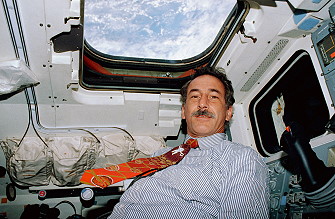
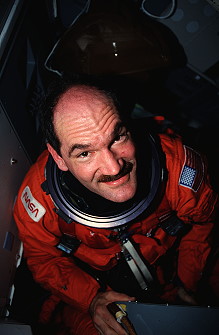
source of all photos is NASA |
|
 |
 |
 |
 |
 |
 |
 |
 |
 |
 |
 |
 |
 |
 |
 |
|
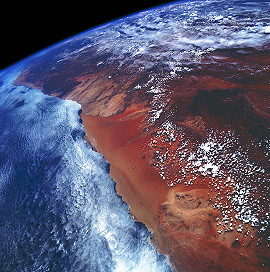
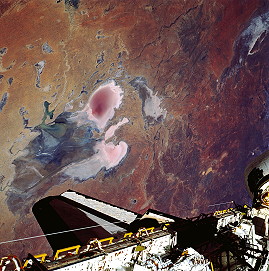
more Earth observation photos |
|
| © |  |
Last update on August 09, 2021.  |
 |