Human Orbital Spaceflights

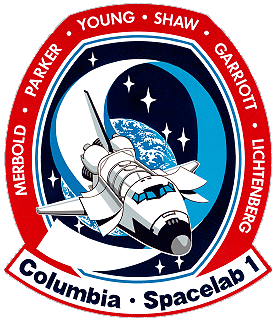
International Flight No. 91STS-9Columbia (6)9th Space Shuttle missionUSA |
 |
 |
 |
 |
|
 |
 |
|
Launch, orbit and landing data
walkout photo |
 |
||||||||||||||||||||||||||||
alternative crew photo |
|||||||||||||||||||||||||||||
alternative crew photo |
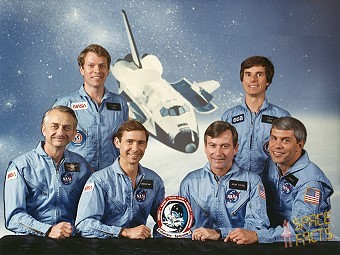
Crew
| No. | Surname | Given names | Position | Flight No. | Duration | Orbits | |
| 1 |  |
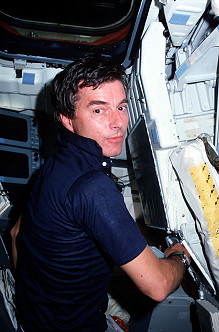
Young | John Watts | CDR, EV-1 | 6 | 10d 07h 47m 24s | 167 |
| 2 | |
Shaw | Brewster Hopkinson, Jr. | PLT | 1 | 10d 07h 47m 24s | 167 |
| 3 | |
Garriott | Owen Kay | MS-1, EV-2 | 2 | 10d 07h 47m 24s | 167 |
| 4 | |
Parker | Robert Alan Ridley | MS-2, FE | 1 | 10d 07h 47m 24s | 167 |
| 5 |  |
Merbold | Ulf Dietrich | PS-1 | 1 | 10d 07h 47m 24s | 167 |
| 6 | |
Lichtenberg | Byron Kurt | PS-2 | 1 | 10d 07h 47m 24s | 167 |
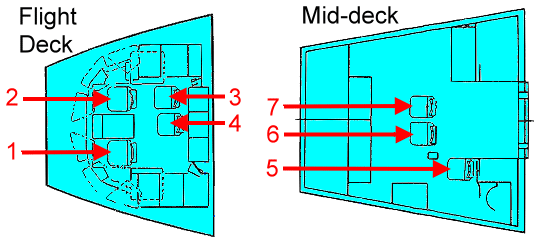
Crew seating arrangement
|
 |
|
||||||||||||||||||||||||||||||||
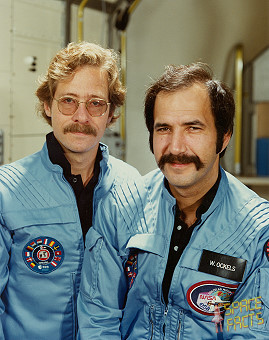
Backup Crew
|
 |
|||||||||||||||
alternative crew photo |

Hardware
| Orbiter : | OV-102 (6.) |
| SSME (1 / 2 / 3): | 2011 (1.) / 2018 (1.) / 2019 (1.) |
| SRB: | A55/56 |
| ET: | ET-11 (LWT-4) |
| OMS Pod: | Left Pod 02 - LV 01 (6.) / Right Pod 02 - RV 01 (6.) |
| FWD RCS Pod: | FRC 2 (6.) |
| RMS: | - |
| EMU: | EMU No. 1037 (PLSS No. 1008) / EMU No. 1036 (PLSS No. 1007) |
Flight
|
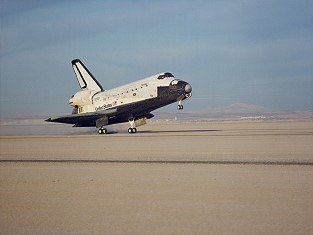
Launch from Cape Canaveral (KSC) and
landing on the Edwards
AFB, Runway
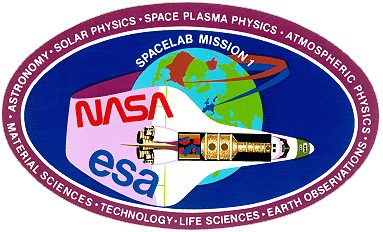
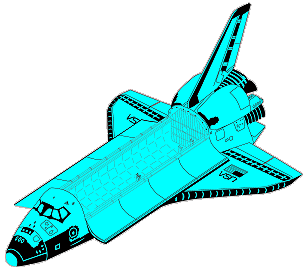
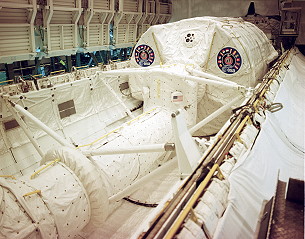
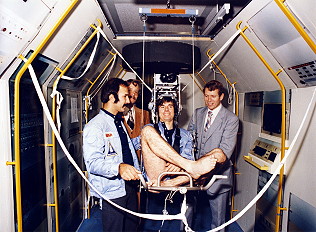
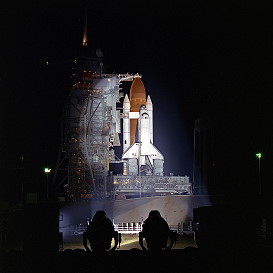
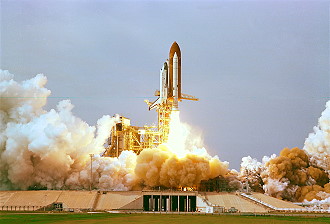
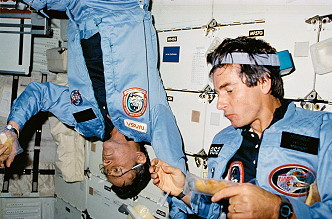
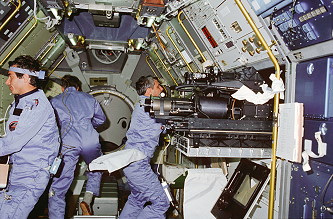
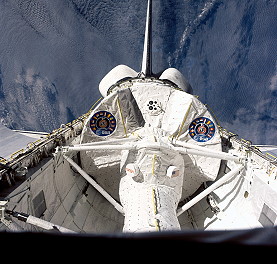
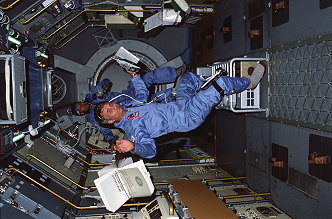
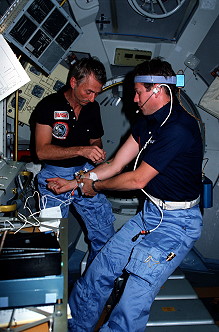
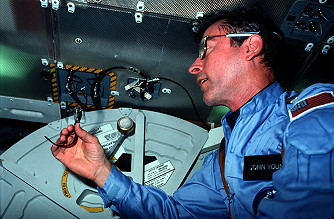
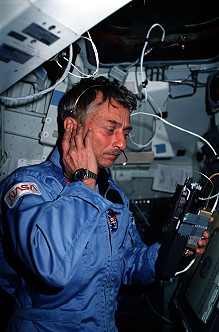
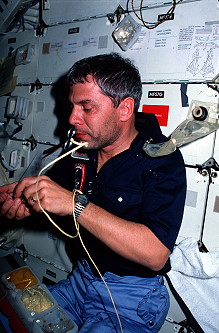
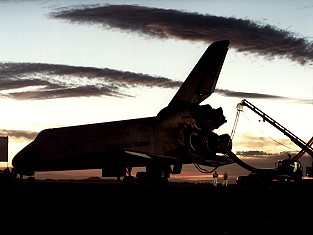
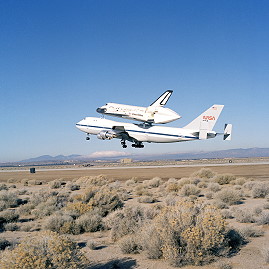
17. The launch occurred after a 1-month delay because of technical reasons. Ulf Merbold was the first non-American in a Space Shuttle. STS-9 carried the first crew of six persons and became the first mission of the ESA sponsored Spacelab (Spacelab 1, SL-1). The ninth flight of the Space Shuttle, STS-9/Spacelab 1, was an international space research expedition. It marked the maiden flight of the newest element of the Space Transportation System, the European Space Agency (ESA)-developed laboratory called Spacelab. Spacelab was designed, developed, funded and built by the European Space Agency as Europe's contribution to the United States Space Transportation System. It represents a European investment of approximately $1 billion. Spacelab is a reusable, research laboratory facility. When carried in the payload bay of the Space Shuttle orbiter, it converts the Shuttle into a versatile, on orbit research center. Spacelab consists of two major elements: a pressurized, habitable laboratory called a module, in which scientists can work without cumbersome space suits; and unpressurized platforms called pallets designed to support instruments such as telescopes, sensors and antennas which require direct exposure to space. These elements may be used separately or in various combinations, returned to earth, and reused on other flights. The module comes in two 4-meter (13.1-foot) diameter sections -- a core segment and an experiment segment. The core segment houses data processing equipment and utilities for the module and pallets when both are flown together. It also has laboratory fixtures such as air-cooled, standard 48.26-centimeter (19-inch) experiment racks, a work bench, and provision for accommodating a high-quality window/viewport assembly for optical experiments and photography. The second section, called the experiment segment, provides further pressurized work area, space for additional experiment racks, and provision for mounting either the window assembly or a scientific airlock designed to enable the crew to expose experiments carried in the module to the space environment. The core segment can be flown by itself, in what is called the short module configuration, or coupled in tandem with the experiment segment in the long module configuration. The short module measures 4.26 m (15.4 ft.) in length overall and consists of the core segment and two cone-shaped end sections. The long module, including end cones, is 7 m (23 ft.) long. When the habitable module is flown, a 1-m (3.3-ft.) diameter enclosed passageway called the Spacelab Transfer Tunnel, connects the module with the mid-deck of the orbiter. The tunnel can be assembled in two lengths. A 2.7-m (8.7-ft.) tunnel can be used for missions during which the module is carried in the forward portion of the payload bay. A 5.8-m (18.8-ft.) tunnel can be used for missions on which the module is carried in the aft portion of the bay. Spacelab pallets are U-shaped aluminum frame and panel structures 4 m (13.1 ft.) wide and 3 m (10 ft.) long. Heavy equipment is mounted on the pallet frame using a series of connectors called hard points. Light weight equipment can be mounted directly onto the panels. As many as five Spacelab pallets can be flown in the cargo bay, individually or with two or three linked together to form trains. When pallets are flown without the module, the subsystems necessary for experiment operation are contained in a pressurized cylinder called an "igloo". When no module is flown, payload specialists operate the experiments from the aft flight deck of the Shuttle orbiter. The shuttle's crew was divided into two teams, each working 12-hour shifts for the duration of the mission. John Young, Robert Parker and Ulf Merbold formed the Red Team, while Brewster Shaw, Owen Garriott and Byron Lichtenberg made up the Blue Team. Usually, the commander and the pilot team members were assigned to the flight deck, while the mission and payload specialists worked inside the Spacelab. Spacelab 1 was a multi-disciplinary mission of more than 70 experiments in five areas of scientific research: Astronomy and Solar Physics; Space Plasma Physics; Atmospheric Physics and Earth observations; Life Sciences; and Materials Science. There were 38 different experiment facilities. Sixteen of the 38 experiments required to conduct investigations are situated on the pallet and 20 in the module. Two of the 38 experiments have components both on the pallet and in the module. Some of the experiments on the pallet and in the module operated automatically, while others were operated from the ground or by the crew remotely through the computer or by means of controls located on the instrument front panels. Other experiments in the module are operated directly by the crew. The investigations in astronomy and solar physics studied astronomical sources of radiation in the ultraviolet and X-Ray wavelengths, performing both surveys and detailed studies of specific objects. The solar experiments measured the energy output of the sun using three different methods, with a view to quantitative measurement of variations in the solar energy output or "solar constant". Spacelab 1 carried a group of telescopes, cameras and other detectors that can see the sun and stars with greater clarity than normally possible from ground-based observatories. The five space plasma physics experiments on Spacelab 1 measured and characterize the magnetized, electrified gas or plasma in the earth's upper atmosphere (ionosphere). These experiments studied the plasma envelope which surrounds the earth and investigate key cause-and-effect relationships that couple the earth's magnetosphere and atmosphere. Some involved emitted beams of charged particles into space and measure the resultant changes in the environment. Others created artificial aurorae that help to explain how natural particle beams carry energy from the solar wind and the magnetosphere into the earth's atmosphere. The atmospheric physics investigators performed studies of the earth's environment through surveys of temperature, composition and motion of the atmosphere. These investigations will employ remote sensing and imaging techniques to study the emissions or absorptions from the atmospheric gases to determine their sources, flow patterns and decay mechanisms. The Earth observations experiments demonstrated advanced measuring systems which will be used on future Spacelab missions. There were six atmospheric physics and earth observations experiments on Spacelab 1. A large film metric camera produced high-resolution photographs for possible use in making better maps. A microwave remote sensing facility on Spacelab 1 will provide all-weather radar viewing of the earth's surface, regardless of cloud cover. The life sciences investigations were concerned with the effects of the space environment (microgravity and hard radiation) on human physiology and on the growth, development, and organization of biological systems. Two experiments will study the effects of direct exposure to space on biological materials. In this low-gravity environment a special category of experiments will probe the interaction between man's vestibular system and the brain, with a view to understanding the causes of space motion sickness (Space Adaptation Syndrome) and providing information that can be used in more general aspects of vestibular research on earth. Another set of experiments assessed the effects of radiation and weightlessness on other organisms. In particular, scientists were interested in possible disturbances of cell growth, development and organization. New "mapping" techniques were used to measure the level of space radiation that penetrates the wall of the Spacelab module. Bacteria and other microbes on Spacelab 1 were examined after the flight to determine the biological hazards of exposure to ambient ultraviolet and cosmic radiation. Observations of sunflower seedlings and fungi growing in Spacelab 1 were yield new information on plant growth patterns normally influenced by gravity and 24-hour circadian rhythms. The 36 material sciences experiments tested low-gravity techniques for processing materials. These experiments took advantage of the microgravity conditions to perform studies in such areas as tribology, fluid physics, crystal growth and metallurgy. A Material Sciences Double Rack facility was carried on the flight. It contained furnaces and other equipment that were be shared by investigators from 10 European countries. Most of the experiments used the facility for studies of crystal growth, fluid physics, chemistry and metallurgy. The effort went so well that the mission was extended an additional day to 10 days, making it the longest duration Shuttle flight to that date. Short time before reentry two guidance computer crashed, but one of them was successfully rebooted. Just before landing two of the three auxiliary power units (APU's) caught fire due to a hydrazine leak, but the landing was successful. The leak was later discovered after it burned itself out and caused major damage to the compartment. |
Photos / Graphics
 |
 |
|
source of all photos is NASA |
|
 |
 |
|
photo courtesy J.L. Pickering |
|
 |
 |
 |
 |
 |
 |
 |
 |
 |
 |
 |
 |
 |
 |
 |
 |
| © |  |
Last update on June 21, 2023.  |
 |