Human Orbital Spaceflights

International Flight No. 204STS-91Discovery (24)91st Space Shuttle missionUSA |
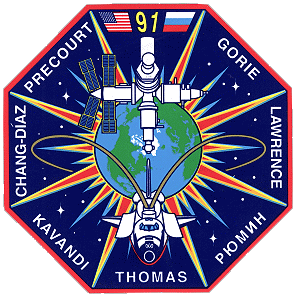 |
 |
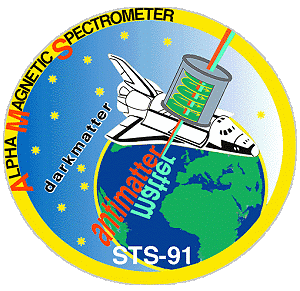 |
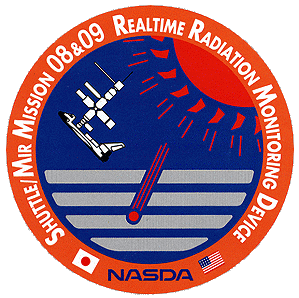 |
Launch, orbit and landing data
walkout photo |
 |
||||||||||||||||||||||||||||||||
alternative crew photo |
|||||||||||||||||||||||||||||||||
alternative crew photo |
|||||||||||||||||||||||||||||||||
alternative crew photo |
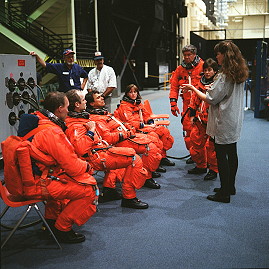
Crew
| No. | Surname | Given names | Position | Flight No. | Duration | Orbits | |
| 1 |  |
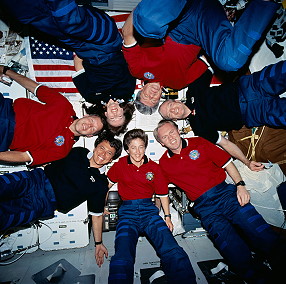
Precourt | Charles Joseph | CDR | 4 | 9d 19h 53m 53s | 155 |
| 2 | |
Gorie | Dominic Lee Pudwill | PLT | 1 | 9d 19h 53m 53s | 155 |
| 3 | |
Chang-Diaz | Franklin Ramon | MS-1, EV-1, PLC | 6 | 9d 19h 53m 53s | 155 |
| 4 | |
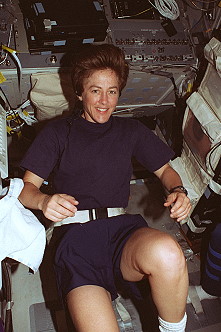
Lawrence | Wendy Barrien | MS-2, RMS, FE | 3 | 9d 19h 53m 53s | 155 |
| 5 | |
Kavandi | Janet Lynn | MS-3, EV-2 | 1 | 9d 19h 53m 53s | 155 |
| 6 |  |
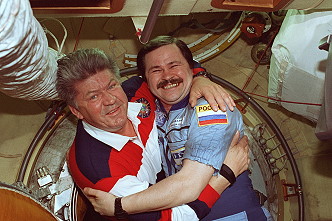
Ryumin | Valeri Viktorovich | MS-4 | 4 | 9d 19h 53m 53s | 155 |
Crew seating arrangement
|
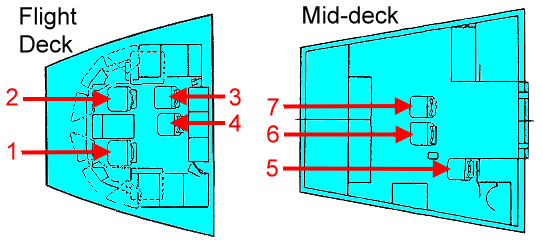 |
|
||||||||||||||||||||||||||||||||
Hardware
| Orbiter : | OV-103 (24.) |
| SSME (1 / 2 / 3): | 2047-2A (1.) / 2040-1 (4.) / 2042-1 (3.) |
| SRB: | BI-091 / RSRM 66 |
| ET: | ET-96 (SLWT-1) |
| OMS Pod: | Left Pod 01 (27.) / Right Pod 03 (25.) |
| FWD RCS Pod: | FRC 3 (24.) |
| RMS: | 201 (15.) |
| EMU: | EMU No. 3011 (PLSS No. 1011) / EMU No. 3014 (PLSS No. 1014) |
Flight
|
Launch from Cape Canaveral (KSC) and
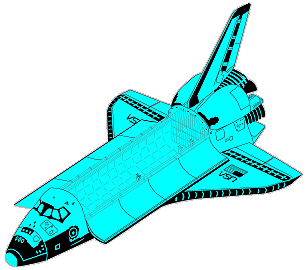
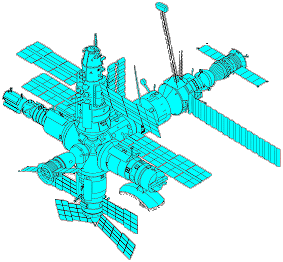
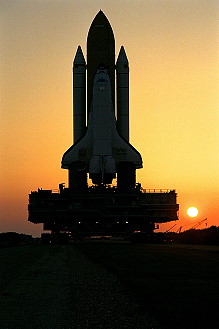
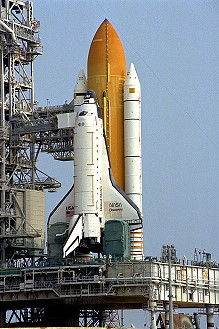
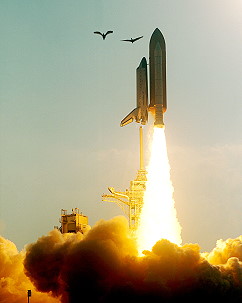
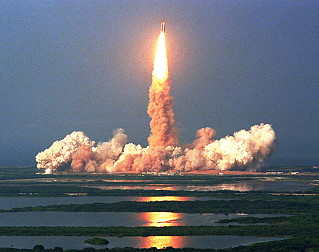
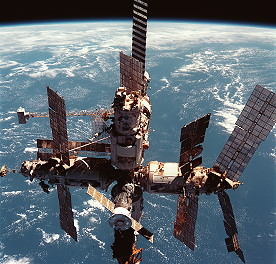
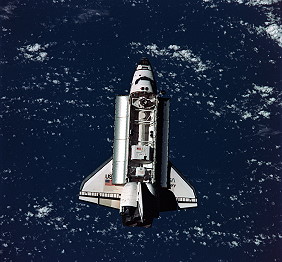
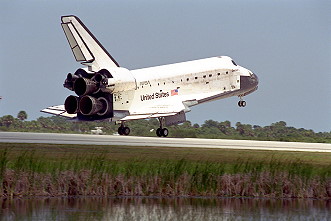
landing on Cape Canaveral (KSC), Runway 15. The mission was the first to use the super lightweight external tank (SLWT) which was the same size, at 154 feet (47 m) long and 27 feet (8.2 m) in diameter, as the external tank used on previous launches, but 7,500 pounds (3,400 kg) lighter. The tank was made of an aluminum lithium alloy and the tank's structural design had also been improved making it 30 percent stronger and 5 percent less dense. The walls of the redesigned hydrogen tank were machined in an orthogonal waffle-like pattern, providing more strength and stability than the previous design. These improvements would later provide additional payload capacity to the International Space Station. STS-91 marked the 9th and final Mir docking mission. The first phase of the cooperative effort in space exploration between the United States and Russia was completed in June 1998 with the launch of Space Shuttle Discovery on the ninth and final docking mission with the Russian space station Mir. The flight delivered logistics and supplies to Mir and brought home NASA Astronaut Andrew Thomas, who has been on the Russian complex since late January 1998. STS-91 was the first time Discovery docked with the Mir. The first eight docking missions were conducted by Atlantis and Endeavour. The prior Shuttle-Mir missions were STS-71, STS-74, STS-76, STS-79, STS-81, STS-84, STS-86 and STS-89. Flying on STS-91 was an experiment by Nobel laureate Dr. Samuel C. C. Ting, the Alpha Magnetic Spectrometer (AMS) experiment. In 1995, Dr. Ting's research proposal for the AMS space experiment was formally selected by the U.S. Department of Energy. The AMS flew for the first time on the STS-91 mission and a second time on the International Space Station. Professor Ting has been among the world's leading researchers in the field of high-energy particle physics for decades. He has received many awards and honors for his research, including the Nobel Prize in Physics in 1976 for the discovery of the "J" subatomic particle. For the STS-91 mission, Discovery carried the single SPACEHAB module in the payload bay of the orbiter. The module housed experiments to be performed by the astronauts and serves as a cargo carrier for the items to be transferred to Mir and those to be returned to Earth. The current Russian cosmonaut crew aboard Mir began its mission on January 31, 1998 when Mir-25 Commander Talgat Musabayev and Flight Engineer Nikolai Budarin were launched from the Baikonur Cosmodrome in Kazakhstan along with French Research Cosmonaut Léopold Eyharts on board of Soyuz TM-27. They arrived on Mir on January 31, 1998. Léopold Eyharts returned to Earth three weeks later with Mir-24 cosmonauts Anatoli Soloviyov and Pavel Vinogradov. Talgat Musabayev and Nikolai Budarin returned to Earth on August 25, 1998 when they were replaced by the Mir-26 crew of Commander Gennadi Padalka, Flight Engineer Sergei Avdeyev and Research Cosmonaut Yuri Baturin, who were launched on board Soyuz TM-28 on August 12, 1998 for a docking on August 15, 1998. Discovery's rendezvous and docking with the Russian space station Mir actually began with the precisely timed launch of the Shuttle on a course for the Mir, and, over the next two days, periodic small engine firings that gradually brought Discovery to a point eight nautical miles (14.8 km) behind Mir on docking day, the starting point for a final approach to the station. About two hours before the scheduled docking time on Flight Day Three of the mission, Discovery reached a point about eight nautical miles (14.8 km) behind the Mir space station and conducted a Terminal Phase Initiation (TI) burn, beginning the final phase of the rendezvous. Discovery closed the final eight nautical miles (14.8 km) to Mir during the next orbit. As Discovery approaches, the shuttle's rendezvous radar system began tracking Mir and providing range and closing rate information to Discovery. Discovery' crew also began air-to-air communications with the Mir crew using a VHF radio. As Discovery reached close proximity to Mir, the Trajectory Control Sensor, a laser ranging device mounted in the payload bay, supplemented the shuttle's onboard navigation information by supplying additional data on the range and closing rate. As Discovery closed in on the Mir, the shuttle had the opportunity for four small successive engine firings to fine-tune its approach using its onboard navigation information. Identical to prior Mir dockings, Discovery aimed for a point directly below Mir, along the Earth radius vector (R-Bar), an imaginary line drawn between the Mir center of gravity and the center of Earth. Approaching along the R-Bar, from directly underneath the Mir, allows natural forces to assist in braking Discovery approach. During this approach, the crew began using a handheld laser ranging device to supplement distance and closing rate measurements made by other shuttle navigational equipment. The manual phase of the rendezvous began just as Discovery reached a point about a half-mile (900 meters) below Mir. Commander Charles Precourt flew the shuttle using the aft flight deck controls as Discovery began moving up toward Mir. Because of the approach from underneath Mir, Charles Precourt had to perform very few braking firings. However, if such firings were required, the Shuttle's jets were used in a mode called "Low-Z", a technique that uses slightly offset jets on Discovery' nose and tail to slow the spacecraft rather than firing jets pointed directly at Mir. This technique avoids contamination of the space station and its solar arrays by exhaust from the shuttle steering jets. Using the centerline camera fixed in the center of Discovery' docking mechanism, Charles Precourt centered Discovery' docking mechanism with the Docking Module mechanism on Mir, continually refining this alignment as he approached within 300 feet (91.4 meters) of the station. At a distance of about 170 feet (51.8 meters) from docking, Charles Precourt stopped Discovery and held stationkeep momentarily to adjust the docking mechanism alignment, if necessary. At that time, a final go or no-go decision to proceed with the docking was made by flight control teams in both Houston and Moscow. When Discovery proceeded with docking, the shuttle crew used ship-to-ship communications with Mir to inform the Mir crew of the Shuttle's status and to keep them informed of major events, including confirmation of contact, capture and the conclusion of damping. Damping, the halt of any relative motion between the two spacecraft after docking, was performed by shock absorber-type springs within the docking device. Mission Specialist Wendy Lawrence had to oversee the operation of the Orbiter Docking System from onboard Discovery. Docking of Discovery to Mir, the first for that orbiter, occurred at 16:01 UTC, June 04, 1998 at an altitude of 208 miles (385 km). Hatches opened at 18:34 UTC the same day. At hatch opening, Andrew Thomas officially became a member of Discovery's crew as MS-5, completing 130 days of living and working on Mir. The transfer wrapped up a total of 907 days spent by seven U.S. astronauts aboard the Russian space station as long-duration crew members. The Mir-25 and STS-91 crews transferred more than 500 kilograms (1,100 lb) of water, and almost 2,130 kilograms (4,700 lb) of cargo experiments and supplies were exchanged between the two spacecraft. During this time, long-term U.S. experiments aboard the Mir were moved into Discovery’s middeck locker area and the SPACEHAB single module in the orbiter’s payload bay, including the Space Acceleration Measurement System (SAMS) and the tissue engineering co-culture (COCULT) investigations, as well as two crystal growth experiments. The crews also conducted Risk Mitigation Experiments (RMEs) and Human Life Sciences (HLS) investigations. The SPACEHAB module accommodates various quantities, sizes, and locations of experiment hardware. Attachment locations were available on the bulkheads, the rack support structures and on the top exterior surfaces. Standard experiment accommodations included lockers and racks, and for Earth and space viewing, there was the capability to mount to the optical viewport on the module top panel. Also, there were attachment capabilities on the flat top of the module exterior, in order to provide direct access to space. Russian Logistics - A double rack was dedicated to some of the Russian Logistics and three Russian Storage Batteries were mounted on the aft bulkhead of the SPACEHAB module for transfer to Mir. During docked operations, the crew removed the batteries and transferred them to Mir. Numerous Russian Logistics items, totaling approximately 2,600 pounds (1,179 kg), were carried in the SPACEHAB. Items included food and water containers, clothing and sleeping articles, Personal Hygiene Aids (PHAS), a variety of film cases, and Cosmonaut Return Packages. American Logistics - Water (1200 lbs.) was transferred from the Shuttle to Mir; a cosmonaut family package, phase 1 program gifts and crew gifts were transferred from the Shuttle to Mir; and new film was swapped for film already shot onboard Mir. Science and Technology - The SPACEHAB Universal Communication System (SHUCS) payload was used to send and receive telephone voice and faxes, as well as provided video images of the crew from the SPACEHAB module, to test the improved availability of payload uplink and downlink communications with the ground. On STS-91, the crew had scheduled voice and fax contacts that are pre-approved by the Flight Control Team. SHUCS "round-trip" latency of 0.7 - 1.2 seconds allows file transfer, commanding, up/downlink fax and voice communications globally via three ground stations and the INMARSAT satellite system. The American long duration astronauts performed the majority of the experiment operations while on orbit, while their Russian counterparts primarily concerned themselves with station upkeep and maintenance. All were equal contributors to the joint program and have dedicated their time during intensive training in both the US and Russia, as well as by staying on board the Mir for several months. Norman Thagard was the American who took the first step in this era of joint space cooperation by staying onboard the Mir for 116 days (which set the space duration record for an American). He was also the first astronaut to travel to Mir on a Soyuz rocket, with his Mir-18 crewmates. Norman Thagard was followed by Shannon Lucid, who stayed on the Mir for 188 days, breaking Norman Thagard's record and setting a new record as the longest stay in space for a woman. John Blaha replaced Shannon Lucid in September 1996. Jerry Linenger replaced John Blaha in January 1997. Michael Foale replaced Jerry Linenger in May 1997 and he was replaced by David Wolf in September 1997. Andrew Thomas replaced David Wolf in January 1998, and remained on Mir until June 1998, when STS-91 retrieved him. These American crewmembers' stays on Mir have demonstrated to the world the commitment of both countries to work together for the betterment of human kind through scientific advancement. The KU-band system failure was determined to be located in a component that was not accessible to the crew. The failure prevented television transmission throughout the mission. Television broadcasts from Mir were prevented by a problem between a Russian ground station and the mission control center outside of Moscow, limiting communications to audio only on NASA television. Several secondary payloads: The Space Acceleration Measurement System (SAMS) and the tissue engineering co-culture (COCULT) investigations, as well as two crystal growth experiments. A prototype of the Alpha Magnetic Spectrometer (AMS) was carried. It was designed to look for dark and missing matter in the universe. Data originally planned to be sent to ground stations through Discovery’s KU-band communications system was recorded on board because of a problem with the KU-band system that prevented it from sending high-rate communications, including television signals, to the ground. The system was able to receive uplink transmissions. On June 03,1998 the crew was able to set up a bypass system that allowed AMS data to be downlinked via S-band/FM communications when the orbiter came within range of a ground station. Data that could not be recorded by ground stations was recorded on board throughout the mission. Other experiments conducted by the Shuttle crew during the mission included a checkout of the orbiter’s robot arm to evaluate new electronics and software and the Orbiter Space Vision System for use during assembly missions for the ISS. Also on-board, in the payload bay were eight Get Away Special experiments, while combustion, crystal growth and radiation monitoring experiments were conducted in Discovery’s mid-deck crew cabin area. The Astroculture (ASC) flight experiment was a space-based controlled environment chamber that provided all the conditions required to support plant growth in microgravity. The main payload components included subsystems required to provide temperature, humidity, and carbon dioxide control in an isolated chamber. A unique LED lighting system was used to meet plant light requirements. Ethylene released by the plants is removed from the atmosphere of the plant chamber with a photocatalytic oxidation unit that does not require any consumables. The ASC payload was configured as a standard Priroda locker and contained a single board computer which provided data download and video observation/recording capabilities. The Astroculture unit was transferred to the Mir during the docked phase of STS-89. The ASC system was designed to operate in a fully automated mode with continuous power. The NASA crewmember performed a daily monitoring of the ASC, as well as, a weekly download and downlink of plant data and video from the ASC. Crew interaction with ASC was done via the MIPS System, built-in LCD displays and LED indicators, and ASC Video System. The ASC remained on orbit until the unit was returned on STS-91. The XDT experiment was flown in an effort to understand the high energy radiation environment of space. The XDT system consisted of three detectors which measured the incidence rate of cosmic rays and induced background levels expected for future x-ray crystallography systems to be flown in the International Space Station. Besides the detectors, it included a microcomputer system and flash disk mass storage devices to allow virtually autonomous operations during several months of data-taking on-board Mir. The Alpha Magnetic Spectrometer (AMS) experiment was the first time a high energy particle magnetic spectrometer was placed in orbit. As high energy physicists continue to prove the fundamental laws that govern our universe, they ask such basic questions as: What are the ultimate building blocks of matter? What are the fundamental forces through which these basic particles interact? Fifteen Nobel Prizes in Physics have gone to high energy physicists for their discoveries. In 1995, Department of Energy-funded scientists found the top quark, the last to be discovered of the basic particles believed to make up all known matter. The AMS continued this scientific journey of discovery in a region here to date untapped by high energy physics research, the environment of space. The space environment provided a copious flux of atomic and subatomic particles which have been naturally accelerated to energies which are impossible to achieve in Earth bond accelerators. The AMS provided the first In-situmagnetic detector of these particles and will open a unique and rich new area of experimental high energy physics. On STS-91, a group of eminent scientists in the field who reviewed AMS for the department unanimously endorsed its scientific merit. Researchers used the detector to search for both antimatter and "dark matter" to answer two specific questions: First, if equal amounts of matter and antimatter were produced at the beginning of the universe as described by the Big Bang scenario, and the galaxies we now see are made only of matter, where has the antimatter gone? Second, since the mass of a galaxy seems to be greater than the visible mass of all its stars, gas and dust, is there dark matter of a new kind that has eluded discovery? The Alpha Magnetic Spectrometer was a particle detector that weighed 3-½ tons and consisted of five major elements: a permanent magnet, time-of-flight scintillators, a silicon microstrip tracker, anti-coincidence counters and an aerogel Cerenkov threshold counter. The AMS also had electronics, a support structure and interfaces to computers on the Space Shuttle and at Johnson Space Center. The permanent magnet was a cylindrical shell made of blocks of magnetic material called neodymiumferrous-boron. The blocks were arranged around the cylinder to create a magnetic field confined inside the magnet. The trajectory that a particle takes when it enters the magnetic field allows researchers to determine its charge. The SSCE series of experiments were designed to characterize flame spreading in microgravity and its differences from normal gravity behavior, leading to a better understanding of the physical processes involved. The knowledge gained is expected to enhance our understanding of fire behavior, both in space and on Earth. On Earth, gravity causes hot gases produced by flames to rise in the same way that oil floats on water, or helium balloons rise. Air flow induced by gravity is called buoyant convection. This convection brings fresh oxygen to meet the fuel vapor coming from the burning material. The spread rate of the flame is directly affected by the rate at which the fuel and oxygen are mixed with the help of buoyant convection. Once Discovery was ready to undock from Mir, the initial separation was performed by springs that gently pushed the shuttle away from the docking module. Both the Mir and Discovery were in a configuration called "free drift" during the undocking, which keeps the steering jets of each spacecraft shut off to avoid any inadvertent firings. Once the docking mechanism's springs had pushed Discovery away to a distance of about two feet (61 centimeters) from Mir, and the two spacecraft were clear of one another, Discovery' steering jets were turned back on to increase the separation distance between the two vehicles. The shuttle continued to back away through a corridor similar to that used during approach until it reached a distance of approximately 240 feet (73.2 meters) below the Mir. Pilot Dominic Gorie then performed a nose forward flyaround of the station. During the flyaround, about 20 minutes after undocking, Discovery reached a point about 240 feet (73.2 meters) directly in front of the Mir, on what is known as the velocity vector. About three minutes prior to sunrise, Mir-25 Commander Talgat Musabayev and Flight Engineer Nikolai Budarin released a tracer gas comprised of acetone and biacetyl into the depressurized Spektr module using a special device attached to the Spektr's modified hatch. The release of gas into Spektr lasted about 20 minutes, enabling Discovery's astronauts to document any ionization glow from the gas through the hole in Spektr's hull prior to sunrise and any fluorescent glow from the gas after sunrise. The gas should appear as a dull green cloud. The test was designed to pinpoint the location of the breach in Spektr's hull resulting from last year's collision of a Progress resupply ship with the Russian station. Two days earlier, a similar release of gas into Spektr were conducted by the cosmonauts while Discovery was docked to Mir to test the gas release system and enable the crew members to document any areas of special interest for the flyaround experiment. Both experiments failed. Finally, almost an hour and a half after undocking, Dominic Gorie fired Discovery's jets one more time as the shuttle passed directly above the Mir to separate from the Russian station for the final time. |
Photos / Graphics
 |
 |
 |
 |
 |
 |
 |
 |
 |
 |
 |
 |
 |
 |
 |
 |
 |
 |
| © |  |
Last update on March 27, 2020.  |
 |