Human Orbital Spaceflights

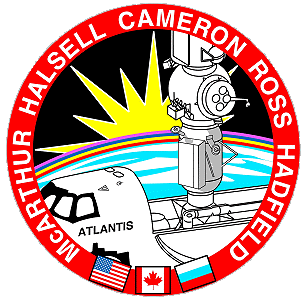
International Flight No. 181STS-74Atlantis (15)73rd Space Shuttle missionUSA |
 |
 |
 |
||
Launch, orbit and landing data
walkout photo |
 |
||||||||||||||||||||||||||||||||
alternative crew photo |
|||||||||||||||||||||||||||||||||
alternative crew photo |
Crew
| No. | Surname | Given names | Position | Flight No. | Duration | Orbits | |
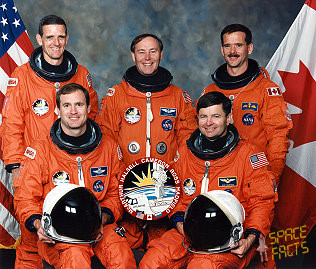
| 1 |  |
Cameron | Kenneth Donald | CDR | 3 | 8d 04h 30m 44s | 128 |
| 2 | |
Halsell | James Donald, Jr. | PLT | 2 | 8d 04h 30m 44s | 128 |
| 3 |  |
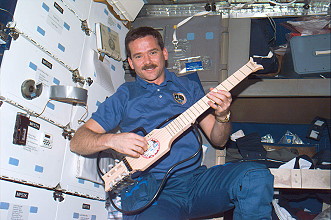
Hadfield | Chris Austin | MS-1, RMS | 1 | 8d 04h 30m 44s | 128 |
| 4 | |
Ross | Jerry Lynn | MS-2, EV-1, FE | 5 | 8d 04h 30m 44s | 128 |
| 5 | |
McArthur | William Surles, Jr. "Bill" | MS-3, EV-2 | 2 | 8d 04h 30m 44s | 128 |
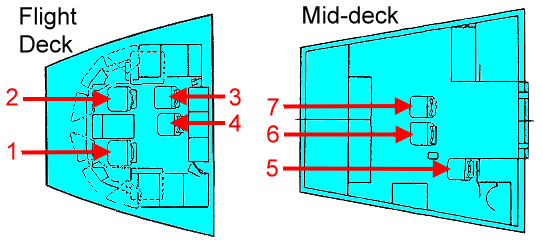
Crew seating arrangement
|
 |
|
||||||||||||||||||||||||
Hardware
| Orbiter : | OV-104 (15.) |
| SSME (1 / 2 / 3): | 2012 (17.) / 2026 (5.) / 2032 (4.) |
| SRB: | BI-076 / RSRM 51 |
| ET: | ET-74 (LWT-67) |
| OMS Pod: | Left Pod 03 (19.) / Right Pod 04 (15.) |
| FWD RCS Pod: | FRC 4 (15.) |
| RMS: | 301 (13.) |
| EMU: | EMU No. 2035 (PLSS No. 1015) / EMU No. 2038 (PLSS No. 1008) |
Flight
|
Launch from Cape Canaveral (KSC) and
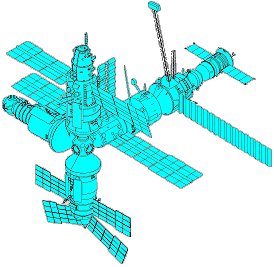
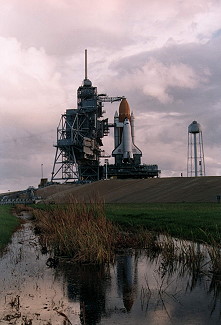
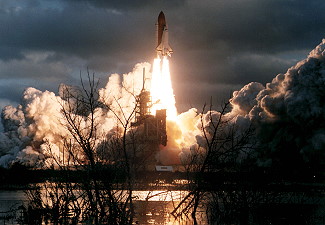
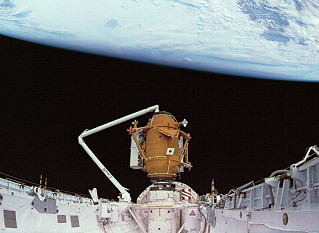
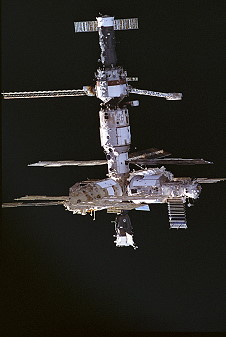
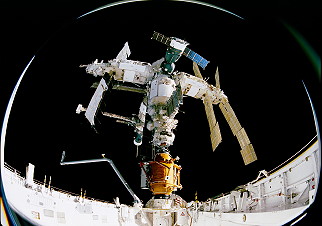
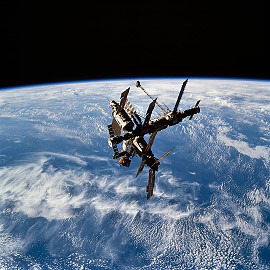
landing on Cape Canaveral (KSC), Runway 33. The launch was scheduled for November 11, 1995 but was cancelled due to poor weather at the Transatlantic Abort (TAL) site. It was the second time that a launch was delayed due to the weather at the TAL site. This first one was STS-61C. STS-74 was a Space Shuttle Atlantis mission to the Mir space station. It was the fourth mission of the US/Russian Shuttle-Mir Program, and it carried out the second docking of a space shuttle to Mir. The mission delivered the Russian-built Mir Docking Module to the station along with a pair of solar arrays, and was the second in a series of seven straight missions to the station flown by Atlantis. This mission marked the first-time astronauts from the European Space Agency, Canada, Russia and the U.S. were in space on the same complex at one time - a prime example of nations that will be represented on the International Space Station. Mir was the first space station designed for expansion. The 20.4-ton Core Module, Mir's first building block, was launched in February 1986. The Core Module provided basic services (living quarters, life support, power) and scientific research capabilities. It had two axial docking ports, fore and aft, for Soyuz TM manned transports and automated Progress M supply ships, plus four radial berthing ports for expansion modules. Until STS-74, the Russians had added four expansion modules to the Mir core: Kvant: Berthed at the core module's aft axial port in 1987, the module weighed 11 tons and carried telescopes and equipment for attitude control and life support. Kvant2: Berthed at a radial port since 1989, the module weighed 19.6 tons and carried an EVA airlock, two solar arrays, and science and life support equipment. Kristall: Berthed opposite Kvant2 in 1990, Kristall weighed 19.6 tons and carried two stowable solar arrays, science and technology equipment, and a docking port equipped with a special androgynous docking mechanism designed to receive heavy (up to about 100 tons) spacecraft equipped with the same kind of docking unit. The androgynous unit was originally developed for the Russian Buran Shuttle program. Atlantis used the androgynous docking unit on Kristall. Spektr: Launched on a Russian Proton rocket from the Baikonur launch center in central Asia, Spektr was lofted into orbit on May 20, 1995. The module was berthed at the radial port opposite Kvant2 after Kristall was moved out of the way. Spektr carried four solar arrays and scientific equipment (including more than 1600 pounds (726 kg) of U.S. equipment). STS-74's rendezvous and docking with the Russian space station Mir actually began with the precisely timed launch of Atlantis on a course for the station, and, over the next four days, periodic small engine firings that gradually brought Atlantis to a point eight nautical miles (14.8 km) behind Mir, the starting point for a final approach to the station. The day before docking, the crew unberthed and installed the docking module scheduled to be left permanently attached to the Mir. Prior to installation operations, several preliminary spacewalk preparations were completed by the crew to shorten the amount of time required to begin a spacewalk in case one is needed to assist with the docking module installation. These included depressurizing the crew cabin to 10.2 pounds per square inch (50.3 kilopascal) and performing a standard checkout of spacesuit equipment early in the flight. Also, on Flight Day three, the Shuttle middeck was prepared for a spacewalk in case one is required. The extravehicular activity crew members were Mission Specialists Jerry Ross and William McArthur. However, Jerry Ross and William McArthur did not begin donning any spacesuit gear unless a spacewalk will be actually deemed necessary. The Russian-built Docking Module (DM), carried aloft by Atlantis and left attached to the Kristall module of the Mir space station, was designed to allow Shuttle-Mir dockings with the Kristall module located at the Mir radial port. Without the DM, Kristall would have to be moved to the longitudinal axis of Mir to provide clearance for each Shuttle docking. The longitudinal axis location was undesirable for Kristall because the longitudinal port was normally a location for Progress resupply modules and Soyuz spacecraft. In addition, it was not desirable to continually move the Kristall from port to port in preparation for a Shuttle docking. The DM was 15.4 feet (4.7 meters) long from tip to tip of the identical Androgynous Peripheral Docking Systems (APDS) located on either end. For identification purposes, APDS-1 was the system that was attached to Kristall and APDS-2 was attached to Atlantis. The DM diameter was 7.2 feet (2.2 meters), and the module weighed approximately 9,011 pounds (4,087 kg). The DM was constructed of aluminum alloy covered on the exterior by Screen Vacuum Thermal Insulation (SVTI) and a micrometeoroid shield over the body of the module. A truss structure was attached to the module to provide latching to the Shuttle while horizontal in the cargo bay, and the truss remained attached to the module after the cargo bay latches were released and the DM was unberthed. On the exterior of the module, two Mir solar array containers were attached to transport solar arrays to the Mir. The solar array containers were attached on either side of the top of the module as it was situated while in the cargo bay of Atlantis. The solar arrays will be removed from the containers and attached to the Mir during a spacewalk by the Mir cosmonauts after STS-74. The two solar arrays were different types. One was called the Cooperative Solar Array (CSA) and was built as a cooperative effort between NASA and Russia. The other was a Russian Solar Array (RSA). The Cooperative Solar Array used Russian structures and NASA photovoltaic modules and was designed as part of the Phase 1 operations of the International Space Station Program. The array was expected to provide greater power and longer life expectancy over existing arrays and will help to power U.S. experiments aboard the Mir. To install the docking module on Flight Day three, Mission Specialist Chris Hadfield first maneuvered Atlantis' mechanical arm into position to attach to a grapple fixture mounted on the module. Next, latches were released that have held the module horizontal in the payload bay for launch, and Chris Hadfield lifted the module out of the bay. Above the bay, he rotated the module to a vertical position. Chris Hadfield then began to precisely align the docking system at the end of the module with the Orbiter Docking System (ODS) on Atlantis. During this operation, the Orbiter Space Vision System (OSVS), a precise alignment system for the mechanical arm that was being tested on STS-74, was evaluated as well. The OSVS, a Detailed Test Objective on STS-74, consisted of a series of large dots placed on the exterior of the docking module and the ODS. Using digitized television camera views of the dots, the OSVS generated a display on a laptop computer aboard the Shuttle that indicated alignment both graphically and digitally. William McArthur had to oversee operations of the OSVS during the module installation. For the installation, Chris Hadfield, using a view from a camera mounted in the center of the ODS, slowly lowered the docking module toward the ODS, aligning it at a point about 30 inches (76.2 centimeters) above Atlantis' docking mechanism and pausing at that point. Next, he lowered it to a point only five inches above the docking ring. Atlantis' reaction control system jets were turned off during these operations to avoid any inadvertent movement of the arm and module. To engage the docking mechanism, Chris Hadfield put the arm into a test mode that essentially turns off brakes on the joints and left them free to move. With the arm in this limp mode, Commander Kenneth Cameron reactivated Atlantis' steering jets and fired a short downward pulse to move Atlantis the final few inches to the module and engage the docking mechanism. Once the module was installed, it was pressurized and leak checks were performed. Once these are complete, the arm was detached from the module and moved to an extended park position overnight, and the centerline camera was moved up to be mounted in the center of the module's docking mechanism. About two hours before the scheduled docking time on Flight Day Four of the mission, Atlantis reached a point about eight nautical miles (14.8 km) behind the Mir space station. Just prior to that time, the mechanical arm was moved from the extended park position to a poised for docking position, extended out from the right-hand side of Atlantis. This position allowed the arm's elbow camera, a camera mounted at the middle arm joint, to use by the crew for a lateral view of the docking mechanism and Mir approach. Also about this time, Atlantis' crew began air-to-air communications with the Mir-20 crew. At a point eight nautical miles (14.8 km) behind Mir, a Terminal Phase Initiation (TI) burn was fired and the final phase of the rendezvous began. Atlantis closed the final eight nautical miles (14.8 km) to Mir during the next orbit. As Atlantis closed in, the Shuttle's rendezvous radar system began tracking Mir and providing range and closing rate information to Atlantis. As Atlantis closed the final eight nautical miles (14.8 km), the Shuttle had the opportunity for four small successive engine firings to fine-tune its approach using its onboard navigation information. Identical to the STS-71 Mir rendezvous, Atlantis aimed for a point directly below Mir, along the Earth radius vector (R-Bar), an imaginary line drawn between the Mir center of gravity and the center of Earth. Approaching along the R-Bar, from directly underneath the Mir, allowed natural forces to brake Atlantis' approach more than would occur along a standard Shuttle approach from directly in front of Mir. During this approach, the crew will began using a handheld laser-ranging device to supplement distance and closing rate measurements made by Shuttle navigational equipment. Also, as Atlantis reached close proximity to Mir, the Trajectory Control Sensor, a laser-ranging device mounted in the payload bay, did supplement the Shuttle's onboard navigation information by supplying additional data on the range and closing rate. The manual phase of the rendezvous began just as Atlantis reached a point about a half-mile (900 meters) below Mir when Kenneth Cameron took the controls. Kenneth Cameron flew the Shuttle using the aft flight deck controls as Atlantis began moving up toward Mir. Because of the approach along the R-bar, from underneath Mir, Kenneth Cameron had to perform very few braking firings. However, if such firings are required, the Shuttle's jets will be used in a mode called "Low-Z", a technique that uses slightly offset jets on Atlantis' nose and tail to slow the spacecraft rather than firing jets pointed directly at Mir. This technique avoids contamination of the space station by exhaust from the Shuttle steering jets. Using the centerline camera fixed in the center of the module's docking mechanism, Kenneth Cameron centered the module docking device with the Mir docking device, continually refining this alignment as he approached within 170 feet (51.8 meters) of the station. At 170 feet (51.8 meters), Kenneth Cameron stopped the approach while Mir maneuvered into docking attitude. After consulting with Russian flight controllers, NASA flight controllers gave Kenneth Cameron permission to continue in. At a distance of about 30 feet (9.14 meters) from docking, Kenneth Cameron performed stationkeep momentarily to adjust the docking mechanism alignment if necessary. From that point on, the crew used ship-to-ship communications with Mir constantly to inform the station crew of the Shuttle's status and keep them informed of major events, including confirmation of contact, capture and conclusion of damping. Damping, the halt of any relative motion between the spacecraft after docking, was performed by springs and motors within the docking device. Due to the length of the docking module, the elbow camera on the mechanical arm provided the only direct view for Atlantis' astronauts of the docking mechanism's operation during the final docking sequence. The docking occurred on November 15, 1995. During three days of joint operations, astronauts and cosmonauts transferred the American biomedical and microgravity science samples and data collected by the Mir-18, Mir-19, and Mir-20 resident crews, from the space station to the Shuttle. After return to Earth, the information was analyzed by researchers on the ground. Included in the items being returned were some samples from an ongoing European Space Agency mission - continuing the international cooperation in space that will carry on into the future. Crew members also transferred hardware and supplies to Mir for future biomedical and environmental investigations. Data and samples gathered from those investigations will be retrieved during future Shuttle/Mir missions. All materials gathered during STS-74, and other planned missions, will provide important information in the design, development, and operation of future space stations. Water, food, and science instruments were transferred to Mir for resupply and to support experiments to be conducted on board the space station by the resident Mir-20 crew and the following Mir-21 crew in early 1996. American astronaut Shannon Lucid is then scheduled to launch on the Shuttle (STS-76) in March 1996, and join the Mir-21 crew to continue these investigations that will focus on life sciences, microgravity science, space science, Earth science and technology. Water samples collected from Mir were returned to Earth for analysis to help determine its purity. The Mir Source and Reclaimed Waters investigations provided researchers with information to be used in designing, developing, and evaluating water purification units for the ISS. Samples of Mir's potable, reclaimed hygiene water, unprocessed hygiene water, and humidity condensate all was analyzed postflight to determine their chemical and microbiological characteristics. The Greenhouse Integrated Plant Experiment began with the Mir-19 crew and was continued by the resident Mir-20 crew. The studies, which were expected to be complete prior to the arrival of Atlantis, were designed to study how plants grow in microgravity and determine how space flight affects plant reproduction, metabolism and productivity. This investigation provided data that could validate the use of oxygen-generating plants in an advanced life support system for future space stations. Meanwhile, flying aboard Atlantis was the GPP payload which consisted of two experiments – the GPP experiment and the Photogrammetric Appendage Structural Dynamics Experiment (PASDE). The payload was managed by Goddard Space Flight Center's Special Payloads Division. The GPP studied the Earth's thermosphere, ionosphere and mesosphere energetics and dynamics using broadband spectroscopy. GPP also studied spacecraft interactions with the atmosphere by observing shuttle and Mir glow, shuttle engine firings, water dumps and fuel cell purges. Star tracker systems and inertial measurement units were integral to the navigation systems of both the Mir and the Shuttle. The Shuttle/Mir Alignment Stability Experiment entails multiple three-hour data collection periods during the docked phase when navigational-dependent events occur (i.e. thruster firings, IMU alignments, or inertial attitude hold). These data were used to determine the stability of, and sources of any instability between, the Shuttle and Mir navigation systems while the two vehicles were docked. Characterization of Shuttle/Mir relative alignment stability enabled mission planners to determine the feasibility of transferring attitude data between Shuttle and Mir, or Shuttle and the International Space Station. Three PASDE canisters, located throughout the cargo bay, also photogrammetrically recorded structural response data of the Mir solar arrays during the docked phase of the mission. This data was later analyzed on the ground to verify the use of photogrammetric techniques to characterize the structural dynamics of the array, thus demonstrating that this technology would result in cost and risk reduction for the International Space Station. During the STS-74 mission, the crew used an IMAX Cargo Bay Camera (ICBC) to document Atlantis' rendezvous and docking with the Mir station. After the mission, selected still images from the film were made available to the public via the Internet. Sections of the film were transferred to videotape and were broadcasted on NASA-TV. The IMAX Cargo Bay Camera was a space-qualified, 65 mm color motion picture camera system consisting of a camera, lens assembly, and a film supply magazine containing approximately 3500 feet of film and an empty take-up magazine. The camera was housed in an insulated, pressurized enclosure with a movable lens window cover. The optical center line of the 30 mm camera lens was fixed and pointed directly out of the payload bay along the Orbiter Z axis with a 23-degree rotation towards the Orbiter nose. Heaters and thermal blankets provided proper thermal conditioning for the camera electronics, camera window and film magazines. As part of the Shuttle Amateur Radio Experiment (SAREX) students in the United States and other countries had a chance to speak via amateur radio with astronauts aboard the Space Shuttle Endeavour during STS-74. Ground-based amateur radio operators ("hams") were able to contact the Shuttle through automated computer-to-computer amateur (packet) radio links. There also were voice contacts with the general ham community as time permitted. Shuttle Commander Kenneth Cameron (call sign KB5AWP) and mission specialists Jerry Ross (N5SCW), William McArthur (KC5ACR), Chris Hadfield and James Halsell talked to students in five schools in the United States using "ham radio". After three days of common flight, the separation occurred. Once Atlantis was ready to undock from Mir, the initial separation was performed by springs that slightly pushed the Shuttle away from the docking mechanism. Both the Mir and Atlantis were in a mode called "free drift" during the undocking, a mode that has the steering jets of each spacecraft shut off to avoid any inadvertent firings. Once the docking mechanism's springs had pushed Atlantis away to a distance of about two feet (61 centimeters) from Mir - when the docking devices were clear of one another - Kenneth Cameron turned Atlantis' steering jets back on. Immediately thereafter, he slightly fired the Shuttle's jets in the Low-Z mode to begin moving very slowly away from Mir. Atlantis continued away from Mir to a distance of about 400 feet (121.9 meters), where James Halsell began a flyaround of the station. At that distance, Atlantis circled Mir twice, the crew performing a photographic survey of Mir, before firing its jets again to depart the vicinity of the station. |
Photos / Graphics
 |
 |
 |
 |
 |
 |
 |
 |
 |
 |
 |
 |
 |
| © |  |
Last update on March 27, 2020.  |
 |