Human Orbital Spaceflights

International Flight No. 202Soyuz TM-27KristallRussia |
 |
 |
Launch, orbit and landing data
walkout photo |
 |
|||||||||||||||||||||||
alternative crew photo |
alternative crew photo |
|||||||||||||||||||||||
alternative crew photo |
alternative crew photo |
|||||||||||||||||||||||
alternative crew photo |
alternative crew photo |
|||||||||||||||||||||||
Crew
| No. | Surname | Given names | Position | Flight No. | Duration | Orbits | |
| 1 |  |
Musabayev | Talgat Amangeldyyevich | Commander | 2 | 207d 12h 49m 02s | 3284 |
| 2 | |
Budarin | Nikolai Mikhailovich | Flight Engineer | 2 | 207d 12h 49m 02s | 3284 |
| 3 |  |
Eyharts | Léopold Paul Pierre | Research Cosmonaut | 1 | 20d 16h 35m 48s | 325 |
Crew seating arrangement
|
 |
|
||||||||||||||||
Backup Crew
|
 |
||||||||||||||||||||
alternative crew photo |
Hardware
| Launch vehicle: | Soyuz-U (No. S15000-657) |
| Spacecraft: | Soyuz TM-27 (7K-STM No. 76) |
Flight
|
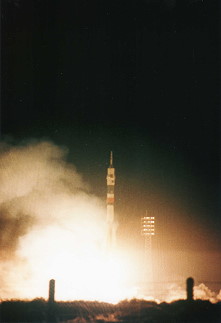
Launch from the Baikonur Cosmodrome and
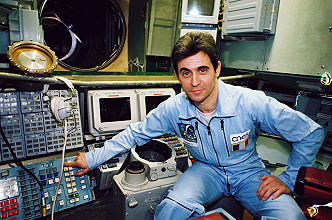
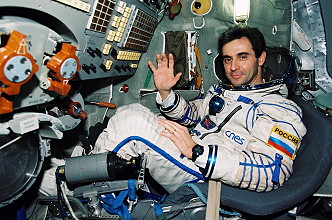
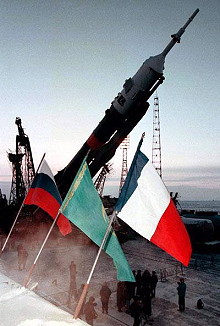
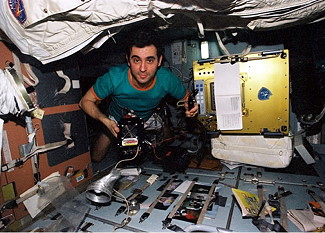
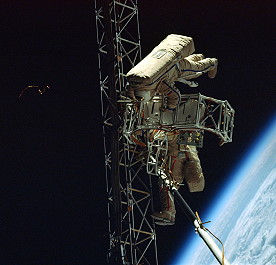
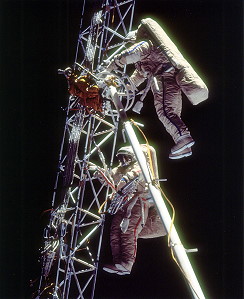
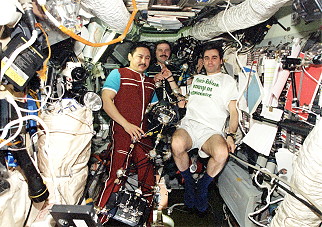
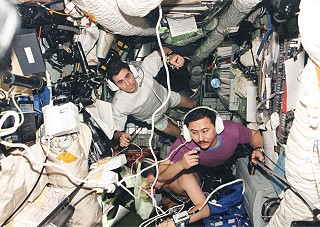
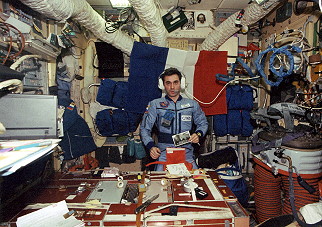
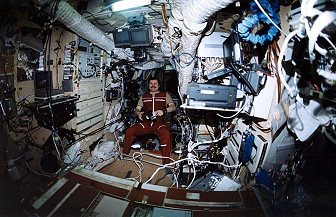
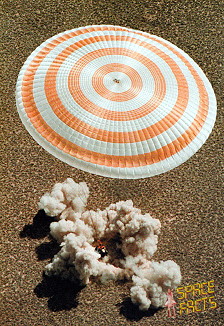
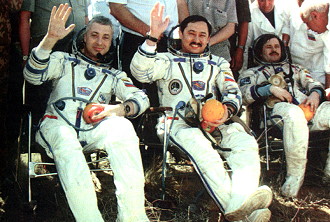
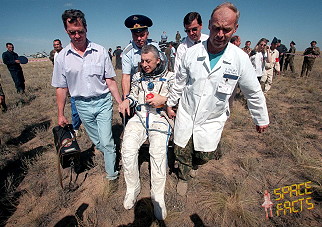
landing 145 km east of Dzheskasgan. The current Russian cosmonaut crew aboard Mir began its mission on January 31, 1998 when Mir-25 Commander Talgat Musabayev and Flight Engineer Nikolai Budarin were launched from the Baikonur Cosmodrome in Kazakhstan along with French Research Cosmonaut Léopold Eyharts on board of Soyuz TM-27. They arrived on Mir on January 31, 1998. Léopold Eyharts returned to Earth three weeks later with Mir-24 cosmonauts Anatoli Soloviyov and Pavel Vinogradov. Talgat Musabayev and Nikolai Budarin returned to Earth on August 25, 1998 when they were replaced by the Mir-26 crew of Commander Gennadi Padalka, Flight Engineer Sergei Avdeyev and Research Cosmonaut Yuri Baturin, who were launched on board Soyuz TM-28 on August 12, 1998 for a docking on August 15, 1998. NASA and the Russian Space Agency had hoped Soyuz TM-27 could dock with Mir while STS-89 Endeavour was still there, resulting in an on-board crew of 13, a record which would have stood for years or decades. But the French vetoed this, saying the commotion and time wasted would ruin Léopold Eyharts Pegase experimental program. Soyuz TM-27 docked at the Kvant module port at 17:54 UTC on January 31, 1998, less than five hours before Endeavour landed in Florida. Progress M-37 had to free the aft docking port (Kvant1 +X axis) for the Soyuz TM-27 and when it was clear that all went well with that transport ship Progress M-37 separated from Mir on January 30, 1998 at 12:50:30 UTC. Initially there were no plans for a redocking, but as long as the Russians did not make a final decision Progress M-37 flew autonomously. The advantage of the occupation of the aft docking port by a ship is a better thermo-protection of the docking mechanism of that port and the additional possibility for the crew to get rid off stuff which is no longer needed. First in the focus was the French mission "PEGASE". The crew worked on common scientific experiments. Anatoli Soloviyov and Pavel Vinogradov together with Léopold Eyharts undocked from the -X port on Mir at 05:52 UTC on February 19, 1997 aboard Soyuz TM-26. The spacecraft fired its deorbit engines at 08:16 UTC and the craft landed in Kazakhstan. Redocking of Soyuz TM-27 from aft to forward port place on February 20, 1998 between 08:47 and 09:32 UTC during a window in which the Soyuz TM-27 via Mir could communicate with TsUP via Altair-2. Talgat Musabayev was steered the Soyuz TM-27. In fact, this was not a flight around the Mir complex but after the undocking of Soyuz TM-27 at 08:47:45 UTC Talgat Musabayev brought his ship in a safe station keeping distance from the complex. He reported the distances in meters. The maximum distance was reported approximately 60 meters. As soon as Soyuz TM-27 was far enough from Mir the complex executed a rotation of 180 degrees in the horizontal plane (Z-axis). In this way the aft docking port turned away and Soyuz TM-27 came in a position right in front of the forward (-X-axis, transition section) port. This meant just a minimal fuel consumption for Soyuz TM-27. Regretfully something went wrong with the communications. From the outset there was a very stable link via Altair-2, but this ceased at 09:06:10 UTC. At that moment Mir and Soyuz TM-27 were not yet in range of Russian tracking stations and so the crew and TsUP were unable to contact each other. The window for the use of Altair-2 was open until 09:33 UTC. The communications via Altair-2 were not restored before 09:33 UTC and so later on they had to use 121.750 mc for direct contact with Russian tracking stations. Here they also encountered problems. For the crew this was an unpleasant experience. The official statement spoke about the fact that there had been something wrong with the relay between Mir and Altair-2. Probably wrong commands for the transmitter selection played a role. At 09:32 UTC Talgat Musabayev manually accomplished the soft touch. This touch was so smooth that a surprised Andrew Thomas was still waiting for the 'bump' when the docking had already taken place. After returning on board Mir they met other problems: the crew had to work on the life support systems. They switched on the Elektron oxygen generators in Kvant2 as well as in Module-E (Kvant1). There were problems with a Vozdukh CO2 scrubber, a pressure meter in the Kvant1 and an air pressure equalization valve in the transition section (P.Kh.O.). On February 23, 1998 Progress M-37 flawlessly docked at the aft docking port (+X axis Kvant1) at 09:43:27 UTC. Approach and docking were executed in the automatic mode by the system Kurs. Before the final phase of the approach Talgat Musabayev extensively tested the TORU system. At 09:04:30 UTC he reported that he switched off the TORU system and that the result of the test was positive. Opening of the hatch was scheduled for 10:20 - 10:30 UTC. After the opening of the hatch of Progress M-37 some orbits later a strong terrible smell came out the freighter. Possibly a bag or container with garbage had gone open. The crew decided to set the hatch to the Progress ajar. A planned EVA by Talgat Musabayev and Nikolai Budarin on March 03, 1998 was cancelled, because the hatch could not be opened and all wrenches broke. At 02:32 UTC Talgat Musabayev and Nikolai Budarin were in the Sh.S.O. (the unserviceable airlock) as their attempts to open the airlock had failed. To open the hatch, they had to unlock 10 locks. They unlocked 9 of them, but the last one had been fixed so tightly that Nikolai Budarin had to use extreme strength to do that. Doing this he broke all 3 available spanners. Immediately after getting in touch with TsUP Talgat Musabayev reported that they last of the 10 locks hampered the continuation of the operation and that Nikolai Budarin had broken all 3 spanners. The heads of the spanners broke off and floated away. Talgat Musabayev told that he started repressurising the P.N.O. to enable them to take off their spacesuits. He added that this day was not a festive day at all. The launch of freighter Progress M-38 from Baikonur took place on March 14, 1998 at 22:45:55 UTC. The most important cargo is the VDU. This is the external thruster which has to be installed in the Sofora mast on Kvant1 during one of the EVA's in the future. The new VDU will replace the old one which almost run out of fuel. Under the cargo is a new lock for the EVA hatch of Kvant2, the necessary tools for the repair of that hatch and of course the normal cargo: food, post and some other convenient items for the crew. The docking took place on March 17, 1998 at 00:31:17 UTC. The last 20 meters and the docking itself were manually executed by Talgat Musabayev with the system TORU. Progress M-38 was regularly used to support the attitude control of the Mir complex. The old freighter Progress M-37 separated from Mir on March 15, 1998 at 19:16:01 UTC and burned up in the atmosphere east of New Zealand at 23:03:46 UTC. The first EVA was performed by Talgat Musabayev and Nikolai Budarin on April 01, 1998 (6h 40m). Main objective was to repair the damaged Spektr solar panel. Handrails were installed near the panel but the crew could not complete the work before the scheduled time ran out. The cosmonauts worked energetically. Talgat Musabayev observed Nikolai Budarin, instructed him what to do and warned him if he moved to fast or came too close to obstacles. He spoke with Andrew Thomas to tell him how and from where to make photographs and video. Andrew Thomas regularly reported temperatures inside Mir varying between 32 and 37 degrees Celsius. Meanwhile the spacewalkers enjoyed the cool temperatures in their spacesuits. For their transport Talgat Musabayev observed Nikolai Budarin used the Strela crane. The package with the handrails which they had to install at the outside of the Spektr module had been placed outside Mir during one of the EVA's of Anatoli Soloviyov. They spoke about the 'Soloviyov package'. Unpacking, deploying and installing of these handrails lasted much longer than was expected and so there was no time left for the reinforcement of the damaged solar panel of Spektr by a beam. They also had to install 2 foot restraints for future work at Spektr. They succeeded in stalling just one of those restraints. At 19:12 UTC there was a gruesome event: Nikolai Budarin called Talgat Musabayev, but he did not get a reaction. After a few minutes the voice of Talgat Musabayev showed up again. He reported that he had switched off the power supply of his spacesuit by accident. Thus, he lost all functions: cooling, communication, ventilation, distillation, etc. The second spacewalk occurred on April 06, 1998 (4h 23m). The crew accomplished the main task: the strengthening of the lateral structure of the damaged solar panel on module Spektr. They succeeded in fastening the 1.5 meters long splint. The cosmonauts had to use every effort and the work lasted longer than planned. They had to work under very unfavorable circumstances. Due to a malfunction of a ground facility for the Altair-2 satellite they did not have this satellite at their disposal and the quality of the communications via tracking stations was bad. So, in fact there were two reasons to cut short the EVA: tired cosmonauts and unwarranted communication gaps. But the cosmonauts did not want to stop and the authorities on earth badly needed an EVA which was 100% successful. And then there emerged a 3rd reason to stop: the roll (movement along the X-axis) of the station had to be adjusted to align the complex with the sun. This had to be done with the VDU (the external thruster in the Sofora mast). The experts still expected to have some drops of fuel, but there was nothing left. It was impossible to use an alternative: the thrusters of the module Priroda, as the only person who could give the command for that operation, Andrew Thomas, was not trained to do so. The unfavorable angle of the complex towards the sun was risky for a lack of power supply might influence the functioning of the gyrodynes and cause other imponderabilia. So, the spacewalkers got orders to return to the air-lock and do that quickly, because they had to be on board to be able to take measures to take care of the attitude correction. Talgat Musabayev and Nikolai Budarin performed the third EVA on April 11, 1998 (6h 25m). The cosmonauts began a series of three EVAs to install the new VDU station orientation engine (delivered by Progress M-38) into the Sofora boom. On this first spacewalk they disconnected the old engine (in use for six years) and pushed it into space. Talgat Musabayev continuously advised Nikolai Budarin about his movements and how he had to steer the Strela boom, but also warned him for obstacles, for instance solar panels. Talgat Musabayev did not forget Andrew Thomas who was on duty inside Mir. He asked him whether he was seeing them or not and told him to make videos and photos. A minor glitch was the bad performance of Nikolai Budarin's receiver, but he solved this problem by using his back-up system. Sometimes the cosmonauts had to unwrap safety lines and cables, but this did not hamper the progress of the EVA. Their mood was excellent and they even had time to enjoy the good sight of the Sahara and other territories on earth. At 12:25 UTC it was clear that they almost achieved the main goal of the EVA: dismantling and pushing away the old VDU (the external thruster in the top of the Sofora boom). At 12:27 UTC Talgat Musabayev told Andrew Thomas that he had to be ready to observe and film a very special event: the launch into open space of the VDU. Don't go away during the next 5 minutes. It lasted somewhat longer before TsUP gave permission for the actual push as they had to be sure that all cables and safety lines were disconnected. Exactly at 12:35 UTC this permission came and Talgat Musabayev told Andrew Thomas at 12:35:20 UTC: we push him away, 1, 2, 3, 4 Do you see him moving away? For a while Andrew Thomas could see the jettisoned VDU, but was not able to keep the leaving VDU in sight somewhat longer. The cosmonauts also repaired an outlet valve of the Elektron oxygen generator in Module E (Kvant1). As long as the new VDU is not operational the control of the roll will be done by steering rockets of the Priroda module. The fourth EVA by the same cosmonauts was conducted on April 17, 1998 (6h 33m). The main goal of this EVA was the dismantling and pushing away the old VDU (the external thruster in the top of the Sofora boom). The transfer of Talgat Musabayev and the packages with equipment was done with the use of the Strela boom steered by Nikolai Budarin. The operation started with the dismantling of 2 truss structures: the Rapana and the so-called 3rd truss. The 3rd truss was folded up and installed on the outer surface of the Kvant1 module. The original plan to jettison the Rapana into open space was abandoned and this truss also was parked horizontally on the outer surface. (Obviously they refrained from this launch to keep the Rapana available for future use.) Then the cosmonauts went to the Progress M-38 and unlocked the bolts which had been prevented the new VDU from autonomous adventures. Further the VDU was raised by telecommands from earth. The VDU had to be inclined from the Progress M-38 to an angle of 35 degrees. The cosmonauts had to help the VDU to reach that angle for the automatic regime did not function during the last few degrees. When the inclination reached 35 degrees the cosmonauts secured the VDU in that starting point for their work during the 5th EVA. The fifth EVA again by Talgat Musabayev and Nikolai Budarin occurred on April 22, 1998 (6h 21m). Two truss structures on the Kvant module and the new Sofora VDU station orientation engine assembly was unlatched from Progress M-38. The crew installed the new VDU in the top of the Sofora boom and connected the cables. Between 10:28 and 10:46 UTC Talgat Musabayev reported the numbers of the cables he had connected. At 10:48 UTC he told TsUP that they had accomplished their tasks. There had been an order or request to do something else, but TsUP told them to do this during a possible next EVA. In May 1998 the new external thruster has been fully implemented in the attitude control of the Mir complex. When the gyrodynes have to be reset to their initial settings, the VDU takes over the control of the roll (movements around the X-axis). The fact that the VDU has been used could be derived from radio traffic. When the cosmonauts load a quaternion command the VDU will be used. (Quaternion is the coefficient of 2 vectors). In preparation for the departure and decay of the Progress M-38 in the evening of May 16, 1998 the cosmonauts stowed as much garbage and useless goods and equipment in this old freighter. In fact, this freighter was not fully suited for that purpose due to the modification necessary for the delivery of the new VDU thruster. TsUP had sent a list with instructions for the stowage, but the cosmonauts want to add a lot more: bags with used underwear and rags, containers with human waste, empty oxygen balloons of spacesuits, they even still have to get rid of remnants from previous expeditions. The man at TsUP was not authorized to give permission to do that, for there were plans to do some maneuvers with Progress M-38 after undocking and before decay. In fact, the crew had to observe these maneuvers visually. The cosmonauts said that this is always difficult, such slight movements of some degrees are difficult to observe and often the freighter quickly disappears over the horizon. The launch of Progress M-39 took place from Baikonur on May 14, 1998 at 22:12:59 UTC. The old freighter Progress M-38 was separated from Mir's aft docking port on May 15, 1998 at 18:44 UTC. As of 19:14 UTC TsUP executed some maneuvers with the autonomously flying Progress M-38. The cosmonauts had to observe and film 4 impulses of the engines of Progress M-38. This happened during a window via Altair-2 and Talgat Musabayev reported his findings to a Georgiy at TsUP. In the beginning Progress M-38 flew in front of Mir with a gradually increasing distance. The cosmonauts lost sight of the freighter, but between 19:44 and 19:52 UTC a number of observations were possible. At 19:51:03 UTC, just before one of the impulses they again lost sight of Progress M-38. At the moment of the burn at 19:51:38 UTC Progress M-39 was exactly below Mir and the crew were able to see the fan-shaped flames coming out of the Progress M-38. On May 16, 1998 at 23:50:34 UTC Progress M-39 docked at the aft (Kvant1) docking port. Approach and docking took place in the automatic mode by the system Kurs. After the docking of Progress M-39 at Mir the cosmonauts started the unloading of that freighter while Andrew Thomas already started the packing of 30 bags with things which will go to Earth with the Discovery. Andrew Thomas also tried to accomplish some of his experiments. After a very long time a failure of the attitude control computer occurred. On May 30, 1998, this computer failed, causing the well-known chain reaction, i.e. deterioration of the proper angles of sunlight on the solar panels, the reduction of power-supply, and so on. The crew had to use the attitude control possibilities of the Soyuz TM-27 to correct the station's attitude as efficient as possible to regain a part of the needed power-supply. On June 04, 1998 the Space Shuttle Discovery (STS-91) docked with the Mir. STS-91 marked the 9th and final Mir docking mission. The first phase of the cooperative effort in space exploration between the United States and Russia was completed in June 1998 with the launch of Space Shuttle Discovery on the ninth and final docking mission with the Russian space station Mir. The flight delivered logistics and supplies to Mir and brought home NASA Astronaut Andrew Thomas, who has been on the Russian complex since late January 1998. Docking of Discovery to Mir, the first for that orbiter, occurred at 16:01 UTC, June 04, 1998 at an altitude of 208 miles (385 km). Hatches opened at 18:34 UTC the same day. At hatch opening, Andrew Thomas officially became a member of Discovery's crew, completing 130 days of living and working on Mir. The transfer wrapped up a total of 907 days spent by seven U.S. astronauts aboard the Russian space station as long-duration crew members. The Mir-25 and STS-91 crews transferred more than 500 kilograms (1,100 lb) of water, and almost 2,130 kilograms (4,700 lb) of cargo experiments and supplies were exchanged between the two spacecraft. During this time, long-term U.S. experiments aboard the Mir were moved into Discovery's middeck locker area and the SPACEHAB single module in the orbiter's payload bay, including the Space Acceleration Measurement System (SAMS) and the tissue engineering co-culture (COCULT) investigations, as well as two crystal growth experiments. The crews also conducted Risk Mitigation Experiments (RMEs) and Human Life Sciences (HLS) investigations. The SPACEHAB module accommodates various quantities, sizes, and locations of experiment hardware. Attachment locations were available on the bulkheads, the rack support structures and on the top exterior surfaces. Standard experiment accommodations included lockers and racks, and for Earth and space viewing, there was the capability to mount to the optical viewport on the module top panel. Also, there were attachment capabilities on the flat top of the module exterior, in order to provide direct access to space. Russian Logistics - A double rack was dedicated to some of the Russian Logistics and three Russian Storage Batteries were mounted on the aft bulkhead of the SPACEHAB module for transfer to Mir. During docked operations, the crew removed the batteries and transferred them to Mir. Numerous Russian Logistics items, totaling approximately 2,600 pounds (1,179 kg), were carried in the SPACEHAB. Items included food and water containers, clothing and sleeping articles, Personal Hygiene Aids (PHAS), a variety of film cases, and Cosmonaut Return Packages. American Logistics - Water (1200 lbs.) was transferred from the Shuttle to Mir; a cosmonaut family package, phase 1 program gifts and crew gifts were transferred from the Shuttle to Mir; and new film was swapped for film already shot onboard Mir. Science and Technology - The SPACEHAB Universal Communication System (SHUCS) payload was used to send and receive telephone voice and faxes, as well as provided video images of the crew from the SPACEHAB module, to test the improved availability of payload uplink and downlink communications with the ground. On STS-91, the crew had scheduled voice and fax contacts that are pre-approved by the Flight Control Team. SHUCS "round-trip" latency of 0.7 - 1.2 seconds allows file transfer, commanding, up/downlink fax and voice communications globally via three ground stations and the INMARSAT satellite system. The Astroculture (ASC) flight experiment was a space-based controlled environment chamber that provided all the conditions required to support plant growth in microgravity. The main payload components included subsystems required to provide temperature, humidity, and carbon dioxide control in an isolated chamber. A unique LED lighting system was used to meet plant light requirements. Ethylene released by the plants is removed from the atmosphere of the plant chamber with a photocatalytic oxidation unit that does not require any consumables. The ASC payload was configured as a standard Priroda locker and contained a single board computer which provided data download and video observation/recording capabilities. The Astroculture unit was transferred to the Mir during the docked phase of STS-89. The ASC system was designed to operate in a fully automated mode with continuous power. The NASA crewmember performed a daily monitoring of the ASC, as well as, a weekly download and downlink of plant data and video from the ASC. Crew interaction with ASC was done via the MIPS System, built-in LCD displays and LED indicators, and ASC Video System. The ASC remained on orbit until the unit was returned on STS-91. The XDT experiment was flown in an effort to understand the high energy radiation environment of space. The XDT system consisted of three detectors which measured the incidence rate of cosmic rays and induced background levels expected for future x-ray crystallography systems to be flown in the International Space Station. Besides the detectors, it included a microcomputer system and flash disk mass storage devices to allow virtually autonomous operations during several months of data-taking on-board Mir. The shuttle STS-91 backed away through a corridor similar to that used during approach until it reached a distance of approximately 240 feet (73.2 meters) below the Mir. Pilot Dominic Gorie then performed a nose forward flyaround of the station. During the flyaround, about 20 minutes after undocking, Discovery reached a point about 240 feet (73.2 meters) directly in front of the Mir, on what is known as the velocity vector. About three minutes prior to sunrise, Mir-25 Commander Talgat Musabayev and Flight Engineer Nikolai Budarin released a tracer gas comprised of acetone and biacetyl into the depressurized Spektr module using a special device attached to the Spektr's modified hatch. The release of gas into Spektr lasted about 20 minutes, enabling Discovery's astronauts to document any ionization glow from the gas through the hole in Spektr's hull prior to sunrise and any fluorescent glow from the gas after sunrise. The gas should appear as a dull green cloud. The test was designed to pinpoint the location of the breach in Spektr's hull resulting from last year's collision of a Progress resupply ship with the Russian station. Two days earlier, a similar release of gas into Spektr were conducted by the cosmonauts while Discovery was docked to Mir to test the gas release system and enable the crew members to document any areas of special interest for the flyaround experiment. Both experiments failed. Finally, almost an hour and a half after undocking, Dominic Gorie fired Discovery's jets one more time as the shuttle passed directly above the Mir to separate from the Russian station for the final time. The transport ship Soyuz TM-28 with on board the crew for the 26th Main Expedition to Mir was launched from Baikonur on August 13, 1998 at 09:43:11 UTC. The crew consists of Gennadi Padalka and Sergei Avdeyev. Also on-board, was the politician Yuri Baturin who made a spaceflight of 12 days. To free the docking port for the arrival of Soyuz TM-28 the freighter Progress M-39 separated from Mir on August 12, 1998 at 09:28:55 UTC. The autonomous flight of Progress M-39 lasted until August 29, 1998 when Progress M-39 had to redock to the then again available docking port. Soyuz TM-28 docked at Mir's aft (+X-axis) docking port on August 15, 1998 at 10:56:52 UTC. The intention was to perform approach and docking in the automatic mode with the system Kurs, but at the distance of about 20 meters, when the approach speed was almost 0 M/sec., TsUP seemed to be unsure about the good functioning of the Kurs system and ordered Gennadi Padalka to take over the approach manually. From the distance of 12 meters Gennadi Padalka flawlessly steered his ship to the docking port and accomplished a perfect docking. Well done for a cosmonaut who makes his first spaceflight. He certainly deserved the so called 'manual docking bonus'. The Soyuz spacecraft is composed of three elements attached end-to-end - the Orbital Module, the Descent Module and the Instrumentation/Propulsion Module. The crew occupied the central element, the Descent Module. The other two modules are jettisoned prior to re-entry. They burn up in the atmosphere, so only the Descent Module returned to Earth. The deorbit burn lasted about 240 seconds. Having shed two-thirds of its mass, the Soyuz reached Entry Interface - a point 400,000 feet (121.9 kilometers) above the Earth, where friction due to the thickening atmosphere began to heat its outer surfaces. With only 23 minutes left before it lands on the grassy plains of central Asia, attention in the module turned to slowing its rate of descent. Eight minutes later, the spacecraft was streaking through the sky at a rate of 755 feet (230 meters) per second. Before it touched down, its speed slowed to only 5 feet (1.5 meter) per second, and it lands at an even lower speed than that. Several onboard features ensure that the vehicle and crew land safely and in relative comfort. Four parachutes, deployed 15 minutes before landing, dramatically slowed the vehicle's rate of descent. Two pilot parachutes were the first to be released, and a drogue chute attached to the second one followed immediately after. The drogue, measuring 24 square meters (258 square feet) in area, slowed the rate of descent from 755 feet (230 meters) per second to 262 feet (80 meters) per second. The main parachute was the last to emerge. It is the largest chute, with a surface area of 10,764 square feet (1,000 square meters). Its harnesses shifted the vehicle's attitude to a 30-degree angle relative to the ground, dissipating heat, and then shifted it again to a straight vertical descent prior to landing. The main chute slowed the Soyuz to a descent rate of only 24 feet (7.3 meters) per second, which is still too fast for a comfortable landing. One second before touchdown, two sets of three small engines on the bottom of the vehicle fired, slowing the vehicle to soften the landing. Soyuz TM-27 with on-board the relieved Mir-25 crew and the politician Yuri Baturin undocked from Mir on August 25, 1998 at 02:05 UTC and after a short autonomous flight the landing capsule (SA) made a safe landing in Kazakhstan at 05:22:44 UTC. The flight and the descent took place without problems. |
EVA data
| Name | Start | End | Duration | Mission | Airlock | Suit | Stripes | |
| IVA | Musabayev, Talgat | 03.03.1998, 01:30 UTC | 03.03.1998, 03:00 UTC | 1h 30m | Soyuz TM-27 | Mir - Kvant2 | Orlan-M No. 5 | red |
| IVA | Budarin, Nikolai | 03.03.1998, 01:30 UTC | 03.03.1998, 03:00 UTC | 1h 30m | Soyuz TM-27 | Mir - Kvant2 | Orlan-M No. 6 | blue |
| EVA | Budarin, Nikolai | 01.04.1998, 13:35 UTC | 01.04.1998, 20:15 UTC | 6h 40m | Soyuz TM-27 | Mir - Kvant2 | Orlan-M No. 6 | blue |
| EVA | Musabayev, Talgat | 01.04.1998, 13:35 UTC | 01.04.1998, 20:15 UTC | 6h 40m | Soyuz TM-27 | Mir - Kvant2 | Orlan-M No. 5 | red |
| EVA | Budarin, Nikolai | 06.04.1998, 11:27 UTC | 06.04.1998, 15:50 UTC | 4h 23m | Soyuz TM-27 | Mir - Kvant2 | Orlan-M No. 6 | blue |
| EVA | Musabayev, Talgat | 06.04.1998, 11:27 UTC | 06.04.1998, 15:50 UTC | 4h 23m | Soyuz TM-27 | Mir - Kvant2 | Orlan-M No. 5 | red |
| EVA | Budarin, Nikolai | 11.04.1998, 09:55 UTC | 11.04.1998, 16:20 UTC | 6h 25m | Soyuz TM-27 | Mir - Kvant2 | Orlan-M No. 6 | blue |
| EVA | Musabayev, Talgat | 11.04.1998, 09:55 UTC | 11.04.1998, 16:20 UTC | 6h 25m | Soyuz TM-27 | Mir - Kvant2 | Orlan-M No. 5 | red |
| EVA | Budarin, Nikolai | 17.04.1998, 07:40 UTC | 17.04.1998, 14:13 UTC | 6h 33m | Soyuz TM-27 | Mir - Kvant2 | Orlan-M No. 6 | blue |
| EVA | Musabayev, Talgat | 17.04.1998, 07:40 UTC | 17.04.1998, 14:13 UTC | 6h 33m | Soyuz TM-27 | Mir - Kvant2 | Orlan-M No. 4 | blue |
| EVA | Budarin, Nikolai | 22.04.1998, 05:34 UTC | 22.04.1998, 11:55 UTC | 6h 21m | Soyuz TM-27 | Mir - Kvant2 | Orlan-M No. 6 | blue |
| EVA | Musabayev, Talgat | 22.04.1998, 05:34 UTC | 22.04.1998, 11:55 UTC | 6h 21m | Soyuz TM-27 | Mir - Kvant2 | Orlan-M No. 4 | blue |
Note
Relocations of Manned Spacecrafts
| Spacecraft | from | Undocking | Time UTC | to | Redocking | Time UTC |
| Soyuz TM-27 | Mir - Kvant | 20.02.1998 | 08:47:45 | Mir - Baseblock | 20.02.1998 | 09:32:21 |
Photos / Graphics
 |
 |
 |
 |
 |
 |
 |
 |
 |
 |
 |
 |
 |
 |
 |
 |
more EVA photos |
|
| © |  |
Last update on January 29, 2023.  |
 |