Human Orbital Spaceflights

International Flight No. 189STS-79Atlantis (17)79th Space Shuttle missionUSA |
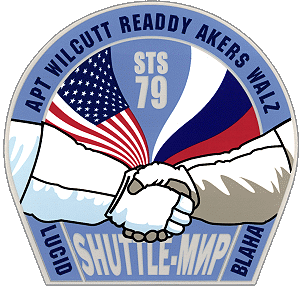 |
 |
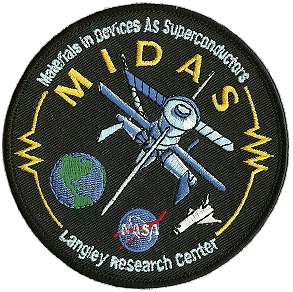 |
||
Launch, orbit and landing data
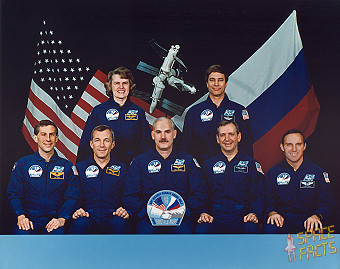
walkout photo |
 |
||||||||||||||||||||||||||||||||
alternative crew photo |
|||||||||||||||||||||||||||||||||
alternative crew photo |
Crew
| No. | Surname | Given names | Position | Flight No. | Duration | Orbits | |
| 1 |  |
Readdy | William Francis "Bill" | CDR | 3 | 10d 03h 18m 24s | 160 |
| 2 | |
Wilcutt | Terrence Wade | PLT | 2 | 10d 03h 18m 24s | 160 |
| 3 | |
Apt | Jerome "Jay" | MS-1, EV-2 | 4 | 10d 03h 18m 24s | 160 |
| 4 | |
Akers | Thomas Dale | MS-2, PLC, IV-1, FE | 4 | 10d 03h 18m 24s | 160 |
| 5 | |
Walz | Carl Erwin | MS-3, EV-1 | 3 | 10d 03h 18m 24s | 160 |
| 6 | |
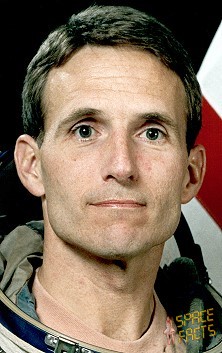
Blaha | John Elmer | MS-4 | 5 | 128d 05h 27m 55s | 2027 |
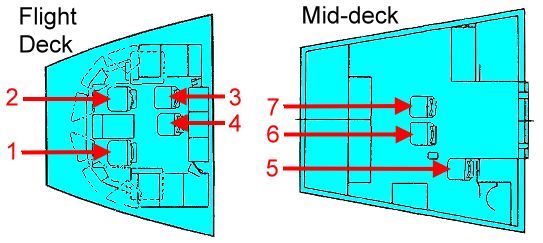
Crew seating arrangement
|
 |
|
||||||||||||||||||||||||||||
Backup Crew
|
 |
||||||||||
Hardware
| Orbiter : | OV-104 (17.) |
| SSME (1 / 2 / 3): | 2012 (18.) / 2031 (14.) / 2033 (8.) |
| SRB: | BI-083 / RSRM 56 |
| ET: | ET-82 (LWT-75) |
| OMS Pod: | Left Pod 03 (21.) / Right Pod 04 (17.) |
| FWD RCS Pod: | FRC 4 (17.) |
| RMS: | - |
| EMU: | EMU No. 3014 (PLSS No. 1014) / EMU No. 3011 (PLSS No. 1011) |
Flight
|
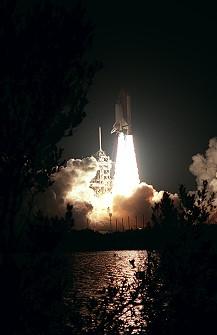
Launch from Cape Canaveral (KSC) and
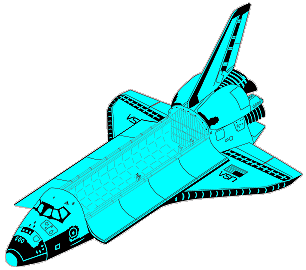
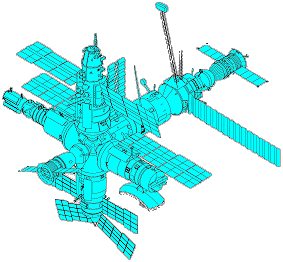
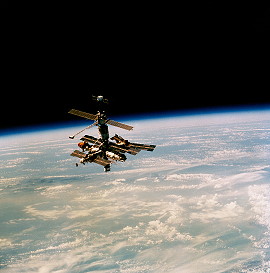
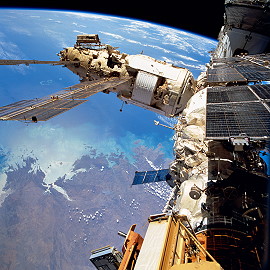
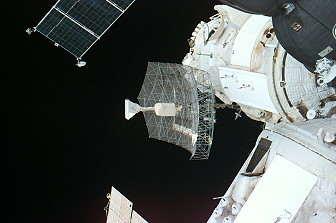
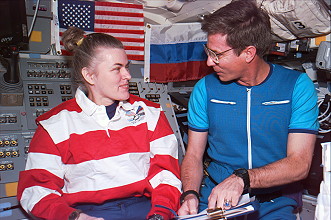
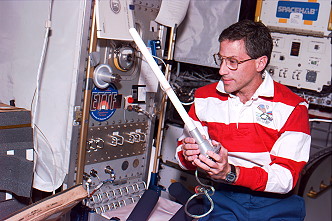
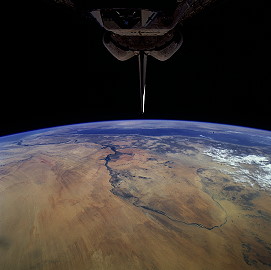
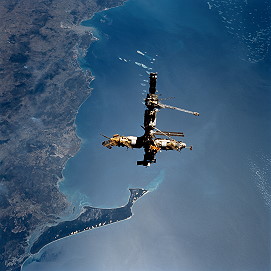
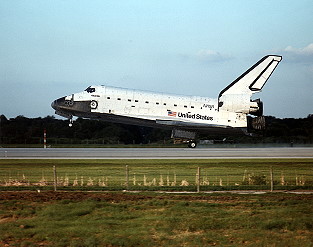
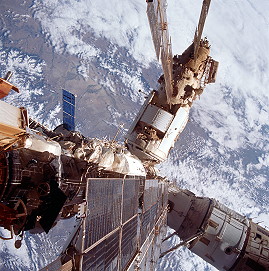
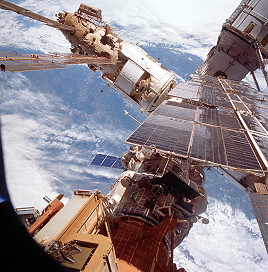
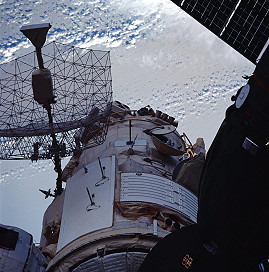
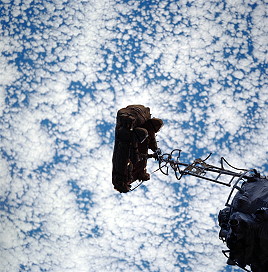
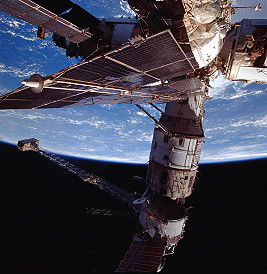
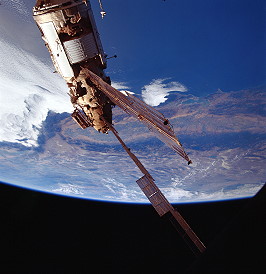
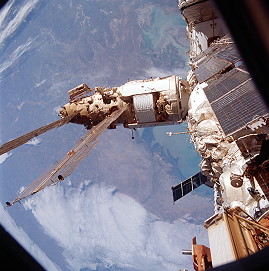
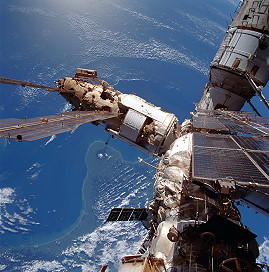
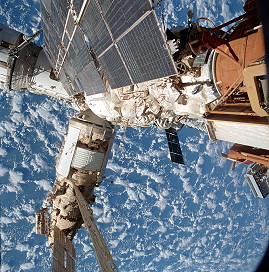
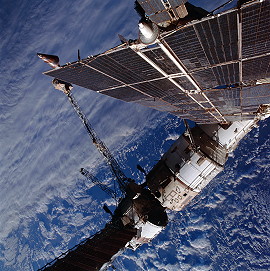
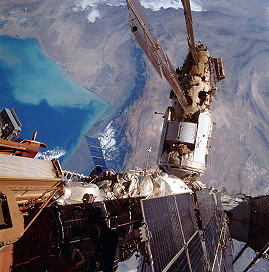
landing on Cape Canaveral (KSC), Runway 15. A rendezvous and docking with the Russian Mir space station and the exchange of astronauts - including the holder of the record for longest space flight ever by a U.S. astronaut - highlighted the flight of Space Shuttle Atlantis on Mission STS-79. This was the fourth of nine planned missions to Mir between 1995 and 1998 and the first exchange of astronauts. Astronaut Shannon Lucid, who was on Mir since late March 1996, was replaced on Mir by astronaut John Blaha. He spent more than four months on Mir. He returned to Earth on Space Shuttle Mission STS-81, launched in January 1997. STS-79 was the second Shuttle-Mir mission to carry a SPACEHAB module on board, and the first to carry a double module. The forward portion of the double module housed experiments conducted by the crew before, during and after Atlantis was docked to the Russian space station. The aft portion of the double module primarily housed the logistics equipment to be transferred to the Russian space station. Logistics include food, clothing, experiment supplies, and spare equipment for Mir. The current Mir-21 mission began when the cosmonaut crew launched on February 21, 1996, in Soyuz TM-23 and docked with the Mir two days later. Shannon Lucid joined the Mir-21 crew with the March 1996, docking of STS-76. Shannon Lucid completed her stay on the Mir and returned with the STS-79 crew. On August 19, 1996 the Mir-21 crew was joined by the crew of Mir-22 launched with Soyuz TM-24. The Mir-22 crew will remain on Mir after the Mir-21 crew returns to Earth in September 1996. STS-79 was the first shuttle mission to a fully completed Mir space station, following the arrival of its Priroda module. Atlantis carried the 1,821-kilogram (4,010 lb) Orbiter Docking System. Atlantis' rendezvous and docking with the Russian space station Mir actually began with the precisely timed launch of the shuttle on a course for the Mir, and, over the next two days, periodic small engine firings that gradually brought Atlantis to a point eight nautical miles (14.8 km) behind Mir on docking day, the starting point for a final approach to the station. About two hours before the scheduled docking time on Flight Day Three of the mission, Atlantis reached a point about eight nautical miles (14.8 km) behind the Mir space station and conducted a Terminal Phase Initiation burn, beginning the final phase of the rendezvous. Atlantis closed the final eight nautical miles (14.8 km) to Mir during the next orbit. As Atlantis approaches, the shuttle's rendezvous radar system began tracking Mir and providing range and closing rate information to Atlantis. Atlantis' crew also began air-to-air communications with the Mir crew using a VHF radio. As Atlantis reached close proximity to Mir, the Trajectory Control Sensor, a laser ranging device mounted in the payload bay, supplemented the shuttle's onboard navigation information by supplying additional data on the range and closing rate. As Atlantis closed in on the Mir, the shuttle had the opportunity for four small successive engine firings to fine-tune its approach using its onboard navigation information. Identical to the three prior Mir dockings, Atlantis will aim for a point directly below Mir, along the Earth radius vector (R-Bar), an imaginary line drawn between the Mir center of gravity and the center of Earth. Approaching along the R-Bar, from directly underneath the Mir, allowed natural forces to brake Atlantis' approach more so than would occur along a standard shuttle approach from directly in front of Mir. During this approach, the crew began using a handheld laser ranging device to supplement distance and closing rate measurements made by shuttle navigational equipment. The manual phase of the rendezvous began just as Atlantis reached a point about a half-mile (900 meters) below Mir. Commander William Readdy flew the shuttle using the aft flight deck controls as Atlantis began moving up toward Mir. Because of the approach from underneath Mir, William Readdy had to perform very few braking firings. However, if such firings were required, the shuttle's jets were used in a mode called "Low-Z", a technique that uses slightly offset jets on Atlantis' nose and tail to slow the spacecraft rather than firing jets pointed directly at Mir. This technique avoids contamination of the space station and its solar arrays by exhaust from the shuttle steering jets. William Readdy centered Atlantis' docking mechanism with the Docking Module mechanism on Mir, continually refining this alignment as he approached within 300 feet (91.4 meters) of the station. At a distance of about 30 feet (9.14 meters) from docking, William Readdy stopped Atlantis and held stationkeep momentarily to adjust the docking mechanism alignment, if necessary. At that time, a final go or no-go decision to proceed with the docking was made by flight control teams in both Houston and Moscow. When Atlantis proceeded with docking, the shuttle crew used ship-to-ship communications with Mir to inform the Mir crew of the shuttle's status and to keep them updated on major events, including confirmation of contact, capture and the conclusion of damping. Damping, the halt of any relative motion between the two spacecraft after docking, was performed by shock absorber-type springs within the docking device. Mission Specialist Carl Walz had to oversee the operation of the Orbiter Docking System aboard Atlantis. The Shuttle-Mir link-up occurred at 15:13 UTC on September 18, 1996. The hatches opened at 05:40 UTC on September 19, 1996 and John Blaha and Shannon Lucid exchanged places at 11:00 UTC. Awaiting John Blaha on Mir were Valeri Korzun, Mir-22 Commander, and Aleksandr Kaleri, Flight Engineer. Shannon Lucid returned to Earth with STS-79 and John Blaha remained on Mir together with the 22nd Mir resident crew until STS-81 docked for the next time with the Russian space station. During her approximately six-month stay on Mir, Shannon Lucid conducted research in the following fields: advanced technology, Earth sciences, fundamental biology, human life sciences, microgravity research and space sciences. Specific experiments included: Environmental Radiation Measurements to ascertain ionizing radiation levels aboard Mir; Greenhouse-Integrated Plant Experiments, to study effect of microgravity on plants, specifically dwarf wheat; and Assessment of Humoral Immune Function During Long-Duration Space Flight, to gather data on effect of long-term spaceflight on the human immune system and involving collection of blood serum and saliva samples. Some of this research was conducted in the newest and final Mir module, Priroda, which arrived at station during Shannon Lucid's stay STS-79 marked the first flight with a double SPACEHAB module, increasing the amount of logistics the shuttle can carry to the Mir space station. In addition to the U.S. astronaut exchange, the STS-79 crew transferred over 4,600 pounds (1,814 kg) of food, water, clothing, personal hygiene supplies, replacement Mir hardware components, and U.S. science experiments and supplies to the Mir, including five powered experiments (experiments requiring electrical power on the shuttle and immediately on Mir). The Atlantis crew simultaneously received over 2,100 pounds (952 kg) of Russian hardware, empty food and water containers, ESA return science items, and U.S. science hardware, data and specimens from Shannon Lucid's science gathering activities during her stay on Mir. This was the largest shuttle transfer of logistics to and from the Mir to date. The Mir-21 mission began when the crew launched on February 21, 1996, in a Soyuz vehicle and docked with the Mir two days later. Shannon Lucid joined the Mir-21 crew with the March 24, 1996, docking of STS-76. The return of STS-79 concluded a mission of experiments in the fields of advanced technology, Earth sciences, fundamental biology, human life sciences, microgravity, and space sciences. Data also supplied insight for the planning and development of the ISS, Earth-based sciences of human and biological processes, and the advancement of commercial technology. The microgravity environment on a long duration mission provides an ideal opportunity to determine the role gravity plays in molecular mechanisms at a cellular level and in regulatory and sensory mechanisms, and how this affects development and fundamental biological growth. Fundamental biology is also responsible for characterizing the radiation of the Mir environment and determining how it may impact station-based science. Environmental Radiation Measurements: Exposure of crew, equipment, and experiments to the ambient space radiation environment in low Earth orbit poses one of the most significant problems to long term space habitation. As part of the collaborative NASA/Mir Science program, a series of measurements were compiled of the ionizing radiation levels aboard Mir. During the mission, radiation was measured in six separate locations throughout the Mir using a variety of passive radiation detectors. This experiment continued on later missions, where measurements will be used to map the ionizing radiation environment of Mir. These measurements will yield detailed information on spacecraft shielding in the 51.6-degree-orbit of the Mir. Comparisons were made with predictions from space environment and radiation transport models. Greenhouse-Integrated Plant Experiments: The microgravity environment of the Mir space station provided researchers an outstanding opportunity to study the effects of gravity on plants, specifically dwarf wheat. The greenhouse experiment determined the effects of space flight on plant growth, reproduction, metabolism, and production. By studying the chemical, biochemical, and structural changes in plant tissues, researchers hoped to understand how processes such as photosynthesis, respiration, transpiration, stomatal conductance, and water use are affected by the space station environment. This study was an important area of research, due to the fact that plants could eventually be a major contributor to life support systems for space flight. Plants produce oxygen and food, while eliminating carbon dioxide and excess humidity from the environment. These functions are vital for sustaining life in a closed environment such as the Mir or the International Space Station. Human Life Sciences: The task of safely keeping men and women in space for long durations, whether they are doing research in Earth orbit or exploring other planets in our solar system, requires continued improvement in our understanding of the effects of space flight factors on the ways humans live and work. The Human Life Sciences (HLS) project had a set of investigations for the Mir-22 mission to determine how the body adapts to weightlessness and other space flight factors, including the psychological and microbiological aspects of a confined environment and how they readapt to Earth's gravitational forces. The results of these investigations will guide the development of ways to minimize any negative effects so that crewmembers can remain healthy and efficient during long flights, as well as after their return to Earth. Assessment of Humoral Immune Function During Long Duration Space Flight: Experiments concerned with the effects of space flight on the human immune system are important to protect the health of long duration crews. The human immune system involves both humoral (blood-borne) and cell-mediated responses to foreign substances known as antigens. Humoral responses include the production of antibodies, which can be measured in samples of saliva and serum (blood component). The cell-mediated response, which involves specialized white blood cells, appears to be suppressed during long duration space missions. Preflight, a baseline saliva and blood sample were collected. While on Mir, the crew was administered a subcutaneous antigen injection. In flight and postflight, follow-up blood and saliva samples were collected to measure the white blood cell activation response to the antigen. Two commercial payloads were transferred to Mir on STS-79 and were retrieved by STS-81 some four months later: Biotechnology System (BTS): The Bioreactor rotating wall vessel developed at the Space Cell Biology and Biotechnology Center at NASA's Johnson Space Center was the first of a series of long-duration cell culture experiments. BTS studied the three-dimensional growth of cartilage cells during its 147-day mission. Material in Devices as Superconductors (MIDAS): The MIDAS experiment developed at NASA's Langley Research Center, Hampton, VA, flew into orbit on STS-79 and was transferred over to the Russian Mir space station for approximately four months. While on the Mir, MIDAS measured the electrical properties of high temperature superconductor (HTS) materials during extended space flight and compiled the results in a database for commercial use. HTS materials may be used in a variety of device applications to reduce power requirements and thermal losses. In addition to the development of a database, the MIDAS experiment demonstrated the development of a manufacturing process using integrated superconductor and conventional microelectronics. There have been no previous flights which characterize HTS material in spaceflight at cryogenic temperatures. Commercial Generic Bioprocessing Apparatus (CGBA): The CGBA hardware was used extensively on short duration Shuttle missions to house a great variety of biotechnology experiments of interest to commercial product development. There are many biotechnology processes which require much longer periods of time than a Shuttle mission can provide. For this reason, the commercial affiliates of BioServe Space Technologies, a NASA Commercial Space Center, are eager to take advantage of the long duration mission which the Shuttle/Mir program provides. In addition, three experiments made a round-trip voyage aboard Atlantis itself: Extreme Temperature Translation Furnace (ETTF): The ETTF, which was integrated into the SPACEHAB module, was a new furnace design allowing space-based processing up to 1,600 degrees Centigrade and above. ETTF was designed to investigate how flaws form in cast and sintered metals. Studying the basic thermodynamics and behavior of pores and metal grains allowed metallurgists to make stronger machine tools on Earth. Commercial Protein Crystal Growth (CPCG) Experiments: STS-79 included the 31st Shuttle flight of a Protein Crystal Growth payload. The complement of CPCG experiments aboard this mission was comprised of 128 individual samples involving twelve different proteins. The samples were processed at 22 degrees Centigrade using the newly developed Commercial Vapor Diffusion Apparatus (CVDA). The goal of these experiments was to produce large, well-ordered protein crystals in the microgravity environment from very small volumes of protein solutions. These crystals will be used for x-ray diffraction studies to determine the three-dimensional structures of the individual proteins singly, and as they are bonded to other key molecules. Mechanics of Granular Materials: This experiment seeked to develop a quantitative scientific understanding of the behavior of cohesionless granular materials in dry and saturated states at very low confining pressures and effective stresses. Cohesionless granular materials are unlike other engineering materials since their strength and stiffness properties derive entirely from friction and dilatancy. Dilatency is the change of volume associated with the application of shear stresses. The strength and stiffness of these materials are usually several orders of magnitude lower than cementious composites. Granular material properties depend on confinement. Investigators expect to see higher axial loads for a given axial displacement in microgravity. This data could help scientists to understand the behavior of the Earth's surface during earthquakes and landslides. During the STS-79 mission, the crew used an onboard IMAX camera to document activities on Atlantis and Mir. NASA has flown IMAX camera systems on many Shuttle missions. Footage from STS-79, as well as the recent STS-63, STS-71, and STS-74 missions was incorporated in a large-format feature film about NASA's cooperation with Russia. The IMAX system consisted of a space-qualified 65 mm camera, lenses, rolls of film, lights and other equipment necessary for filming. The IMAX and supporting equipment are stowed in the middeck of the orbiter. An audio tape recorder with microphones will be used in the crew compartment to record audio sounds and crew comments during camera operations. This IMAX camera remained on Mir. Ham radio operators and students attempted to make radio contacts with the orbiting Shuttle as part of the Shuttle Amateur Radio Experiment, SAREX, during STS-79. Amateur radio has been flying aboard Space Shuttles since 1983. Mission Specialist Jerome Apt's amateur radio call sign is N5QWL. Jerome Apt has flown on three previous Shuttle missions and has operated amateur radio during each flight. John Blaha also served as a Mission Specialist, and his ham radio call sign was KC5TZQ. Astronaut Carl Walz was KC5TIE; he participated in SAREX from Columbia during STS-65 in July 1994. Once Atlantis was ready to undock from Mir, the initial separation was performed by springs that gently pushed the shuttle away from the docking module. Both the Mir and Atlantis were in a mode called "free drift" during the undocking, a mode that has the steering jets of each spacecraft shut off to avoid any inadvertent firings. Once the docking mechanism's springs had pushed Atlantis away to a distance of about two feet (61 centimeters) from Mir, where the docking devices were clear of one another, William Readdy turned Atlantis' steering jets back on. Immediately, he fired the shuttle's jets in the Low-Z mode to begin slowly moving away from Mir. Atlantis continued away from Mir to a distance of about 600 feet (182.9 meters), where William Readdy and Pilot Terrence Wilcutt began a flyaround of the station. Atlantis circled Mir twice before firing its jets again to depart. During this flyaround the crew performed documentary photography of the Mir space station, including the newly arrived "Priroda" science module, using still and video cameras as well as the IMAX large format movie camera. |
Note
Photos / Graphics
 |
 |
 |
 |
 |
 |
 |
 |
 |
 |
 |
 |
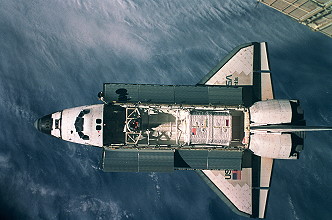 |
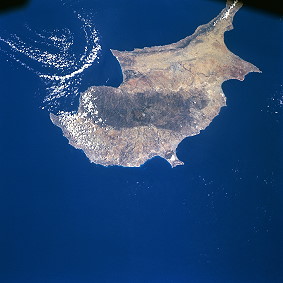 |
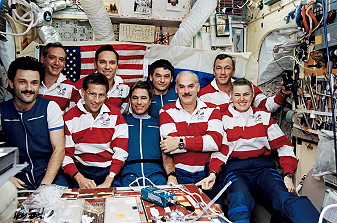 |
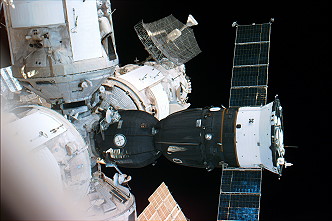 |
 |
|
more Earth observation photos |
|
More Mir photos
 |
 |
 |
 |
 |
 |
 |
 |
 |
 |
 |
 |
 |
| © |  |
Last update on March 27, 2020.  |
 |