Human Orbital Spaceflights

International Flight No. 170STS-68Endeavour (7)65th Space Shuttle missionUSA |
 |
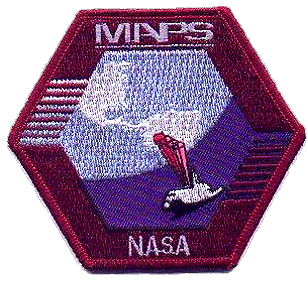 |
Launch, orbit and landing data
walkout photo |
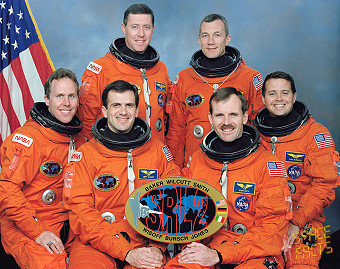 |
||||||||||||||||||||||||||||
alternative crew photo |
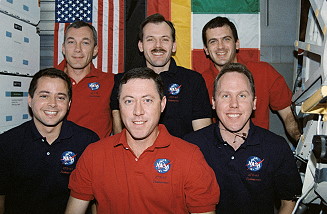
Crew
| No. | Surname | Given names | Position | Flight No. | Duration | Orbits | |
| 1 |  |
Baker | Michael Allen | CDR | 3 | 11d 05h 46m 08s | 182 |
| 2 | |
Wilcutt | Terrence Wade | PLT, IV-1 | 1 | 11d 05h 46m 08s | 182 |
| 3 | |
Smith | Steven Lee | MS-1, EV-2 | 1 | 11d 05h 46m 08s | 182 |
| 4 | |
Bursch | Daniel Wheeler | MS-2, FE | 2 | 11d 05h 46m 08s | 182 |
| 5 | |
Wisoff | Peter Jeffrey Kelsay "Jeff" | MS-3, EV-1 | 2 | 11d 05h 46m 08s | 182 |
| 6 | |
Jones | Thomas David | MS-4, PLC | 2 | 11d 05h 46m 08s | 182 |
Crew seating arrangement
|
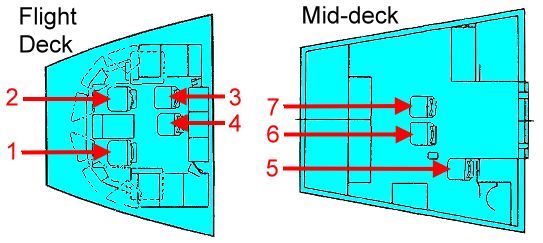 |
|
||||||||||||||||||||||||||||
Hardware
| Orbiter : | OV-105 (7.) |
| SSME (1 / 2 / 3): | 2028 (9.) / 2033 (6.) / 2026 (4.) |
| SRB: | BI-067 / RSRM 40 |
| ET: | ET-65 (LWT-58) |
| OMS Pod: | Left Pod 04 (14.) / Right Pod 01 (20.) |
| FWD RCS Pod: | FRC 5 (7.) |
| RMS: | 303 (8.) |
| EMU: | EMU No. 2025 (PLSS No. 1010) / EMU No. 2030 (PLSS No. 1014) |
Flight
|
Launch from Cape Canaveral (KSC) and
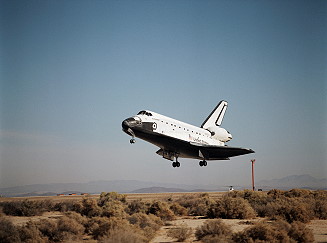
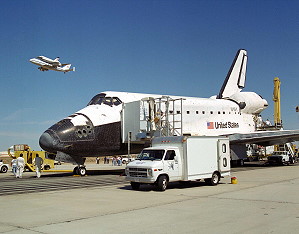
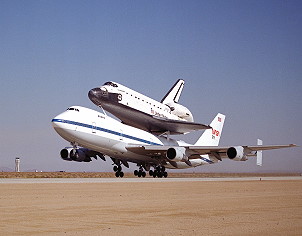
landing on the Edwards
AFB, Runway 22.
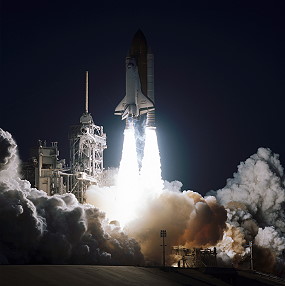
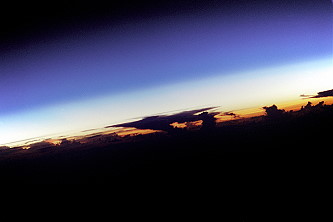
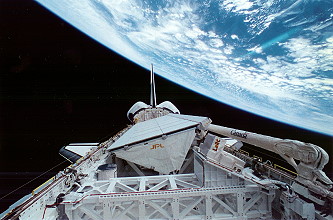
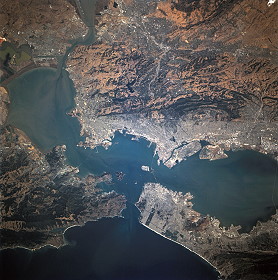
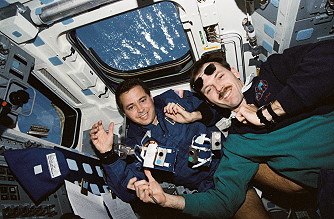
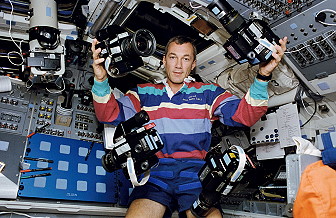
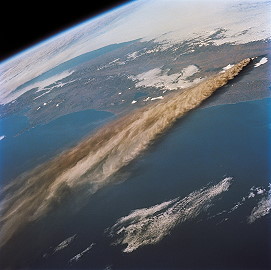
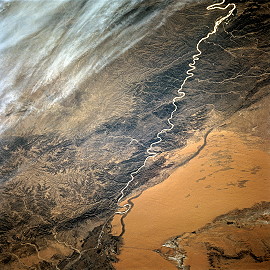
The launch was originally scheduled for August 18, 1994, but there was an RSLS abort at T-1.9 s after all three main engines ignited. This is the fifth time in the shuttle program where an RSLS abort has occurred after main engine ignition. Previous aborts have occurred on STS-41D, STS-51F, STS-55 and STS-51. The automatic abort was initiated by the onboard General-Purpose Computers (GPC) when the discharge temperature on MPS Main Engine #3 High Pressure Oxidizer Turbopump (HPOT) exceeded its redline value. The HPOT typically operates at 28,120 rpm and boosts the liquid oxygen pressure from 422 to 4,300 psi (2.91 to 29.6 MPa). There are 2 sensor channels measuring temperature on the HPOT. The B channel indicated a redline condition while the other was near redline conditions. The temperature at shutdown was at 1563 degrees Rankine (868 K), while a normal HPOT discharge temperature is around 1,403 °R (779 K). The redline limit to initiate a shutdown is at 1560 °R (867 K). This limit increases to 1760 °R (980 K) at T-1.3 s (5.3 s after Main Engine Start). Main Engine #3 (SN 2032) has been used on two previous flights with 2,412 seconds (40 min) of hot-fire time and a total of eight starts. This was the first flight for the HPOT on Main Engine (SSME) #3. STS-68 was not far away from a Return To Launch Site (RTLS) abort. There were five abort modes available during ascent, in addition to pad (RSLS) aborts. Redundant Set Launch Sequencer (RSLS) Abort: The main engines were ignited roughly 6.6 seconds before liftoff. From that point to ignition of the Solid Rocket Boosters at T - 0 seconds, the main engines could be shut down. This was called a "Redundant Set Launch Sequencer Abort", and happened five times, on STS-41D, STS-51F, STS-55, STS-51, and STS-68. It always happened under computer (not human) control, caused by computers sensing a problem with the main engines after starting but before the SRBs ignited. The SRBs could not be turned off once ignited, and afterwards the shuttle was committed to take off. If an event such as an SSME failure requiring an abort happened after SRB ignition, acting on the abort would have to wait until SRB burnout 123 seconds after launch. No abort options existed if that wait was not possible. There were four intact abort modes for the Space Shuttle. Intact aborts were designed to provide a safe return of the orbiter to a planned landing site or to a lower orbit than planned for the mission. In a Return To Launch Site (RTLS) abort, the Shuttle would have continued downrange until the solid rocket boosters were jettisoned. It would then pitch around, so the SSMEs fired retrograde. This maneuver would have occurred in a near-vacuum above the appreciable atmosphere and was conceptually no different from the OMS engines firing retrograde to de-orbit. The main engines continued burning until downrange velocity was killed and the vehicle began heading back toward the launch site at sufficient velocity to reach a runway. Afterwards the SSMEs were stopped, the external tank was jettisoned, and the orbiter made a normal gliding landing on the runway at Kennedy Space Center about 25 minutes after lift-off. The CAPCOM would call out the point in the ascent at which an RTLS was no longer possible as "negative return", approximately four minutes after lift-off. Should all three SSMEs have failed, the shuttle would not have been able to make it back to the runway at KSC, forcing the crew to bail out. While this would have resulted in the loss of the Shuttle, the crew could escape safely and then be recovered by the SRB recovery ships. This abort mode was never needed in the history of the Shuttle program. A Transoceanic Abort Landing (TAL) involved landing at a predetermined location in Africa or western Europe about 25 to 30 minutes after lift-off. It was used when velocity, altitude, and distance downrange did not allow return to the launch point via RTLS. It was also used when a less time-critical failure did not require the faster but possibly more stressful RTLS abort. A TAL abort would be declared between roughly T+2:30 minutes (2 minutes and 30 seconds after liftoff) and Main Engine Cutoff (MECO), about T+8:30 minutes. The Shuttle would then land at a predesignated friendly airstrip in Europe. The last four TAL sites until the Shuttle's retirement were Istres Air Base in France, Zaragoza and Morón air bases in Spain, and RAF Fairford in England. Prior to a Shuttle launch, two of them were selected depending on the flight plan, and staffed with standby personnel in case they were used. The list of TAL sites changed over time; most recently Ben Guerir Air Base in Morocco (TAL site from July 1988–June 2002) was eliminated due to terrorist attack concerns. Other previous TAL sites included Lajes Air Base, Terceira, Azores, Mallam Aminu Kano International Airport, Kano, Nigeria; Mataveri International Airport, Easter Island, Chile (for Vandenberg launches); Rota, Spain; Casablanca, Morocco; Banjul, Gambia; and Dakar, Senegal. This abort mode was never needed during the entire history of the space shuttle program. An Abort Once Around (AOA) was available when the shuttle could not reach a stable orbit but had sufficient velocity to circle the earth once and land, about 90 minutes after lift-off. The time window for using the AOA abort was very short – just a few seconds between the TAL and ATO abort opportunities. Therefore, taking this option was very unlikely. This abort mode was never needed during the entire history of the space shuttle program. An Abort to Orbit (ATO) was available when the intended orbit could not be reached but a lower stable orbit was possible. This occurred on mission STS-51F, which continued despite the abort to a lower orbit. The Mission Control Center in Houston (located at Lyndon B. Johnson Space Center) observed an SSME failure and called "Challenger--Houston, Abort ATO. Abort ATO". The moment at which an ATO became possible was referred to as the "press to ATO" moment. In an ATO situation, the spacecraft commander rotated the cockpit abort mode switch to the ATO position and depressed the abort push button. This initiated the flight control software routines which handled the abort. In the event of lost communications, the spacecraft commander could have made the abort decision and taken action independently. STS-68 carried the mission "Space Radar Laboratory" (SRL-2). Radar images of Earth's surface and volcanic eruption observations were taken. The SRL payload is comprised of the Spaceborne Imaging Radar-C/X-Band Synthetic Aperture Radar (SIR-C/X-SAR), and the Measurement of Air Pollution from Satellite (MAPS). The German Space Agency (DARA) and the Italian Space Agency (ASI) provided the X-SAR instrument. The SRL payload, which first flew during STS-59 in April 1994, again gave scientists highly detailed information that will help them distinguish between human-induced environmental changes and other natural forms of change. Experiment operations conducted around the clock on this flight, with the astronauts divided into two teams. Commander Michael Baker, pilot Terrence Wilcutt and mission specialist Peter Wisoff were the "red team". Mission specialists Daniel Bursch, Thomas Jones and Steven Smith were the "blue team". The SIR-C/X-SAR radar data provided information about how elements of the complex "Earth system" Q particularly land surfaces, water and life Q work together to create Earth's livable environment. The science team was particularly interested in studying vegetation coverage, the extent of snow packs, wetland areas, geologic features such as rock types and their distribution, volcanic processes, ocean wave heights and wind speeds. SIR-C was a two-frequency radar including L-band (23-cm wavelength) and C-band (6-cm wavelength). SIR-C represented a technological advance from previous imaging radar. Just as color pictures contain more information than do black and white pictures, SIR-C's multi- frequency, multi-polarization radar imagery provide more information about Earth's surface features than do single- frequency, single-polarization images. SIR-C was the first spaceborne radar with the ability to transmit and receive horizontally (H) and vertically (V) polarized waves at both frequencies. Polarization describes how the radar wave travels in space. The interaction between the transmitted waves and the Earth's surface determines the polarization of the waves received by the antenna. For example, when data are acquired with HH (horizontal- horizontal) polarization, the wave is transmitted from the antenna in the horizontal plane and the antenna receives the backscattered radiation in the horizontal plane. The other polarizations are HV (horizontally transmitted, vertically received), VH (vertical-horizontal) and VV (vertical-vertical). The SIR-C antenna was the most massive piece of flight hardware ever built at JPL. Its mass was 23,100 pounds (10,500 kilograms) and it measured approximately 39 feet by 13 feet (12 meters by 4 meters). The instrument was composed of several subsystems: the antenna array, transmitter, receivers, data-handling subsystem and the ground processor. The antenna consisted of three leaves, each divided into four subpanels. X-SAR was built by the Dornier and Alenia Spazio companies for the German Space Agency, Deutsche Agentur für Raumfahrtangelegenheiten (DARA), and the Italian space agency, Agenzia Spaziale Italiana (ASI), respectively. The scientific processing progress is managed by DARA. It was a single-polarization radar operating at X- band (3-cm wavelength). X-SAR used a slotted-waveguide antenna, which was finely tuned to produce a narrow, pencil-thin beam of energy. The X-SAR antenna was mounted on a supporting structure that is tilted mechanically to align the X-band beam with the L-band and C-band beams. X-SAR provided VV polarization images. The SIR-C and X-SAR instruments could be operated individually or in conjunction. The width of the ground swath varied from 9 to 56 miles (15 to 90 kilometers), depending on the orientation of the antenna beams. The resolution of the radars Q the size of the smallest objects they can distinguish Q could be varied from 33 to 656 feet (10 to 200 meters). Flying aboard STS-59 in April 1994, SIR-C collected 65 hours of data during the 10-day mission, roughly corresponding to 26 million square miles (66 million square kilometers). All data were stored onboard the Shuttle using a new generation of high density, digital, rotary head tape recorders. The data filled 166 digital tape cartridges (similar to VCR tape cassettes). X- SAR data filled 25 of those tapes. STS-68 flew over the same sites that STS-59 observed so that scientists were able to study seasonal changes that may have occurred in those areas between the missions. Data were taken over more than 400 sites on Earth. Nineteen of the sites are "supersites", the highest priority targets and the focal point for many of the scientific investigators. There are 15 backup supersites. The supersites represented different environments within each scientific discipline. They were areas where intensive field work occurred before, during and after the flight. In the field of ecology supersites were Manaus, Brazil; Raco, Mich.; Duke Forest, N.C. Ecologists studied life on Earth and how different species of animals and plants interact with one another and their local environment. SIR-C/X-SAR ecology investigations focus on mapping wetlands, deforestation and flooding under forest canopies over the tropical forests of the Amazon basin in South America and over the temperate forests of North America and Central Europe. Scientists also were studying wetlands and were using the data to validate computer models to determine the type and density of vegetation and to study seasonal thaws. The science team used the images to study land use, including the volume, types and extent of vegetation and the effects of fires, floods and clear- cutting. In the field of hydrology supersites were Chickasha, Oklahoma; Ötztal, Austria; Bebedouro, Brazil; Montespertoli, Italy. The radar data were used to determine soil moisture patterns. These studies helped scientists develop ways to estimate soil moisture and evaporation rates over large areas, which could ultimately be incorporated into computer models to help predict a region's water cycle. Another significant part of hydrology centers on snow cover. Using data from STS-59, investigators generated a snow and ice classification map over the Öetztal, Austria, supersite and a snow-wetness map of the Mammoth Mountain, Calif., backup supersite. Spring snow melt often determines the annual runoff cycle and the resulting water supply, ground water and reservoir replenishment rates. For many areas, long-term or ground-based snow cover data do not exist, and radar data is the only efficient way to collect this information. In the field of oceanography supersites were The Gulf Stream (mid-Atlantic region); eastern North Atlantic Ocean; Southern Ocean. Oceanographers studied how waves move through the ocean and how the air and sea interact. The ocean is a reservoir for heat and energy, and the air-sea interaction moves this heat and energy around the globe regulating the Earth's climate. The Gulf Stream off the eastern coast of North America is a major ocean current that transports heat from the equator toward the poles. In the field of geology supersites were Galapagos Islands; Sahara Desert; Death Valley, Calif.; Andes Mountains, Chile. Geologists studied the present surface of the Earth. By observing older rocks, they can determine how an area came to be and what it may have looked like in the past. Scientists were using SIR-C/X-SAR data to map geologic structures and variations in rock types over large areas, as well as areas of volcanic activity and erosion. In the field of calibration supersites were Flevoland, The Netherlands; Kerang, Australia; Oberpfaffenhofen, Germany; Western Pacific Ocean. The ground teams placed calibration devices, called corner reflectors, and transponders in southern Germany, the Netherlands, Australia and Death Valley, Calif., to measure the amount of radar energy obtained on the ground during the flight. The teams are calibrating the radar data and applying what they learn to the image processing and scientific interpretation of the images. Two SIR-C/X-SAR experiments imaged rain over the Western Pacific Ocean, area scientists call it the "rainiest place on Earth". Rain can change conditions on the surface and thus change the radar image. At the shorter wavelengths of X-band and C-band, rain may reduce the strength of the radar or scatter the signals significantly. The rain experiments offered a unique challenge to the operation of the radar during flight. All the other experiments could be reasonably tied to a specific area, while the rain experiments only require that a "deep" rainstorm be in progress. Weather targets are transitory in both space and time and cannot be scheduled, so finding a good target of opportunity is a gamble. Scientists chose the western Pacific because there is a high probability that it will be raining there when the Shuttle passes over it. The Measurement of Air Pollution from Satellite (MAPS) experiment measured the global distribution of carbon monoxide in the troposphere, or lower atmosphere. Measurements of carbon monoxide, an important element in several chemical cycles, provide scientists with indications of how well the atmosphere can clean itself of "greenhouse gases", chemicals that can increase the atmosphere's temperature. MAPS' primary goal was to measure the distribution of carbon monoxide in the atmosphere between the altitudes of 2 and 10 miles (4 and 15 kilometers). The data were recorded on a tape recorder and transmitted directly to the ground using the Space Shuttle telemetry system. The signals will be processed at the Payload Operations Control Center to produce "quick look" maps of the carbon monoxide distribution. These "quick look" data were used to plan the exact periods of data acquisition during the flight. Following the flight, the recorded data were processed using more refined techniques, and the data were combined with ground-and aircraft-based data obtained by collaborating scientists from several countries. This presented a more detailed description of the distribution of the gas than can be obtained by any single technique. The MAPS hardware consisted of an optical box, an electronics box, a tape recorder and a camera, all mounted to a single base plate. This assembly was mounted to a Multi- purpose Experiment Support Structure near the forward end of the cargo bay. The instrument was about 36 inches (91 centimeters) long, 30 inches (76 centimeters) wide and 23 inches (58 centimeters) high. It weighed 203 pounds (92 kg) and consumed about 125 watts of electrical power. MAPS, the first Space Shuttle science payload, has flown three times: in November 1981 (STS-2), October 1984 (STS-41G) and April 1994 (STS-59). The 1981 flight proved surprising because the greatest concentrations of tropospheric carbon monoxide were found in the Earth's tropical regions rather than in the industrialized Northern Hemisphere as had been expected. The 1981 flight also showed that carbon monoxide concentrations vary greatly from region to region. Preliminary results from the April 1994 flight showed low carbon monoxide concentrations in the Southern Hemisphere (very clean air) and a gradual increase in carbon monoxide levels from the Southern Hemisphere to the Northern Hemisphere. The highest levels of carbon monoxide measured by MAPS were present north of the 40-degree latitude band in the Northern Hemisphere. Scientists also were able to examine the seasonal effects near and downwind from the industrial source regions of the Northern Hemisphere. This ability to study global seasonal differences in tropospheric carbon monoxide levels is available only through the unique measurements provided by the MAPS instrument. The Commercial Protein Crystal Growth (CPCG) experiment had several objectives. One objective was to grow and retrieve highly structured protein crystals of sufficient size and quality to analyze the molecular structures of various proteins. Another objective was to obtain information on the dynamics of protein crystallization, allowing scientists to determine the parameters necessary to optimize scientific methods for producing large, high quality, well-ordered crystals. The CPCG experiment was flown in what is known as a Block I configuration for STS-68. This configuration included the utilization of one Commercial Refrigerator/Incubator Module (CRIM) to maintain a specific profile for three Vapor Diffusion Apparatus (VDA) trays. Each VDA tray contained 20 double-barrel syringes which empty into individually sealed sample chambers. Each syringe contained a protein solution in one barrel and a precipitant solution in the other barrel. STS-68 flew the first in a new series of life sciences experiments titled, "Biological Research in Canisters (BRIC)". BRIC experiments were designed to examine the effects of microgravity on a wide range of physiological processes in higher order plants and arthropod animals (e.g., insects, spiders, centipedes, crustaceans). BRIC hardware consisted of a small, self-contained, two-chambered aluminum container that required no power. The first BRIC experiment (BRIC-01) flew gypsy moth eggs to determine how microgravity affects the developing moth's diapause cycle. The diapause cycle is the period of time when the moth is in a dormant state and undergoing development. Previous spaceflights of gypsy moths have indicated that microgravity may shorten the diapause cycle which leads to the emergence of sterile gypsy moth larvae. Since the gypsy moth is among the most damaging insect pests of hardwood trees in the eastern United States, extensive ground- based research has been conducted to modify the gypsy moth's life cycle to create sterile moths. STS-68 marked the fifth flight in the series of CHROMEX experiments designed to examine the effects of microgravity on a wide range of physiological processes in plants. CHROMEX experiments are flown in the Plant Growth Unit (PGU), an automated system that provides lighting, limited temperature control, and nutrients to support plant growth in the Shuttle middeck. Previous CHROMEX experiments (CHROMEX-03 and 04) indicate that plants grown in space may not produce seed embryos. The primary objective of CHROMEX-05 was to determine if plants grown in space are infertile due to microgravity or some other environmental factor. For this experiment, 13-day old Mouse-ear Cress (Arabidopsis thaliana) seedlings were grown in space and were compared to plants grown under similar conditions on the Earth. Results from this experiment advanced the field of space biology and will benefit the development of planned plant-based life support systems for future long duration space crews. Results may also benefit the nation's horticulture industry which produces plants under artificial conditions (e.g., aquaculture). The Cosmic Radiation Effects and Activation Monitor (CREAM) experiment on STS-68 was designed to collect data on cosmic ray energy loss spectra, neutron fluxes and induced radioactivity. The data were collected by active and passive monitors placed at specific locations throughout the orbiter's cabin. The active monitor obtained real-time spectral data while the passive monitors obtained data during the entire mission to be analyzed after the flight. The flight hardware contained the active cosmic ray monitor, a passive sodium iodide detector and up to five passive detector packages. All hardware fitted in one locker on Endeavour's middeck. Once in orbit, a crew member was available at regular intervals to monitor the payload/experiment. The Office of Naval Research (ONR) was sponsoring the Military Applications of Ship Tracks (MAST) experiment on STS-68. MAST was part of a five-year research program developed by ONR to examine the effects of ships on the marine environment. The Naval Postgraduate School, Monterey, Calif., conducted the experiment at JSC during the mission. The objective of MAST was to determine how pollutants generated by ships modify the reflective properties of clouds. Ship tracks were observed in satellite imagery as long, narrow, curvilinear cloud features that have greater brightness than the surrounding clouds. The STS-68 crew photographed ship tracks using handheld cameras. These high-resolution photographs provided insight into the processes of ship track production on a global scale. MAST helped in understanding the effects of man-made aerosols on clouds and the resulting impact on the climate system. MAST was a Department of Defense payload and was being flown under the direction of the DOD Space Test Program. Two universities and a foreign country had small self-contained payloads flying on this mission. These customers are taking advantage of NASA's unique Get Away Special (GAS) program. GAS hardware also was used by the U.S. Postal Service to fly 500,000 commemorative stamps in recognition of the 25th anniversary of the Apollo 11 Moon Landing. The stamp that was flown is a $9.95 Express Mail stamp. Due to clouds over the KSC the Space Shuttle was diverted to the Edwards AFB. |
Photos / Graphics
 |
 |
|
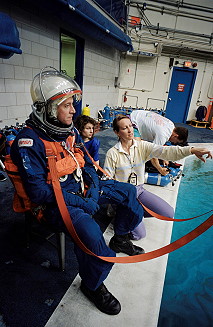
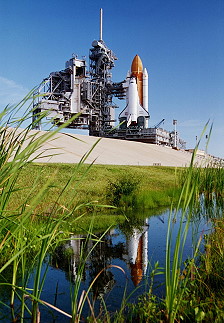
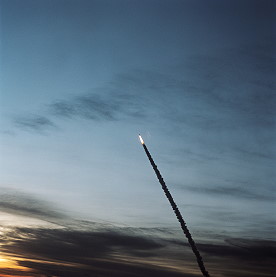
source of all photos is NASA |
|
 |
 |
 |
 |
 |
 |
 |
 |
 |
 |
 |
 |
 |
 |
 |
 |
more Earth observation photos |
|
| © |  |
Last update on June 20, 2023.  |
 |