Human Orbital Spaceflights

International Flight No. 160STS-51Discovery (17)57th Space Shuttle missionUSA |
 |
 |
 |
 |
Launch, orbit and landing data
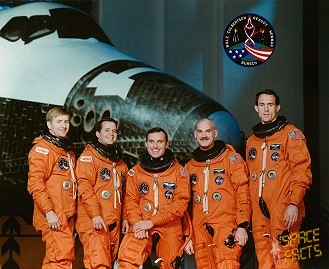
walkout photo |
 |
|||||||||||||||||||||||||||||
alternative crew photo |
alternative crew photo |
|||||||||||||||||||||||||||||
alternative crew photo |
||||||||||||||||||||||||||||||
alternative crew photo |
||||||||||||||||||||||||||||||
Crew
| No. | Surname | Given names | Position | Flight No. | Duration | Orbits | |
| 1 |  |
Culbertson | Frank Lee, Jr. | CDR | 2 | 9d 20h 11m 06s | 157 |
| 2 | |
Readdy | William Francis "Bill" | PLT, IV-1 | 2 | 9d 20h 11m 06s | 157 |
| 3 | |
Newman | James Hansen | MS-1, EV-2 | 1 | 9d 20h 11m 06s | 157 |
| 4 | |
Bursch | Daniel Wheeler | MS-2, RMS, FE | 1 | 9d 20h 11m 06s | 157 |
| 5 | |
Walz | Carl Erwin | MS-3, EV-1 | 1 | 9d 20h 11m 06s | 157 |
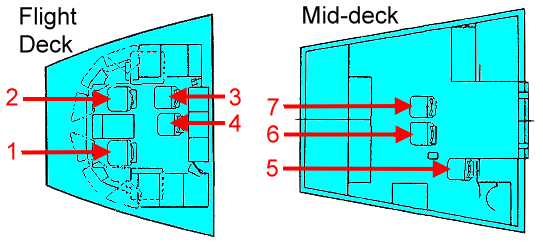
Crew seating arrangement
|
 |
|
||||||||||||||||||||||||
Hardware
| Orbiter : | OV-103 (17.) |
| SSME (1 / 2 / 3): | 2031 (9.) / 2034 (3.) / 2029 ( 8.) |
| SRB: | BI-060 / RSRM 33 |
| ET: | ET-59 (LWT-52) |
| OMS Pod: | Left Pod 01 (20.) / Right Pod 03 (18.) |
| FWD RCS Pod: | FRC 3 (17.) |
| RMS: | 201 (11.) |
| EMU: | EMU No. 2025 (PLSS No. 1010) / EMU No. 2023 (PLSS No. 1003) |
Flight
|
Launch from Cape Canaveral (KSC) and
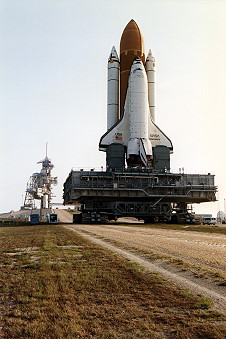
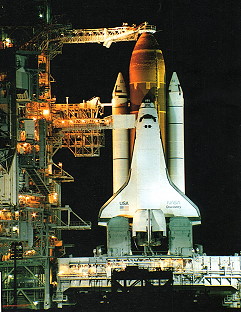
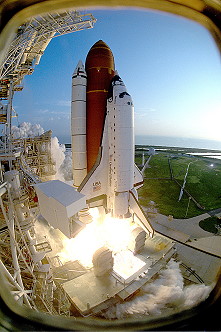
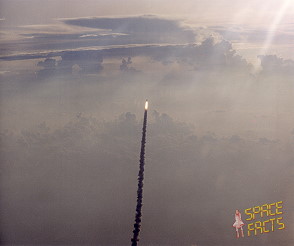
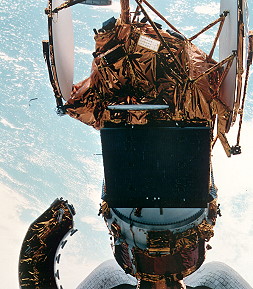
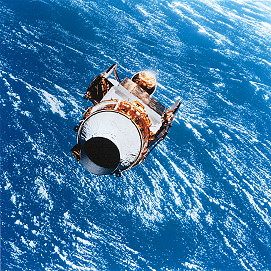
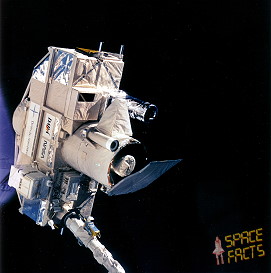
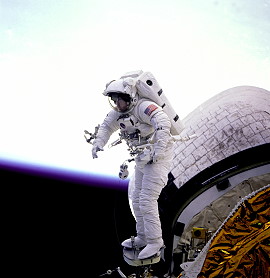
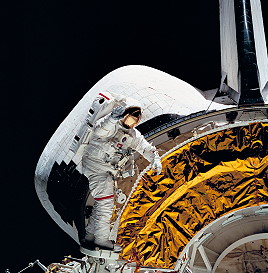
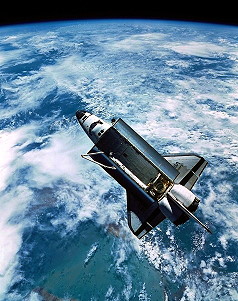
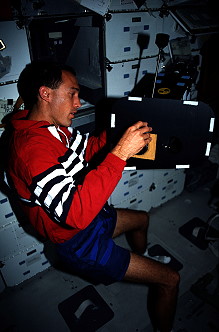
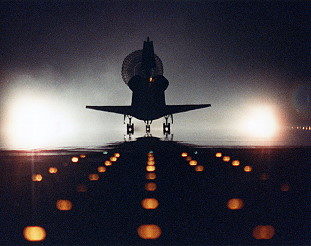
landing on Cape Canaveral (KSC), Runway 15. Three launch attempts failed on July 17, 1993, on July 24, 1993 and on August 12, 1994 due to technical reasons, each time after the crew had boarded the spacecraft. On August 12, 1993, the count reached the T-3 second mark, at which point the Space Shuttle Main Engines (SSMEs) had ignited. A shutdown was then triggered by faulty fuel flow sensors in one of the SSMEs. This was the fourth Redundant Set Launch Sequenzer (RSLS) Abort in the history of Space Shuttle's. The deployment of the satellite ACTS which will serve as a testbed for technology leading to a new generation of communication satellites and the deployment and retrieval of the U.S./German free-flying scientific observation satellite Orbiting and Retrievable Far and Extreme Ultraviolet Spectrometer - Shuttle Pallet Satellite (ORFEUS-SPAS) were the highlights NASA's Shuttle Mission STS-51. The ACTS was deployed on flight day one. The Advanced Communications Technology Satellite (ACTS), a significant activity of the NASA Space Communications Program, provided for the development and flight test of high risk, advanced communications satellite technology. Using multiple spot beam antennas and advanced on-board switching and processing systems, ACTS pioneered new initiatives in communications satellite technology. NASA Glenn Research Center was responsible for the development, management, and operation of ACTS as part of a long legacy of experimental communications satellites. This satellite served as a test bed for advanced experimental communications satellite concepts and technology. Its Transfer Orbit Stage (TOS) upper stage fired on time 45 minutes after deployment and boosted the satellite to geosynchronous altitude on the first day of the mission. ACTS provided new communications satellite technology for: operating in the Ka-band (30/20 GHz) where there is 2.5 GHz of spectrum available (five times that available at lower frequency bands), very high-gain, multiple hopping beam antenna systems which permit smaller aperture Earth stations, on-board baseband switching which permits interconnectivity between users at an individual circuit level and a microwave switch matrix which enables gigabit per second communication between users. ACTS was comprised of a spacecraft bus with basic housekeeping functions and a payload, known as the multi-beam communications package (MCP). At launch, ACTS weighed 6,108 pounds (2,771 kg) including the propellants and the spacecraft adapter and clamp band which remained with the Transfer Orbit Stage (TOS) upon separation. When in the stowed configuration in the Shuttle payload bay, ACTS' overall height was 15.9 feet (5 m) from the spacecraft separation plane to the tip of the highest antenna. ACTS should be deployed from Discovery's cargo bay approximately 8 hours after launch on orbit six. About 2 hours before deployment from the orbiter, the astronauts performed a sequence of events beginning with preliminary TOS checks, unlatching the TOS cradle and elevating the ACTS/TOS flight element to a 42-degree angle for deployment. The first attempt to deploy ACTS was delayed by the crew when two-way communications were lost with Mission Control about 30 minutes before the deploy time. Flight controllers could receive telemetry and voice communications from Discovery, however the crew could not receive communications from the ground. The crew waived off the deploy when they did not receive a "go" from Mission Control as called for in preflight plans made for just such an occurrence. After the waive off of deploy, the crew changed the shuttle's S-Band communications system to a lower frequency and restored two-way communications with the ground. The two-way communications had been lost for a total of about 45 minutes. After consulting the crew, flight controllers began immediately planning for the second, and ultimately successful deploy. During the deployment on September 12, 1993, two Super-Zip explosive cords in the Airborne Support Equipment cradle (ASE) designed to release the spacecraft, one primary and the other a backup, simultaneously detonated. This caused minor tears in two dozen insulation blankets mounted on the bulkhead between the payload bay and the AFT near the #3 APU. The ASE ring holding the TOS was damaged as well, and ejected debris was visible as the stack moved away from the orbiter. The Transfer Orbit Stage, built by Martin Marietta Astronautics Group in Denver, for Orbital Sciences Corp., Dulles, Va., is a single-stage, solid-propellant rocket system. TOS, constructed primarily of high-strength aluminum alloy, weighed 20,780 pounds (9,426 kg) including solid propellant fuel. It was almost 11 feet (3.3 m) long and about 7.5 feet (2.3 m) in diameter. The satellite, weighing 6,108 pounds (2,771 kg), was mounted on top of the Transfer Orbit Stage. Portions of both the satellite and TOS are covered with gold foil multi-layered insulation for thermal protection from the Sun. The satellite-TOS was coast for 45 minutes while the Shuttle maneuvered to a safe distance, 11.7 miles (18.8 km) away, to avoid a possible collision or damage from the TOS solid rocket exhaust plume. The TOS burned which injected ACTS into a geosynchronous transfer orbit. The spacecraft apogee kick motor injected ACTS into a drift orbit. Finally, ACTS was placed in a geostationary orbit at 100 degrees west longitude over the equator, approximately in line with the center of the United States. A geostationary orbit is one where a satellite takes 24 hours to complete one revolution, thus appearing to remain motionless above a single place on the Earth. Another payload on this mission was the Orbiting Retrievable Far and Extreme Ultraviolet Spectrometer (ORFEUS) telescope mounted on the Shuttle Pallet Satellite (ORFEUS) payload carrier. ORFEUS was designed to provide information on how stars are born and how they die, while studying gaseous interstellar clouds. It was released on September 13, 1993 and it was the fourth flight of the SPAS platform. Also, in the cargo bay was the Limited Duration Space Environment Candidate Materials Exposure (LDCE) experiment. MBB (Messerschmitt-Bölkow-Blohm) began development of the SPAS carrier (flown previously on STS-7, STS-41B, and STS-39) in 1986 into a free-flying astronomical platform. The DARA/NASA agreement called for four co-operative science missions, with DARA providing the satellite, NASA the Shuttle launch and deployment/retrieval services, and the two parties sharing the science instruments. NASA provided the Shuttle free of charge, in return for access to data and the inclusion of US experiments. SPAS was designed for up to 10 days of autonomous operation in the Shuttles vicinity, commanded by the mobile German SPAS Payload Operations Center (SPOC). SPAS provided standardized equipment support panels, extensive onboard facilities and resources to scientific payloads. Energy was provided by a new powerful Li-SO2 battery pack, which was space qualified for SPAS. Precise attitude-control was achieved by a 3-axis stabilized cold gas system in combination with a star tracker and a specially developed space borne GPS receiver. The versatility of SPAS permitted it to support experiments ranging from ultraviolet astronomy to infrared sensing of the Earth's atmosphere. Refurbishment between missions was achieved in less than a year. ORFEUS was an astrophysics mission, designed to investigate very hot and very cold matter in the universe. The one-meter diameter ORFEUS-Telescope with the Far Ultraviolet (FUV) Spectrograph and the Extreme Ultraviolet (EUV) Spectrograph was the main payload. A secondary, but highly complementary payload was the Interstellar Medium Absorption Profile Spectrograph (IMAPS). In addition to the astronomy payloads, ORFEUS-SPAS carried the Surface Effects Sample Monitor (SESAM) and the Remote IMAX Camera System (RICS). The ORFEUS-SPAS Mission was dedicated to astronomical observations at very short wavelengths, specifically the two spectral ranges Far Ultraviolet (FUV, 90-125 nm) and Extreme Ultraviolet (EUV, 40-90 nm). This part of the electromagnetic spectrum, which is obscured by the Earth's atmosphere for ground-based observations, bears among the highest density of spectral lines (especially from various states of hydrogen and oxygen), which are emitted or absorbed by matter of very different temperature. The core instrument was the ORFEUS telescope with the FUV Echelle spectrometer and the EUV spectrometer, built into the telescope structure. The one-meter diameter ultraviolet telescope had a 2.426 m focal length. An iridium coating on the primary mirror served as a reflection enhancement for ultraviolet wavelengths. Essential stability against mechanical and thermal load deformations was provided by the carbon fiber epoxy compound tube structure. The EUV spectrometer was directly exposed to light reflected off the main mirror. It covered the spectral range 40-115 nm, offering a resolution of about 5000 over the whole bandwidth. In order to achieve this unprecedentedly high, resolution over such a wide band-width, a completely new design was used. A set of four novel gratings are the key to producing high quality spectra. The groove density of up to 6,000 lines per millimeter is not uniform, but varies over the gratings in a way which compensates for distortions introduced by their unusual location in the telescope beam. Novel detectors, allowing for the resolution of single photon events, can locate the distance between individual photons with a precision of about 30 micro-meters. The FUV Echelle spectrometer was operated alternatively with the EUV spectrometer, by flipping a mirror into the beam reflected off the primary mirror. The FUV spectrometer covers the wavelength range 90-125 nm and provided a spectral resolution on the order of 10,000. Two reflection gratings dispersed the light into a spectrum, which was projected onto a two-dimensional micro channel-plate-detector. The detector was optimized for high spatial resolution. IMAPS, the Interstellar Medium Absorption Profile Spectrograph was a separate instrument, attached to the ASTRO-SPAS framework. IMAPS was successfully flown on several sounding rocket missions. IMAPS was operated for about 1 day during the ORFEUS-SPAS mission and during that time observed the brightest galactic objects. IMAPS operated independently of the ORFEUS telescope. It covers the 95-115 n.m band and provided a resolution of about 240,000, which is by far the highest spectral resolution ever achieved by a space telescope. This resolution allowed study of fine structure in interstellar gas lines. The individual motions of interstellar gas clouds could be determined to an accuracy of 1.6 km per second. Another science payload was the Surface Effects Sample Monitor (SESAM), a passive carrier for state-of-the-art optical surfaces and potential future detector materials. SESAM investigated the impact of the space environment on materials and surfaces in different phases of a Space Shuttle mission, from launch, orbit phase to re-entry into the Earth's atmosphere. Among the SESAM samples were also witness samples to the telescope mirror, allowing for accurate calibration measurements after landing. Sample spaces are available to scientific and industrial users. Since SESAM is very efficient with respect to volume, weight and resources, it is envisaged for future ASTRO-SPAS missions as well. The Remote IMAX Camera System (RICS) aboard ORFEUS-SPAS took footage of the Shuttle during deployment and retrieval, to contribute to a motion picture. At the same time, RMS operations and the ORFEUS-SPAS satellite were filmed by another IMAX camera aboard the shuttle. The ORFEUS-SPAS was released by Mission Specialist Daniel Bursch using Discovery's mechanical arm on the second day of the mission. Once Daniel Bursch had released the satellite, Commander Frank Culbertson fired Discovery's small steering jets twice to separate from the vicinity of ORFEUS-SPAS, moving at least 13 nautical miles (24 km) ahead of the satellite. This was the fourth flight of the SPAS platform, of a total of seven during the space shuttle program. The ORFEUS-SPAS version was reflown on mission STS-80 in 1996. An EVA was performed by James Newman and Carl Walz on September 16, 1993 (7h 05m), to evaluate tools, tethers and a foot restraint platform. The new equipment tested during the extensive spacewalk would later be required for the December 1993 Hubble Space Telescope servicing mission, including a power socket wrench, a torque wrench, foot restraint, safety tethers and tool holder. Unlike Shuttle mission STS-57, the astronauts did not use the 50-foot long robot arm during the spacewalk, since it will be important for use several days after the spacewalk to retrieve the ORFEUS-SPAS satellite. Carl Walz and James Newman spend part of their time outside Discovery testing various types of rigid and semi-rigid tethers as well as moving up and down the bay carrying each other, evaluating how well spacewalking astronauts can maneuver in weightlessness with a large object. Other tests included an evaluation of how well an astronaut must be restrained in weightlessness to apply a large amount of tightening to a bolt using the tools provided. In addition, the spacewalkers used a large tool onboard Discovery for use in case of a problem with the ACTS/TOS satellite's deployment to evaluate methods of using bulky tools. As the two astronauts were cleaning up, a balky tool box lid slowed them down when they had to pry it free and close it for Discovery's trip home. The toolbox lid stretched the spacewalk by about 45 minutes over what had been planned. The ORFEUS/SPAS platform was retrieved after six days in free flight in a maximum distance about 115 kilometers to the orbiter. Discovery moved from being ahead of the satellite to trailing it the day before it was recaptured. The actual maneuvers to recapture the satellite will began about 5 ½ hours before ORFEUS/SPAS was captured, with Discovery trailing 30 n.m. (55 km) behind the satellite. Discovery then performed an engine firing to begin closing in on to a point 8 n.m. (14.8 km) behind the satellite at a rate of about 11 n.m. (20 km) per orbit. After two orbits and one fine-tuning burn once the ORFEUS/SPAS was in sight of the electronic star trackers on the Shuttle's nose, Discovery reached the 8 n.m. (14.8 km) point. From 8 n.m., (14.8 km) the final rendezvous sequence began with the Terminal Intercept (TI) burn. The TI burn, occurring less than 2 hours before capture, sent Discovery on a final approach to ORFEUS/SPAS. As Discovery closed in, four mid-course correction firings were done, if needed, with the Shuttle's small steering jets. The dish-shaped Ku-band antenna on the Shuttle obtained a radar lock on the satellite. About 1 hour, 10 minutes before capture, when Discovery was passing about 1 statute mile (1.6 km) below ORFEUS/SPAS, Frank Culbertson took manual control of the rendezvous. Around that time, two laser ranging devices that measure distance and closing rate by bouncing a laser beam off of the satellite, was used for navigation as well. One laser ranging unit is hand-held and was pointed by Pilot William Readdy through the Shuttle cockpit window at ORFEUS/SPAS. A second laser ranging unit, being flown for the first time, mounted in the cargo bay of Discovery, was remotely operated. These two units supplemented onboard radar information. Frank Culbertson stopped Discovery, flying with the control stick on the flight deck as it moved toward ORFEUS/SPAS, finally reaching a point a few hundred feet in front of the satellite. While Discovery was closing in, Daniel Bursch extended the mechanical arm. With Frank Culbertson moving Discovery to within 35 feet (10.6 meters) of ORFEUS/SPAS and holding position, Daniel Bursch grappled the satellite and reberthed it in the cargo bay for the trip back to Earth. The Radiation Monitoring Equipment-III (RME-III) measured ionizing radiation exposure to the crew within the orbiter cabin. RME-III measured gamma ray, electron, neutron and proton radiation and calculated in real time exposure in RADS-tissue equivalent. The information was stored in a memory module for post-flight analysis. The hand-held instrument was stored in a middeck locker during flight except for when the crew activated it and replaced the memory module every two days. RME-III was activated by the crew as soon as possible after they achieve orbit and it operated throughout the mission. A crew member entered the correct mission elapsed time upon activation. The Air Force Maui Optical Site (AMOS) tests allowed ground- based electro-optical sensors located on Mt. Haleakala, Maui, Hawaii, to collect imagery and signature data of the orbiter during cooperative overflights. The scientific observations made of the orbiter, while performing reaction control system thruster firings, water dumps or payload bay light activation, and were used to support the calibration of the AMOS sensors and the validation of spacecraft contamination models. The AMOS tests had no payload unique flight hardware and only required that the orbiter be in predefined attitude operations and lighting conditions. The mission objectives of the Aurora Photography Experiment-B (APE-B) were to photograph the airglow aurora, auroral optical effects, the Shuttle glow phenomenon and thruster emissions in the imaging mode of photography as well as in the Fabry-Perot and spectrometer modes of photography. The Commercial Protein Crystal Growth (CPCG) payload was designed to conduct experiments which supply information on the scientific methods and commercial potential for growing large high-quality protein crystals in microgravity. The CPCG payload consisted of Commercial Refrigerator/Incubator Modules (CR/IM's) and their contents. There are two possible configurations for this experiment, Block I and Block II. This experiment was configured in Block II configuration for the STS-51 mission, in which the CR/IM contents consisted of four-cylinder containers of the same diameter but different volumes. The four cylinders were 500 mm, 200 mm, 100 mm and 20 mm. Depending on the specific protein being flown, the temperature was either lowered or raised in up to a five-step process over Flight Day 1 and 2. The High Resolution Shuttle Glow Spectroscopy-A (HRSGS-A) was an experimental payload designed to obtain high resolution spectra in the visible and near visible wavelength range (4000 angstroms to 8000 angstroms) of the Shuttle surface glow as observed on the orbiter surfaces which face the velocity vector while in low Earth-orbit. The spectral resolution of the spectrograph was 2 angstroms and it was hoped this will help identify the cause of the Shuttle glow. The HRSGS-A looked at the vertical tail, Orbital Maneuvering System Pod or a suitable alternative. The IMAX payload was a 70 mm motion picture camera system for filming general orbiter scenes. The system consists of a camera, lenses, rolls of film, two magazines with film, an emergency speed control, a Sony recorder and associated equipment, two photographic lights, supporting hardware in the form of mounting brackets to accommodate the mode of use, two cables and various supplemental equipment. The IMAX and supporting equipment were stowed in the middeck for in-cabin use. The IMAX uses two film magazines which can be interchanged as part of the operation. Each magazine runs for approximately 3 minutes. When both magazines are consumed, reloading of the magazines from the stowed supply of film is required. Lenses are interchanged based on scene requirements. The research objectives of the Investigations into Polymer Membrane Processing (IPMP) was to flash evaporate mixed solvent systems in the absence of convection to control the porosity of a polymer membrane. Two experimental units were flown. Each unit consisted of two 304L stainless steel sample cylinders connected to each other by a stainless steel packless valve with an aluminum cap. Before launch, the two larger canisters were evacuated and sealed with threaded stainless steel plugs using a Teflon tape threading compound. In the smaller units, a thin film polymer membrane was swollen in a solvent compound. The film was rolled up and inserted into the canisters. The small canisters were sealed at ambient pressure (approximately 14.7 psia). The valves are secured with Teflon tape. The primary objective of the Limited Duration Space Environment Candidate Material Exposure (LDCE) was to introduce development composite materials to a flux atomic oxygen atoms in low-Earth orbit. The candidate materials-polymeric, coated polymeric, and light metallic composites had undergone extensive ground-based material performance testing prior to being attached to reusable test fixtures designed for multi-mission Space Shuttle use. The Chromosome and Plant Cell Division in Space-4 (CHROMEX-4) payload consisted of three scientific experiments. They are plant reproduction studies which are a reflight of the CHROMEX-3 experiment; plant cell developmental studies which carry the studies of CHROMEX-1 and CHROMEX-2 to another plant species; and cell wall formation and gene expression studies. The CHROMEX-4 payload also provided the opportunity to evaluate a new nutrient support system developed at Washington State University. The anticipated science benefits may lead to new strategies to manipulate and exploit the effect of gravity in plant growth, development, biochemistry and biotechnology. Such understandings will directly benefit the agriculture, horticulture and forestry industries which depend upon plant growth for their products. The plants being studied on CHROMEX-4 were mouse-ear cress (Arabidopsis thaliana) and a strain of wheat (Triticum aestivum). Arabidopsis is a small, fast-growing plant widely studied by plant scientists. It is found in the wild and cultivated for research. This plant did self-pollinate during the 9-day mission and began producing seeds. Scientists investigated the effects of the microgravity environment on seed production and seed forming structures of the plants. On board, Mission Specialist James Newman donned a special visor to perform a medical experiment testing vision in weightlessness as part of investigations into how vision compensates for the inner ear's lack of balance in space. James Newman also successfully tested a Global Positioning System receiver flying aboard Discovery as an evaluation of using such equipment to supplement the shuttle's navigation. Also, in a precursor of space station operations, one of Discovery’s fuel cells was turned off and restarted. In another medical evaluation, Commander Frank Culbertson and Mission Specialist Daniel Bursch rode a stationary bike on Discovery’s lower deck as part of a continuing study of using exercise to counteract the effects of weightlessness on the body. The crew also powered up an experiment that looks at improving membrane filters in weightlessness and checked on another experiment that has been running well studying the effects of microgravity on plant cells. Astronauts Carl Walz and James Newman operated the experiments designed to study the glowing effect, one a spectrometer that records the effect on film in fine detail and another that records the effect on still photographs. The experiments are hoped to provide information about just what types of gases – in addition to atomic oxygen – create the glow. The information on kinds of gases in the extreme reaches of the atmosphere may be coupled with the materials exposure experiment in the cargo bay to assist with the design and construction of future spacecraft. Due to clouds and high winds around the Kennedy Space Center the landing was delayed for 24 hours. |
EVA data
| Name | Start | End | Duration | Mission | Airlock | Suit | Stripes | |
| EVA | Walz, Carl | 16.09.1993, 08:32 UTC | 16.09.1993, 15:37 UTC | 7h 05m | STS-51 | Discovery | EMU No. 2025 | red |
| EVA | Newman, James | 16.09.1993, 08:32 UTC | 16.09.1993, 15:37 UTC | 7h 05m | STS-51 | Discovery | EMU No. 2023 | without |
Photos / Graphics
 |
 |
|
source of all photos is NASA |
|
 |
 |
 |
 |
 |
 |
 |
 |
 |
 |
 |
 |
 |
 |
Earth observation photos |
|
more EVA photos |
|
| © |  |
Last update on June 26, 2023.  |
 |