Human Orbital Spaceflights

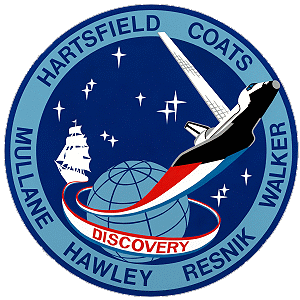
International Flight No. 97STS-41DDiscovery (1)12th Space Shuttle missionUSA |
 |
 |
|
Source: www.spacepatches.nl |
||
 |
 |
|
Launch, orbit and landing data
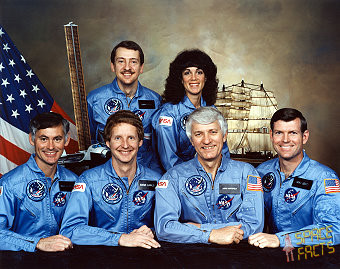
walkout photo |
 |
||||||||||||||||||||||||||||
alternative crew photo |
|||||||||||||||||||||||||||||
alternative crew photo |
|||||||||||||||||||||||||||||
alternative crew photo |
Crew
| No. | Surname | Given names | Position | Flight No. | Duration | Orbits | |
| 1 |  |
Hartsfield | Henry Warren, Jr. "Hank" | CDR | 2 | 6d 00h 56m 04s | 97 |
| 2 | |
Coats | Michael Lloyd | PLT | 1 | 6d 00h 56m 04s | 97 |
| 3 | |
Mullane | Richard Michael | MS-1, EV-1 | 1 | 6d 00h 56m 04s | 97 |
| 4 | |
Hawley | Steven Alan | MS-2, EV-2, FE | 1 | 6d 00h 56m 04s | 97 |
| 5 | |
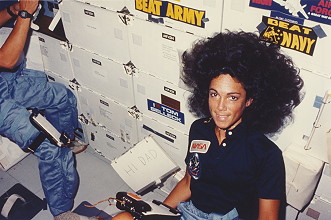
Resnik | Judith Arlene "J.R." | MS-3RMS | 1 | 6d 00h 56m 04s | 97 |
| 6 | |
Walker | Charles David | PS-1 | 1 | 6d 00h 56m 04s | 97 |
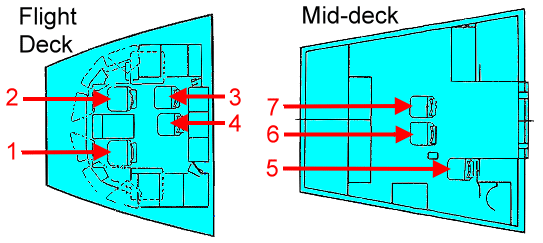
Crew seating arrangement
|
 |
|
||||||||||||||||||||||||||||
Hardware
| Orbiter : | OV-103 (1.) |
| SSME (1 / 2 / 3): | 2109 (3.) / 2018 (2.) / 2021 (1.) |
| SRB: | BI-011 |
| ET: | ET-13 (LWT-6) |
| OMS Pod: | Left Pod 03 (2.) / Right Pod 03 (1.) |
| FWD RCS Pod: | FRC 3 (1.) |
| RMS: | 301 (1.) |
| EMU: | EMU No. 1046 (PLSS No. 1006) / EMU No. 1048 (PLSS No. 1010) |
Flight
|
Launch from Cape Canaveral (KSC) and
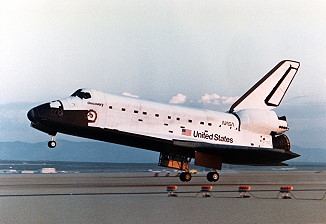
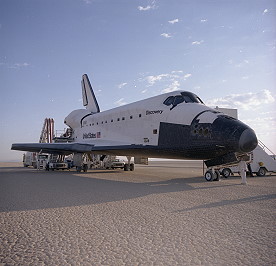
landing on the Edwards
AFB, Runway
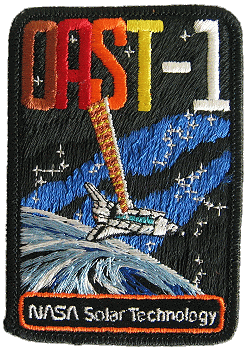
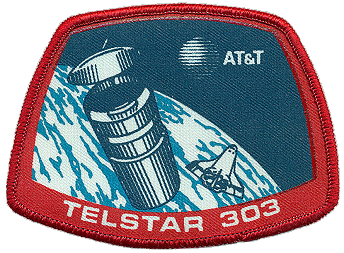
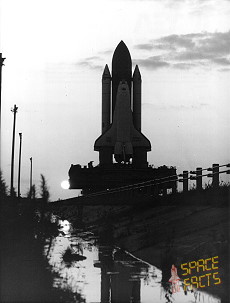
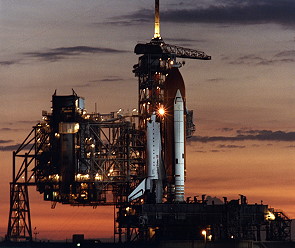
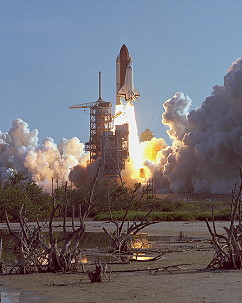
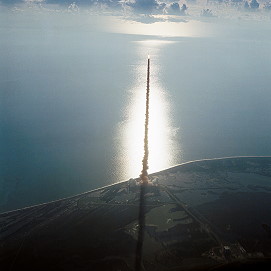
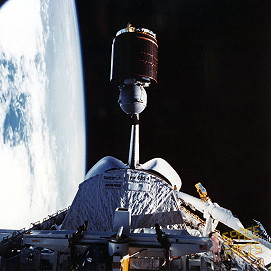
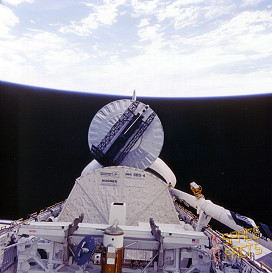
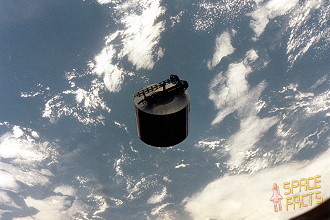
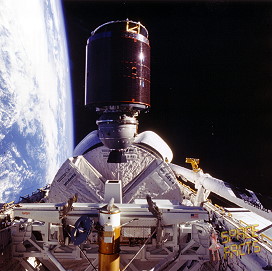
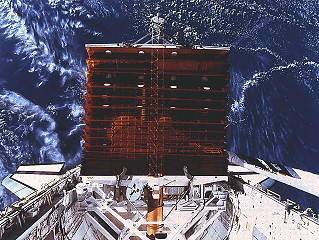
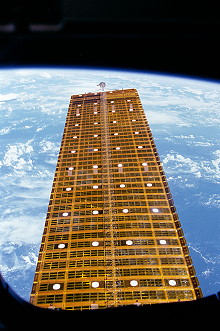
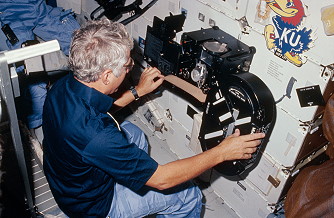
17. This was the first mission of the orbiter "Discovery". The launch was originally planned for June 25, 1984, but because of a variety of technical problems, including rollback to the Vehicle Assembly Building to replace a faulty main engine, the launch was delayed by over two months. The June 26, 1984 launch attempt marked the first time since Gemini 6A that a manned spacecraft had experienced a shutdown of its engines just prior to launch. The shutdown was at T-6 seconds and resulted to a launch abort. While evacuating the shuttle, the crew was doused with water from the pad deluge system, which was activated due to a hydrogen fire on the launch pad. Because the fire was invisible to humans, had the astronauts used the normal emergency escape procedure across the service arm to the slidewire escape baskets, they would have run into the fire. STS-41D finally launched on August 30, 1984, after a six-minute, 50-second delay when a private aircraft flew into the restricted airspace near the launch pad. It was the fourth launch attempt for Discovery. Because of the two-month delay, the STS-41F mission was cancelled (STS-41E had already been cancelled), and its primary payloads were included on the STS-41D flight. The combined cargo weighed over 41,184 pounds (18,681 kg), a record for a Space Shuttle payload up to that time. Cargo bay payloads on the combined mission included: Leasat 2 (Syncom IV-2) for Hughes Communications Services, Inc.; SBS-4 for Satellite Business Systems; Telstar 3 for American Telephone and Telegraph (AT&T); and OAST-1 for NASA's office of Aeronautics and Space Technology (OAST). The three commercial communications satellites were originally scheduled to fly on Mission STS-41F. The OAST-1 payload was retained from the original STS-41D flight. To accommodate the combined mission, several payloads had to be dropped from the cargo bay roster, including the Leasat 1 (Syncom IV-1) satellite, the Large Format Camera, the Cinema-360 special camera and one Getaway Special canister. The crew deployed the communications satellites SBS-D (USA), Telstar 3-C (USA) and Syncom IV-2/Leasat 2 (US Navy). Leasat-2 was the first large communications satellite designed specifically to be deployed from the Space Shuttle. All three satellites were released successfully and became operational. The first to be deployed was SBS-4, the fourth in a series of corporate communications satellites launched for Satellite Business Systems, a communications company owned by Aetna, Communications Satellite Corp. (COMSAT) and IBM. SBS-4 and its McDonnell Douglas-built Payload Assist Module (PAM-D) boost motor were mounted vertically in a special cradle. For deployment, the cradle's sunshield was opened, the astronaut crew conducted a final check of the satellite's health and then initiates spin-up of the satellite and its PAM-D solid rocket motor. The 50-rpm spin rate gave the satellite gyroscopic stability and provides protection from uneven heating from the sun. With the orbiter precisely pointed and at the correct instant, the mission specialist in charge of the deployment initiated the ejection sequence. Released by an explosive bolt/clamp, the satellite was pushed out of the cargo bay by powerful springs with a separation speed of about three feet per second. Once clear of the satellite, the Shuttle flight crew performed a brief separation maneuver to insure a safe distance between the two craft when the PAM-D motor fired automatically after a 45-minute delay. The PAM-D motor placed the spacecraft into an elliptical transfer orbit. At the high point of a selected orbit, a smaller onboard solid propellant apogee kick motor fired to stabilize the satellite at its final 22,300 s. mi. (35,888 km) orbital altitude. SBS-4 provided 10 transponders, each with a digital transmission capacity of 48 million bits per second or, alternatively, 1,300 simultaneous telephone calls. Five of SBS-4's transponders were used for the expansion of SBS Skyline telephone service. The other five were leased to Satellite Television Corp. for transmission of television programming. SBS operated in the 14/12 Gigahertz Ku-band of the frequency spectrum, avoiding the congestion encountered in C-band frequencies. The physical characteristics of SBS-4 are similar to those of its predecessors. In a launch configuration, the satellite was 2.16 m (7 it. 1 in.) in diameter and 2.82 m (9 ft. 3 in.) tall. The gross weight of the payload, including the PAM-D, was 3,349 kg (7,384 lb.). The satellite weighed 485 kg (1,069 lb.), exclusive of its 508-kg (1,119-lb.) apogee kick motor and 149 kg (328 lb.) of hydrazine attitude control fuel. Deployed in orbit, the satellite is 6.6 m (21.6 ft.) high. Syncom IV-2/Leasat 2 was the first satellite designed exclusively for launch aboard the Space Shuttle. Measuring 4.2 m (14 ft.) across, the spacecraft is too large to fit in the protective nose cone that sits on top of an expendable booster, such as a Delta or Atlas Centaur rocket. Unlike the two other satellites carried on this mission, Syncom IV-2/Leasat 2 was mounted horizontally in the orbiter's cargo bay. Installation of the spacecraft in the payload bay was accomplished with the aid of a cradle structure. The cradle permitted the spacecraft to be installed laying on its side, with its retracted antennas pointing toward the nose of the orbiter and its propulsion system pointing toward the back. Mounting the antennas on deployable structures allowed them to be stowed for launch. Another unique feature of the Syncom IV-2/Leasat 2 series of satellites was that they do not require a separately purchased upper stage, as have all the other communications satellites launched to date from the Shuttle. The Syncom IV-2/Leasat 2 satellites contained their own unique upper stage to transfer them from the Shuttle deploy orbit of about 182 s. mi. to a circular orbit 22,300 s. mi. over the equator. Each satellite was 6 m (20 ft.) long with the UHF and omnidirectional antennas deployed. Total payload weight in the Shuttle was 7,740 kg (17,049 lb.). The satellite's weight on station at the beginning of its planned seven-year life was nearly 1,315 kg (2,900 lb.). Hughes Space and Communications Group build the satellites. Ejection of the spacecraft from the Shuttle was initiated when locking pins at the four contact points are retracted. An explosive device then released a spring that ejects the spacecraft in a "Frisbee" motion. This gave the satellite its separation velocity and gyroscopic stability during the 45-minute coast period between deployment and ignition of the perigee kick motor. The satellite separated from the Shuttle at a velocity of 0.7 m (1.5 ft.) per second and a spin rate of about two rpm. Deployment of the Syncom IV-2/Leasat 2 satellite triggered an onboard automatic sequencer. The sequencer configures the satellite for firing of the solid propellant perigee motor. The telemetry, tracking and command antenna was deployed, attitude electronics, spacecraft power and telemetry were initialized, and the spacecraft spin rate was increased to 30 rpm. The second in the Telstar 3 series of communications satellites, representing the latest in satellite communications technology, was deployed on flight day three during the ascending half of orbit 34. When combined with the new single sideband Earth station equipment developed by Bell Labs, each Telstar 3 satellite was capable of relaying nearly four times the number of simultaneous telephone calls commonly carried by satellites of the previous generation. Designed for domestic communications, Telstar satellites operated in the 6/4 Gigahertz C-band and served the continental United States, Hawaii, Puerto Rico or Alaska, depending on exact orbital placement over the equator. Each satellite was able to relay hundreds of video teleconferences, 24 color television programs or billions of bits of high-speed data and facsimile signals. The second Telstar 3 was placed at 76 degrees W. longitude. It had a total of 24 working transponders, the equipment that receives and transmits communications signals, as well as six amplifiers held in reserve. Each Telstar 3 satellite consisted of two primary sections containing the communications units and the support systems, surrounded by two concentric cylinders. once in space, the outer cylinder dropped down about 1.8 m (6 ft.) exposing the solar cells on the inner cylinder. With its antenna fully deployed in space, the satellite had an overall length of 6.83 m (22.4 ft.) and a diameter of 2.16 m (7.1 ft.). The two cylinders were covered with 15,588 solar cells. When the satellite was in the sun's path, these cells, thin silicon chips, covert solar energy to electrical power to energize the satellite. When not operated by solar power, the Telstar 3 satellite used nickel-cadmium, long-life batteries. Like SBS-4, the Telstar 3 spacecraft used a PAM-D for transfer orbit insertion. Ground controllers monitored the satellite until it reached a selected apogee, or high point, at which time they fired the onboard apogee kick motor to circularize the orbit at the geosynchronous altitude of 22,300 s. mi. (35,888 km). Another payload was the OAST-1 solar array, a device 13 feet (4.0 m) wide and 102 feet (31 m) high, which folded into a package 7 inches (180 mm) deep. The array carried a number of different types of experimental solar cells and was extended to its full height several times. It was the largest structure ever extended from a manned spacecraft and demonstrated the feasibility of large lightweight solar arrays for future application to large facilities in space, such as the International Space Station. OAST-1 consisted of three major experiments: the Solar Array Experiment (SAE); the Dynamic Augmentation Experiment (DAE); and the Solar Cell Calibration Facility (SCCF). Major payload components were carried on a triangular, truss-like MPESS in the orbiter's cargo bay. The primary objectives of OAST-1 were: to demonstrate the performance of a large, low-cost, lightweight, deployable/ retractable solar array; to demonstrate methods to define the structural dynamics of large space structures; and to evaluate solar cell calibration techniques as well as calibrate various types of solar cells. The heart of the payload was the solar array wing. When fully extended, it raised more than 10 stories (31.5 m or 102 ft.) above the Shuttle cargo bay. Yet, when stowed for launch and landing, the wing folded into a package only 17.78 cm (7 in.) deep. Charles Walker became the first commercially sponsored payload specialist to fly aboard the Shuttle. He worked on the Continuous Flow Electrophoresis System. The McDonnell Douglas-sponsored Continuous Flow Electrophoresis System (CFES) experiment, using living cells, was more elaborate than the one flown on previous missions, and payload specialist Charles Walker operated it for more than 100 hours during the flight. The CFES was a device that separates materials in solution by subjecting them to an electrical field. In this process, a continuous stream of biological material was injected into a buffer solution flowing through a thin, rectangular chamber. When the electrical field was applied, the biological materials pulled apart into separate streams. These streams flow out of the top of the chamber and are collected. The system weighed about 288.4 kg (634.4 lb.). The orbiter supplied the necessary power to the unit and access to a cooling system to dissipate the heat generated by the process. A flight experiment to characterize surface-originated vehicle glow was conducted during flight STS-41D. Observations made during recent Shuttle flights indicate that optical emissions originate on spacecraft surfaces facing the direction of orbital motion. Material specimens flown on STS-8 have shown spectral distribution and intensity of the glow to be different for different materials, and that the intensity becomes stronger as spacecraft altitude is reduced. These results are of principal concern to mission scientists for the Space Telescope and for the astronomical observatories that will be aboard the Space Station, because slight orbit degradations will cause the glow to become more intense and possibly interfere with faint star-light measurements for attitudes where the telescope optics are oriented toward the "windward" direction. Nine strips of material, representing different spacecraft materials, have been attached circumferentially to the orbiter's robot arm. The flight crew took pictures of the strips from the orbiter's aft flight deck during two night passes late in the mission. Prior to each photographic opportunity, the attitude of the orbiter was adjusted to produce direct impingement of the orbital environment onto the material strips. The Clouds payload consisted of two, 250-exposure camera assemblies with battery-powered motor drives, l05 mm F/2 lenses and infrared filters. All of the hardware was stowed in a middeck locker and was used at the aft flight deck station for cloud photography data collection. Located in the middeck was an IMAX motion picture camera, making the second of three scheduled trips into space aboard the Shuttle. Footage from the Shuttle flights will be assembled into a film called "The Dream Is Alive". The IMAX high-fidelity motion picture system uses a large 70 mm film frame that, because of its size, improves picture quality. IMAX films are displayed on a screen that is nine times larger than a conventional screen, producing a more compelling effect. A student experiment to study crystal growth in microgravity was also carried out. The material consisted of a 25-cm (10-in.) rod of gallium impregnated with thallium. Heat was applied to the crystal interface until a molten zone was formed, and the zone then moved up the length of the rod. In the absence of gravity, a more uniform distribution of the thallium and a more perfect gallium crystal was expected to result. The experiment was contained in the middeck. |
Photos / Graphics
 |
 |
 |
 |
 |
 |
 |
 |
 |
 |
 |
 |
 |
 |
 |
 |
 |
 |
 |
 |
 |
 |
 |
 |
 |
 |
| © |  |
Last update on May 31, 2020.  |
 |