Human Orbital Spaceflights

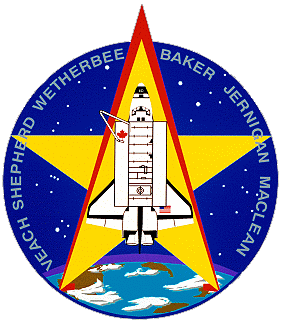
International Flight No. 152STS-52Columbia (13)51st Space Shuttle missionUSA |
 |
 |
 |
||
Launch, orbit and landing data
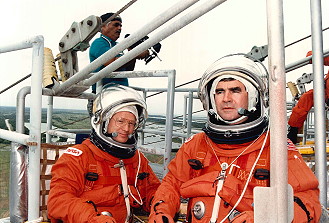
walkout photo |
 |
||||||||||||||||||||||||||||
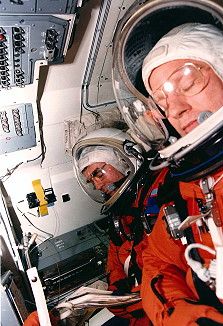
alternative crew photo |
|||||||||||||||||||||||||||||
alternative crew photo |
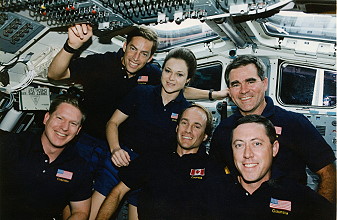
Crew
| No. | Surname | Given names | Position | Flight No. | Duration | Orbits | |
| 1 |  |
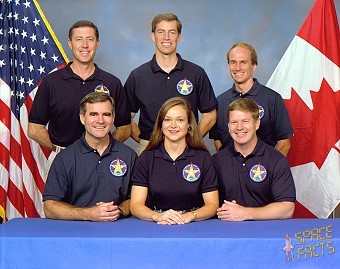
Wetherbee | James Donald "Wexbee" | CDR | 2 | 9d 20h 56m 13s | 159 |
| 2 | |
Baker | Michael Allen | PLT, IV-1 | 2 | 9d 20h 56m 13s | 159 |
| 3 | |
Veach | Charles Lacy | MS-1, RMS | 2 | 9d 20h 56m 13s | 159 |
| 4 | |
Shepherd | William McMichael | MS-2, EV-1, FE | 3 | 9d 20h 56m 13s | 159 |
| 5 | |
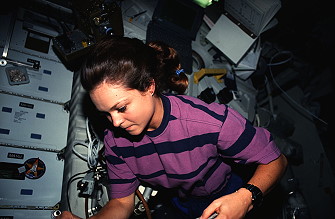
Jernigan | Tamara Elizabeth "Tammy" | MS-3, EV-2 | 2 | 9d 20h 56m 13s | 159 |
| 6 |  |
MacLean | Steven Glenwood | PS-1 | 1 | 9d 20h 56m 13s | 159 |
Crew seating arrangement
|
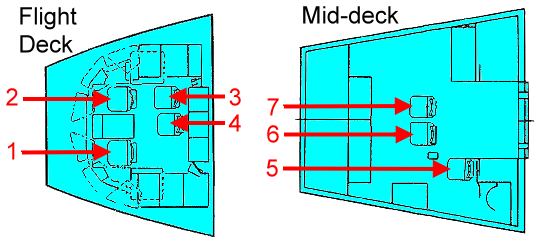 |
|
||||||||||||||||||||||||||||
Backup Crew
|
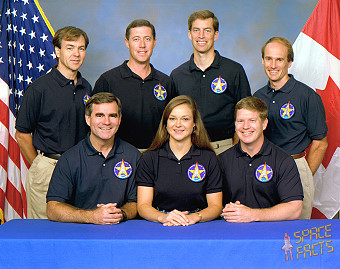 |
||||||||||
Hardware
| Orbiter : | OV-102 (13.) |
| SSME (1 / 2 / 3): | 2030 (8.) / 2015 (9.) / 2034 (1.) |
| SRB: | BI-054 / RSRM 27K |
| ET: | ET-55 (LWT-48) |
| OMS Pod: | Left Pod 05 (2.) / Right Pod 05 (2.) |
| FWD RCS Pod: | FRC 2 (13.) |
| RMS: | 301 (11.) |
| EMU: | EMU No. 2017 (PLSS No. 1013) / EMU No. 2015 (PLSS No. 1010) |
Flight
|
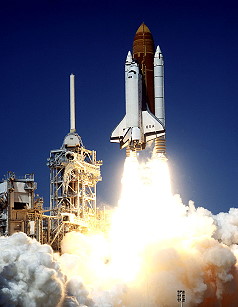
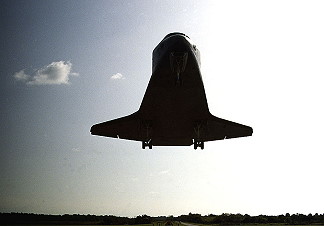
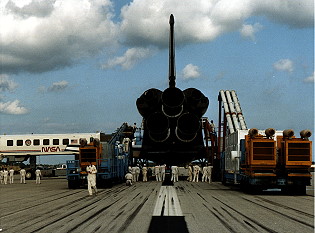
Launch from Cape Canaveral (KSC) and
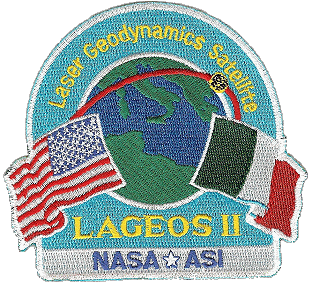
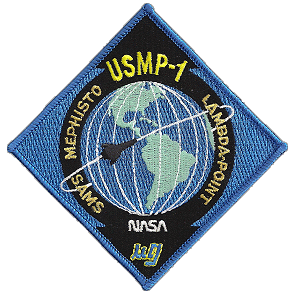
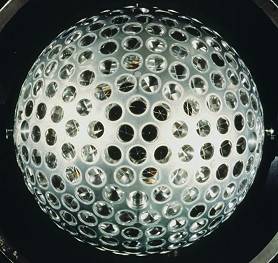
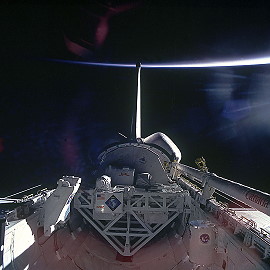
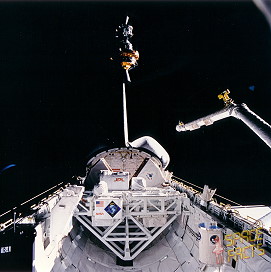
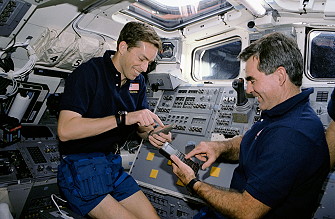
landing on Cape Canaveral (KSC), Runway 33. The launch was originally planned for mid October 1992. Technical problems with one of the main engines forced the NASA to replace it. This work was done on the launch pad. Primary mission objectives were the deployment of the Laser Geodynamic Satellite II (LAGEOS II) and the operation of the U.S. Microgravity Payload-1 (USMP-1). The Laser Geodynamics Satellite (LAGEOS) II, like its predecessor launched in 1976, was a passive satellite dedicated exclusively to laser ranging. Laser ranging involves sending laser beams from Earth to the satellite and recording the round-trip travel time. This measurement enables scientists to precisely measure the distances between laser ranging stations on the Earth and the satellite. LAGEOS was designed to provide a reference point for laser ranging experiments that monitored the motion of the Earth's crust, measure and understand the "wobble" in the Earth's axis of rotation, collected information on the Earth's size and shape and more accurately determined the length of the day. The information was particularly useful for monitoring regional fault movement in earthquake-prone areas such as California and the Mediterranean Basin. The LAGEOS II project is a joint program between NASA and the Italian space agency ASI. The LAGEOS II satellite was a spherical satellite made of aluminum with a brass core. It was only 24 inches (60 cm) in diameter yet it weighed approximately 900 pounds (405 kg). This compact, dense design made the satellite's orbit as stable as possible. The LAGEOS design evolved from several trade-offs that proved necessary to achieve the program objectives. For example, the satellite had to be as heavy as possible to minimize the effects of nongravitational forces, yet light enough to be placed in a high orbit. The satellite had to be big enough to accommodate many retroreflectors, but small enough to minimize the force of solar pressure. LAGEOS II had the dimpled appearance of a large golf ball. Imbedded into the satellite are 426 nearly equally spaced, cube-corner retroreflectors, or prisms. Most of the retroreflectors (422) are made of suprasil, a fused silica glass. The remaining four, made of germanium, may be used by lasers of the future. About 1.5 inches (3.8 cm) in diameter, each retroreflector had a flat, circular front-face with a prism-shaped back. The retroreflectors on the surface of LAGEOS II were three-dimensional prisms that reflected light, in this case a laser beam, directly back to its source. A timing signal started when the laser beam leaves the ground station and continues until the pulse, reflected from one of LAGEOS II's retroreflectors, returned to the ground station. After the Shuttle released under the lead of Tamara Jernigan on flight day 2 LAGEOS II, two solid-fuel stages, the Italian Research Interim Stage (IRIS) and the LAGEOS Apogee Stage (LAS), engaged. The IRIS boosted LAGEOS II from the Shuttle's 184-mile (296 km) parking orbit to the satellite injection altitude of 3,666 miles (5,900 km). The LAS circularized the orbit. This was the first IRIS mission and qualified the IRIS, a spinning solid fuel rocket upper stage, for use in deploying satellites from the Space Shuttle cargo bay. LAGEOS II's circular orbit was the same as that of LAGEOS I, but at a different angle to the Earth's equator: 52 degrees for LAGEOS II and 110 degrees for LAGEOS I. The complementary orbit provided more coverage of the seismically active areas such as the Mediterranean Basin and California, improving the accuracy of crustal-motion measurements. It also may help scientists understand irregularities noted in the position of LAGEOS I, which appear to be linked to erratic spinning of the satellite itself. The USMP program was a series of NASA missions designed for microgravity experiments that do not require the "hands-on" environment of the Spacelab. The USMP-1 payload carried three investigations. The Lambda-Point Experiment (LPE) studied fluid behavior in microgravity. The Materials for the Study of Interesting Phenomena of Solidification on Earth and in Orbit, (Materiel pour l'Etude des Phenomenes Interessant la Solidification sur Terre et en Orbite, or MEPHISTO) studied metallurgical processes in microgravity. The Space Acceleration Measurement System (SAMS) studied the microgravity environment onboard the Space Shuttle. Two Mission-Peculiar Equipment Support Structures (MPESS) in the Shuttle cargo bay made up USMP-1. Carrier subsystems mounted on the front MPESS provided electrical power, communications, data-handling capabilities and thermal control. MSFC developed the USMP carrier. The Lambda-Point Experiment (LPE) studied liquid helium as it changes from normal fluid to a superfluid state. In the superfluid state, helium moves freely through small pores that block other liquids, and it also conducts heat 1,000 times more effectively than copper. This change occurs at liquid helium's "lambda point" (-456 degrees Fahrenheit or 2.17 degrees Kelvin). Because the transition from one phase to another causes the organized interaction of large numbers of particles, it is of great scientific interest. The transition from fluid to superfluid state could studied more closely in microgravity than on Earth. Gravity caused a sample of liquid helium to have greater pressure at the bottom than at the top, in turn causing the top of the sample to become superfluid at higher temperatures. Onboard USMP, a sample of helium cooled far below its lambda point was placed in a low-temperature cryostat (an apparatus used to keep something cold, such as a thermos bottle). During a series of 2-hour runs controlled by an onboard computer, the helium's temperature was raised through the transition point by a precision temperature- control system. Sensitive instruments inside the cryostat measured the heat capacity of the liquid helium as it changes phases. The temperature of the helium sample was maintained to within a billionth of degree during the experiment. Materials for the Study of Interesting Phenomena of Solidification on Earth and in Orbit (MEPHISTO) was a joint American-French cooperative program. The definition and development of the flight hardware has been led by CNES (French Space Agency) and CEA (French Atomic Energy Commission). MEPHISTO studied the behavior of metals and semiconductors as they solidify to help determine the effect gravity has during solidification at the point where solid meets liquid, called the solid/liquid interface. Data gathered from MEPHISTO were used to improve molten materials. For example, more resilient metallic alloys and composite materials could be designed for engines that will power future aircraft and spacecraft. The cylindrical-shaped MEPHISTO furnace experiment contained three identical rod-shaped samples of a tin-bismuth alloy. MEPHISTO will process the samples using two furnaces, one fixed and one moving. As a run begins, the mobile furnace will move outward from the fixed furnace, melting the samples. The mobile furnace then moved back toward the fixed furnace, and the sample resolidifies. The fixed furnace contained a stationary solid/liquid interface to be used as a reference for studying the mobile solid/liquid interface. MEPHISTO has been designed to perform quantitative investigations of the solidification process by using several specific diagnosis methods. During the experiment runs, a small electrical voltage constantly measured the temperature changes at the interface to verify solidification rates. During the last experimental run, electrical pulses were sent through one sample, "freezing" the shape of the interface for post-mission analysis. The MEPHISTO apparatus allowed many cycles of solidification and remelting and was particularly welladapted for long-duration missions. During the mission, scientists compared the electrical signal to data from a SAMS sensor to see if the Shuttle's movement is disturbing the interface. They then could make adjustments to the experiments if necessary. Post-mission analysis of the space-solidified sample allowed correlation between the electrical measurements and changes in the sample. The Space Acceleration Measurement System (SAMS) was designed to measure and record low-level acceleration during experiment operations. The signals from these sensors were amplified, filtered and converted to digital data before it was stored on optical disks and sent via downlink to the ground control center. USMP-1 was the first mission for two SAMS flight units in the cargo bay configuration. The two units each supported two remote sensor heads. Two heads were mounted in the Lambda Point Experiment (LPE) and the other two heads were mounted to the MPESS structure near the MEPHISTO furnace. SAMS flight hardware was designed and developed in-house by the NASA Lewis Research Center and Sverdrup Technology Inc. project team. The units have flown on STS-40, STS-43, STS-42, STS-50 and STS-47 missions. The Attitude Sensor Package (ASP) experiment consisted of three unique spacecraft attitude sensors, an on-board computer and a support structure. The primary sensor was the Modular Star Sensor (MOSS). The other two sensors were the Yaw Earth Sensor (YESS) and the Low Altitude Conical Earth Sensor (LACES). The ASP sensors and their support structure were assembled on a Hitchhiker small mounting plate. The Hitchhiker avionics, mounted to another small mounting plate, provided power and signal interfaces between the ASP experiment and the Shuttle. Often the performance of the space instruments cannot be predicted accurately on Earth because of the lack of knowledge of and actual simulation of the space environment. The ASP experiment exposed these attitude sensors to actual space conditions, demonstrating their performance and accuracy. This flight experience was evaluated by ESA for possible use of these sensors on future ESA programs. Canadian Experiments-2 (CANEX-2) was a group of space technology, space science, materials processing and life sciences experiments which were performed in space by Canadian Payload Specialist Steven MacLean during the STS-52 mission of Space Shuttle Columbia. Bjarni Tryggvason was a backup crew member and alternative to Steven MacLean for this mission. The potential applications of CANEX-2 space research included machine vision systems for use with robotic equipment in space and in environments such as mines and nuclear reactors. Other potential applications related to the manufacturing of goods, the development of new protective coatings for spacecraft materials, improvements in materials processing, a better understanding of the stratosphere which contains the protective ozone layer, and greater knowledge of human adaptation to microgravity. Many of these experiments are extensions of the work carried out by Marc Garneau as part of the CANEX group of experiments that helped form his 1984 mission (STS-41G). The development of the Space Vision System (SVS), a machine vision system for robotic devices, such as the Canada arm, was undertaken to enhance human vision in the unfavorable viewing conditions of space. The SVS could provide information on the exact location, orientation and motion of a specified object. Steven MacLean evaluated an experimental Space Vision System for possible use in the Space Shuttle and in the construction of Space Station Freedom. For the CANEX-2 experiments, target dots have been placed on the Canadian Target Assembly (CTA), a small satellite carried in the Space Shuttle's cargo bay. During the flight, a mission specialist used the arm to deploy the CTA and take it through a series of maneuvers using the information displayed by the SVS. Steven MacLean evaluated SVS performance and investigated details that need to be considered to design a production model of the system. The Materials Exposure in Low-Earth Orbit (MELEO) experiment was an extension of work performed by the CSA which began with the Advanced Composite Materials Experiment (ACOMEX) flown on Marc Garneau's 1984 mission. Researchers now wanted to extend the valuable baseline date obtained to further investigate the deterioration process, try new protective coatings and test materials designed for use on specific space hardware such as the Mobile Servicing System (MSS) for the Space Station Freedom and RADARSAT, the Canadian remote sensing satellite scheduled for launch in early 1995. The MELEO experiment exposed over 350 material specimens mounted on "witness plates" on the Canada arm and analyzed after the mission. Typical spacecraft materials were tested along with new developments in protective measures against atomic oxygen. The specimens were exposed in the flight direction for at least 30 hours. Steven MacLean periodically photographed the specimens to record the stages of erosion. All materials were returned to Earth for detailed examination. The experiments included Orbiter Glow-2 (OGLOW-2), Queen's University Experiment in Liquid-Metal Diffusion (QUELD), Sun Photo Spectrometer Earth Atmosphere Measurement (SPEAM-2), Phase Partitioning in Liquids (PARLIQ), Space Adaptation Tests and Observations (SATO), Vestibular-Ocular Reflex Check, Body Water Changes in Microgravity, Illusions During Movement. Tank Pressure Control Experiment/Thermal Phenomena (TPCE/TP) represented an extension of the data acquired in the Tank Pressure Control Experiment (TPCE) which flew on STS-43 in 1991. The flight of TPCE significantly increased the knowledge base for using jet-induced mixing to reduce the pressure in thermally stratified subcritical tanks. Mixing represents a positive means of limiting pressure build-up due to thermal stratification and may allow non-vented storage of cryogenics for some of the shorter duration missions. The purpose of the reflight, TPCE/TP, was to focus on the thermal phenomena involved in the selfpressurization of subcritical tanks in a low-g environment. Physiological Systems Experiment-02 (PSE-02) evaluated a compound being developed to treat osteoporosis. The experiment tested the ability of the compound to slow or stop bone loss induced by microgravity. Scientists examined whether the lower gravity experienced on a space flight accelerates the rate at which bone mass is lost, compared to losses observed when a limb is immobilized on Earth. In this experiment, six healthy, adolescent, male, albino rats were treated with the Merck developmental anti-osteoporotic compound prior to flight. An equivalent number of flight rats remained untreated to serve as controls. The two groups were housed in completely self- contained units called Animal Enclosure Modules (AEMs) during the flight. The AEMs contained enough food and water for the duration of the mission. No interaction with the crew was required on orbit. A clear plastic cover on the AEM permitted the crew to visually inspect the condition of the rats. The Heat Pipe Performance (HPP) experiment on STS-52 evaluated the sensitivity of state-of-the-art heat pipes to large and small accelerations. It also gathered data on the force needed to 'deprime' (dry out) heat pipes and how long it takes them to recover. During the mission, the astronauts assembled HPP in the orbiter's middeck area and conducted the tests. Four heat pipes were evaluated in each experiment run by rotating them on a cross-shaped frame. A motor on an instrument unit mounted to the middeck floor drove the assembly. A battery-powered data logger recorded the data. The Shuttle Plume Impingement Experiment (SPIE) recorded measurements of atomic oxygen and contamination from Shuttle thruster firings during STS-52. With sensors located at the end of Columbia's mechanical arm, SPIE supported the CANEX-2 MELEO experiment as it exposed materials to the atomic oxygen in the vicinity of Columbia. During these operations, the mechanical arm was positioned to place the SPIE sensor package in the direction of travel of Columbia, and the atomic oxygen levels were recorded on a portable computer in the Shuttle cabin. The objective of the Commercial Programs is sponsoring the Commercial MDA ITA Experiments (CMIX) payload was to provide industry and CCDS users with low-cost space experimentation opportunities, thereby supporting one of the objectives of the NASA CCDS program to provide commercial materials development projects that benefit from the unique attributes of space. The goal of the protein crystal growth experiments was to produce larger, more pure crystals than can be produced on Earth. The pharmaceutical industry will use such crystals to help decipher the structure of a protein using X-Ray crystallographic analysis. The principal commercial application of such data is in the development of new drugs or treatments. The Crystal Vapor Transport Experiment (CVTE) experiment was important to the semiconductor industry because the ability of semiconductors to process and store information is dependent on the quality of the crystals used. Thus, large, uniform crystals grown in space may lead to greater speed and capability of computers, sensors and other electronic devices. Thermal convection is turbulence induced by variations in densities caused by the temperature differences that occur in a material when it's heated. Buoyancy and sedimentation is a similar phenomenon, created by Earth's gravitational pull, that makes less dense materials rise (buoyancy) and denser materials sink (sedimentation). Because of these gravity-induced phenomena, crystals grown on Earth are smaller and less ordered, containing imperfections that limit the capability of transistors, sensors and other types of electronic devices. The Commercial Protein Crystal Growth (CPCG) goal was to develop the technology and applications needed for successful space-based protein crystal growth (PCG). Structural information gained from CPCG activities can provide, among other information, a better understanding of the body's immune system, and ultimately aid in the design of safe and effective treatment for disease and infections. For these reasons, CPCG crystal structure studies were conducted on 7 Shuttle missions starting in 1988. The Ultraviolet Plume Experiment (UVPI) was an instrument on the Low-Power Atmospheric Compensation Experiment (LACE) satellite launched by the Strategic Defense Initiative Organization in February 1990. LACE was in a 43-degree inclination orbit of 290 n.m. (537 km). Imagery of Columbia's engine firings or attitude control system firings were taken on a non-interference basis by the UVPI whenever an opportunity was available during the STS-52 mission. |
Photos / Graphics
 |
 |
 |
 |
 |
 |
 |
 |
 |
 |
 |
 |
 |
 |
 |
 |
 |
 |
more Earth observation photos |
|
| © |  |
Last update on March 27, 2020.  |
 |