Human Orbital Spaceflights

International Flight No. 148STS-50Columbia (12)48th Space Shuttle missionUSA |
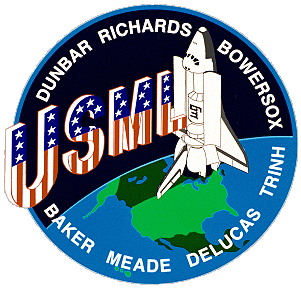 |
 |
 |
||
Launch, orbit and landing data
walkout photo |
 |
||||||||||||||||||||||||||||
alternative crew photo |
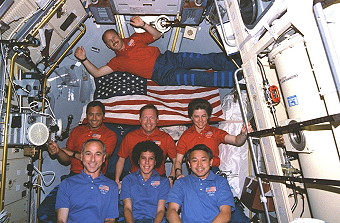
Crew
| No. | Surname | Given names | Position | Flight No. | Duration | Orbits | |
| 1 |  |
Richards | Richard Noel "Dick" | CDR | 3 | 13d 19h 30m 05s | 221 |
| 2 | |
Bowersox | Kenneth Dwane "Sox" | PLT | 1 | 13d 19h 30m 05s | 221 |
| 3 | |
Dunbar | Bonnie Jeanne | MS-1, PLC | 3 | 13d 19h 30m 05s | 221 |
| 4 | |
Baker | Ellen Louise Shulman | MS-2, EV-1, FE | 2 | 13d 19h 30m 05s | 221 |
| 5 | |
Meade | Carl Joseph | MS-3, EV-2 | 2 | 13d 19h 30m 05s | 221 |
| 6 | |
DeLucas | Lawrence James | PS-1 | 1 | 13d 19h 30m 05s | 221 |
| 7 | |
Trinh | Eugene Huu-Chau | PS-2 | 1 | 13d 19h 30m 05s | 221 |
Crew seating arrangement
|
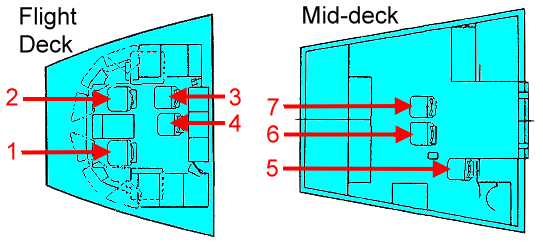 |
|
||||||||||||||||||||||||||||||||
Backup Crew
|
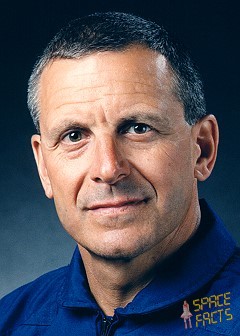 |
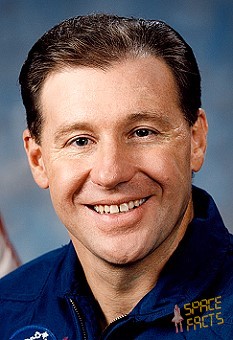 |
|||||||||||||||
Hardware
| Orbiter : | OV-102 (12.) |
| SSME (1 / 2 / 3): | 2019 (10.) / 2031 (7.) / 2011 (7.) |
| SRB: | BI-051 / RSRM 24W |
| ET: | ET-50 (LWT-43) |
| OMS Pod: | Left Pod 05 (1.) / Right Pod 05 (1.) |
| FWD RCS Pod: | FRC 2 (12.) |
| RMS: | - |
| EMU: | EMU No. 2013 (PLSS No. 1005) / EMU No. 2017 (PLSS No. 1013) |
Flight
|
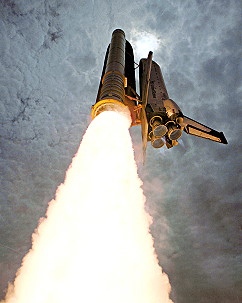
Launch from Cape Canaveral (KSC) and
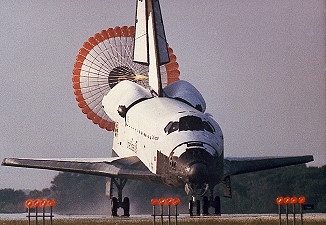
landing on Cape Canaveral (KSC), Runway 33. Columbia landed at the Kennedy Space
Center for the first time ever due to bad weather at the Edwards
AFB caused by
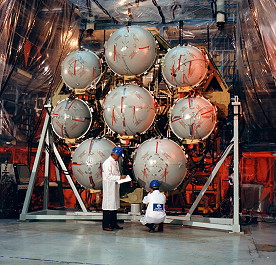
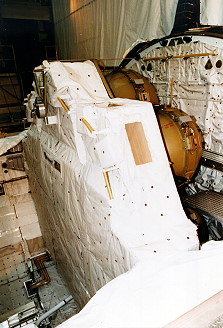
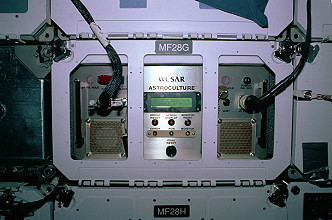
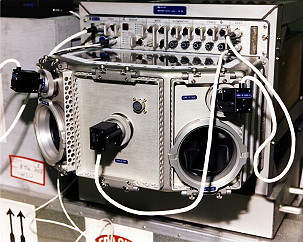
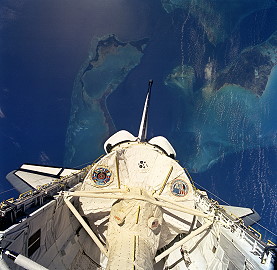
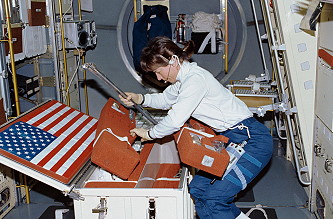
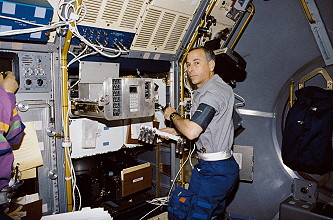
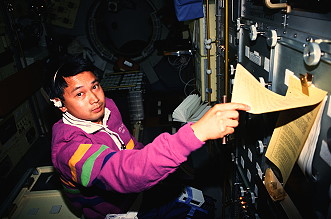
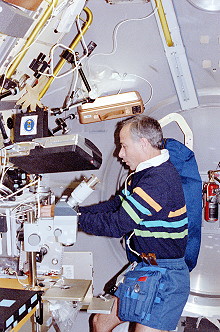
the remnants of Hurricane Darby. The U.S. Microgravity Laboratory 1 was a Spacelab mission, with experiments in material science, fluid physics and biotechnology. It was the first flight of a Space Shuttle with the Extended Duration Orbiter (EDO) hardware, allowing longer flight durations. This was made possible by the first use of the new Extended Duration Orbiter kit, which included equipment and fuel for extra energy production, additional nitrogen tanks for cabin air and a regeneration system to remove carbon dioxide. The kit eventually may permit Shuttle missions up to 30 days long. Primary payload, U.S. Microgravity Laboratory-1 (USML-1), made its first flight; featured pressurized Spacelab module. USML-1 was the first in planned series of flights to advance U.S. microgravity research effort in several disciplines. Experiments conducted were: Crystal Growth Furnace (CGF); Drop Physics Module (DPM), that permitted the study of liquids without the interference of a container; Surface Tension Driven Convection Experiments (STDCE); Zeolite Crystal Growth (ZCG); Protein Crystal Growth (PCG); Glovebox Facility (GBX); Space Acceleration Measurement System (SAMS); Generic Bioprocessing Apparatus (GBA); Astroculture-1 (ASC); Extended Duration Orbiter Medical Project (EDOMP); Solid Surface Combustion Experiment (SSCE). The Zeolite Crystal Growth (ZCG) processed 38 separate samples which were mixed in the Glovebox. Zeolite crystals are used to purify biological fluids, as additives in laundry detergents, and in waste clean-up applications. Microgravity literally means a state of very small or minute gravity. Earth's gravitational field extends far into space. It is the Shuttle's balance between that gravity, which pulls it down, and centrifugal force, created as the Shuttle flies along a circular path, that causes space travelers and anything in the Shuttle that is not secured to "float" in space as they fall free in Earth's gravitational field. Though microgravity is a relatively new term, it could become a household word in the next century as the potential benefits of space-based research are realized. The Crystal Growth Furnace (CGF) is a reusable facility for investigating crystal growth in microgravity. It is capable of automatically processing up to six large samples at temperatures up to 1,600 degrees Celsius. Additional samples can be processed upon performing manual sample exchange. Two methods of crystal growth, directional solidification and vapor transport, were used on The Investigations into Polymer Membrane Processing (IPMP), a middeck payload, made its fifth Space Shuttle flight. The objective of the IPMP was to investigate the physical and chemical processes that occur during the formation of polymer membranes in microgravity such that the improved knowledge base can be applied to commercial membrane processing techniques. Supporting the overall program objective, the STS-50 mission provided additional data on the polymer precipitation process-1. By analyzing the composition and the atomic structure of crystals grown without the dominating influence of gravity, scientists will gain insight into correlations between fluid flows during solidification and the defects in a crystal. CGF operated for 286 hours and processed seven samples, three more than scheduled, including two gallium arsenide semiconductor crystals. Gallium arsenide crystals are used in high-speed digital integrated circuits, optoelectronic integrated circuits, and solid-state lasers. Crew members were able to exchange samples, using a specially designed flexible Glovebox, to provide the additional experiment operations. The Surface Tension Driven Convection Experiment (STDCE) was the first space experiment to use state- of-the-art instruments to obtain quantitative data on surface tension-driven flows on the surface of liquids over a wide range of variables in a microgravity environment. Very slight surface temperature differences are sufficient to generate subtle fluid flows on the surface of liquids. Such flows, referred to as "thermocapillary", exist on fluid surfaces on Earth. However, thermocapillary flows on Earth are very difficult to study because they are often masked by much stronger buoyancy-driven flows. In microgravity, buoyancy-driven flows are greatly reduced permitting the study of this phenomenon. STDCE provided the first observations of thermocapillary flow in a curved-surface fluid and demonstrated that surface tension is a powerful driving force for fluid motion. The Drop Physics Module (DPM) permitted the study of liquids without the interference of a container. Liquids on Earth take the shape of the container that holds them. Furthermore, the materials that make up the container may chemically contaminate the liquids under study. The DPM uses acoustical (sound) waves to position a drop in the center of a chamber. By studying drops in this manner, scientists have the opportunity to test basic fluid physics theories in the areas of nonlinear dynamics, capillary waves, and surface rheology (changes in the form and flow of matter). Crew members, through manipulation of the sound waves, were able to rotate, oscillate, merge, and even split drops. In another test, the crew members were able to create the first compound drop, a drop within a drop, to investigate a process that could eventually be employed to encapsulate living cells within a semi-permeable membrane for use in medical transplantation treatments. The Glovebox facility perhaps proved to be the most versatile new space laboratory equipment introduced in the last few years. The Glovebox offers crew members the opportunity to manipulate many different kinds of test activities and demonstrations and materials (even toxic, irritating, or potentially infectious ones) without making direct contact with them. The Glovebox has a viewport (window) into a clean workspace, built-in gloves for manipulation of samples and equipment, a negative air pressure system, a filter system, and an entry door for passing materials and experiments into and out of the work area. The primary use of the Glovebox was to selectively mix protein crystals and monitor their growth. The Glovebox allowed crew members to periodically change compositions to optimize the growth, a first for space. Other tests conducted inside the Glovebox included studies on candle flames, fiber pulling, particle dispersion, surface convection in liquids, and liquid/container interfaces. Sixteen tests and demonstrations in all were conducted inside the Glovebox. The Glovebox also provided crew members the opportunity to perform backup operations on the Generic Bioprocessing Apparatus which were not planned. Another of the Spacelab experiments was the Generic Bioprocessing Apparatus (GBA), a device for processing biological materials. The GBA processed 132 individual experiments with volumes of several milliliters. The apparatus studied living cells, microorganisms used in ecological waste treatment, and the development of brine shrimp and wasp eggs, and other biomedical test models which are used in cancer research. One sample studied, Liposomes, consist of spherical structures that could be used to encapsulate pharmaceuticals. If this biological product can be formed properly, it could be used to deliver a drug to a specific tissue in the body, such as a tumor. The Space Acceleration Measurement System (SAMS) instrument measured the low-level acceleration (aka microgravity) conditions experienced by the microgravity experiments during the mission. These data are invaluable for the scientists to ascertain whether effects seen in their experimental data are due to external disturbances or not. The SAMS instruments flew on more than twenty Shuttle missions, 3.5 years on Mir, and a new version is presently (2006) on the International Space Station. The Protein Crystal Growth experiment made its fourteenth shuttle flight, but USML-1 represented the first-time crew members were able to optimize growth conditions using the Glovebox facility. About 300 samples were seeded from 34 protein types including HIV Reverse Transcriptase Complex (an enzyme that is a chemical key to the replication of AIDS) and Factor D (an important enzyme in human immune systems). About 40 percent of the proteins flown will be used for X-ray diffraction studies. The increased size and yield can be attributed to the extended crystal growth time provided by this mission. Scientists on the ground will use X-ray crystallography to study each protein's three-dimensional structure which, when determined, may aid in controlling each protein's activity through rational drug design. The Astroculture experiment evaluated a water delivery system to be used for supporting the growth of plants in microgravity. Plant growth in space is looked at as a possible method of providing food, oxygen, purified water, and carbon dioxide removal for long-term human habitation in space. Since fluids behave differently in microgravity than they do on Earth, plant watering systems used on Earth do not adapt well to microgravity use. The Zeolite Crystal Growth experiment processed 38 separate samples which were mixed in the Glovebox. Zeolite crystals are used to purify biological fluids, as additives in laundry detergents, and in waste clean-up applications. The Solid Surface Combustion Experiment (SSCE) was a major study of how flames spread in microgravity. Comparing data on how flames spread in microgravity with knowledge of how flames spread on Earth may contribute to improvements in all types of fire safety and control equipment. This will be the fifth time SSCE has flown aboard the Shuttle. Ultimately, plans call for SSCE to fly a total of eight times, testing the combustion of different materials under different atmospheric conditions. In the SSCE planned for USML-1, scientists to test how flames spread along a sample of Plexiglas in an artificial atmosphere containing oxygen mixed with nitrogen. The Extended Duration Orbiter Medical Project validated countermeasures for longer duration flights. EDOMP had middeck investigations and pre- and post-flight investigations to assess the medical status of the crew following 13 days of exposure to microgravity. Three experiments selected for Spacelab used involve Lower Body Negative Pressure, Variability of Heart Rate and Blood Pressure and a Microbial Air Sampler. During early phases of a mission, observers notice that crew members' faces become puffy due to fluid shifting from the lower body toward the head and chest in the absence of gravity. While it is not a problem on orbit, the fluid shift and resultant fluid loss, although appropriate for microgravity, can pose potential problems upon return to Earth. Crew members may experience reduced blood flow to the brain when standing up. This could lead to fainting or dizziness. The investigators hypothesize that redistributing body fluids through exposure to Lower Body Negative Pressure in conjunction with fluid loading and salt tablets will improve this situation and help prevent fainting. The benefit is believed to remain in the body for 24 hours after the last treatment. The LBNP experiment used an inflatable cylinder which seals around the waist. The device is tethered to the floor of the Spacelab and stands 4 feet tall. A vent to the Spacelab vacuum was used to apply negative pressure to the device after the crew member is inside. The pressure was gradually decreased, drawing fluids to the lower body and somewhat offsetting the upward fluid shift that occurs upon entry to microgravity. A controller was used to automatically reduce and increase the pressure according to a preset protocol. Measurements of heart dimensions and function, heart rate and blood pressure were recorded. Leg volume measurements were performed before and after each protocol using the LBNP device. The data collected were analyzed to determine the physiological changes in the crew members and the effectiveness of the treatment. The result of the procedure was expected to be an increased tolerance of orthostasis - or standing upright - upon return to Earth's gravity. The Orbital Acceleration Research Experiment (OARE) provided measurements of orbiter aerodynamic data within the thin atmosphere of extreme altitudes. Aerodynamic data is acquired on-orbit and during the high-altitude portion of atmospheric entry. The OARE instrument comprised a three-axis set of extremely sensitive linear accelerometers, which measured the vehicle's response to aerodynamic forces. These accelerometers are capable of measuring acceleration levels as small as one part per billion of Earth's gravity. Because of their extreme measurement sensitivity, the OARE sensors cannot be adequately calibrated on the ground, in the presence of Earth's gravity. Consequently, the sensors were mounted on a rotary calibration table which enables an accurate instrument calibration to be performed on-orbit. The Shuttle Amateur Radio Experiment (SAREX) was designed to demonstrate the feasibility of amateur short-wave radio contacts between the Space Shuttle and ground amateur radio operators, often called ham radio operators. SAREX also served as an educational opportunity for schools around the world to learn about space first hand by speaking directly to astronauts aboard the Shuttle via ham radio. Contacts with certain schools were included in planning the mission. Ham operators communicated with the Shuttle using VHF FM voice transmissions, slow scan television and digital packet. Several selected ground stations also were able to send standard television to the crew via SAREX. The television uplink was used to send video of the crew's families and of the launch. An Ultraviolet Plume Instrument on the LACE satellite observed the Shuttle for calibration information. The Investigations into Polymer Membrane Processing (IPMP), a middeck payload, made its fifth Space Shuttle flight. The objective of the IPMP was to investigate the physical and chemical processes that occur during the formation of polymer membranes in microgravity such that the improved knowledge base can be applied to commercial membrane processing techniques. Supporting the overall program objective, the STS-50 mission provided additional data on the polymer precipitation process. It was the longest Shuttle flight to date. |
Photos / Graphics
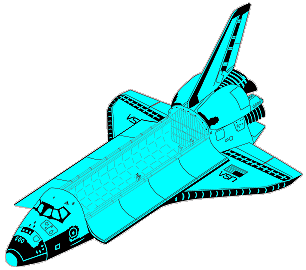 |
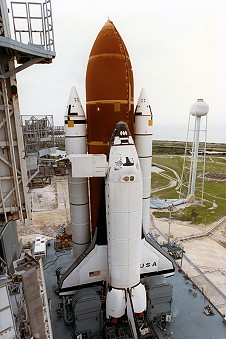 |
|
source of all photos is NASA |
|
 |
 |
 |
 |
 |
 |
 |
 |
 |
 |
 |
 |
| © |  |
Last update on June 19, 2023.  |
 |