Resident Crews of the International Space Station (ISS)

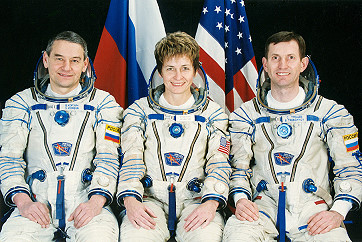
ISS: Expedition 3 |
 |
 |
 |
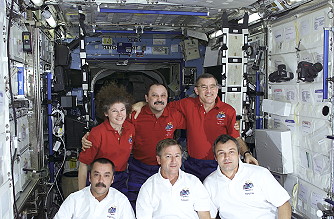
alternative crew photoalternative crew photoalternative crew photoalternative crew photo |
|
Crew, launch- and landing data
| No. | Nation | Surname | Given names | Position | Spacecraft (launch) |
Launch date |
Launch time |
Spacecraft (landing) |
Landing date |
Landing time |
Mission duration |
Orbits |
| 1 |  |
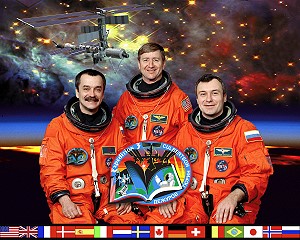
Culbertson | Frank Lee, Jr. | ISS-CDR | STS-105 | 10.08.2001 | 21:10:14.019 UTC | STS-108 | 17.12.2001 | 17:55:10.884 UTC | 128d 20h 44m 57s | 2028 |
| 2 |  |
Dezhurov | Vladimir Nikolayevich | Pilot | STS-105 | 10.08.2001 | 21:10:14.019 UTC | STS-108 | 17.12.2001 | 17:55:10.884 UTC | 128d 20h 44m 57s | 2028 |
| 3 | |
Tyurin | Mikhail Vladislavovich | Flight Engineer | STS-105 | 10.08.2001 | 21:10:14.019 UTC | STS-108 | 17.12.2001 | 17:55:10.884 UTC | 128d 20h 44m 57s | 2028 |
Backup Crew
| No. | Nation | Surname | Given names | Position |
| 1 | |
Korzun | Valeri Grigoriyevich | ISS-CDR |
| 2 | |
Treshchyov | Sergei Yevgeniyevich | Flight Engineer |
| 3 | |
Whitson | Peggy Annette | Flight Engineer |
 |
 |
Expedition Report
|
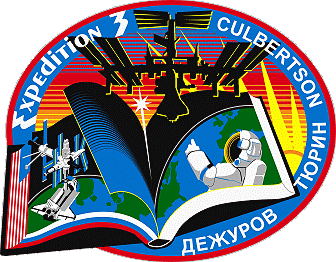
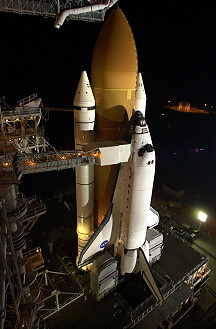
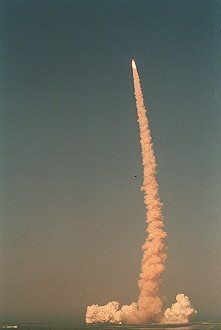
Expedition 3 launched from Cape Canaveral
(KSC)
with STS-105.
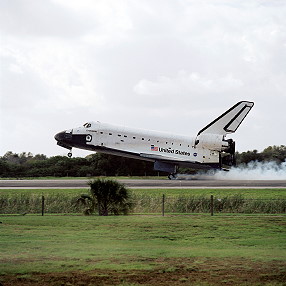
The crewmembers landed on Cape Canaveral (KSC) with
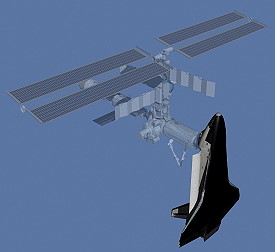
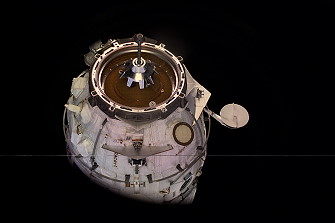
STS-108. The Expedition 3 officially began with undocking of Space Shuttle STS-105 on August 20, 2001 at 14:51:30 UTC. The main purpose of STS-105 (ISS-11-7A.1) was the rotation of the International Space Station crew and the delivery of supplies utilizing the Italian-built Multi-Purpose Logistics Module (MPLM) Leonardo on its second flight. Aboard Leonardo were six Resupply Stowage Racks, four Resupply Stowage Platforms, and two new scientific experiment racks for the station's U.S. laboratory Destiny. The two new science racks (EXPRESS Racks 4 and 5) added further science capability to the station. EXPRESS stands for Expedite the Processing of Experiments to the Space Station. EXPRESS Rack 4 weighs 533 kilograms (1,180 lb) and EXPRESS Rack 5 weighs 544 kilograms (1,200 lb). The empty weight of each EXPRESS rack is about 356 kilograms (780 lb). EXPRESS Racks 1 and 2A were delivered aboard the Raffaello cargo module during STS-100/6A in April 2001. EXPRESS Rack 3 was brought to the station during STS-111 in 2002. The Resupply Stowage Racks and Resupply Stowage Platforms were filled with Cargo Transfer Bags that contain equipment and supplies for the station. The six Resupply Stowage Racks contained almost 1,451 kilograms (3,200 lb) of cargo and the four Resupply Stowage Platforms contained about 544 kilograms (1,200 lb) of cargo, not including the weight of the Cargo Transfer Bags, the foam packing around the cargo or the straps and fences that held the bags in place. The total weight of cargo, racks and packing material aboard Leonardo was just over 4,990 kilograms (11,000 lb). Total cargo weight was about 3,073 kilograms (6,770 lb). Also carried in the payload bay was an Integrated Cargo Carrier (ICC) carrying the Early Ammonia Servicer and MISSE PECs 1 & 2. The Materials International Space Station Experiments (MISSE) was a NASA/Langley Research Center-managed cooperative endeavor to fly materials and other types of space exposure experiments on the space station. The objective was to develop early, low-cost, non-intrusive opportunities to conduct critical space exposure tests of space materials and components planned for use on future spacecraft. Johnson Space Center, Marshall Space Flight Center, Glenn Research Center, the Materials Laboratory at the Air Force Research Laboratory and Boeing Phantom Works were participants with Langley in the project. The MISSE experiments were the first externally mounted experiments conducted on the ISS. The experiments were in four Passive Experiment Containers (PECs) that were initially developed and used for an experiment on MIR in 1996 during the Shuttle-MIR Program. The PECs were transported to MIR on STS-76. After an 18-month exposure in space, they were retrieved on STS-86. PECs are suitcase-like containers for transporting experiments via the space shuttle to and from an orbiting spacecraft. Once on orbit and clamped to the host spacecraft, the PECs are opened and serve as racks to expose experiments to the space environment. STS-105 docked with the ISS on August 12, 2001. Frank Culbertson, Vladimir Dezhurov and Mikhail Tyurin became as third expedition the new resident crew of the ISS. The second expedition with James Voss, Susan Helms and Yuri Usachyov returned to Earth with STS-105. Space station crew transfer is a carefully thought out process. As a member of the Expedition Three crew transferred from the shuttle to the ISS, that crewmember's custom-designed seat liner, called an Individual Equipment Liner Kit, was installed in the Soyuz spacecraft docked to the station. The seat liner of the replaced crewmember was removed from the Soyuz, and that individual then became a member of the shuttle crew. All three Expedition Three crewmembers completed the liner changeout with members of the Expedition Two crew on Discovery's Flight Day Four, though the formal beginning of Expedition Three occurred at final closing of the hatches between Discovery and the space station. Leonardo was lifted out of Discovery's payload bay on flight day four and attached directly to the station's Unity node for the unloading of its cargo. Once Leonardo was attached to Unity, half a dozen power, data and fluid connecters were hooked up. The following day the ISS crew began transferring equipment and supplies to the station. At the end of the common flight Leonardo was unberthed from the space station and, loaded with unneeded equipment and trash from the station, returned to Discovery's cargo bay. The first EVA was performed by Daniel Barry and Patrick Forrester on August 16, 2001 (6h 16m) to attach an ammonia servicing unit and two science experiment packages. During the first spacewalk, Daniel Barry and Patrick Forrester also attached an experiment to the outside of the station's airlock that will collect information on how various materials weather the space environment. The experiment, called the Materials International Space Station Experiment (MISSE), was housed in two carriers that were attached to the station's exterior for an extended duration. As Daniel Barry and Patrick Forrester exited Discovery's airlock, Scott Horowitz maneuvered the shuttle's robotic arm into position to latch onto a grapple fixture on the EAS, bolted to a carrier in the shuttle's payload bay for launch. After Scott Horowitz had latched the arm onto the EAS, Daniel Barry and Patrick Forrester went to the pallet, called an Integrated Cargo Carrier, and began loosening the six bolts that held the unit in place. In addition, Daniel Barry translated hand-over-hand up to the station's Destiny Lab, where he picked up a foot platform to be used during installation of the EAS. With the bolts free, Scott Horowitz began lifting the EAS, with Daniel Barry and Patrick Forrester holding on to handrails on the EAS as well, up to the station. Scott Horowitz maneuvered the spacewalkers and EAS up to the position on the station's P6 truss where the EAS will be installed. There, Daniel Barry attached the foot platform and secured himself to it. Scott Horowitz released the arm's grip on the EAS, basically handing off the unit to Daniel Barry. Patrick Forrester then helped Daniel Barry align the unit over its attachment position and moved it to a "soft dock", where it was preliminarily held in place by a hook mechanism closed and locked with a pip pin inserted by Patrick Forrester. Patrick Forrester then tightened a bolt to firmly attach the EAS in position on the truss. The two spacewalkers then unfurled and attached cables to supply station electrical power to heaters on the EAS, completing the installation. That done, the spacewalkers held on to the station arm again as Scott Horowitz lowered them back to Discovery's payload bay, pausing at the station's Z1 truss to allow Daniel Barry to put the foot restraint in a stowed location needed for upcoming mission STS-110. In Discovery's cargo bay, Daniel Barry and Patrick Forrester moved to the carrier platform and released the two Passive Experiment Containers containing the MISSE investigations from their launch restraints. With each of the spacewalkers holding an experiment container, they held onto the arm while Scott Horowitz maneuvered them up to the station's airlock. There they let go of the arm and clamped the MISSE carriers to two separate airlock handrails. The second and final EVA by Daniel Barry and Patrick Forrester occurred on August 18, 2001 (5h 29m) to lay backup cables for future assembly. Scott Horowitz again operated the shuttle robotic arm to maneuver the spacewalkers, who were hanging on to the arm at times. As the spacewalk began, Daniel Barry and Patrick Forrester took with them from Discovery's airlock two bags containing the heater cables they installed on the station. Called Launch to Activation heater cables, they were used on shuttle mission STS-110 to power heaters on the station's S0 truss segment, the center segment of the station's truss structure, more than 300 feet (91.4 meters) long. In addition, they took with them two bags holding 11 new handrails they installed on the Destiny Lab, called Orbit-Installed Handrails. Daniel Barry and Patrick Forrester held on to the shuttle arm, carrying the heater cable bags, as Scott Horowitz lifted them to the station's Destiny lab. There, they temporarily attached the bags to handrails, one on the port side of the lab and another on the starboard side. Daniel Barry installed six handrails on the lab's starboard side while Patrick Forrester installed five handrails on the port side. The spacewalkers also relocated two existing lab handrails. With the handrails installed, the spacewalkers then feed the heater cables along the rails on either side of the lab, connecting one end to the station and placing the other end in position for use when the S0 truss segment is delivered on STS-110. On August 20, 2001 Discovery backed away from the ISS to a distance of about 450 feet (137.2 meters), where Frederick Sturckow began a close flyaround of the station, circling the complex 1 ¼ times. Frederick Sturckow passed directly above the station, then behind, then underneath, then in front and then reached a point directly above it for a second time. At that point, passing above the station for a second time, Frederick Sturckow fired Discovery's jets to separate from the area of the station. Progress M-45 was launched at 09:23:54 UTC on August 21, 2001. The spacecraft docked with the Aft port of the Zvezda module at 09:51:32 UTC on August 23, 2001. Progress M-45 carried supplies to the International Space Station, including food, water and oxygen for the crew and equipment for conducting scientific research. It remained docked for three months before undocking at 16:12:01 UTC on November 22, 2001 to make way for Progress M1-7. It left debris on the docking port which prevented Progress M1-7 from achieving a hard dock until it was removed during an EVA on December 03, 2001. Progress M-45 was deorbited at 20:48:00 UTC on the same day that it undocked. The spacecraft burned up in the atmosphere over the Pacific Ocean, with any remaining debris landing in the ocean at around 21:35:23 UTC. Pirs was launched on September 14, 2001, as ISS Assembly Mission 4R, on a Russian Soyuz-U rocket, using a modified Progress spacecraft, Progress M-SO1, as an upper stage. The 3,580-kilogram Pirs Docking Compartment is attached to the nadir (bottom, Earth-facing) port of the Zvezda service module. It docked to the International Space Station on September 16, 2001, and was configured during three spacewalks by the Expedition 3 crew. Two Strela cargo cranes were later added by the STS-96 and STS-101 missions, carried up on Integrated Cargo Carriers and installed during EVA's. Pirs (meaning "pier") - also called "Stikovochny Otsek 1" or "SO-1" ("docking module", or DC-1 (docking compartment)) is one of the two Russian docking compartments originally planned for the ISS. It provides the ISS with one docking port for Soyuz and Progress spacecraft, and allows egress and ingress for spacewalks by cosmonauts using Russian Orlan space suits. The docking port can accommodate one Soyuz-TMA or one Progress-M spacecraft. Visiting spacecraft can deliver people and cargo to and from to the space station. In addition, the Docking Compartment can transport fuel from the fuel tanks of a docked Progress resupply vehicle to either the Zvezda Service Module Integrated Propulsion System or the Zarya Functional Cargo Block. It can also transfer propellant from Zvezda and Zarya to the propulsion system of docked vehicles - Soyuz and Progress. The first station EVA by Vladimir Dezhurov and Mikhail Tyurin occurred on October 08, 2001 (4h 58m) using first time the new Russian built airlock and docking port named Pirs, which docked on the Zvezda module since September 2001. Vladimir Dezhurov and Mikhail Tyurin made connections between Pirs and the station's Zvezda Service Module. The spacewalkers installed a cable that will allow spacewalk radio communications between the two station sections. They also installed handrails on the new compartment. Then, they installed an exterior ladder that will be used to help spacewalkers leave Pirs' hatch. Mikhail Tyurin and Vladimir Dezhurov installed a Strela cargo crane onto the station. The second spacewalk was performed by Vladimir Dezhurov and Mikhail Tyurin on October 15, 2001 (5h 52m) to mount a variety of instruments outside the Zvezda service module. Vladimir Dezhurov and Mikhail Tyurin installed Russian commercial experiments on the exterior of Pirs. Among the experiments is a set of investigations of how various materials react to the space environment over a long time. Called MPAC-SEEDS, the investigation is housed in three briefcase-sized containers. On October 23, 2001 a Soyuz spacecraft arrived at the International Space Station. Soyuz TM-33 marked the second taxi crew to the ISS. Following a two-day solo flight Soyuz TM-33 docked to the International Space Station on October 23, 2001. The crew performed common work with ISS Expedition 3. The French "Andromède" mission had two main purposes: to exchange the Soyuz spacecraft Soyuz TM-32 (Soyuz TM-33 now served as a new lifeboat) and to carry out a scientific and technical research program organized by the French space agency CNES. On October 31, 2001 the taxi crew undocked onboard Soyuz TM-32 and landed a few hours later in Kazakhstan. The third EVA by Vladimir Dezhurov and Frank Culbertson was conducted on November 12, 2001 (5h 04m) to connect seven cables between Zvezda service module and Pirs docking module and take photos. Vladimir Dezhurov and Frank Culbertson connected cables on the exterior of Pirs for the Kurs automated docking system. They completed checks of the Strela cargo crane, using one spacewalker at the end of the crane's boom to simulate a cargo. They also inspected and photographed a small panel of one solar array on the Zvezda Service Module that has one portion of a panel not fully unfolded. Progress M1-7 was launched at 18:24:12 UTC on November 26, 2001. Progress M1-7 carried supplies to the International Space Station, including food, water and oxygen for the crew and equipment for conducting scientific research. It also carried the Kolibri-2000 satellite, which it deployed at 22:28 UTC on March 19, 2002, a few hours after departing the ISS. The spacecraft docked with the Aft port of the Zvezda module at 19:43:02 UTC on November 28, 2001. It was unable to establish a hard dock due to debris from Progress M-45 on the docking port, which had to be removed in an unscheduled extra-vehicular activity on December 03, 2001, after which it was able to establish a hard dock. Progress M1-7 remained docked to the ISS for three and a half months before undocking at 17:43 UTC on March 19, 2002 to make way for Progress M1-8. It was deorbited at 01:27 UTC on March 20, 2002. The spacecraft burned up in the atmosphere over the Pacific Ocean, with any remaining debris landing in the ocean at around 02:20 UTC. The fourth and final EVA was performed by Vladimir Dezhurov and Mikhail Tyurin on December 03, 2001 (2h 46m) to cut away a rubbery O-ring seal that was preventing an unmanned cargo freighter from properly docking to the complex. Vladimir Dezhurov and Mikhail Tyurin removed an obstruction that prevented a Progress resupply ship from firmly docking with the International Space Station. They also took pictures of the debris, which was a rubber seal from the previous cargo ship, and of the docking interface. The Expedition Three crew of the International Space Station enjoyed a unique view of the 2001 Leonid meteor storm. "It looked like we were seeing UFOs approaching the earth flying in formation, three or four at a time", recalls astronaut Frank Culbertson. "There were hundreds per minute going beneath us, really spectacular!" News reports had warned sky watchers in advance: On November 18, 2001, Earth was due to plow through a minefield of debris shed by Comet Tempel-Tuttle. Innumerable bits of comet dust would become meteors when they hit Earth's atmosphere at 144,000 miles per hour (64,000 m/s). Experts predicted an unforgettable display ... and it came. Millions of people saw the show, but only three of them - the ones on board the space station - saw it from above. "We had to look down to see the meteors", says Frank Culbertson. "That's because the atmosphere (where comet dust burns up) is below the station." The crew carried home the results of following experiments: Advanced Protein Crystallization Facility, the Dynamically Controlled Protein Crystal Growth experiment and cells from the Cellular Biotechnology Operations Support System (CBOSS). Advanced Protein Crystallization Facility (APCF): Growing Large, High-Quality Protein Crystals in Space: Scientists study the three-dimensional structure of protein crystals to determine how structure affects the function of individual proteins. They want to understand how proteins work, how to build them from scratch, or how to improve them. To do this they need large, uniform crystals. Protein crystals grown in microgravity are often larger and of better quality than those grown on Earth. The APCF is designed to develop difficult-to-produce, biologically important protein crystals for analysis, and to study different methods of protein crystal growth. It is sponsored by the European Space Agency. Active Rack Isolation System (ARIS) - ARIS ISS Characterization Experiment (ARIS ICE): Even in the virtually gravity-free environment of the International Space Station, tiny potential vibrations or disturbances - such as those caused by crew exercise - can upset the delicate balance of sensitive science experiments. The Active Rack Isolation System (ARIS) acts as a vibration absorber to help isolate them. By acting as a buffer between the experiment and these vibrations, ARIS protects delicate experiments housed in EXPRESS Rack No. 2 from outside influences that could potentially affect research results. The EXPRESS Rack, which stands for EXpedite the PRocessing of Experiments to the Space Station, is a standardized payload rack system that transports, stores and supports experiments aboard the space station. A related experiment to the ARIS system, the ARIS ISS Characterization Experiment (ARIS ICE), is a separate payload created to characterize ARIS' on-orbit performance. In addition to generating controlled disruptions on and off the rack, ARIS ICE will enable real-time monitoring of the on-orbit vibration isolation capabilities of various ARIS configurations. Bonner Ball Neutron Detector: The Bonner Ball Neutron Detector measures neutron radiation. Neutrons are uncharged atomic particles that have the ability to penetrate living tissues. Neutron radiation can affect the blood-forming marrow in the mineral bones of human beings and other animals. By operating the Bonner Ball in space, neutron radiation information can be collected and used for the development of safety measures to protect crewmembers during long-duration space flights. The objective of the Cellular Biotechnology Operations Support System (CBOSS) is to provide a controlled environment for the cultivation of cells into healthy, three-dimensional tissues that retain the form and function of natural, living tissue. CBOSS will enable investigations on normal and cancerous mammalian cells, including ovarian and colon cancer cells, neural precursor and human renal cells. The system is comprised of the Biotechnology Specimen Temperature Controller (BSTC), the Biotechnology Refrigerator (BTR), the Gas Supply Module (GSM) and the Biotechnology Cell Science Stowage (BCSS). The crew will support the experiment by periodic recording of scientific data, adding fresh media to the tissue culture modules and processing samples for return to Earth. Periodically, the crew will perform preventive maintenance on system components. Using photographs taken from space, the Crew Earth Observations (CEO) experiment provides people on Earth with data needed to better understand our planet. The photographs - taken by crewmembers using handheld cameras - record observable Earth surface changes over a period of time, as well as more fleeting events such as storms, floods, fires and volcanic eruptions. Dynamically Controlled Protein Crystal Growth: Proteins are the building blocks of our bodies and the living world around us. Within our bodies, some proteins make it possible for red blood cells to carry oxygen, while others help transmit nerve impulses that allow us to see, hear, smell and touch. Other proteins play crucial roles in causing diseases. Pharmaceutical companies may be able to develop new or improved drugs to fight those diseases once the exact structure of the proteins is known. These protein structures can be established only after growing biological crystals of proteins. The low-gravity environment of space often improves the quality of biological crystals beyond those grown on Earth. Scientists frequently grow these crystals by dissolving a protein in a specific liquid solution, and then allowing that solution to evaporate. Dynamically Controlled Protein Crystal Growth is the first hardware for space that can control the rate of this evaporation, and will hopefully provide more perfect crystals. By sending X-rays through crystals, scientists are then able to produce computer models of the three-dimensional structures of proteins and other biological macromolecules. Knowledge of the precise three-dimensional atomic structure of a biological macromolecule is an important component in biotechnology, particularly in the areas of protein engineering and rational drug design. Dreamtime High Definition Television Camera/Recorder: The deployment of a high definition television camcorder on the International Space Station is part of a public/private NASA partnership with Dreamtime Holdings Inc., Moffet Field, Calif., to upgrade NASA's equipment to next-generation HDTV technology. Crewmembers will use the equipment to acquire a variety of high-quality video of the space shuttle and the space station. They will also gather footage for documentary, future training, historical and educational use. This includes crew activities, Earth observation, and experiment documentation. In addition to the traditional applications of imagery captured in orbit for public information, education and operations, the camera will be used to capture commercial imagery that may be used for a variety of purposes by NASA's multimedia partner, Dreamtime. EarthKAM (Earth Knowledge Acquired by Middle school students) is a NASA-sponsored educational program that enables students to photograph and examine the Earth from the vantage point of the International Space Station. EarthKAM is operated by the University of California, San Diego and NASA field centers. Using a digital camera mounted at the optical quality window in the station's Destiny lab, EarthKAM students are able to remotely photograph the Earth's coastlines, mountain ranges and other geographic items of interest from the unique vantage point of space. Physics of Colloids in Space (PCS): The experiment will focus on the growth and behavior of three different classes of colloid mixtures of tiny manmade particles of either polymethyl methacrylate or silica or polystyrene; these will include samples of binary colloidal crystal alloys, samples of colloidpolymer mixtures and samples of colloidal gels. Binary colloidal crystal alloys are dispersions of two different size particles in a stabilizing fluid. Colloid-polymer mixtures are solutions of mono-disperse particles mixed with a polymer in a stabilizing fluid, where the phase behavior - solid, liquid and gas - is controlled by the concentration of the polymer. Colloidal gels include aqueous solutions of particles, in this case aggregated on-orbit with a salt solution, to form fractal structures. The structure, stability and equilibrium properties of all the samples, as well as their structure, dynamics and mechanical properties, are being studied. The EXPRESS Rack is a standardized payload rack system that transports, stores and supports experiments aboard the International Space Station. EXPRESS stands for EXpedite the PRocessing of Experiments to the Space Station, reflecting the fact this system was developed specifically to maximize the station's research capabilities. The EXPRESS Rack system supports science payloads (including commercial activities) in several disciplines including biology, chemistry, physics, ecology and medicine. The Human Research Facility, the first rack-sized payload to be installed in the U.S. Laboratory module of the International Space Station, provides an on-orbit laboratory that will enable life science researchers to study and evaluate the physiological, behavioral and chemical changes in human beings induced by space flight. The Human Research Facility is a rack which provides services and utilities to experiments and instruments installed within it. These include electrical power, command and data handling, cooling air and water, pressurized gases and vacuum. Effects of Altered Gravity on Spinal Cord Excitability (H-Reflex): A goal of the H-Reflex experiment is to help researchers determine if exercise could be made more effective on long space flights. The experiment measures spinal cord excitability - its ability to respond to stimuli. Researchers believe that spinal cord excitability decreases during prolonged space flight. If this proves true, they hypothesize that in-flight exercise would be less effective and the crews will have to work harder and longer to achieve any benefit. If spinal cord excitability does decrease on prolonged flights, researchers may be able to reverse the effect and lower the amount of exercise now required in space and thus increase crewmember productivity during the flight. Crewmember and Crew-Ground Interactions During ISS Missions (Interactions): The Interactions experiment seeks to identify and characterize important interpersonal and cultural factors that may impact the performance of the crew and ground support personnel during International space station missions. The study will examine - as it did in similar experiments on the Russian Space Station MIR and during Expedition Two - issues involving tension, cohesion and leadership roles in the crew in orbit and in the ground support crews. The study will have both the crewmembers and ground control personnel complete a standard questionnaire. The Space Acceleration Measurement System II (SAMS-II) will measure accelerations caused by vehicle, crew and equipment disturbances. To complement the SAMS-II measurements, the Microgravity Acceleration Measurement System (MAMS) will record accelerations caused by the aerodynamic drag created as the station moves through space. It also will measure accelerations created as the vehicle rotates and vents water. These small, quasi-steady accelerations occur in the frequency range below 1 Hertz. The Materials International Space Station Experiments (MISSE) Project is a NASA Langley Research Center-managed cooperative endeavor to fly materials and other types of space exposure experiments on the space station. The objective is to develop early, low-cost, non-intrusive opportunities to conduct critical space exposure tests of space materials and components planned for use on future spacecraft. PuFF - The Effects of EVA and Long-Term Exposure to Microgravity on Pulmonary Function: The Pulmonary Function in Flight (PuFF) experiment focuses on the lung functions of astronauts both while they are aboard the International Space Station and following spacewalks. PuFF uses the Gas Analyzer System for Metabolic Analysis Physiology instrument in the Human Research Facility rack, along with a variety of other equipment. Data is stored in a personal computer located in the HRF rack and then transmitted to the ground. Renal Stone Risk During Space Flight: Assessment and Countermeasure Validation: Exposure to microgravity results in a number of physiological changes in the human body, including alterations in kidney function, fluid redistribution, bone loss and muscle atrophy. Previous data have shown that human exposure to microgravity increases the risk of kidney stone development during and immediately after space flight. Potassium citrate, a proven Earth-based therapy to minimize calcium-containing kidney stone development, will be tested during Expedition Three as a countermeasure to reduce the risk of kidney stone formation. This study also will assess the kidney stone-forming potential in humans based on mission duration, and determine how long after space flight the increased risk exists. Sub-Regional Assessment of Bone Loss In The Axial Skeleton In Long-Term Space Flight: As demonstrated by Skylab and Russian space station MIR missions, bone loss is an established medical risk in long-duration space flight. There is little information about the extent to which lost bone is recovered after space flight. This experiment is designed to measure bone loss and recovery experienced by crewmembers on the International Space Station. Xenon 1: Effects of Microgravity on the Peripheral Subcutaneous Veno-arteriolor Reflex in Humans: After being in the microgravity environment of space, the body's ability to regulate blood pressure while standing is reduced. This is called orthostatic intolerance, which can severely inhibit the functional capacity of crewmembers during re-entry and landing. The Xenon 1 study will investigate the mechanism of this syndrome, specifically the extent to which the blood vessels are active in maintaining normal blood pressure, laying an important foundation for the development of treatments for orthostatic intolerance. To study orthostatic intolerance, a tracer material, 133Xenon, will be injected just below the skin in the lower leg above the ankle. Arterial blood pressure will then be recorded continuously to calculate how blood vessels help regulate arterial blood pressure and prevent orthostatic hypotension, or dizziness when standing. The rate at which the Xenon is removed from the area by the circulatory system will also be measured. These measurements will be done on each of the Expedition Three crewmembers 30 days before their launch and repeated one day after they return to Earth. On December 07, 2001 Space Shuttle STS-108 brought the Expedition 4 to the station. Finally, the station command changed from US astronaut Frank Culbertson to Russian cosmonaut Yuri Onufriyenko. Expedition 3 officially ended with undocking of STS-108, carrying Frank Culbertson, Vladimir Dezhurov and Mikhail Tyurin, on December 15, 2001 at 17:28:00 UTC. During the stay on board of the ISS the crew of Expedition 3 carried out the following scientific experiments: APCF-Camelids (Advanced Protein Crystallization Facility - Extraordinary Structural Features of Antibodies from Camelids), APCF-Crystal_Growth (Advanced Protein Crystallization Facility - Solution Flows and Molecular Disorder of Protein Crystals: Growth of High Quality Crystals, Motions of Lumazin Crystals and Growth of Ferritin Crystals), APCF-Crystal_Quality (Advanced Protein Crystallization Facility - Effect of Different Growth Conditions on the Quality of Thaumatin and Aspartyl-tRNA Synthetase Crystals Grown in Microgravity), APCF-Lipoprotein (Advanced Protein Crystallization Facility - Crystallization of Human Low Density Lipoprotein (LDL) Subfractions in Microgravity), APCF-Lysozyme (Advanced Protein Crystallization Facility - Testing New Trends in Microgravity Protein Crystallization), APCF-Octarellins (Advanced Protein Crystallization Facility - Crystallization of the Next Generation of Octarellins), APCF-PPG10 (Advanced Protein Crystallization Facility - Protein Crystallization in Microgravity, Collagen Model (X-Y-Gly) Polypeptides - the case of (Pro-Pro-Gly) 10), APCF-Rhodopsin (Advanced Protein Crystallization Facility - Crystallization of Rhodopsin in Microgravity), ARIS-ICE (Active Rack Isolation System - ISS Characterization Experiment), ARISS (Amateur Radio on the International Space Station), BBND (Bonner Ball Neutron Detector), Brados (Acquisition of Data About the Radiological, Electromagnetic and Different Physical Environments on Board ISS, and Their Effects on the Safety of the Crew, Space Equipment and Materials), Cardio-ODNT (Dynamics of the Main Factors of Cardiac Function, of Central and Regional Circulation in Rest and During the Influence of Lower Body Negative Pressure), CardioScience (Study of Cardiovascular Deconditioning Under Weightlessness Conditions), CBOSS-01-02-Renal (Cellular Biotechnology Operations Support Systems: Human Renal Cortical Cell Differentiation and Hormone Production), CBOSS-01-Colon (Cellular Biotechnology Operations Support Systems: Use of NASA Bioreactor to Study Cell Cycle Regulation: Mechanisms of Colon Carcinoma Metastasis in Microgravity), CBOSS-01-Ovarian (Cellular Biotechnology Operations Support Systems: Evaluation of Ovarian Tumor Cell Growth and Gene Expression), CBOSS-01-PC12 (Cellular Biotechnology Operations Support Systems: PC12 Pheochromocytoma Cells - A Proven Model System for Optimizing 3-D Cell Culture Biotechnology in Space), CEO (Crew Earth Observations),Clinical_Nutrition_Assessment (Clinical Nutrition Assessment of ISS Astronauts, SMO-016E), Cogni (Cognitive Process for 3-D Orientation perception and Navigation in Weightlessness), DCPCG (Dynamically Controlled Protein Crystal Growth), Diatomeya (Stability of Geographical Position and Configuration of Borders of Bioproductive Water Zones of the World Oceans, Observations by Orbition Station Crews), Diurez (Fluid and Electrolyte Metabolism and Hormonal Regulaltion of Fluid Volume), DREAMTiME (DREAMTiME), EarthKAM (Earth Knowledge Acquired by Middle School Students), Environmental Monitoring (Environmental Monitoring of the International Space Station), ESA-GCF (European Space Agency - Granada Crystallisation Facility), EXPPCS (EXPRESS Physics of Colloids in Space), Farma (Characteristics of Pharmacological Responses (absorption, distribution and elimination of acetominophene) in Long Duration Space Flight), Glidoproteid (Extraction and Investigation of surface glycoproteins E1-E2 Alphavirises on Earth and in Space), H-Reflex (Effects of Altered Gravity on Spinal Cord Excitability), Identifikatsia (Identification of the Sources of Dynamic Loads on ISS), Imedias (Observation of Environmental Phenomena), Inflight Education Downlinks (International Space Station Inflight Education Downlinks), Interactions (Crewmember and Crew-Ground Interaction During International Space Station Missions), Iskazheniye (Determination and Analysis of Magnetic Interference on ISS), ISS Acoustics (International Space Station Acoustic Measurement Program), Izgib (Effect of Performance of Flight and Science Activities on the Function of On-Orbit Systems on ISS (Mathematical Model)), Kromka (Verification of the Effectiveness of Devices for the Protection of the Exterior Surface of ISS from Contaminants Deposited by Pulsed Cycling of Liquid-Jet), Meteoroid (Recording Meteoroidal and Technogenic Particles on the External Surface of the Service Module of the Russian Segment of ISS), Mimetik-K (Crystalization of antigen Binding Fragment of Monoclonalical Antibody to Glucosaminilmuramildepeptide), MISSE and 2 (Materials International Space Station Experiment - 1 and 2), Paradont (Condition of Peridontal Tissues in Space Flight), Plasma Crystal (Dusty and Liquid Plasma Crystals in Conditions of Microgravity), Privyazka (Development of High Precision Orientation of Scientific Devices in Space with Reports of Deformation of the ISS Hull), Profilaktika (Mechanisms of Action and Influence, and Effectiveness of Various Methods of Phrophylaxis Directed Toward Prevention of Disturbances of the Human Locomotion System in Weightlessness), Prognoz (Development of a Method of Operational Prediction of Work Load on Crew Piloting Objectives), PuFF (The Effects of EVA and Long-Term Exposure to Microgravity on Pulmonary Function), Renal_Stone (Renal Stone Risk During Spaceflight: Assessment and Countermeasure Validation), SKR (Skorpion: Development and Acquisition of Multifunctional Control-Measurement Device for Controlling the Environment of Scientific Experiments Inside a Pressurized Station), Sprut-MBI (Determination of Intracellular and Extracellular Fluid Volume in Humans in Space Flight), Subregional_Bone (Subregional Assessment of Bone Loss in the Axial Skeleton in Long-term Space Flight), Tenzor (Definition of Dynamic Characteristics of ISS), Uragan (Hurricane: Experimental Development of Groundbased System of Monitoring and Predicting the Progression of a Naturally Occurring Technogenic Catastrophe), Vektor-T (Study of a High Precision System for Prediction Motion of ISS), Vzglyad (Photographing the Interior of ISS), Xenon1 (Effect of Microgravity on the Peripheral Subcutaneous Veno-Arteriolar Reflex in Humans). |
EVA data
| Name | Start | End | Duration | Mission | Airlock | Suit | Stripes | |
| EVA | Barry, Daniel | 16.08.2001, 13:58 UTC | 16.08.2001, 20:14 UTC | 6h 16m | STS-105 | Discovery - ISS | EMU No. 3010 | red |
| EVA | Forrester, Patrick | 16.08.2001, 13:58 UTC | 16.08.2001, 20:14 UTC | 6h 16m | STS-105 | Discovery - ISS | EMU No. 3013 | without |
| EVA | Barry, Daniel | 18.08.2001, 13:42 UTC | 18.08.2001, 19:11 UTC | 5h 29m | STS-105 | Discovery - ISS | EMU No. 3010 | red |
| EVA | Forrester, Patrick | 18.08.2001, 13:42 UTC | 18.08.2001, 19:11 UTC | 5h 29m | STS-105 | Discovery - ISS | EMU No. 3013 | without |
| Name | Start | End | Duration | Mission | Airlock | Suit | Stripes | |
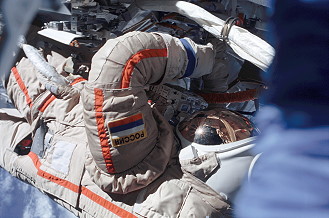
| EVA | Tyurin, Mikhail | 08.10.2001, 14:24 UTC | 08.10.2001, 19:22 UTC | 4h 58m | ISS-03 | ISS - Pirs | Orlan-M No. 12 | blue |
| EVA | Dezhurov, Vladimir | 08.10.2001, 14:24 UTC | 08.10.2001, 19:22 UTC | 4h 58m | ISS-03 | ISS - Pirs | Orlan-M No. 23 | red |
| EVA | Tyurin, Mikhail | 15.10.2001, 09:17 UTC | 15.10.2001, 15:0? UTC | 5h 52m | ISS-03 | ISS - Pirs | Orlan-M No. 12 | blue |
| EVA | Dezhurov, Vladimir | 15.10.2001, 09:17 UTC | 15.10.2001, 15:0? UTC | 5h 52m | ISS-03 | ISS - Pirs | Orlan-M No. 23 | red |
| EVA | Culbertson, Frank | 12.11.2001, 20:41 UTC | 13.11.2001, 02:4? UTC | 5h 04m | ISS-03 | ISS - Pirs | Orlan-M No. 12 | blue |
| EVA | Dezhurov, Vladimir | 12.11.2001, 20:41 UTC | 13.11.2001, 02:4? UTC | 5h 04m | ISS-03 | ISS - Pirs | Orlan-M No. 23 | red |
| EVA | Tyurin, Mikhail | 03.12.2001, 13:20 UTC | 03.12.2001, 16:06 UTC | 2h 46m | ISS-03 | ISS - Pirs | Orlan-M No. 12 | blue |
| EVA | Dezhurov, Vladimir | 03.12.2001, 13:20 UTC | 03.12.2001, 16:06 UTC | 2h 46m | ISS-03 | ISS - Pirs | Orlan-M No. 23 | red |
Relocations of Manned Spacecrafts
| Spacecraft | from | Undocking | Time UTC | to | Redocking | Time UTC |
| Soyuz TM-32 | ISS - Zarya | 19.10.2001 | 10:48:10 | ISS - Pirs | 19.10.2001 | 11:04:10 |
ISS Assembly
 |
|
Photos / Graphics
 |
 |
|
source of all photos is Roscosmos / NASA |
|
 |
 |
 |
 |
 |
 |
 |
 |
 |
|
more onboard photos |
|
| © |  |
Last update on December 12, 2020.  |
 |