Human Orbital Spaceflights

International Flight No. 209STS-96Discovery (26)94th Space Shuttle missionUSA |
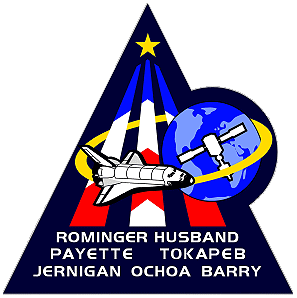 |
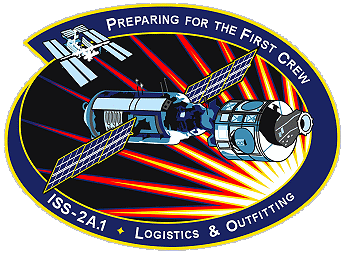 |
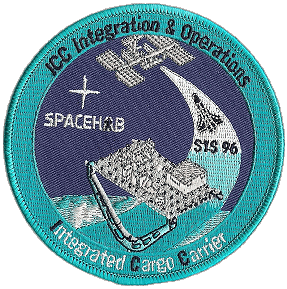 |
||
Launch, orbit and landing data
walkout photo |
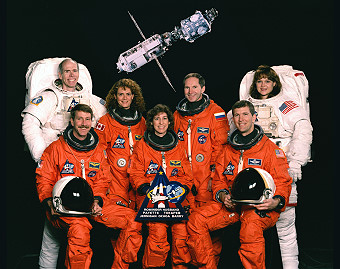 |
||||||||||||||||||||||||||||||||
alternative crew photo |
|||||||||||||||||||||||||||||||||
alternative crew photo |
|||||||||||||||||||||||||||||||||
alternative crew photo |
Crew
| No. | Surname | Given names | Position | Flight No. | Duration | Orbits | |
| 1 |  |
Rominger | Kent Vernon | CDR | 4 | 9d 19h 13m 00s | 153 |
| 2 | |
Husband | Rick Douglas | PLT, EV-3 | 1 | 9d 19h 13m 00s | 153 |
| 3 | |
Jernigan | Tamara Elizabeth "Tammy" | MS-1, EV-1 | 5 | 9d 19h 13m 00s | 153 |
| 4 | |
Ochoa | Ellen Lauri | MS-2, RMS, FE, PLC | 3 | 9d 19h 13m 00s | 153 |
| 5 | |
Barry | Daniel Thomas | MS-3, EV-2 | 2 | 9d 19h 13m 00s | 153 |
| 6 |  |
Payette | Julie | MS-4, IV-1 | 1 | 9d 19h 13m 00s | 153 |
| 7 |  |
Tokarev | Valeri Ivanovich | MS-5 | 1 | 9d 19h 13m 00s | 153 |
Crew seating arrangement
|
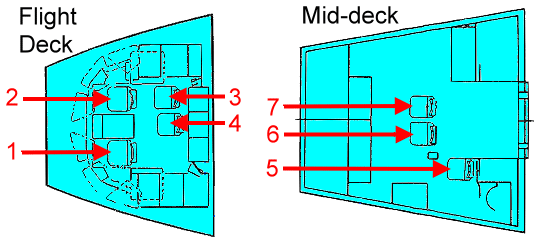 |
|
||||||||||||||||||||||||||||||||
Hardware
| Orbiter : | OV-103 (26.) |
| SSME (1 / 2 / 3): | 2047-2A (2.) / 2051-2A (1.) / 2049-2A (1.) |
| SRB: | BI-098 / RSRM 70 |
| ET: | ET-100 (SLWT-4) |
| OMS Pod: | Left Pod 01 (29.) / Right Pod 03 (27.) |
| FWD RCS Pod: | FRC 3 (26.) |
| RMS: | 303 (12.) |
| EMU: | EMU No. 3006 (PLSS No. 1006) / EMU No. 3011 (PLSS No. 1011) / EMU No. 3010 (PLSS No. 1010) |
Flight
|
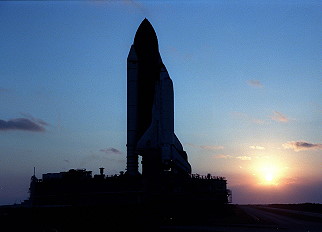
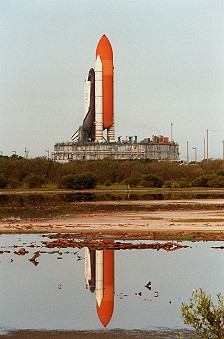
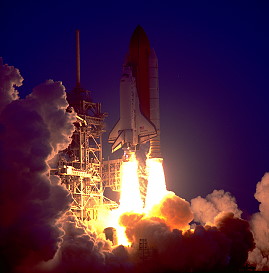
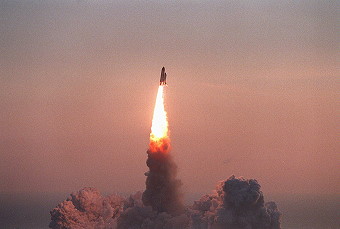
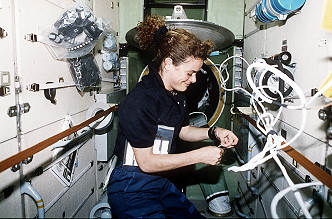
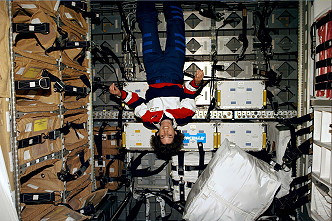
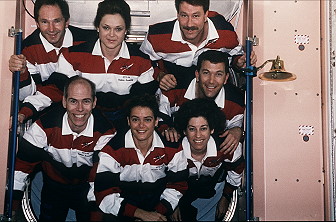
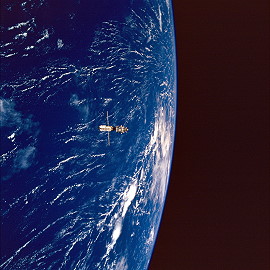
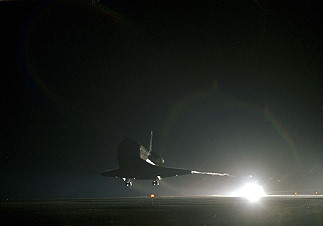
Launch from Cape Canaveral (KSC) and
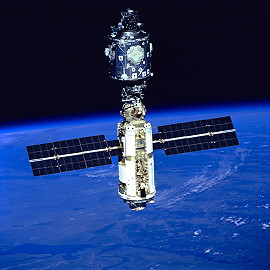
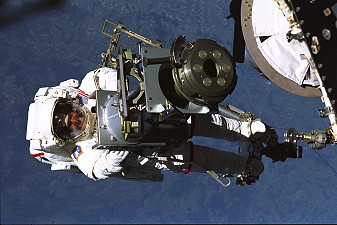
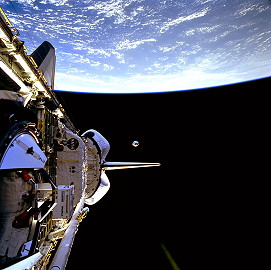
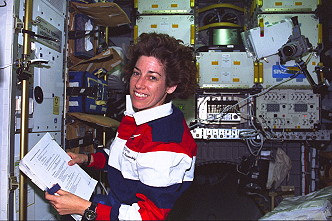
landing on Cape Canaveral (KSC), Runway 15. The originally scheduled launch of Discovery on May 20, 1999 was postponed because of hail damage sustained May 08, 1999 by the external tank while on the pad. It was determined that some of the tank's foam insulation could not be reached for repairs with the orbiter on the pad. The orbiter was returned to the VAB, and inspections revealed more than 650 divots in the tank's outer foam. Workers repaired about 460 critical divots over four days to minimize ice formation prior to launch. The countdown proceeded smoothly, with the only concern the presence of a sailboat in the solid rocket booster recovery area. The major objective of the Second Space Station Assembly Mission (ISS-02-2A.1) was the transfer of almost two tons of logistical supplies from the shuttle Discovery to the International Space Station. STS-96 was a logistics and resupply mission for the International Space Station carrying the SPACEHAB Double Module (SH-DM), the 13th SPACEHAB overall (6th dual module use). Also transported were the Integrated Cargo Carrier (ICC) carried the Russian cargo crane, known as STRELA, which was mounted to the exterior of the Russian station segment, the SPACEHAB Oceaneering Space System Box (SHOSS) and a U.S. built crane called the ORU Transfer Device (OTD). These supplies were used to not only continue the outfitting of the Unity and Zarya modules already joined together in orbit, but were used by a future Shuttle assembly crew later in 1999 to set up the Russian Service Module for occupancy by a three-man crew early next year. In addition to the supply delivery, the astronauts deployed a small satellite called STARSHINE which was observed by international students on Earth as they calculate its precise orbit and the rate of its orbital decay over a period of time. Discovery's rendezvous and docking with the International Space Station began with the precisely timed launch of the shuttle on a course for the station. During the first two days of the mission, periodic engine firings gradually brought Discovery to a point about eight nautical miles (14.8 km) behind the station, the starting point for a final approach to the station. About three hours before the scheduled docking time on Flight Day Three, Discovery reached the point about eight nautical miles (14.8 km) behind the ISS. At that time, Discovery's jets were fired in a Terminal Phase Initiation (TI) burn to begin the final phase of the rendezvous. Discovery closed the final eight nautical miles (14.8 km) to the station during the next orbit. As Discovery closed in, the shuttle's rendezvous radar system began tracking the station and providing range and closing rate information to the crew. As Discovery began to close in on the station, flight controllers commanded the station to the docking orientation, perpendicular to the Earth's surface with the Unity module pointed toward space and Zarya toward Earth. For Discovery's final approach, the solar panels on the station were "feathered" to have their edge facing the shuttle. Also, when within about 1,000 feet (304.8 meters) of the station, Commander Kent Rominger used Discovery's steering jets in a mode called "Low Z", a mode that fires jets offset rather than pointed directly at the station to control the shuttle's approach. This jet mode together with the solar panel's feathering prevented exhaust from shuttle jets from flexing and overstressing the station's solar panels. As Discovery reached close proximity to the station, the Trajectory Control Sensor, a laser ranging device mounted in the shuttle payload bay, supplemented the shuttle's onboard navigation information by supplying additional data on the range and closing rate. As Discovery closed in, the shuttle had the opportunity for several small successive engine firings to fine-tune its approach using its onboard navigation information. As Discovery moved to within about a half-mile (900 meters) of the station, Kent Rominger took over manual control of the shuttle's approach, flying the spacecraft from the aft flight deck and monitoring the approach through the rear and overhead windows. Kent Rominger slowed Discovery's approach and flew to a point about 500 feet (152.4 meters) directly below the station, from which he began a half-circle of the station. During the rendezvous, Kent Rominger was assisted by Pilot Rick Husband in controlling Discovery's approach. Mission Specialists Tamara Jernigan and Ellen Ochoa also played key roles in the rendezvous, with Tamara Jernigan operating the shuttle's docking mechanism and Ellen Ochoa assisting with the rendezvous navigation. The crew used a handheld laser pointed through the shuttle windows to provide supplemental information on the station's range and closing rate. Kent Rominger flew Discovery to cross about 350 feet (106.7 meters) in front of the station and then continued to reach a point about 250 feet (76.2 meters) directly above the station. He stopped Discovery and then slowly descended toward the station to a point about 170 feet (51.8 meters) away from it. At approximately 170 feet (51.8 meters) distant, Kent Rominger held Discovery's position for about a half-hour to allow the station to move within range of Russian communications stations. Also at this time, Tamara Jernigan powered up the docking mechanism and prepared it for contact and capture with the station. A day ahead of the rendezvous, the docking mechanism was scheduled to be checked out and its docking ring extended. Once the station was in communications with Russia and flight controllers had confirmed it was in the proper configuration for docking, Kent Rominger began the final approach. Using the view from a centerline camera fixed in the center of Discovery's docking mechanism, Kent Rominger precisely aligned the shuttle mechanism with the docking mechanism on Unity's conical mating adapter as he approached. At a distance of about 30 feet (9.14 meters) , Kent Rominger held stationkeep momentarily to adjust the alignment. For Discovery's docking, Kent Rominger maintained the shuttle's speed relative to the station at about one-tenth of a foot per second (3 centimeters per second), and kept the docking mechanisms aligned to within three inches of one another. As Discovery moved to within 25 feet (7.6 meters), Kent Rominger switched the shuttle steering jets back to normal mode from "Low Z" to provide better control of Discovery for the final docking. When Discovery made contact with the station, latches automatically attached the two spacecraft together. Immediately after Discovery docked, the shuttle's steering jets were deactivated and ground controllers commanded off the station's steering jets to reduce the forces acting at the docking interface. Shock absorber-type springs in the docking mechanism dampen any relative motion between the shuttle and the station. Once relative motion between the spacecraft had stopped, Tamara Jernigan commanded the docking ring on Discovery's mechanism to retract and close latches in the mechanism to firmly secure the shuttle to the station. Once the two vehicles were firmly secured, the shuttle's steering jets were reactivated to control both spacecraft for the duration of the docked operations. Discovery docked with the International Space Station's PMA-2 docking port at 04:24 UTC on May 29, 1999. ISS was in a 379 km x 385 km x 51.6° orbit. In its configuration at that time it consisted of the PMA-2 docking port, NASA's Unity node, the NASA-owned, Russian-built Zarya module, and the PMA-1 docking unit connecting Unity and Zarya. Tamara Jernigan and Daniel Barry performed an EVA on May 30, 1999 (7h 55m) to install crane systems that will be used on future missions to assist in assembly and transfer operations. The two astronauts were assisted by Flight Engineer Ellen Ochoa, who operated the Shuttle's robotic arm from inside Discovery. Preparations at the begin of the spacewalk included the placement of a work station and portable foot restraints into position for the installation of an American-built crane, called the ORU Transfer Device, or OTD, and the Russian-built crane called Strela (Russian, for "arrow"). Ready to begin the installation work, Tamara Jernigan fixed her boots to a foot restraint on the end of the Shuttle's robotic arm, and Ellen Ochoa maneuvered her from a foot restraint at Pressurized Mating Adapter (PMA-1) to the Integrated Cargo Carrier (ICC). PMA-1 is a passageway between Unity and Zarya, and the ICC is a flatbed pallet attached in Discovery's payload bay. Tamara Jernigan met Daniel Barry on the Integrated Cargo Carrier, where they retrieved the small, 209-pound (94.8 kg) U.S. OTD. While holding the crane, Tamara Jernigan was transported back to PMA-1. Daniel Barry joined her to attach the crane to an EVA worksite fixture on the PMA. The two will returned to the Integrated Cargo Carrier and retrieved the 165-pound (74.8 kg) operator post and 33-pound (15 kg) grapple fixture adapter plate for the Russian crane, Strela. They assembled those pieces on one of the two PMA-2 grapple fixtures. PMA-2 connects the Shuttle external airlock to Unity. Strela is an updated version of the crane used on MIR. It will primarily be used for Science Power Platform operations. Assembly of the three-metric-ton capacity crane was completed during this year's second ISS logistics mission. A 45-ft. (13.7 meters) telescopic boom then was added to the operator post, and the completed assembly was moved to a grapple fixture on Zarya. The astronauts then returned to the ICC to retrieve two portable foot restraints and transferred them into PMA-1. They returned to the Integrated Cargo Carrier, one last time, to remove three tool and hardware bags and three additional pieces of EVA support equipment from the SPACEHAB Oceaneering Space System box. The bags contained tools for handling ISS replacement parts and to assist in the assembly of the Space Station, as well as on-orbit installable handrails. Tamara Jernigan and Daniel Barry stowed them on Unity. Once those primary tasks were accomplished, Tamara Jernigan and Daniel Barry installed an insulating cover on a trunnion pin on the Unity module, documented painted surfaces on both the Unity and Zarya modules, and inspected one of two Early Communications System (E-Com) antennas on the Unity. The Integrated Cargo Carrier is an unpressurized flat bed pallet and keel yoke assembly housed in Discovery's payload bay. Constructed of aluminum, it is eight feet (2.4 meters) long, 15 feet (4.6 meters) wide and 10 inches (25.4 centimeters) thick and has the capability to carry cargo on both faces of the pallet, both atop and below. During STS-96, the ICC carried the U.S. space walkers' crane, which is called the OTD for Orbital Replacement Unit Transfer Device. The OTD weighs 209 pounds (94.8 kg) and was mounted to the exterior of Unity during a spacewalk by astronauts Tamara Jernigan and Daniel Barry. It also carried 198 pounds (90 kg) of parts for the Russian Strela crane which were stowed on the exterior of Pressurized Mating Adapter 2 (PMA-2) by Tamara Jernigan and Daniel Barry. Also mounted to the ICC, was the Spacehab-Oceaneering Space System Box (SHOSS), which was designed to carry up to 400 pounds (181.4 kg) of space-walking tools and flight equipment to assist astronauts during ISS assembly. On May 31, 1999 the hatches between the Discovery and the ISS were opened. The crew transferred 3,567 pounds (1,618 kg) of material including clothing, sleeping bags, spare parts, medical equipment, supplies, hardware and about 84 gallons (318 liters) of water to the interior of the station. The astronauts also installed parts of a wireless strain gauge system that will help engineers track the effects of adding modules to the Station throughout its assembly, cleaning filters and checking smoke detectors. Eighteen items weighing 197 pounds (89.3 kg) were moved from the Station to Discovery for a return to Earth. The astronauts spent a total of 79 hours, 30 minutes inside the Station before closing the final hatch on the orbiting outpost. Kent Rominger and Rick Husband commanded a series of 17 pulses of Discovery's reaction control system jets to boost the Station to an orbit of approximately 246 by 241 statute miles (395 by 387 km). U.S. and Russian hardware for the International Space Station was carried in the SPACEHAB double module, a pressurized laboratory in the shuttle's cargo bay that is connected to the middeck area of the orbiter. Crew access was through a tunnel system located between the orbiter middeck and the SPACEHAB module. On Flight Days 5 and 6, astronaut Julie Payette and cosmonaut Valeri Tokarev replaced all 18 of the battery charge/discharge units that support Zarya's six nickel-cadmium batteries. Known by the Russian acronym "MIRTs", they were thought to be responsible for voltage problems first detected in January 1999. MIRTs are part of a system that indicates the level of charge for each of Zarya's batteries and, in turn, dictates when the onboard charging system will begin to taper-off the power supply to each. Replacement of the units - they measure 5.9 x 4.7 x 3 inches (15 x 12 x 7.6 centimeters) and weigh 1.43 pounds (0.7 kg) - may reduce the need for weekly cycling, resulting in better long-term battery performance and additional backup equipment capabilities for the ISS. Julie Payette and Valeri Tokarev were trained for this part of the mission in mid-March at the Gagarin Cosmonaut Training Center at Star City outside Moscow, where a full-scale Zarya mock-up is located, and followed procedures jointly developed by engineers at Mission Control Center Moscow and Mission Control Center-Houston. The Shuttle Vibration Forces (SVF) Experiment provided flight measurements of the vibratory forces acting between an aerospace payload and its mounting structure. The force transducers were incorporated into four custom brackets which replaced the existing brackets used to attach the 5 ft (1.5 m) standard canister to the side wall GAS adapter beam. The payload was activated automatically by the Orbiter Lift-off vibration and operated for approximately 100 seconds. STS-96 was the second flight of the SVF experiment. The purpose of the Orbiter Integrated Vehicle Health Monitoring- HEDS Technology Demonstration (IVHM HTD) was to demonstrate competing modern, off-the-shelf sensing technologies in an operational environment to make informed design decisions for the eventual Orbiter upgrade IVHM. The objective of IVHM was to reduce planned ground processing, streamline problem troubleshooting (unplanned ground processing), enhance visibility into systems operation and improve overall vehicle safety. Once Discovery was ready to undock, the initial separation was performed by springs in the docking mechanism that gently pushed the shuttle away from the station. Both Discovery and the station's steering jets were shut off to avoid any inadvertent firings during this initial separation. Once the docking mechanism's springs had pushed Discovery away to a distance of about two feet (61 centimeters), when the docking devices were clear of one another, Rick Husband turned the shuttle's steering jets back on in "Low Z" mode and fired them to begin very slowly moving away. From the aft flight deck, Pilot Rick Husband manually controlled Discovery within a tight corridor as he separated from the ISS, essentially the reverse of the task performed by Commander Kent Rominger when Discovery docked. Discovery continued away to a distance of about 450 feet (137.2 meters), where Rick Husband began the close flyaround of the station, first crossing a point directly behind, then directly underneath and then again above the station. Rick Husband circled the station twice as the crew recorded views of the exterior with still photography and video. As Discovery crossed directly above the station for the second time, Rick Husband fired Discovery's jets to perform a final separation. The separation firing put Discovery on a course that had it pass about a half-mile behind the station and then about a mile and a half below the station before moving ahead of it with constantly increasing distance. Successful deploying of the STARSHINE satellite (Student-Tracked Atmospheric Research Satellite for Heuristic International Networking Experiment) was performed by Julie Payette on the last full day in orbit. The STARSHINE satellite consisted of an inert, 483 millimeters (19.0 in) hollow sphere covered by 1,000 evenly-distributed, flat, polished mirrors, each 1 inch in diameter. The payload consists of the STARSHINE satellite, integrated with the Pallet Ejection System (PES), then mounted inside a lidless carrier. The HH equipment consists of one HH Lightweight Avionics Plate (LAP), then mounted inside a lidless carrier. Additional HH equipment consists of one Hitchhiker Ejection System Electronics (HESE), one 5.0 cubic-foot (142 L) HH canister, and one Adapter Beam Assembly (ABA). The purpose of the mission was to train international student volunteer observers to visually track this optically reflective spacecraft during morning and evening twilight intervals for several months, calculate its orbit from shared observations, and derive atmospheric density from drag-induced changes in its orbit over time. |
EVA data
| Name | Start | End | Duration | Mission | Airlock | Suit | Stripes | |
| EVA | Jernigan, Tamara | 30.05.1999, 02:56 UTC | 30.05.1999, 10:51 UTC | 7h 55m | STS-96 | Discovery - ISS | EMU No. 3006 | red |
| EVA | Barry, Daniel | 30.05.1999, 02:56 UTC | 30.05.1999, 10:51 UTC | 7h 55m | STS-96 | Discovery - ISS | EMU No. 3011 | without |
Photos / Graphics
 |
 |
|
source of all photos is NASA |
|
 |
 |
 |
 |
 |
 |
 |
 |
 |
 |
 |
 |
 |
 |
 |
|
more EVA photos |
|
| © |  |
Last update on March 27, 2020.  |
 |