Human Orbital Spaceflights

International Flight No. 228STS-110Atlantis (25)109th Space Shuttle missionUSA |
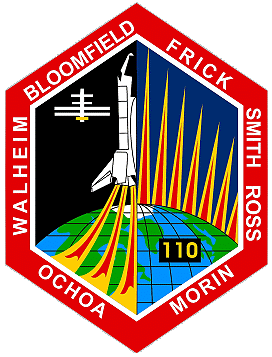 |
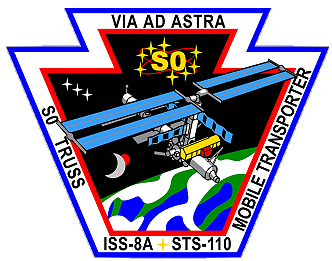 |
Launch, orbit and landing data
walkout photo |
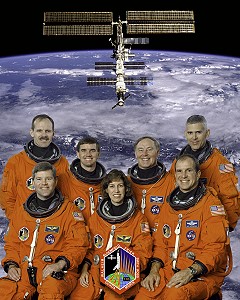 |
|||||||||||||||||||||||||||||||||
alternative crew photo |
alternative crew photo |
|||||||||||||||||||||||||||||||||
alternative crew photo |
||||||||||||||||||||||||||||||||||
alternative crew photo |
||||||||||||||||||||||||||||||||||
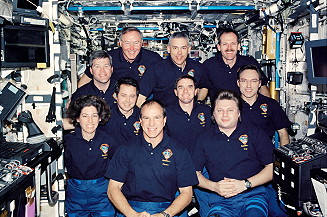
Crew
| No. | Surname | Given names | Position | Flight No. | Duration | Orbits | |
| 1 |  |
Bloomfield | Michael John "Bloomer" | CDR, RMS | 3 | 10d 19h 42m 38s | 171 |
| 2 | |
Frick | Stephen Nathaniel | PLT, RMS | 1 | 10d 19h 42m 38s | 171 |
| 3 | |
Walheim | Rex Joseph | MS-1, EV-2, IV | 1 | 10d 19h 42m 38s | 171 |
| 4 | |
Ochoa | Ellen Lauri | MS-2, SSRMS, FE | 4 | 10d 19h 42m 38s | 171 |
| 5 | |
Morin | Lee Miller Emile | MS-3, EV-4, IV | 1 | 10d 19h 42m 38s | 171 |
| 6 | |
Ross | Jerry Lynn | MS-4, EV-3, IV | 7 | 10d 19h 42m 38s | 171 |
| 7 | |
Smith | Steven Lee | MS-5, EV-1, IV | 4 | 10d 19h 42m 38s | 171 |
Crew seating arrangement
|
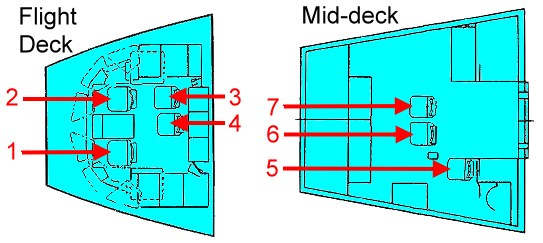 |
|
||||||||||||||||||||||||||||||||
Hardware
| Orbiter : | OV-104 (25.) |
| SSME (1 / 2 / 3): | 2048-2 (4.) / 2051-2 (3.) / 2045-2 (6.) |
| SRB: | BI-112 / RSRM 85 |
| ET: | ET-114 (SLWT-18) |
| OMS Pod: | Left Pod 03 (29.) / Right Pod 04 (25.) |
| FWD RCS Pod: | FRC 4 (25.) |
| RMS: | 202 (8.) |
| EMU (launch): | EMU No. 3015 (PLSS No. 1015) / EMU No. 3006 (PLSS No. 1006) / EMU No. 3003 (PLSS No. 1003) |
| EMU (landing): | EMU No. 3016 (PLSS No. 1016) / EMU No. 3006 (PLSS No. 1006) / EMU No. 3003 (PLSS No. 1003) |
Flight
|
Launch from Cape Canaveral (KSC) and
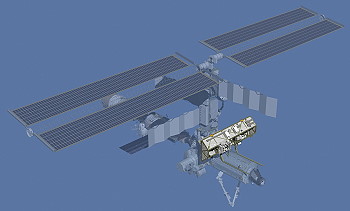
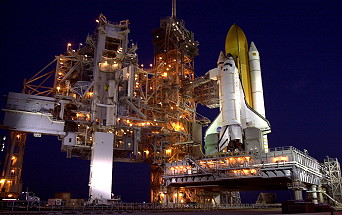
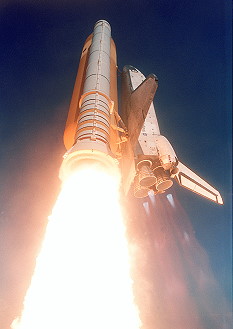
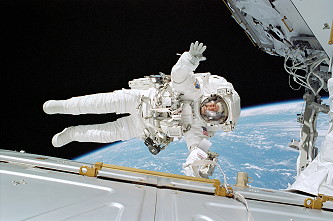
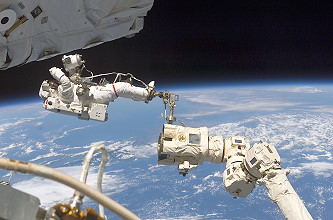
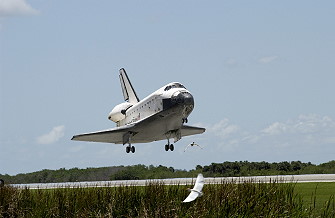
landing on Cape Canaveral (KSC), Runway 33. Due to a hydrogen leak the launch was scrubbed on April 04, 2002. ISS-13-8A Integrated Truss Structure S0, Mobile Transporter. The main purpose of STS-110 (ISS Integrated Truss Structure S0, Mobile Transporter) was to attach the S0 Truss segment to the International Space Station (ISS) to the Destiny Laboratory Module. It forms the backbone of the station to which the S1 and P1 truss segments were attached (on the following missions STS-112 and STS-113, respectively). During four spacewalks, astronauts truly took on the appearance of high-rise construction workers as they assembled beams, attached work lights, bolted girders and plugged in electrical connections. The station's Canadarm2 robotic arm was used exclusively to hoist the 13-ton truss section, called the S-Zero (S0) Integrated Truss Structure, from Atlantis and attach it to the station. Nine additional truss segments were linked on future missions to the centerpiece segment carried by Atlantis to form the finished structure. The finished truss will support almost an acre of solar panels and giant cooling radiators. Although the International Space Station already is a fully functional research complex with a single United States laboratory, the additional solar panels and radiators will provide the electricity and cooling necessary for Japanese and European laboratories to be attached to the station as well as a future U.S. centrifuge laboratory. With the launch of Atlantis, mission specialist Jerry L. Ross became the first human to have traveled to space seven times. STS-110 also delivered the Mobile Transporter (MT), which is an 885-kilograms (1,950 lb) assembly that glides down rails on the station integrated trusses. During the next shuttle mission, STS-111, the Mobile Base System (MBS) was mounted to the MT. This Mobile Servicing System (MSS) allows the Canadarm2 to travel down the length of the installed truss structure. The Starboard 0 (S-Zero or S0) truss segment was delivered to the orbiting outpost on STS-110 (ISS Assembly Flight 8A). Power and data cables and the thermal control system that provides heating and cooling wind through the 44-foot (13.4 meters) by 15-foot (4.6 meters), 27,000-pound (12,247 kg) truss segment to carry energy and information to and from the station's extremities where solar panels collect electrical energy used to power experiments, computers, life support systems and other services. The Integrated Truss Segment (ITS) S0 provides the capability to attach the four Photovoltaic Module truss segments to increase the ISS power production capacity. The S0 truss is launched with a complement of pre-integrated hardware to increase ISS functionality including the Mobile Transporter (MT), the Trailing Umbilical System (TUS), the Portable Work Platform, four Global Positioning System (GPS) antennas, two rate gyros, an Extravehicular Charged Particle Detection System (EVCPDS), and umbilicals for U.S. on-orbit elements. Mission 8A also delivered four Main Bus Switching Units (MBSUs), two Circuit Interrupt Devices, three Crew and Equipment Translation Aid (CETA) lights and the Airlock Spur. The S0 is the center segment of 11 integrated trusses that provide the foundation for station subsystem hardware installation, utility distribution, power generation, heat rejection and external payload accommodations. The S0 truss acts as the junction from which external utilities are routed to the pressurized modules by means of EVA-deployed umbilicals. These utilities include power, data, video and Active Thermal Control System ammonia. The S0 truss provides a mounting point for electronic equipment such as the MBSUs, four of the DC-to-DC Converter Units (DDCUs), and four Secondary Power Distribution Assemblies. As mentioned, also mounted on S0 are the space station's four GPS antennas and two Rate Gyros. The S0 truss will connect to its neighboring truss segments (S1 and P1) by means of the Segment-to-Segment Attachment System, which consists of a remotely operated capture latch and four motorized bolt assemblies. Structural attachment to the U.S. lab is accomplished through the Module-to-Truss Structure, which consists of 10 EVA-deployed telescoping struts. The S0 structure has an elongated hexagonal cross section with five bays arrayed along the long axis. Although S0 has a large complement of pre-integrated equipment on its structure, the frame is open enough to allow EVA operations within the spaces of the bays. The numbered faces of S0 make identification of worksites easier for EVA crews translating around the truss segment. These faces are numbered sequentially counterclockwise from the forward nadir face to the aft nadir face. Just as trains carried supplies to the Old West frontier, the Mobile Transporter (MT) became the first railroad in space on the International Space Station (ISS) during STS-110. The 1,950-pound (885 kg) structure travel along the rails of the Integrated Truss Structure (ITS) and, together with the Mobile Base System, will provide the work platform for the Canadian-built mechanical arm (also known as the Space Station Remote Manipulator System or Canadarm2). Strong and powerful, the high-strength aluminum transporter provides the mobility to relocate the Canadarm2 to 10 pre-designated space station worksites and helps deploy segments of the ITS with its payload capacity of 46,100 pounds (20,911 kg). The MT will lock itself down to the rails to move the massive payloads. Built for performance, the transporter measures 108 inches (274 centimeters) long, 103 inches (262 centimeters) wide and 38 inches (97 centimeters) high. It travels on a three-point suspension system: the Linear Drive Unit, which drives and supports the MT, and the two Roller Suspension Units, which provide additional support as the MT travels down the ITS rails. The second day of the mission day was devoted to checks of the spacesuits and spacewalking gear that were used later in the mission. Atlantis' robotic arm also was powered up and checked out, and television cameras on the arm were used to survey the cargo bay. The crew also checked the operation of navigation aids and other equipment that will were during the final phase of rendezvous with the station. Atlantis' thrusters were fired periodically during the day to fine-tune the rate at which the shuttle was approaching the station, and the docking mechanism in Atlantis' cargo bay was powered up and extended in readiness for the docking. A precisely timed launch with a window of only about five minutes began the process that ultimately took Atlantis to its rendezvous and docking with the International Space Station. Atlantis pursued the station during the first two days of the mission. Engine firings adjusted the orbit of the shuttle, brought Atlantis to a point about 9 ½ statute miles (24.6 km) behind the station about 2 ½ hours before docking on flight day three. There Commander Michael Bloomfield and pilot Stephen Frick fired Atlantis' jets in a Terminal Phase Initiation (TI) burn to begin a final approach to the station. As Atlantis closed in, the shuttle's rendezvous radar system provided range and closing rate information to the crew. During the approach, the shuttle had an opportunity to make four, small mid-course corrections at regular intervals. Just after the fourth correction, Atlantis was about half a mile below and behind the station. There, about an hour before the scheduled docking, Michael Bloomfield took over manual control. He slowed Atlantis' approach. Then, beginning at a point about 600 feet (182.9 meters) directly below the station, he began a quarter-circle of the orbiting laboratory, slowly moving to a position in front of the station. Mission Specialists Rex Walheim and Ellen Ochoa also played key roles in the rendezvous, with Rex Walheim operating a handheld laser-ranging device. Ellen Ochoa operated a laptop computer program that gave position and guidance information regarding the rendezvous. Michael Bloomfield stopped Atlantis a little more than 300 feet (91.4 meters) directly ahead of the station with the cargo bay facing it. There he began slowly moving directly toward the station's shuttle docking port - moving at about a tenth of a mile per hour (0.16 kilometers per hour). Using a view from a camera mounted in the center of Atlantis' docking mechanism as a key alignment aid, Michael Bloomfield centered the docking ports of the two spacecraft. When the docking mechanisms were 30 feet (9.14 meters) apart, he stopped Atlantis for a few minutes to check their alignment. For Atlantis' docking on April 10, 2002, Michael Bloomfield moved the shuttle at about a one-tenth of a foot per second (3 centimeters per second) toward the station, keeping the docking mechanisms aligned to within a three-inch (7.6 centimeters) tolerance. When the two spacecraft made contact, preliminary latches automatically engaged, attaching them to one another. Just after docking, Michael Bloomfield deactivated the shuttle's steering jets to reduce the forces acting at the docking interface. Shock absorber-type springs in the docking mechanism dampened any relative motion between the shuttle and the station. Once relative motion between the spacecraft had been stopped, Mission Specialists Jerry Ross and Ellen Ochoa secured the docking mechanism, sending commands for Atlantis' mechanism to retract and closed a final set of latches between the shuttle and station. Less than two hours after docking, the hatches between the shuttle and station were opened and the crews of STS-110 and Expedition Four greeted one another. The remainder of the day was spent transferring supplies and equipment, including two crystal growth experiments, between the two spacecraft as well as a joint review by the two crews of plans for installation of the S0 truss and the first spacewalk. Ellen Ochoa and Daniel Bursch powered up the station's robotic arm and maneuvered it through a practice run, going through the same motions that will be required to install the truss to the station. The station arm was left overnight in a position near the fixture it latched onto to lift the truss out of Atlantis' payload bay. Ellen Ochoa and Daniel Bursch worked together aboard the station to use the complex's Canadarm2 to lift the 43.3-foot (13.2 meters), 27,830-pound (12,624 kg) S0 truss segment from Atlantis' cargo bay and attached it atop the station's Destiny laboratory. Stephen Frick operated the shuttle's robotic arm aboard Atlantis to use views from television cameras on that arm to assist Ellen Ochoa and Daniel Bursch. Once in place, the crew inside commanded the capture latch to close. This was done to make the truss stable enough for attitude control and the small loads the spacewalkers will induce. The first EVA was performed by Steven Smith and Rex Walheim on April 11, 2002 (7h 48m), installing the (S-Zero) truss segment. Their first task was releasing starboard and port forward Module-to-Truss Structure (MTS) strut clamshell fasteners. Using a standard EVA power tool, they had to undo a total of eight bolts, four on each side, beginning on the starboard side. Then they released four launch restraint bolts, two on each side, from footplates. That allowed the V-shaped structures to rotate downward. Steven Smith and Rex Walheim installed four bolts through each footplate, securing the structures to the lab. Then each clamshell fastener was tightened to rigidize the struts. By releasing two bolts, Steven Smith deployed the Aft Lab Avionics Tray, which contained power, data and fluid umbilicals that were connected to the lab, node and Z1. He mated the avionics connectors only (not the fluid connectors) to the lab and Z1. He paused from that task periodically to help Rex Walheim, who was simultaneously installing and mating the Lab Forward Avionics Umbilicals on the starboard and then port side. Steven Smith removed the port drag link and entered the truss to install two Circuit Interrupt Devices (circuit breakers). That done, he again teamed up with Rex Walheim to install the Zenith Trailing Umbilical System Cable. On flight day 5 the crews turned their attention to continuing the transfer of supplies, equipment and experiments between the station and shuttle. Nitrogen and oxygen were transferred from tanks aboard Atlantis to replenish tanks on the station's Quest airlock. All crewmembers also had time set aside for a group review of plans for the upcoming second and third spacewalks. The crewmembers had a couple of hours of off-duty time at the end of the day. The second spacewalk by Jerry Ross und Lee Morin occurred on April 13, 2002 (7h 30m) to mate two large tripod legs of the truss to the Destiny Laboratory. After leaving the airlock and standard setup activities, the first task of Jerry Ross and Lee Morin during their spacewalk was to install the aft MTS struts, first the starboard and then the port. The aft strut groups are tripods, with three adjustable struts meeting at a common footplate that attaches to the lab structure. Jerry Ross and Lee Morin worked together to deploy the struts, with Lee Morin on Canadarm2 near S0 and Jerry Ross at the lab receiving the "point" of the tripod. Each strut has two clamshell fasteners that must be released (for a total of 12 fasteners), and each strut group has five launch restraint bolts that must be released. Six bolts attach each aft MTS strut group to the lab's aft endcone and five bolts attach each strut group to S0. This task was somewhat more difficult than other tasks because of the size of the strut groups and the specialized procedure required to torque down the bolts. Then each clamshell fastener was tightened to rigidize the struts. With the completion of the strut attachments, S0 was attached rigidly to the ISS, and was able to support its design loads, including the solar arrays that were on the ends of the truss at assembly complete. Jerry Ross, later joined by Lee Morin, moved on to remove and stow drag links, large metal rods used to support the S0 truss during launch. They were stowed on the truss' exterior. Jerry Ross also removed a thermal cover from the truss and brought it into the airlock. Next both Jerry Ross and Lee Morin moved on to mate the Trailing Umbilical System 2 nadir cable to the Mobile Transporter. Launched on the S0 Truss, the Mobile Transporter serves as an installation point for Canadarm2's Mobile Servicing System (MSS) Base System, launched on STS-111. Finally, the spacewalkers removed the truss' keel pin assemblies. Like the drag links, they were attached to the truss for long-term stowage. The third EVA was again performed by Steven Smith and Rex Walheim on April 14, 2002 (6h 27m). They rewired the Canadarm2 and readied the complex's newly-delivered rail-car (Mobile Transporter) to move. The first task of the third spacewalk after Steven Smith and Rex Walheim left the airlock and completed setup, was release of the Lab Cradle Claw atop Destiny by Rex Walheim and the installation of the J300 Panel Connectors by Steven Smith. The claw initially held the S0 truss to Destiny's Lab Cradle Assembly. The J300 Connectors and subsequent reconfiguration of the J400 Power Data and Grapple Fixture (PDGF) Connectors by Steven Smith will route power, data, and video through the S0 truss for later operation of Canadarm2 from the MSS Base System after STS-111. Steven Smith and Rex Walheim then turned their attention to the Mobile Transporter, spending about 45 minutes releasing its many launch restraints and removing a small thermal cover from a radiator on the Mobile Transporter. Then they continued work on the J400 reconfiguration for another hour and a half. After transferring tools from the shuttle to the station's exterior and transferring other tools on the station exterior, the spacewalkers depressed three sensors on the starboard side of S0 to test them for future mating of the S1 truss. The last task of the spacewalk was to install the Airlock Spur. The spur is a beam almost 14 feet (4.3 meters) long and fitted with handrails. The spur will help spacewalkers move more efficiently from the Quest airlock to the forward side of the S0 Truss and the Destiny laboratory. The Mobile Transporter railcar was commanded to move for the first time on the eighth day of the mission. A checkout of the space railway commanded the transporter to roll up and down its 43.3-foot-long (13.2 meters) rails. Television cameras on Atlantis' robotic arm were used to record the transporter checkout. Interior cargo continued to be transferred during the day and preparations were made for the fourth and final spacewalk. The crew also had about a half-day off duty to rest. The fourth and final EVA by Jerry Ross and Lee Morin was conducted on April 16, 2002 (6h 37m), installing a ladder, testing electrical switches for upcoming truss expansion and attaching external light and equipment to be used in future assembly work. Tasks of the flight's final spacewalk began with release of Lab Cradle Assembly guide cones, used to guide the S0 Truss onto the assembly, by Lee Morin and installation by Jerry Ross of a light on the Unity node to help future spacewalkers and robotics operators. Those tasks complete, both spacewalkers spent the next 30 minutes partially assembling a portable work platform, which will aid future spacewalkers in maintenance activities. They depressed three sensors on the port side of the S0 truss to test them for future installation operations of the P1 truss segment. Jerry Ross then installed a second light on Destiny. While Jerry Ross did the 45-minute light installation, Lee Morin deployed the Extravehicular Charged Particle Directional Spectrometer. That instrument measures and characterizes the radiation environment outside the station for documenting crew exposure. It also can provide almost instant information on exposure rates during unexpected radiation events. Lee Morin's next task was to deploy the Node 1 Swing Arm. Only the beam was deployed on this mission. Its three umbilical connectors from the S0 truss aft to the Unity Node's endcone were deployed on a later flight. After the beam was deployed, the crew's outfitting of the S0 truss was complete. Jerry Ross, meanwhile, was using that hour to install Mobile Transporter Energy Absorbers, port and starboard, to provide a barrier and attach point between the Mobile Transporter and future hand-propelled carts that will be used by spacewalkers. Other tasks on this spacewalk included installation of handrails on the S0 truss, removal of a thermal blanket from S0, and tool relocations in preparation for the next flight's spacewalkers. Additionally, Lee Morin performed a checkout of a Trace Gas Analyzer that is designed to detect minute amounts of gas in the environment of space. Once Atlantis was ready to undock, Jerry Ross sent a command to release the docking mechanism. The initial separation was provided by springs that gently pushed the shuttle away from the station. Atlantis' steering jets were deactivated during this initial separation. Once the docking mechanism's springs had pushed Atlantis to a distance of about two feet (61 centimeters) and the docking devices were clear of one another, Stephen Frick turned the steering jets back on and fired them to begin very slowly moving away. From the aft flight deck, Stephen Frick manually flew Atlantis in a tight corridor as he separated from the ISS. Atlantis continued away to a distance of about 450 feet (137.2 meters), where Stephen Frick began a close, 90-minute flyaround of the station, circling it 1 ¼ times. Atlantis moved directly over the station, then behind it, underneath it, and back in front of the ISS, where the flyaround began. The last quarter-circle brought the shuttle directly above the station. There Stephen Frick fired Atlantis's jets to move away from the station. |
EVA data
| Name | Start | End | Duration | Mission | Airlock | Suit | |
| EVA | Smith, Steven | 11.04.2002, 14:36 UTC | 11.04.2002, 22:24 UTC | 7h 48m | STS-110 | ISS - Quest | EMU No. 3015 |
| EVA | Walheim, Rex | 11.04.2002, 14:36 UTC | 11.04.2002, 22:24 UTC | 7h 48m | STS-110 | ISS - Quest | EMU No. 3009 |
| EVA | Ross, Jerry | 13.04.2002, 14:09 UTC | 13.04.2002, 21:39 UTC | 7h 30m | STS-110 | ISS - Quest | EMU No. 3006 |
| EVA | Morin, Lee | 13.04.2002, 14:09 UTC | 13.04.2002, 21:39 UTC | 7h 30m | STS-110 | ISS - Quest | EMU No. 3003 |
| EVA | Walheim, Rex | 14.04.2002, 13:48 UTC | 14.04.2002, 20:15 UTC | 6h 27m | STS-110 | ISS - Quest | EMU No. 3009 |
| EVA | Smith, Steven | 14.04.2002, 13:48 UTC | 14.04.2002, 20:15 UTC | 6h 27m | STS-110 | ISS - Quest | EMU No. 3015 |
| EVA | Morin, Lee | 16.04.2002, 14:39 UTC | 16.04.2002, 21:06 UTC | 6h 37m | STS-110 | ISS - Quest | EMU No. 3003 |
| EVA | Ross, Jerry | 16.04.2002, 14:29 UTC | 16.04.2002, 21:06 UTC | 6h 37m | STS-110 | ISS - Quest | EMU No. 3006 |
Photos / Graphics
 |
 |
 |
 |
 |
 |
 |
 |
 |
 |
 |
 |
 |
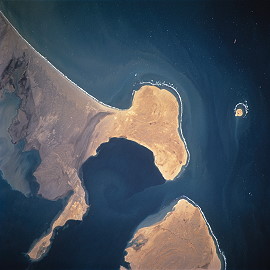 |
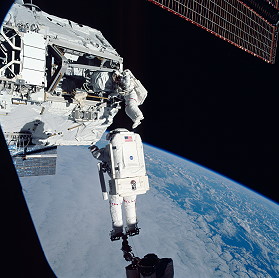 |
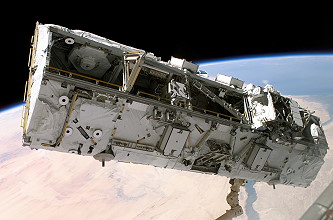 |
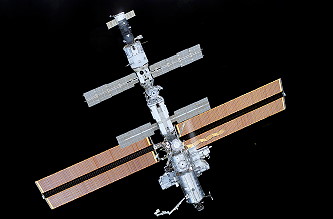 |
 |
 |
|
more EVA photos |
|
| © |  |
Last update on March 27, 2020.  |
 |