Human Orbital Spaceflights

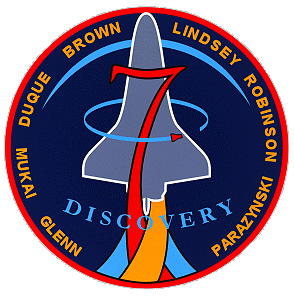
International Flight No. 206STS-95Discovery (25)92nd Space Shuttle missionUSA |
 |
 |
Launch, orbit and landing data
walkout photo |
 |
|||||||||||||||||||||||||||||
alternative crew photo |
alternative crew photo |
|||||||||||||||||||||||||||||
alternative crew photo |
alternative crew photo |
|||||||||||||||||||||||||||||
alternative crew photo |
||||||||||||||||||||||||||||||
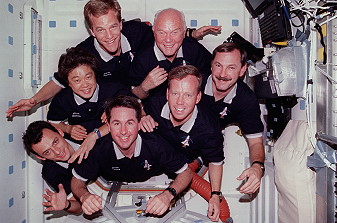
Crew
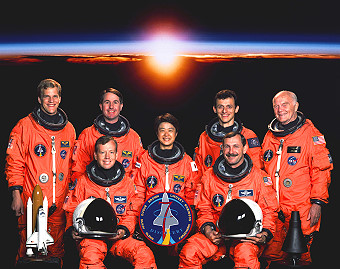
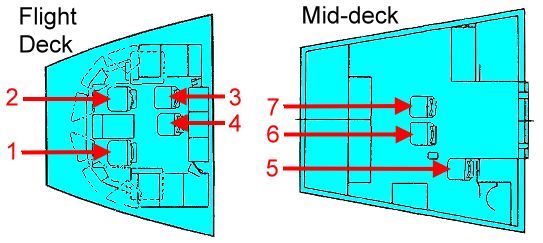
| No. | Surname | Given names | Position | Flight No. | Duration | Orbits | |
| 1 |  |
Brown | Curtis Lee, Jr. "Curt" | CDR | 5 | 8d 21h 43m 56s | 134 |
| 2 | |
Lindsey | Steven Wayne | PLT | 2 | 8d 21h 43m 56s | 134 |
| 3 | |
Robinson | Stephen Kern | MS-2, EV-2 | 2 | 8d 21h 43m 56s | 134 |
| 4 | |
Parazynski | Scott Edward | MS-1, PLC, EV-1, FE | 3 | 8d 21h 43m 56s | 134 |
| 5 |  |
Duque | Pedro Francisco | MS-3 | 1 | 8d 21h 43m 56s | 134 |
| 6 |  |
Mukai | Chiaki | PS-1 | 2 | 8d 21h 43m 56s | 134 |
| 7 | |
Glenn | John Herschel, Jr. | PS-2 | 2 | 8d 21h 43m 56s | 134 |
Crew seating arrangement
|
 |
|
||||||||||||||||||||||||||||||||
Hardware
| Orbiter : | OV-103 (25.) |
| SSME (1 / 2 / 3): | 2048-2A (1.) / 2043-1 (2.) / 2045-1 (2.) |
| SRB: | BI-096 / RSRM 68 |
| ET: | ET-98 (SLWT-2) |
| OMS Pod: | Left Pod 01 (28.) / Right Pod 03 (26.) |
| FWD RCS Pod: | FRC 3 (25.) |
| RMS: | 201 (16.) |
| EMU: | EMU No. 3011 (PLSS No. 1011) / EMU No. 3010 (PLSS No. 1010) |
Flight
|
Launch from Cape Canaveral (KSC) and
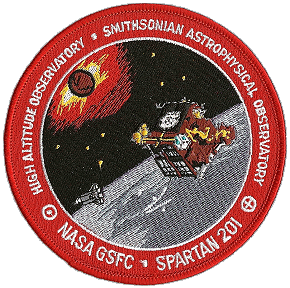
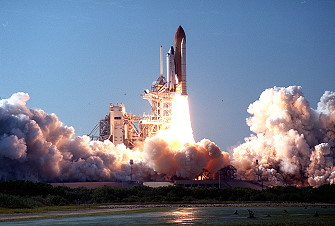
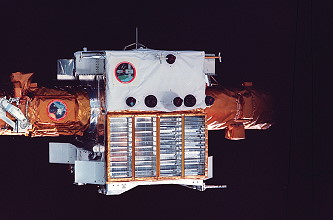
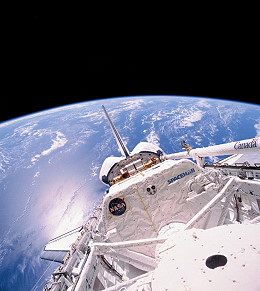
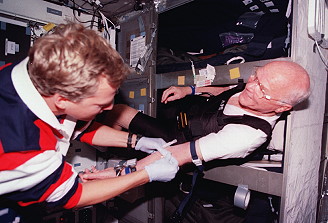
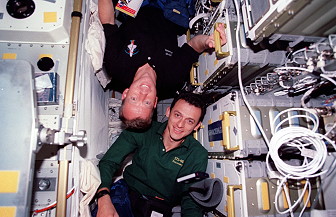
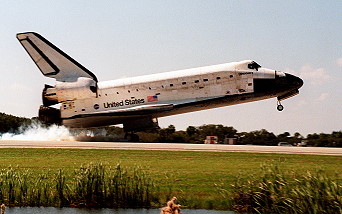
landing on Cape Canaveral (KSC), Runway 33. The countdown proceeded to T-9 minutes, but was held an additional 8.5 minutes while the launch team discussed the status of a master alarm heard during cabin leak checks after hatch closure. Once the count picked up and the Orbiter Access Arm was retracted, the Range Safety Officer (RSO) requested a hold at T-5 minutes due to aircraft in the restricted air space around KSC. Once the aircraft cleared the area, the RSO gave the all-clear signal and the countdown proceeded. Following main engine start, and prior to booster ignition, the drag chute compartment door fell off but posed no problem for the mission. Managers decided not to deploy the chute upon landing. The primary objectives of STS-95 included conducting a variety of science experiments in the pressurized SPACEHAB module, the deployment and retrieval of the SPARTAN free-flyer payload, and operations with the Hubble Space Telescope Orbiting Systems Test (HOST) and the International Extreme Ultraviolet Hitchhiker payloads being carried in the payload bay. The scientific research mission also returned space pioneer John Glenn to orbit - 36 years, eight months and nine days after he became the first American to orbit the Earth. More than thirty-six years after he made history as the first American to orbit the Earth, Senator John Glenn (77) returned to space as part of a multinational crew with the launch of Space Shuttle Discovery in late October 1998. The flight, designated STS-95, involved more than eighty scientific experiments investigating mysteries that span the realm from the inner universe of the human body to studies of our own Sun and its solar activity. Back on February 20, 1962, when John Glenn flew in his Friendship 7 Mercury capsule, the largest mystery facing the young NASA space program was whether humans could even survive in the hostile environment of space. In the 121 space missions since John Glenn's flight during the Mercury, Gemini, Apollo, Skylab and Shuttle programs, more than 200 Americans have flown - and thrived - in space. John Glenn, who inspired many current astronauts to pursue space flight as a career, continued to inspire people of all generations as he prepared for a return to space. The wealth of scientific data accumulated during these space flights validated apparent similarities between the effects of space flight and aging. John Glenn was a test subject for specific investigations which mimic the effect of aging, including loss of muscle mass and bone density; disrupted sleep patterns; a depressed immune system; and loss of balance. PANSAT, a nonrecoverable satellite developed by the Naval Postgraduate School (NPS) in Monterey, Calif., was basically a small telecommunications satellite. It was used to enhance the education of military officers at NPS by giving them hands-on experience in developing and operating a small satellite. It also served as a space-based laboratory for officers. PANSAT was a spread-spectrum satellite. Spread spectrum allows communication satellites to capture and transmit signals that normally would be lost because the original signals were too weak or had too much interference. The satellite was deployed on flight day two. The SPARTAN 201-5 free-flyer was deployed and retrieved using the Shuttle's mechanical arm. It was designed to investigate physical conditions and processes of the hot outer layers of the Sun's atmosphere, or solar corona. While deployed from the Shuttle, SPARTAN gathered measurements of the solar corona and solar wind. The rectangular SPARTAN 201 spacecraft consisted of a service module that contained attitude control, thermal control, payload function control, and power distribution systems and an instrument carrier, a cylindrical container that holds the telescopes. On the bottom of the spacecraft was the upper portion of the release/engage mechanism, or REM. The lower half of the REM was attached to the spacecraft's payload bay support structure. The two halves of the REM were mated to hold the spacecraft rigidly in place on the support structure and unlatch to allow SPARTAN to be deployed. This is a reflight of the STS-87 SPARTAN 201-04, which developed problems shortly after being deployed from the shuttle in November 1997. After it was released, SPARTAN failed to perform a pirouette maneuver because of an incomplete initialization sequence. The spacecraft was sent into a spin when Columbia's robotic arm bumped it during a retrieval attempt. After spacewalking astronauts recaptured the free flyer four days after its deployment, NASA was cautiously optimistic that SPARTAN could be deployed for a shortened mission. In the end, however, the mission had to be canceled because Columbia would not have had enough propellant for the rendezvous and capture activities. The SPARTAN 201 series was investigating the solar corona - the thin upper layers of the sun's atmosphere, which reach temperatures of about 2 million degrees Fahrenheit (1.1 million Celsius). Scientists hope to determine the mechanisms that cause the heating of the corona and the acceleration of the solar wind, which originates in the corona, and explain why the corona is so much hotter than the rest of the sun. The first three SPARTAN 201 flights have already advanced our understanding of the solar wind and its origin. SPARTAN 201-05 observations were coordinated with observations made from the Solar and Heliospheric Observatory (SOHO) satellite, a cooperative mission of the European Space Agency (ESA) and NASA. The second and third missions were coordinated with the passage of the Ulysses spacecraft over the sun's south and north poles. The sun's corona is difficult to study because its light is relatively dim compared to the sun's total luminance. The white light corona can be viewed from Earth only during a solar eclipse, which strongly reduces the brightness of the scattered sunlight. Ground-based astronomers are never able to see the ultraviolet radiation because of interference from the Earth's atmosphere. SPARTAN 201 was equipped with two complementary telescopes that could measure these emissions from the sun's corona. The white light coronagraph (WLC), provided by the High-Altitude Observatory in Boulder, Colo., measured the density of the electrons in the coronal white light. The ultraviolet coronal spectrometer (UVCS) from the Smithsonian Astrophysical Observatory at Harvard measured the velocities, temperatures, and densities of the coronal plasmas. SPARTAN was deployed from Discovery's cargo bay on flight day 2. Stephen Robinson used the orbiter's 50-foot (15.24 meters) robot arm to lift the free-flying satellite from its support structure and released it in space. After SPARTAN was released, it performed a 45-degree pirouette to confirm that it is functioning properly before its mission can begin. Six minutes after release, the crew of Discovery executed a separation maneuver (SEP1) at a rate of 1fps. The maneuver was designed to clear the Orbiter of the SPARTAN orbital path and to set up the second separation maneuver (SEP2). SEP2 initiated a retrograde separation to place Discovery ahead of the target on the same velocity vector. A phasing maneuver (NC1) then set up the two spacecraft 5-6 miles (9 km) apart - well within range of the Orbiters RF communication system. At this distance, SPARTAN controllers on the ground commanded the spacecraft via the Orbiter Payload Interrogator for the start of TEXAS operations. After 4 orbits of stationkeeping, a second phasing maneuver (NC2) started Discovery on a slow separation to a distance of 30 nautical miles (55.6 km) ahead of the SPARTAN, where NC3 established stationkeeping for several orbits of additional SPARTAN deployed science operations. At completion of SPARTAN autonomous operations, a final phasing maneuver (NC4) initiated a 2-orbit rendezvous profile placing Discovery behind and slightly below the target for the Terminal Phase of the rendezvous. Terminal Phase Initiation began at a distance of 8.2 nautical miles (15.2 km) behind and below the target with a 9.4 fps OMS maneuver (Ti) which set up Discovery for an "R-BAR" (underneath) final approach for the capture of SPARTAN by Stephen Robinson at the controls of the RMS. The Hubble Space Telescope Orbital Systems Test (HOST) platform carried experiments to validate components planned for installation during the third Hubble Space Telescope servicing mission and to evaluate new technologies in an earth orbiting environment. There were four experiments on the HOST platform. The NICMOS Cooling System allowed zero-g verification of a Reverse Turbo Brayton Cycle Cooler which allows longer life operation than the current dewar system. The HST 486 Computer allows the identification of any radiation susceptible parts in the DF-224 replacement and demonstrate hardware and software responses to Single Event Upsets (SEU's). Solid State Recorder compares on-orbit operation of the flight spare solid state recorder with the current HST unit. Fiber Optic Line Test uses the same 4 Kbit/s data stream that is sent to the orbiter's Payload Data Interrogator (PDI) and is routed to a laptop computer for post-flight comparison. The International Extreme Ultraviolet Hitchhiker (IEH) payload involved a half dozen different experiments mounted on a support structure which was carried in Discovery's payload bay. The six experiments that make up the IEH payload are Solar Extreme Ultraviolet Hitchhiker (SEH) payload which obtained EUV and FUV fluxes that are required when studying the Earth's upper atmosphere; Ultraviolet Spectrograph Telescope for Astronomical Research (UVSTAR) payload designed to measure EUV fluxes which can be used to form images of extended plasma sources (ex. Jupiter, hot stars, etc.); STAR-LITE payload which made observations of extended and diffused astrophysical targets; CONCAP-IV payload designed to grow thin films via physical vapor transport; Petite Amateur Navy Satellite (PANSAT) payload which is managed by the Department of Defense Space Test Program and involves a small deployable satellite that stores and transmits digital communications to PANSAT ground stations; and (6) a Getaway Special (GAS) payload. The Spacehab module flown on STS-95 was provided by Spacehab, Inc., a private company which provides single- or double-module Spacehabs to support NASA's space flight efforts. The Spacehab system provides additional pressurized workspace for experiments, cargo and crew activities. Spacehab modules have supported various Shuttle science missions along with several of the joint Shuttle-MIR missions. For STS-95, a single-module Spacehab flew in the forward portion of Discovery's payload bay with the crew gaining access to the module through the airlock tunnel system. A variety of experiments sponsored by NASA, the Japanese Space Agency (NASDA) and the European Space Agency (ESA) focused on life sciences, microgravity sciences and advanced technology during the flight. NASA's Office of Life and Microgravity Sciences and Applications was sponsoring Biological Research in Canisters (BRIC) 13, the latest in a series of life sciences experiments designed to examine the effects of microgravity on a wide range of physiological processes in higher order plants and arthropod animals (e.g., insects, spiders, centipedes, crustaceans). On STS-95, BRIC-13 studied the effects of microgravity on embryogenesis (the formation of embryos) in orchard grass. The Cryogenic Thermal Storage Unit Flight Experiment (CRYOTSU) payload was designed to demonstrate the functionality of four important spacecraft thermal control devices in microgravity: the 60K Thermal Storage Unit (TSU), the Cryogenic Capillary Pumped Loop (CCPL), the Cryogenic Thermal Switch (CTSW) and the Phase Change Upper End Plate (PCUEP). Three of the devices operated at very low ("cryogenic") temperatures, while the fourth operated at just above room temperature. Overall, the payload was a "toolbox" of thermal control elements that aerospace designers can select from to determine ways of reliably solving complex spacecraft thermal design problems with minimum expenditures of power, weight and cost. E-Nose was a new, miniature environmental monitoring instrument that detects and identifies a wide range of organic and inorganic molecules down to the parts-per-million level. The objective on STS-95 was to flight-test E-Nose and assess its ability to monitor changes in Discovery's middeck atmosphere. The monitoring device used an array of thin-film polymer sensors interspersed with carbon. The chemical sensors change resistance when exposed to vapors, but no one sensor is dedicated to identifying any specific vapor. Since gases and gas mixtures are identified by the electrical response pattern of the entire array, E-Nose had a unique ability to monitor and identify a wide variety of odors. For this flight, ten toxic compounds were targeted for identification. In addition to the sensor array, the E-Nose flight equipment included an alcohol wipe kit, a customized display and control palm-top for crew interface, and a valve assembly for collecting "grab" samples. The AGHF experiment was a Bridgeman furnace designed for directional solidification and crystal growth, featuring the capability of demarcation of the solidification front by Peltier pulse marking and of thermal coupling of the experiment cartridge to the cooling zone by means of a liquid metal ring. The AGHF included an electronics module (ELM), the core facility module (CFM), the core access panel, and the gas storage module. Nine processing runs were performed. When a processing run was completed, the crew configured the furnace, either for the next run or for landing, as required. Following a given processing run, the furnace was powered down; however, the electronics, water cooling, and air cooling run continuously. Between experiment runs, the furnace was pressurized to cabin ambient, the processed cartridge removed and stowed, a fresh sample cartridge installed, and vacuum established in the furnace. If a delay greater than 60 minutes was scheduled between runs, the entire AGHF facility could powered down after consultation with the AGHF ground control team. The objective of the APCF experiment on STS-95 was to crystallize solution samples in orbital microgravity and to return them for post-flight analysis. During mission operations, the two APCFs, with reactors and sample materials, were inserted into SPACEHAB lockers and powered prior to launch. Once on-orbit, the Experiment Start switch command was start processing, which progressed automatically through the preprocess stages. Daily status checks were carried out with LED status recorded on the FDF cue card. Near mission end, the Experiment Stop switch command caused the facility to go into its post-processing stage, shut down, but remained powered. The Advanced Separation Space Bio-Processing facility supported three major commercial investigations: the Hemoglobin Separation experiment; the Microencapsulation experiment; and the Phase Partitioning experiment. The facility is making use of major advances in separation technology--obtained through previous research by Space Hardware Optimization Technology, Inc. with the Consortium for Materials Development in Space, a NASA Commercial Space Center in Huntsville, Ala. This investigation allowed researchers to evaluate advanced separation technology for a recombinant - or genetically engineered - hemoglobin product. The development of such a product could be used as a replacement for whole human blood. One STS-95 experiment produced Aerogel - a low-density, open-pore foam - in the weightless environment of space. Aerogel transmits light, insulates against sound and electricity, and is only slightly heavier than air. A single window pane of Aerogel has the insulation equivalent of up to 30 panes of regular glass and trapped air. Aerogel - nicknamed "frozen smoke" for its blue hazy appearance - can be made transparent by decreasing the size of its pores, a procedure that presently can be achieved only in space. Previous microgravity experiments showed an almost 50-percent reduction in pore size compared to ground experiments, resulting in greater transparency and electrical resistance. The ASTROCULTURE facility provided a controlled environment in which to grow plants in the near-weightlessness of space. Researchers studied which plants can be successfully grown without gravity and the changes that occur in different plants' structures and composition. During the STS-95 mission, the ASTROCULTURE facility was scheduled to conduct two experiments. One is to determine how near-weightlessness affects the composition of volatile oils important to the flavor and fragrance of plants. A second experiment was to determine if genes can be transferred from bacteria to a soybean seedling more effectively in microgravity. Soybeans are an important export crop that is valued at over $14 billion annually for the United States. The gene to be transferred has possible medical applications, which if successful would increase the value of the U.S. soybean crop. The Commercial Generic Bioprocessing Apparatus provided experiment support, such as thermal and automated controls, for commercially sponsored science experiments. By encouraging commercial access to orbiting laboratories, NASA was opening more opportunities for new technologies and products. The Commercial Generic Bioprocessing Apparatus consisted of a "family" of payloads located in two specialized lockers, one in the space shuttle middeck and one in the SPACEHAB module. The two bioprocessing apparatus lockers flown on STS-95 contained eight research projects in the areas of protein crystal growth, pharmaceutical production, plant growth, water purification, immune system research, and fish egg development. The Protein Crystallization Facility was used to grow crystals of human insulin. Lack of insulin is the primary cause of diabetes, a life-threatening disease. Previous microgravity research with industry partner Eli Lilly and the Hauptman Woodward Medical Research Institute in Buffalo, N.Y., has yielded crystals that far surpass the quality of insulin crystals grown on the ground. The investigations on STS-95 were aimed at producing crystals of even higher quality, which when combined with new analysis techniques will permit a better understanding of the interaction between insulin and its receptor. This has the potential to aid in the development of improved insulin with unique time-release properties that could reduce fluctuations in a patient's blood sugar level. Microencapsulation Electrostatic Processing System (MEPS): In the future, multilayer microcapsules may hold the key to improving techniques of drug delivery during chemotherapy treatment. Researchers from the Institute for Research, Inc. in Houston, Texas, and NASA Johnson Space Center used MEPS to produce capsules for evaluation. For many cancer patients, chemotherapy is one of the most feared parts of treatment because it can be so debilitating. With large, solid tumors, however, a special type of chemotherapy currently in use is called transcatheter chemoemobilization. In this process, approximately five percent of the "normal" dose is placed directly into the tumor through a catheter in one of the many blood vessels that serve the tumor followed by an injection of Gelfoam particles. These particles then swell to block the blood vessels in and around the tumor so that the treatment does not prematurely "wash out" of the tumor. Using this chemotherapy technique has improved the one-year survival rate of patients with non-operable liver tumors from 18 percent to between 55 and 69 percent, and reduced undesirable side effects. On STS-95, a SAMS unit designed for suborbital rockets and free-flying satellites was placed in the shuttle's cargo bay. The unit, called SAMS-FF, served two purposes: to record any disturbances in the microgravity environment for scientists with experiments on the mission and to support the Hubble Space Telescope Orbital System Test. The Hubble test was a trial of a new cryocooler for the Hubble Space Telescope. As the cryocooler cools the telescope's near infrared camera and multi-object spectrometer, SAMS-FF collected vibratory disturbance data to determine whether operation of the cooler affects the ability to precisely point the telescope at a desired location. The Vestibular Function Experiment Unit (VFEU) aboard STS-95 featured two marine fish, called toadfish, as experiment subjects. Housed in the VFEU, the fish was electronically monitored to determine the effect of gravitational changes on the inner-ear, or otolithic, system. The freely moving fish provided physiological signals of the otolith nerves through an implanted, specially designed multipore electrode. Measurements of afferent and efferent responses were made before, during, and after the flight. An RCS leak venting from a thruster on LHS OMS pod was observed in orbit. An isolation valve was used to disable the jet. Attitude control was maintained by system redundancy. There are 44 RCS jets. |
Photos / Graphics
 |
 |
 |
 |
 |
 |
 |
 |
 |
 |
 |
 |
 |
 |
| © |  |
Last update on March 27, 2020.  |
 |