Human Orbital Spaceflights

International Flight No. 233STS-113Endeavour (19)112th Space Shuttle missionUSA |
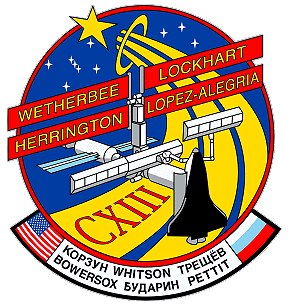 |
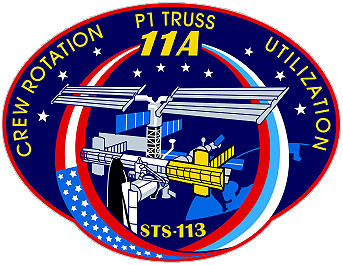 |
 |
||
Launch, orbit and landing data
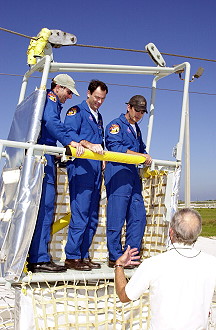
walkout photo |
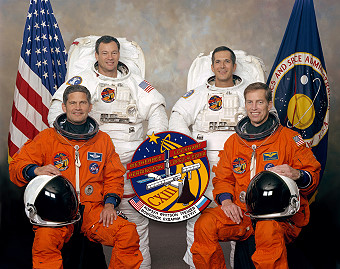 |
|||||||||||||||||||||||||||||||||
original crew photo |
alternative crew photo |
|||||||||||||||||||||||||||||||||
alternative crew photo |
||||||||||||||||||||||||||||||||||
alternative crew photo |
||||||||||||||||||||||||||||||||||
Crew
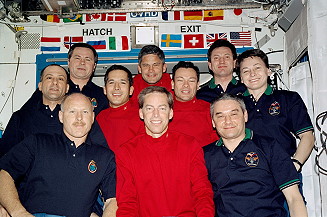
| No. | Surname | Given names | Position | Flight No. | Duration | Orbits | |
| 1 |  |
Wetherbee | James Donald "Wexbee" | CDR, IV, RMS | 6 | 13d 18h 47m 25s | 215 |
| 2 | |
Lockhart | Paul Scott "Paco" | PLTm RMS | 2 | 13d 18h 47m 25s | 215 |
| 3 | |
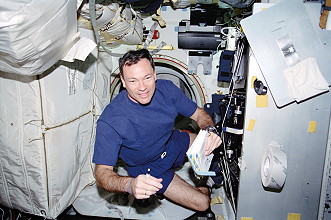
López-Alegria | Michael Eladio "LA" | MS-1, EV-1 | 3 | 13d 18h 47m 25s | 215 |
| 4 | |
Herrington | John Bennett | MS-2, EV-2, FE | 1 | 13d 18h 47m 25s | 215 |
| 5 | |
Bowersox | Kenneth Dwane "Sox" | MS-3 | 5 | 161d 01h 14m 38s | 2534 |
| 6 |  |
Budarin | Nikolai Mikhailovich | MS-4 | 3 | 161d 01h 14m 38s | 2534 |
| 7 | |
Pettit | Donald Roy | MS-5 | 1 | 161d 01h 14m 38s | 2534 |
Crew seating arrangement
|
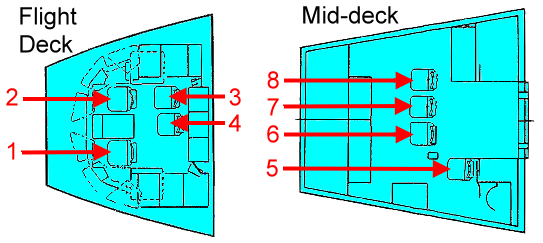 |
|
||||||||||||||||||||||||||||||||||||
Backup Crew
|
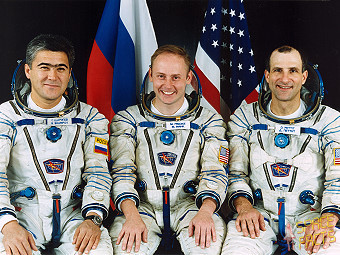 |
|||||||||||||||
Hardware
| Orbiter : | OV-105 (19.) |
| SSME (1 / 2 / 3): | 2050-2 (4.) / 2044-2 (8.) / 2045-2 (7.) |
| SRB: | BI-114 / RSRM 86 |
| ET: | ET-116 (SLWT-21) |
| OMS Pod: | Left Pod 04 (26.) / Right Pod 01 (33.) |
| FWD RCS Pod: | FRC 5 (19.) |
| RMS: | 201 (17.) |
| EMU (launch): | EMU No. 3014 (PLSS No. 1014) / EMU No. 3005 (PLSS No. 1005) |
| EMU (landing): | EMU No. 3014 (PLSS No. 1014) / EMU No. 3009 (PLSS No. 1009) |
Flight
|
Launch from Cape Canaveral (KSC) and
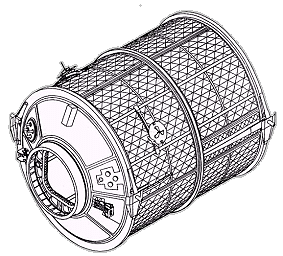
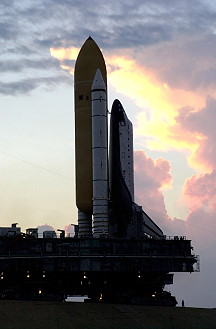
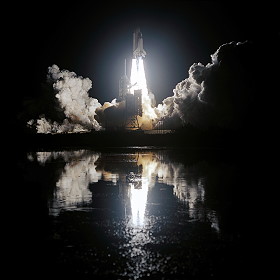
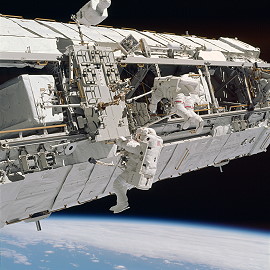
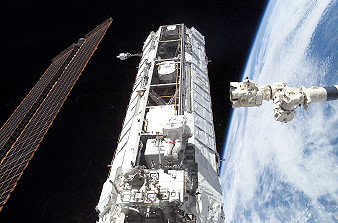
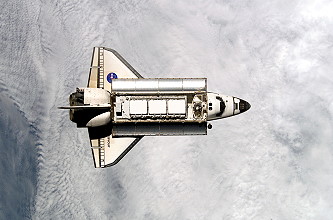
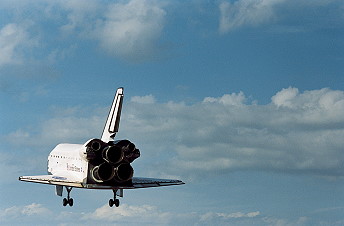
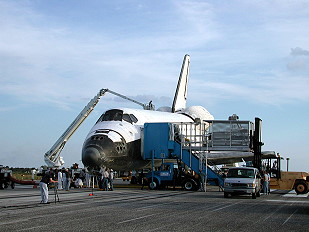
landing on Cape Canaveral (KSC), Runway 33. STS-113 was the 16th American (ISS-16-11A) assembly flight to the International Space Station (ISS). The primary mission was to bring the Expedition 6 crew to the ISS and return the Expedition 5 crew to the Earth. In addition to the crew exchange, STS-113 was the next flight in the assembly sequence to install a major component, the Port 1 (P1) Integrated Truss Assembly. Three spacewalks were carried out to install and activate the truss and its associated equipment. The major objective of the mission was delivery of the 45-foot-long (13.7 meters), 14-ton P1 to the ISS. The segment, identical to the one delivered on the recent STS-112 flight, was attached to the port side of the centerpiece truss, the S-Zero (S0), which is home to the Mobile Transporter (MT), Mobile Base System (MBS) and the Canadarm2 robotic arm. P1 continued the outboard expansion of the station's rail system in preparation for the addition of new power and international science modules in the years to come. With the addition of P1, the station's truss spans 134 feet (40.8 meters). The 27,506 lb. (12,477 kg) P1 Truss is primarily an aluminum structure that is 45 feet (13.7 meters) long, 13 feet (4.0 meters) high and 15 feet (4.6 meters) wide. The structure, along with one CETA (Crew and Equipment Translation Aid) cart, costs about $390 million. P1 contains the Active Thermal Control System (ATCS) for the station that was activated later. This system serves a similar purpose to an automobile's radiator except this system uses 99.9 percent pure ammonia. Additionally, the P1 houses a second Ultra High Frequency (UHF) communications system to provide enhanced and extended voice and data capability, and a second mobile work platform for spacewalkers called the Crew and Equipment Translation Aid (CETA) cart. Like the S1, the P1 includes a Thermal Radiator Rotary Joint (TRRJ), which will provide the mechanical and electrical energy for rotating the station's heat-rejecting radiators. P1 is the fourth of 11 truss structures that ultimately will expand the ISS to the length of a football field and increase its power through the addition of new photovoltaic modules and solar arrays. Christopher Loria was originally scheduled to fly as the pilot for this mission, but was replaced due to an injury by Paul Lockhart. Endeavour's rendezvous and docking with the International Space Station began with the precisely timed launch of the shuttle on a course for the station. During the first two days of the mission, periodic engine firings gradually brought Endeavour to a point about 9 ½ statute miles (24.6 km) behind the station, the starting point for a final approach to the station. About 2 ½ hours before the scheduled docking time on Flight Day 3, Endeavour reached that point, about 50,000 feet (15,240 meters) behind the ISS. There Endeavour's jets were fired in a Terminal Intercept (TI) burn to begin the final phase of the rendezvous. Endeavour closed the final miles to the station during the next orbit. As Endeavour closed in, the shuttle's rendezvous radar system began tracking the station and providing range and closing rate information to the crew. During the final approach, Endeavour could do as many as four small mid-course corrections at regular intervals. Just after the fourth correction was completed, Endeavour reached a point about half a mile (900 meters) below the station. There, about an hour before the scheduled docking, Commander James Wetherbee took over manual control of the approach. He slowed Endeavour's approach and flew to a point about 600 feet (182.9 meters) directly below the station, from which he began a quarter-circle of the ISS, slowly moving to a position in front of the complex, in line with its direction of travel. Pilot Paul Lockhart helped James Wetherbee in controlling Endeavour's approach. Mission Specialist John Herrington also played key roles in the rendezvous, using a handheld laser ranging device and acting as a backup in operation of the docking mechanism to latch the station and Endeavour together after the two spacecraft made contact. Mission Specialist Michael Lopez-Alegria operated the docking system and back up John Herrington on the handheld laser. James Wetherbee flew the quarter-circle of the station while slowly closing in on the complex, stopping at a point a little more than 300 feet (91.4 meters) directly in front of the station. From there, he began slowly moving Endeavour toward the station at about a tenth of a mile per hour. Using a view from a camera mounted in the center of Endeavour's docking mechanism as a key alignment aid, James Wetherbee precisely centered the docking ports of the two spacecraft. He flew to a point where the docking mechanisms were 30 feet (9.14 meters) apart, and paused to check the alignment. For Endeavour's docking, James Wetherbee maintained the shuttle's speed relative to the station at about one-tenth of a one-tenth of a foot per second (3 centimeters per second) (while both Endeavour and the space station were traveling at about five miles a second), and kept the docking mechanisms aligned to within a tolerance of three inches (7.6 centimeters). When Endeavour made contact with the station, preliminary latches automatically attached the two spacecraft. Immediately after Endeavour docked on November 25, 2002, the shuttle's steering jets were deactivated to reduce the forces acting at the docking interface. Shock absorber-like springs in the docking mechanism dampened any relative motion between the shuttle and the station. Once that motion between the spacecraft had stopped, Michael Lopez-Alegria secured the docking mechanism, sending commands for Endeavour's docking ring to retract and to close a final set of latches between the shuttle and station. The docking set the stage for the opening of the hatches and the start of seven days of joint operations, including the fifth transition of one station crew to another. The following day, Michael López-Alegria and John Herrington began spacewalk preparations while James Wetherbee used the shuttle's robotic arm to lift the huge P1 Truss out of Endeavour's payload bay to hand it to the station's Canadarm2 under control of Peggy Whitson inside Destiny. She then carefully installed it on the port side of the S0 Truss. Capture bolts structurally mated the two trusses after a claw-like device on the S0 grabs a fixture on the P1 segment. The procedure was timed so that the two spacewalkers did not exit the station's Quest Airlock until the mating process is complete. The first EVA by Michael López-Alegria and John Herrington occurred on November 26, 2002 (6h 45m) to hook up connections between the P1 and S0 trusses and other installations. Before Michael López-Alegria and John Herrington emerged from the airlock, James Wetherbee used the shuttle's robotic arm to grapple P1 and lifted it from the payload bay, then handed it off to the station's Canadarm2, operated by Peggy Whitson and Kenneth Bowersox. They moved P1 to the end of S0. After a claw attached itself to P1 and drawed it into position and bolts secured ends of the two segments, Michael Lopez-Alegria and John Herrington emerged from the Joint Airlock and began setting up for the first spacewalk. Once he was clear of the airlock, John Herrington moved to the rail lines along P1, where he released CETA cart launch latches, a two-hour and 20-minute job. The task involved releasing a total of 24 bolts. First among them were the cart's brake system bolts; their removal enabled the CETA's brakes to be used. Meanwhile, Michael López-Alegria maneuvered to the cable tray on the bottom of P1. Working from a portable foot restraint, he opened covers of cable trays on the lower sides of S0 and P1, then demated connectors on the S0 side from temporary attachment points and connected their free ends to receptacles on P1. After that task, Michael López-Alegria began installation of four 1 ½-inch (3.1 centimeters) SPD on Flex Hose Rotary Coupler (FHRC) Quick Disconnects (QDs). He then moved inboard along P1 to the truss' bay 12 and installed two more 1½-inch (3.1 centimeters) SPDs. SPDs are devices that maintain the QDs, in ammonia lines that are part of the station's cooling system, in a position to enable them to function optimally. The installation of the 1 ½-inch (3.1 centimeters) SPDs involves installing the aft part of the SPD, then moving a bail (QD valve) back about ¼-in (0.64 centimeter) and installing the forward part of the SPD. This keeps the QD valve in a fixed position. Back together again, John Herrington and Michael López-Alegria moved on to P1's starboard drag link, located on the forward face of the truss. They worked together to release that drag link, a large metal rod used as a launch restraint. Michael López-Alegria released a bolt attaching the drag link to P1, while John Herrington released a similar bolt attaching the drag link to the keel. Michael López-Alegria took the drag link to its stowage location on the P1 framework and attached it with John Herrington's assistance. The processes were repeated on the P1 port drag link. That task completed, Michael López-Alegria moved to the cable tray atop P1. There he made additional connections, opening thermal covers over cable trays atop S0 and P1, then demating connectors on the S0 side from temporary attachment points and connecting their free ends to receptacles on P1. After that task, Michael López-Alegria and John Herrington, who had done some additional work on the CETA, combined on the final major task of the spacewalk, a two-hour installation on the Unity Node of the first WETA, designed to support spacewalkers' helmet cameras. Michael López-Alegria moved to the P1's starboard keel pin, retrieved the WETA stanchion and took it to the Joint Airlock. There he and John Herrington spent about 15 minutes attaching the WETA to the stanchion. John Herrington retrieved the WETA from its temporary airlock stowage position. While Michael López-Alegria held the WETA in place, John Herrington used a pistolgrip tool to secure a center jacking bolt and then two outer bolts. Michael López-Alegria, with the WETA, and John Herrington moved to the installation location on the node. With help from John Herrington, Michael Lopez-Alegria secured it by driving a stanchion bolt. Subsequently he mated three stanchion power and data connectors to the node. The next day - Flight Day 5 - was highlighted by the formal handover of station command from Expedition 5 to Expedition 6. Kenneth Bowersox, Nikolai Budarin and Donald Pettit served as ISS Expedition Six. The Expedition five crew Peggy Whitson, Valeri Korzun and Sergei Treshchyov returned to Earth with this mission. The day included inside transfer work and some off duty time before the second spacewalk began on Flight Day 6 to continue the connection of fluid lines between the P1 and the S0 segments, the installation of another wireless video system transceiver on the P1, and the relocation of the CETA cart in preparation for the relocation of the Mobile Transporter. Also, in preparation for the MT relocation, the station's Canadarm2 was temporarily moved to a grapple fixture on the outside of Destiny. The second EVA was performed by Michael López-Alegria and John Herrington on November 28, 2002 (6h 10m) to install the fluid jumpers where the S0 and the P1 are attached to each other, to remove the P1's starboard keel pin and to relocate the CETA cart from the P1 to the S1 Truss, which will allow the Mobile Transporter to move along the P1 to assist in upcoming assembly mission. Once they were out of the airlock and setup was complete, Michael López-Alegria and John Herrington moved to a point at the junction of S0 and P1 for a two-hour installation of fluid jumpers to move ammonia between the two. The two released two jumpers on S0, then moved to the jumper install position. Michael López-Alegria mated and installed SPDs on two jumper connections on the S0 side, while John Herrington performed a similar task on the P1 side. Each connection involved a three-minute leak check. Michael López-Alegria and John Herrington reinstalled the thermal booties and together they closed their respective ends of the P1 and S0 utility tray shrouds. Then John Herrington and Michael López-Alegria, the latter on the CETA cart, moved on to P1's starboard keel pin. Michael Lopez-Alegria set the CETA brakes, and at the worksite released the top keel pin bolt, rotated the keel pin, then reinstalled the bolt. He then removed the lower keel pin bolt, freed the keel pin and reinstalled the bolt. John Herrington moved the CETA along with Michael López-Alegria and the keel pin, a few feet down the tracks. From the new location, Michael López-Alegria installed the keel pin in stowage brackets inside the P1 framework, completing the half-hour task. Working together, the spacewalkers moved on to installation of the second WETA, on the P1 itself. This installation was completed in a manner similar to the Node WETA installation. While Michael Lopez-Alegria completed the connections to the P1 WETA, John Herrington performed a test of the Segment-to-Segment Attachment System on the outboard end of P1. Michael López-Alegria and John Herrington then moved on to release of the port keel pin, repeating the tasks performed during release of the starboard keel pin. Finally, they spent a little more than an hour moving the CETA launched on P1 to S1. John Herrington was on the end of Canadarm2, operated by Donald Pettit, for this activity. The two spacewalkers released the CETA from its tracks, moved it around the Mobile Transporter (which supports the Mobile Base System for the Canadarm2), attached it to the tracks again and coupled it to its sister CETA. The third and final EVA was again performed by Michael López-Alegria and John Herrington on November 30, 2002 (7h 00m) to install more SPD's (Spool Positioning Devices), to reconfigure electrical harnesses that route power through the Main Bus Switching Units and to attach Ammonia Tank Assembly lines. The third spacewalk was devoted almost entirely to installation of SPDs. After setup, John Herrington entered a bay in the S0 Truss and operated two CIDs allowing ground controllers to begin work on the MBSU reconfiguration. From there, John Herrington moved to the top center of the P1 Truss and attached a foot restraint at the end of the Canadarm2. John Herrington then ingressed the foot restraint and Donald Pettit, at the arm's controls, maneuvered him to the starboard end of the P1. There John Herrington began the installation of a dozen 1-inch (2.5 centimeters) SPDs on lines linking the Radiator Beam Valve Modules (RBVMs) and the radiator junction box. He then got off the arm and continued with the 1-inch (2.5 centimeters) SPD installations, moving out toward the outboard end of the P1. During this three-hour-plus phase of the spacewalk, John Herrington installed a total of 18 SPDs. Meanwhile Michael López-Alegria installed two 1-inch SPDs at the Z1 to P6 interface, and then moved to the bottom of the Z1 Truss at its junction with the U.S. laboratory Destiny. There he installed two 1-inch SPDs. Next, he moved to the Moderate Temperature Loop Heat Exchanger on the lab's exterior, removed a Micro Meteoroid Orbital Debris shield and installed two 1-inch (2.5 centimeters) SPDs, and finally reinstalled the shield. His next task was at the pump module on P1. There he installed three 1½-inch (3.1 centimeters) SPDs and a half-inch SPD. Michael López-Alegria took a break from SPD installation with his next activity, reconfiguration of electrical harnesses that route through Main Bus Switching Units. That task, involving relocating two dustcaps and changing four cable connections from two foot restraint positions in the interior of the S0 Truss in bay 4, was completed by Michael López-Alegria about four hours into the spacewalk. Following the RBVM SPD installation, John Herrington focused his attention on the Ammonia Tank Assembly (ATA) umbilicals. The P1 ATA is on the starboard-most bay of P1 on the aft face. That job, linking the ATA to ammonia lines in the station's cooling system and the Nitrogen Tank Assembly lines to the ATA, involved relocation of four quick disconnect caps and hookup of four connections. John Herrington also installed one ½-inch (1.2 centimeters) SPD during that process. John Herrington's final task of spacewalk No. 3 was installation of three 1 ½-inch (3.1 centimeters) and one ½-inch (1.2 centimeter) SPDs on S1 Pump Module connector lines. Michael López-Alegria also moved to S1, to install four 1 ½-inch (3.1 centimeters) SPDs on Flex Hose Rotary Coupler (FHRC) QDs. Michael Lopez-Alegria and John Herrington installed more than 40 SPDs during STS-113 spacewalks. Also carried aboard STS-113 was the Micro-Electromechanical System (MEMS) based Pico Satellite Inspector. This payload deployed two small satellites which are connected via a 15-meters (49 ft) tether. The next day the shuttle and station crews completed transfer work and get-ahead tasks for future assembly flights. The Expedition 5 Crew had to bid farewell to its home for five months and the shuttle crew had to bid its Expedition 6 replacements bon voyage as the hatches were closed on Flight Day 10. Once Endeavour was ready to undock, Michael López-Alegria sent a command to release the docking mechanism. At initial separation of the spacecraft, springs in the docking mechanism pushed the shuttle away from the station. Endeavour's steering jets were shut off to avoid any inadvertent firings during this initial separation. Once Endeavour was about two feet (61 centimeters) from the station, with the docking devices clear of one another, Paul Lockhart turned the steering jets back on and fired them to very slowly move away. From the aft flight deck, Paul Lockhart manually controlled Endeavour within a tight corridor as she separated from the ISS, essentially the reverse of the task performed by James Wetherbee just before Endeavour docked. Endeavour continued away to a distance of about 450 feet (137.2 meters), where Paul Lockhart began a close flyaround of the station, much like the one he did on STS-111 in June 2002, circling the complex about one and a quarter times. Paul Lockhart passed a point directly above the station, then behind, then underneath, then in front and then reached a point directly above the station for a second time. At that point, passing above the orbiting laboratory, Paul Lockhart fired Endeavour's jets for final separation from the station. The mission was extended three days due of bad weather on Cape Canaveral (KSC). |
EVA data
| Name | Start | End | Duration | Mission | Airlock | Suit | Stripes | |
| EVA | López-Alegria, Michael | 26.11.2002, 19:49 UTC | 27.11.2002, 02:34 UTC | 6h 45m | STS-113 | ISS - Quest | EMU No. 3014 | red |
| EVA | Herrington, John | 26.11.2002, 19:49 UTC | 27.11.2002, 02:34 UTC | 6h 45m | STS-113 | ISS - Quest | EMU No. 3009 | without |
| EVA | López-Alegria, Michael | 28.11.2002, 18:36 UTC | 29.11.2002, 00:46 UTC | 6h 10m | STS-113 | ISS - Quest | EMU No. 3014 | red |
| EVA | Herrington, John | 28.11.2002, 18:36 UTC | 29.11.2002, 00:46 UTC | 6h 10m | STS-113 | ISS - Quest | EMU No. 3009 | without |
| EVA | Herrington, John | 30.11.2002, 19:25 UTC | 01.12.2002, 02:25 UTC | 7h 00m | STS-113 | ISS - Quest | EMU No. 3009 | without |
| EVA | López-Alegria, Michael | 30.11.2002, 19:25 UTC | 01.12.2002, 02:25 UTC | 7h 00m | STS-113 | ISS - Quest | EMU No. 3014 | red |
Note
|
Kenneth
Bowersox, Nikolai
Budarin and Donald
Pettit landed on May 04, 2003, 02:04:25
UTC with Soyuz
TMA-1 spacecraft. |
Photos / Graphics
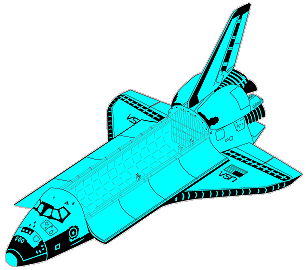 |
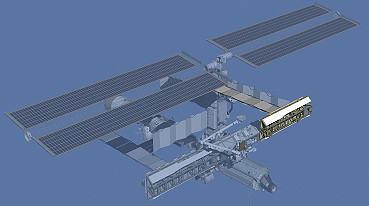 |
 |
 |
 |
 |
 |
 |
 |
 |
 |
 |
 |
 |
 |
 |
more EVA photos |
|
| © |  |
Last update on March 27, 2020.  |
 |