Human Orbital Spaceflights

International Flight No. 232Soyuz TMA-1Soyuz TM-34YeniseiRussia |
 |
 |
Launch, orbit and landing data
walkout photo |
 |
|||||||||||||||||||||||||||||||
original crew photo |
alternative crew photo |
|||||||||||||||||||||||||||||||
alternative crew photo |
||||||||||||||||||||||||||||||||
alternative crew photo |
||||||||||||||||||||||||||||||||
Crew
| No. | Surname | Given names | Position | Flight No. | Duration | Orbits | |
| 1 |  |
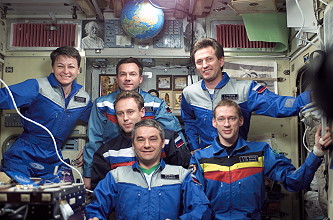
Zalyotin | Sergei Viktorovich | Commander | 2 | 10d 20h 53m 09s | 171 |
| 2 |  |
De Winne | Frank Luc | Flight Engineer | 1 | 10d 20h 53m 09s | 171 |
| 3 | |
Lonchakov | Yuri Valentinovich | Flight Engineer | 2 | 10d 20h 53m 09s | 171 |
Crew seating arrangement
|
 |
|
||||||||||||||||
Backup Crew
|
 |
|||||||||||||||
Hardware
| Launch vehicle: | Soyuz-FG (No. 3M132S E15000-004) |
| Spacecraft: | Soyuz TMA-1 (TMA No. 211) |
Flight
|
Launch from the Baikonur Cosmodrome and
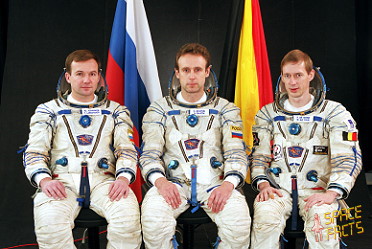
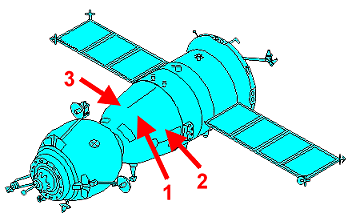
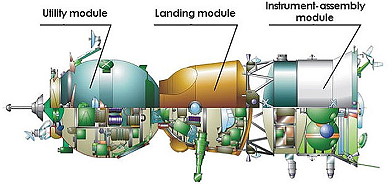
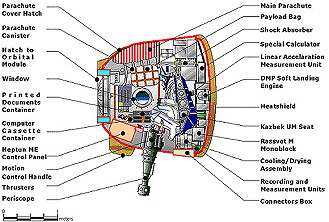
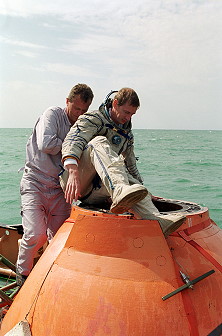
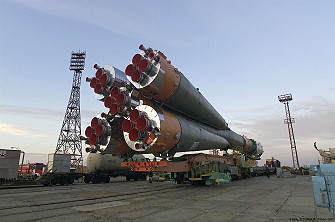
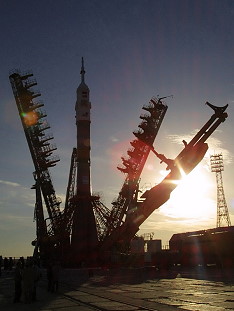
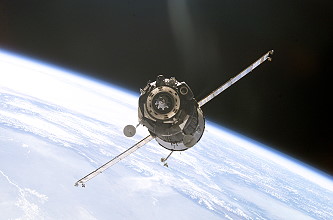
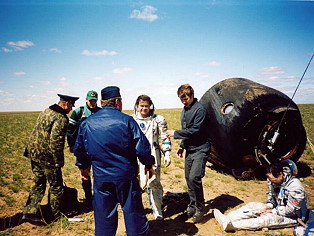
landing 405 km west of Arkalyk. In the spring of 2001, a taxi mission to the space station was being scheduled to take place on October 2002. At first the crew was to be Commander Sergei Zalyotin and Flight Engineer Frank De Winne. However, a report released on February 2002 stated that American musician Lance Bass was interested in joining the crew for a one-week mission on board the Russian spacecraft. The mission began to fall through, and by September 2002 they had discontinued the training of Lance Bass due to the mission organizers' failure to meet the terms of the contract. They filled the vacant seat left by Lance Bass with Russian cosmonaut Yuri Lonchakov. Soyuz TMA-1 became the fourth taxi crew to the ISS. Following a two-day solo flight Soyuz TMA-1 docked to ISS on November 01, 2002 and common scientific work with expedition 5 was performed. Frank De Winne worked as part of the ESA program Odissea. The ISS' escape craft (Soyuz TM-34) was replaced; Soyuz TMA-1 served as a new lifeboat. While the Soyuz TMA-1 was on orbit, the February 2003 Columbia shuttle accident occurred and required a change in crew changeout process. The Soyuz system would now be the sole method for crew to launch to and return from ISS, until the space shuttle was returned to service in July 2005. The Soyuz spacecraft is composed of three elements attached end-to-end - the Orbital Module, the Descent Module and the Instrumentation/Propulsion Module. The crew occupied the central element, the Descent Module. The other two modules are jettisoned prior to re-entry. They burn up in the atmosphere, so only the Descent Module returned to Earth. The deorbit burn lasted 258.1 seconds. Having shed two-thirds of its mass, the Soyuz reached Entry Interface - a point 400,000 feet (121.9 kilometers) above the Earth, where friction due to the thickening atmosphere began to heat its outer surfaces. With only 23 minutes left before it lands on the grassy plains of central Asia, attention in the module turned to slowing its rate of descent. Eight minutes later, the spacecraft was streaking through the sky at a rate of 755 feet (230 meters) per second. Before it touched down, its speed slowed to only 5 feet (1.5 meter) per second, and it lands at an even lower speed than that. Several onboard features ensure that the vehicle and crew land safely and in relative comfort. Four parachutes, deployed 15 minutes before landing, dramatically slowed the vehicle's rate of descent. Two pilot parachutes were the first to be released, and a drogue chute attached to the second one followed immediately after. The drogue, measuring 24 square meters (258 square feet) in area, slowed the rate of descent from 755 feet (230 meters) per second to 262 feet (80 meters) per second. The main parachute was the last to emerge. It is the largest chute, with a surface area of 10,764 square feet (1,000 square meters). Its harnesses shifted the vehicle's attitude to a 30-degree angle relative to the ground, dissipating heat, and then shifted it again to a straight vertical descent prior to landing. The main chute slowed the Soyuz to a descent rate of only 24 feet (7.3 meters) per second, which is still too fast for a comfortable landing. One second before touchdown, two sets of three small engines on the bottom of the vehicle fired, slowing the vehicle to soften the landing. Soyuz TMA-1 disembarked from ISS on May 04, 2003 and immediately began its return to Earth, marking the first entry and descent for this Soyuz class. A technical malfunction caused the Soyuz control system to abandon the gentler controlled entry and descent and instead fall back to the harsher ballistic reentry and descent. This resulted in a steep and off target landing of the spacecraft. The craft landed 300 miles (483 km) short of the planned area, and the crew was subjected to severe gravitational loads. Communication with the Soyuz was lost because one antenna was ripped off during descent, and two more did not deploy. The crew regained communications through an emergency transmitter after landing. Due to this event, future crews would be provided with a satellite phone at their disposal to establish contact with recovery forces. Subsequent Soyuz TMA missions were able to successfully execute controlled reentries, until the Soyuz TMA-10 and Soyuz TMA-11 missions which both also reverted to ballistic descents. |
Photos / Graphics
 |
 |
|
source of all photos is Roscosmos / NASA / ESA |
|
 |
 |
 |
 |
 |
 |
 |
| © |  |
Last update on August 13, 2020.  |
 |