Human Orbital Spaceflights

International Flight No. 53Soyuz 18KavkazUSSR |
 |
 |
 |
||
Launch, orbit and landing data
walkout photo |
 |
|||||||||||||||||||||||
alternative crew photo |
alternative crew photo |
|||||||||||||||||||||||
alternative crew photo |
||||||||||||||||||||||||
alternative crew photo |
||||||||||||||||||||||||
Crew
| No. | Surname | Given names | Position | Flight No. | Duration | Orbits | |
| 1 |  |
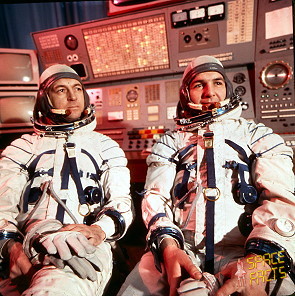
Klimuk | Pyotr Iliyich | Commander | 2 | 62d 23h 20m 08s | 993 |
| 2 | |
Sevastiyanov | Vitali Ivanovich | Flight Engineer | 2 | 62d 23h 20m 08s | 993 |
Crew seating arrangement
|
 |
|
||||||||||||
Backup Crew
|
 |
Hardware
| Launch vehicle: | Soyuz (No. F15000-33) |
| Spacecraft: | Soyuz 18 (7K-T No. 40) |
Flight
|
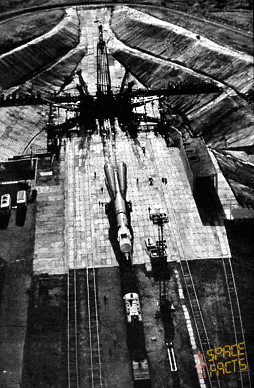
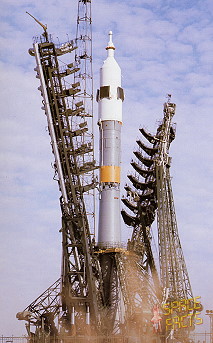
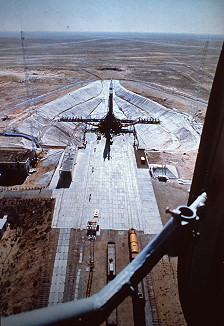
Launch from the Baikonur Cosmodrome and
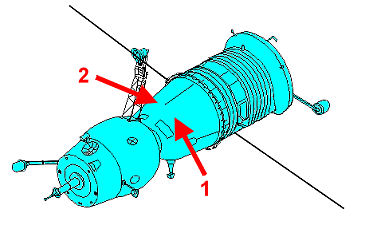
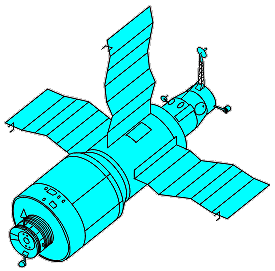
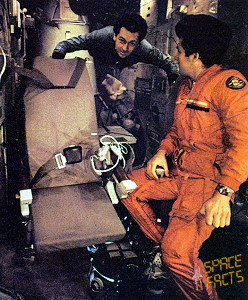
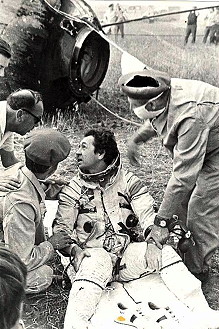
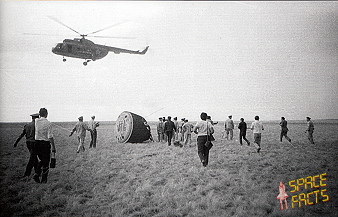
landing 56 km east of Arkalyk. The crew was originally the backup crew for Soyuz 18A crew, but the launch of this mission had failed. Following a one-day solo flight Soyuz 18 docked with Salyut 4 on May 25, 1975. The cosmonauts became the second crew of space station Salyut 4. They stayed 62 days onboard. For that reason, the focus of the mission research into long-term stays in space, with the crew performing various biomedical experiments (including intensive physically exercise) and growing plants in orbit. They also made solar observations and took photos of the Earth's surface. A spectrometer was repaired, a gas analyzer was replaced, and a pumping condenser in the water regeneration system was switched with a hand pump. On May 29, 1975 and May 30, 1975, biological and medical experiments were performed and the Oasis garden was started. Studies of the stars, planets, Earth and its atmosphere were started on June 02, 1975 and June 03, 1975. Some 2,000 photographs of the Earth and 600 of the sun were reported taken. More medical experiments were performed in June 1975, and attempts were made to grow plants, including onions. Experiments were carried out on insects, and experiments on varying the work schedule were carried out. On July 03, 1975, it was announced that the mission would last beyond the upcoming Apollo-Soyuz Test Project (ASTP). To avoid any conflict of resources, the Soyuz 18 crew was controlled from the old Crimean Control Center, while the ASTP Soyuz 19 mission would be controlled from the Kaliningrad Control Center. The Crimean center had not been used since the Soyuz 12 flight. This was the first time the Soviets had to control two unrelated space missions. The crew remained aloft aboard the station during the ASTP joint flight. The Salyut living conditions were starting to degrade by July 1975, with the environmental control system failing, windows fogged over and green mold growing on the station walls. The crew donned exercise suits and increased their exercise period to over two hours a day, and on July 18, 1975 began to prepare the station for unmanned flight. Soyuz craft was activated on July 24, 1975 and the crew returned to earth two days later. The Soviets televised the landing, in keeping with the openness brought along by the ASTP flights. The Soyuz spacecraft is composed of three elements attached end-to-end - the Orbital Module, the Descent Module and the Instrumentation/Propulsion Module. The crew occupied the central element, the Descent Module. The other two modules are jettisoned prior to re-entry. They burn up in the atmosphere, so only the Descent Module returned to Earth. The deorbit burn lasted 188 seconds. Having shed two-thirds of its mass, the Soyuz reached Entry Interface - a point 400,000 feet (121.9 kilometers) above the Earth, where friction due to the thickening atmosphere began to heat its outer surfaces. With only 23 minutes left before it lands on the grassy plains of central Asia, attention in the module turned to slowing its rate of descent. Eight minutes later, the spacecraft was streaking through the sky at a rate of 755 feet (230 meters) per second. Before it touched down, its speed slowed to only 5 feet (1.5 meter) per second, and it lands at an even lower speed than that. Several onboard features ensure that the vehicle and crew land safely and in relative comfort. Four parachutes, deployed 15 minutes before landing, dramatically slowed the vehicle's rate of descent. Two pilot parachutes were the first to be released, and a drogue chute attached to the second one followed immediately after. The drogue, measuring 24 square meters (258 square feet) in area, slowed the rate of descent from 755 feet (230 meters) per second to 262 feet (80 meters) per second. The main parachute was the last to emerge. It is the largest chute, with a surface area of 10,764 square feet (1,000 square meters). Its harnesses shifted the vehicle's attitude to a 30-degree angle relative to the ground, dissipating heat, and then shifted it again to a straight vertical descent prior to landing. The main chute slowed the Soyuz to a descent rate of only 24 feet (7.3 meters) per second, which is still too fast for a comfortable landing. One second before touchdown, two sets of three small engines on the bottom of the vehicle fired, slowing the vehicle to soften the landing. After the landing the cosmonauts exited the capsule under their own power, but it was two days before Pyotr Klimuk could take a 10-minute walk, and a week before he made a full recovery. |
Photos / Graphics
 |
 |
 |
 |
 |
 |
 |
 |
| © |  |
Last update on March 28, 2020.  |
 |