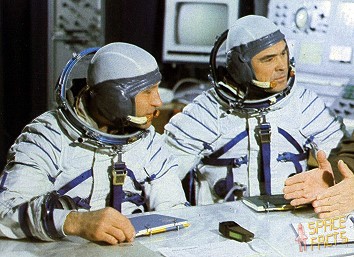
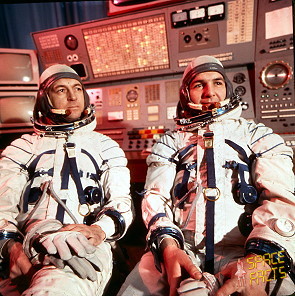
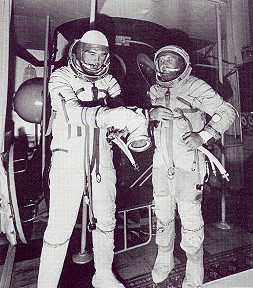
Launch from Baikonur.
Soyuz 18A was intended to be the second mission to
take cosmonauts to the Soviet
Salyut 4 space station for a 60-day
mission.
The launch proceeded according to plan until T+288.6 seconds at
an altitude of 145 kilometers (90 mi), when the second and third stages of the
booster began separation. Only three of the six locks holding the stages
together released and the third stage's engine ignited with the second stage
still attached below it. The third stage's thrust broke the remaining locks,
throwing the second stage free but putting the booster under unanticipated
strain that caused it to deviate from the proper trajectory. At T+295 seconds,
the deviation was detected by the
Soyuz's guidance system, which activated an automatic
abort program. As the escape tower was long gone by this point, the abort had
to be performed with the
Soyuz's own engines. This separated the spacecraft
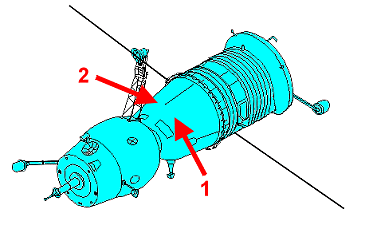
from the third stage booster and then separated the orbital and service modules
of the
Soyuz from the re-entry capsule.
At the time
when the safety system initiated separation the spacecraft was already pointed
downward toward Earth, which accelerated its descent significantly. Instead of
the expected acceleration in such an emergency situation of 15 g (147
m/s²), the cosmonauts experienced up to 21.3 g (209 m/s²). Despite
very high overloading, the capsule's parachutes opened properly and slowed the
craft to a successful landing after a flight of only 21 minutes.
The
capsule landed southwest of Gorno-Altayska (50°50' N, 83°25' E). The
capsule landed on a snow-covered slope and began rolling downhill towards a 152
m (499 ft) sheer drop before it was stopped by the parachutes' becoming snagged
on vegetation.
Having landed in chest-deep powder snow and a local
temperature of -7 °C (19 °F), the cosmonauts donned their cold-weather
survival clothing. As the cosmonauts were uncertain if they had landed in
China, they quickly destroyed documents relating to a military experiment
planned for the flight (this was at a time when Sino-Soviet relations were
extremely hostile). Soon, the crew was in radio contact with a rescue team in
an approaching helicopter, who confirmed their landing point was in the Soviet
Union, near the town of Aleysk. The deep snow, the high altitude, and the
terrain meant the rescuers had great difficulty in making contact with the
cosmonauts. It was the next day before they were safely air-lifted
out.
Initial Soviet reports stated the men had suffered no ill effects
from their flight. Vladimir
Shatalov, the Director of Cosmonaut Training, reported they
were fit to fly another mission. However, subsequent reports claimed that
Vasili
Lazarev was injured by the high acceleration of re-entry.
The
Soyuz 18A flight has been the only case of a manned
booster accident at high altitude until the
Soyuz MS-10
flight on October 11, 2018. The exact landing site of the capsule had been a
subject of debate amongst space historians in subsequent years.