Besatzungen der ISS

ISS: Expedition 10 |
 |
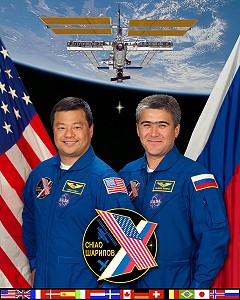
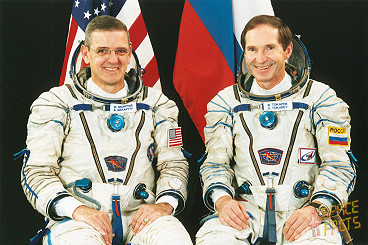
hochauflösende Version (805 KB) alternatives Crewfoto |
 |
 |
|
 |
|
Besatzung, Start- und Landedaten
| Nr. | Nation | Name | Vorname | Position | Raumschiff (Start) |
Startdatum | Startzeit | Raumschiff (Landung) |
Landedatum | Landezeit | Flugdauer | Erdorbits |
| 1 |  |
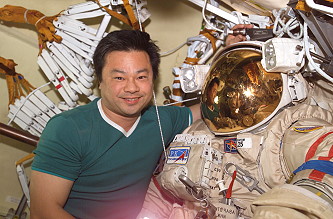
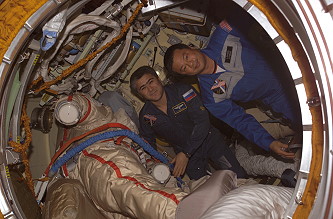
Chiao | Leroy | ISS-CDR | Sojus TMA-5 | 14.10.2004 | 03:06:27,898 UTC | Sojus TMA-5 | 24.04.2005 | 22:08:27,2 UTC | 192d 19h 01m 59s | 3032 |
| 2 |  |
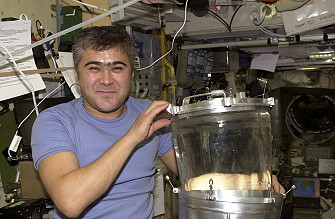
Scharipow | Salishan Schakirowitsch | Bordingenieur | Sojus TMA-5 | 14.10.2004 | 03:06:27,898 UTC | Sojus TMA-5 | 24.04.2005 | 22:08:27,2 UTC | 192d 19h 01m 59s | 3032 |
Ersatzmannschaft bzw. Double Crew
| Nr. | Nation | Name | Vorname | Position |
| 1 | |
McArthur | William Surles, Jr. "Bill" | ISS-CDR |
| 2 | |
Tokarew | Waleri Iwanowitsch | Bordingenieur |
 |
 |
Expeditionsverlauf
|
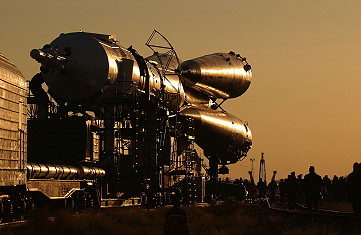
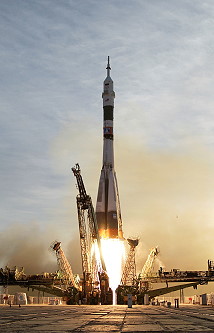
Sojus TMA-5 startete vom Kosmodrom Baikonur und landete 85 km
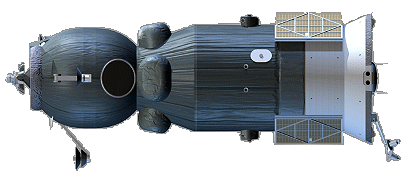
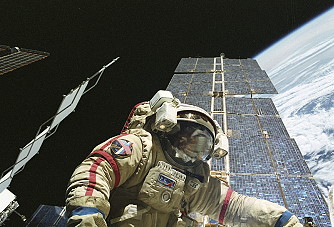
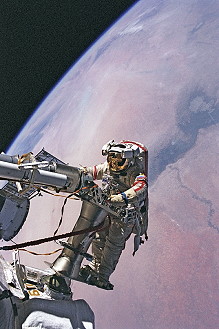
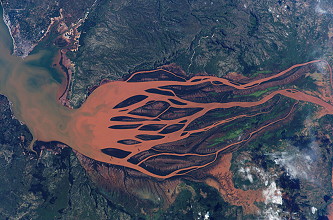
nordöstlich von Arkalyk. Offiziell begann die Expedition 10 mit der Abkopplung des russischen Raumschiffs Sojus TMA-4 am 23. Oktober 2004 um 21:08:22 UTC. Gleichzeitig war damit die Expedition 9 beendet. Es war die ISS Expedition 10. Die Mannschaft wurde auch als "Caretaker"-Crew bezeichnet. Nach zweitägigem Alleinflug koppelte Sojus TMA-5 am 16. Oktober 2004 an die ISS an. Es folgte die Ablösung der bisherigen Stammbesatzung. 17 neue Experimente wurden während dieser Mission seitens der NASA durchgeführt. Dazu gehörten die Fertigstellung der In Space Soldering Investigation (ISS), ein Löt-Experiment, das bereits seit der siebten Stammbesatzung lief, und erste Arbeiten mit dem DAFT-Experiment. Leroy Chiao benutzte am 08. November 2004 das Greifsystem der Station dazu, das Labormodul Destiny auf Schäden zu inspizieren. Die Kameras des SSRMS Canadarm2 bildeten die während der Shuttle-Mission STS-113 bemerkten Schäden ab, die aber offenbar nicht durch Mikrometeoriten oder Weltraumtrümmer verursacht wurden. Am 17. November 2004 wurde die Umlaufbahn der ISS durch eine Antriebsphase des am Heck angekoppelten Frachtraumschiffs Progress M-50 angehoben. Am 24. November 2004 wurde der Status der Triebwerke von Sojus TMA-5 überprüft. Dies war notwendig, da das Raumschiff am 29. November 2004 zum Kopplungsstutzen von Sarja umgesetzt wurde. Der Flug dauerte etwa 20 Minuten. Zuvor waren einige Systeme der Station in einen automatischen Betriebsmodus versetzt oder deaktiviert worden. Dies geschah für den Fall, dass ein Wiederankoppeln nicht gelungen wäre. Die Raumfahrer ersetzten kritische Hardware an der Quest Joint Airlock, reparierten die US-amerikanischen Raumanzüge und führten Untersuchungen zu Ultraschall im Weltraum aus. Leroy Chiao nahm als erster Astronaut an den US-Präsidentschaftswahlen 2004 vom All aus teil. Der unbemannte russische Frachter Progress M-51 legte am 25. Dezember 2004 um 23:57:45 UTC an der Internationalen Raumstation an. Er war am 23. Dezember 2004 um 22:19:34 UTC vom Kosmodrom Baikonur gestartet. Das Transport-Raumschiff brachte Ausrüstungsgegenstände einschließlich Lebensmittel, Wasser, Sauerstoff und wissenschaftliche Experimente zur Stammbesatzung. Am 27. Februar 2005 um 16:06:30 UTC koppelte Progress M-51 wieder ab und wurde noch einige Tage für Tests verwendet. Der Frachter wurde kontrolliert zum Absturz gebracht und verglühte am 09. März 2005 über dem Pazifischen Ozean. Am 01. Januar 2005 traten erneut Probleme mit dem Sauerstoffgenerator Elektron auf. Während der Reparaturarbeiten wurde die Atmosphäre der ISS zeitweise mit Sauerstoff aus Progress M-51 aufgefüllt. Am 15. Januar 2005 wurde in Vorbereitung auf die Ankunft des nächsten Frachters eine erneute Bahnanhebung des Orbitalkomplexes ausgeführt. Zum wissenschaftlichen Programm gehörten Experimente zur Medizin, Erdbeobachtung, Biologie, Materialwissenschaft und Raumfahrttechnologie. Ohne zusätzlichen Materialaufwand liefen Untersuchungen zu natürlichen und vom Menschen verursachten Phänomenen auf der Erde und in der Erdatmosphäre (Experimente: Crew Earth Observation, ESTER, Biotomeja, Uragan, Molnija SM), zu Strukturen auf der Erdoberfläche durch die Fernbedienung einer Stationskamera durch Schülergruppen auf der Erde (EarthKAM), zur Zusammenarbeit zwischen Stations- und Bodencrew (Crew Interactions), zu Strahlungs- und Beschleunigungsmessungen innerhalb der Station (Radiation Monitoring, Prognos, BraDos, MAMS, SAMS) sowie verschiedene außenbords angebrachte Materialtests (Kromka, MPAC, SEED, MISSE, Meteoroid) ab. Die erste EVA durch Leroy Chiao und Salishan Scharipow erfolgte am 26. Januar 2005 (5h 30m) zur Installation einer Arbeitsplatte auf dem Servicemodul Swesda und auf dieser wiederum eines Experimentes. Anschließend montierten die Raumfahrer eine Antenne und setzten die Experimente MPC und SEED, mit denen Mikrometeoriten und Trümmerreste aus der Erdumlaufbahn gesammelt sowie verschiedene Materialien den Bedingungen des Weltraums ausgesetzt wurden, an der Außenseite von Swesda um. Danach inspizierten Leroy Chiao und Salishan Scharipow Auslässe des Sauerstoffgeneratorsystems Elektron und des Kohlenstoffdioxydabsorbers Wosduch, um Erklärungen für die immer wieder auftretenden Schwierigkeiten der Systeme zu ermitteln. Abschließend installierten sie ein Materialexperiment an der Luftschleuse Pirs. Weitere Arbeiten betrafen die Vorbereitung von Materialien für den Rücktransport zur Erde, die Inventarisierung neuer Materialien und Versorgungsgüter, die Entsättigung der Lageregelungsgyroskope sowie weitere Wartungs- und Reinigungsprozesse. Am 09. Februar 2005 wurde der Sauerstoffgenerator im russischen Servicemodul erneut abgeschaltet, während Sauerstoff aus Gastanks des Frachters Progress M-51 in die Station abgelassen wurde. Außerdem wurde Treibstoff in die Tanks des Moduls Sarja umgepumpt. Am 27. Februar 2005 wurde Progress M-51 von der ISS abgekoppelt, verblieb für ein Plasmaexperiment aber bis zum 09. März 2005 im Orbit. Der unbemannte russische Frachter Progress M-52 legte am 02. März 2005 um 20:10:08 UTC an der Internationalen Raumstation an. Er war am 28. Februar 2005 um 19:09:18 UTC vom Kosmodrom Baikonur gestartet. Das Transport-Raumschiff brachte Versorgungs- und Ausrüstungsgegenstände wie Lebensmittel, Wasser, Sauerstoff und den Nanosatelliten TNS-0 zur Stammbesatzung. Am 15. Juni 2005 um 20:16:10 UTC koppelte Progress M-52 wieder ab. Der Frachter wurde kontrolliert zum Absturz gebracht und verglühte am gleichen Tag über dem Pazifischen Ozean. Die durch den am 28. Februar 2005 gestarteten Frachter Progress M-52 gelieferten Wärmetauscher wurden durch Leroy Chiao im US-Schleusenmodul Quest installiert, um wieder Außenbordeinsätze mit amerikanischen Raumanzügen zu ermöglichen. Am 16. März 2005 wurde die Energiezufuhr zum Lageregelungsgyroskop 2 aufgrund des Ausfalles einer Energiefernsteuerungseinheit erneut unterbrochen. Ein derartiges Steuerungsmodul war bereits im April 2004 ausgefallen und während eines Außenbordeinsatzes im Juni ausgetauscht worden. Die Steuerungseinheit wurde später einfach überbrückt. Nach dem Austausch des bereits 2002 ausgefallenen Gyroskopes Nummer 1 funktionierte das aus vier Einheiten bestehende System später wieder komplett. Die zweite und letzte EVA durch Leroy Chiao und Salishan Scharipow wurde am 28. März 2005 (4h 30m) zur Installation von drei Kommunikations-Antennen für das ATV (Automated Transfer Vehicle) und einer GPS (Global Positioning System) Antenne unternommen. Salishan Scharipow setzte manuell ein russisches Experiment mit dem kleinen wissenschaftlichen Satelliten "NanoSputnik" in den Orbit aus. Der Kleinsatellit hatte eine Masse von etwa 5 Kilogramm und fungierte als Testboje für das weltweite Notsignalsystem Kospas-Sarsat. Nach etwa 2 Monaten verglühte er in der Erdatmosphäre. In ihren Raumanzügen hatten die Kosmonauten für die Rückkehr zur Erde ihre Plätze im Landemodul eingenommen, nachdem sie die Luke zur Orbitalsektion geschlossen hatten. Dann richteten sie das Raumschiff so aus, das die Triebwerke des Geräteteils in Flugrichtung zeigten. Diese wurden kurz darauf für 105,6 Sekunden gezündet und leiteten den Abstieg zur Erdoberfläche ein. Im nächsten Schritt erfolgte das planmäßige Abtrennen der Orbitalsektion und des Geräteteils, die beide in der Erdatmosphäre verglühten. Das verbleibende Landemodul wurde so ausgerichtet, dass der Eintrittswinkel für eine möglichst genaue Landung in Kasachstan erreicht wurde. Nach dem Eintritt in die Erdatmosphäre brach der Funkkontakt wegen der heißen Plasmagase rund um die Kapsel ab. Dann löste sich der Deckel des Fallschirmbehälters und der Bremsfallschirm wurde ausgestoßen. Nachdem auch der Hitzeschutzschild abgetrennt worden war, schwebte die Sojus an ihrem Hauptfallschirm Richtung Erdboden. Kleine Feststoff-Bremsraketen, die kurz vor dem Berühren des Bodens ausgelöst worden waren, verminderten die Aufprallgeschwindigkeit. Sofort nach der erfolgreichen Landung wurden die Fallschirmleinen gekappt, damit die Kapsel nicht durch den Wind über den Boden gezogen werden konnte. Nach der Landung gehört es zum Ritual, dass die Kosmonauten das Raumschiff mit ihrer Unterschrift versehen. Am 17. April 2005 brachte das russische Raumschiff Sojus TMA-6 die Expedition 11 zur ISS. Gegen Ende der Mission übertrug der amerikanische Astronaut Leroy Chiao das Kommando über die Station an den russischen Kosmonauten Sergej Krikaljow. Mit der Abkopplung von Sojus TMA-5 am 24. April 2005 um 18:44:40 UTC endete offiziell die Expedition 10 und die ISS Expedition 11 begann. Während ihres Aufenthaltes an Bord der ISS führte die Crew der Expedition 10 folgende wissenschaftliche Experimente durch (vollständige Auflistung): ADUM (Advanced Diagnostic Ultrasound in Microgravity), ARISS (Amateur Radio on the International Space Station), BCAT-3-4-CP (Binary Colloidal Alloy Test - 3 and 4: Critical Point), BCAT-3-SC (Binary Colloidal Alloy Test - 3: Surface Crystallization), Biodegradation (Initial stage of Biodegradation and Biodeterioration in Space), Bioekologia (Generation of High Efficiency of Microorganisms for the Production of Preparations of Biodegradable Oil, Organophosphorus Material, Measures for the Protection of Plants, as well as, of Exopolysaddharides Uses in the Petroleum Industry), Bioemulsia (Research and Development of a Self-Contained Reactor of the Shielded Type For Production of Biomass of Microorganisms and Biologically Active Substances), Biopsy (Effect of Prolonged Space Flight on Human Skeletal Muscle), Biorisk (Influence of Factors of the Space Environment on the Condition of the System of Microorganisms-Hosts Relating to the Problem of Environmental Safety of Flight Techniques and Planetary Quarantine), Biotest (Biochemical Status of Humans in Long Duration Space Flight), BOP (Bone Proteomics), Brados (Acquisition of Data About the Radiological, Electromagnetic and Different Physical Environments on Board ISS, and Their Effects on the Safety of the Crew, Space Equipment and Materials), Cardio-ODNT (Dynamics of the Main Factors of Cardiac Function, of Central and Regional Circulation in Rest and During the Influence of Lower Body Negative Pressure), CBOSS-FDI (Cellular Biotechnology Operations Support Systems: Fluid Dynamics Investigation), CEO (Crew Earth Observations), Chromosome-1 (Chromosomal Aberrations in Blood Lymphocytes of Astronauts-1), Clinical Nutrition Assessment (Clinical Nutrition Assessment of ISS Astronauts, SMO-016E), Conjugation (Development of Methods for Designing New Recombinants Producing Strains of Bacteria in Space Flight), DAFT (Dust and Aerosol Measurement Feasibility Test), Diatomeya (Stability of Geographical Position and Configuration of Borders of Bioproductive Water Zones of the World Oceans, Observations by Orbition Station Crews), Diurez (Fluid and Electrolyte Metabolism and Hormonal Regulaltion of Fluid Volume), EarthKAM (Earth Knowledge Acquired by Middle School Students), Ekon (Experimental Survey on Evaluating the Possibility of Using th Russian Segment of ISS for Environmental Inspection of Work Areas of Various Facilities (Features)), Environmental Monitoring (Environmental Monitoring of the International Space Station), EPO-Demos (Education Payload Operation - Demonstrations), ETD (Eye Tracking Device), Farma (Characteristics of Pharmacological Responses (absorption, distribution and elimination of acetominophene) in Long Duration Space Flight), Fischer Rat Thyroid Low Serum 5 (Fischer Rat Thyroid Low Serum 5%), Gematologia (Morphofunctional Characteristic of Blood Cells and the Intensity of Erythropoiesis in Humans by the Influence of Factors of Space Flight), Identifikatsia (Identification of the Sources of Dynamic Loads on ISS), Inflight Education Downlinks (International Space Station Inflight Education Downlinks), Interleukin-K (Production of Hight Quality Crystals of Interleukin -1Alpha, -1Beta and Receptor of Antagonist of Interleukin-1), ISSI (In Space Soldering Investigation), ISS Acoustics (International Space Station Acoustic Measurement Program), JAXA-GCF (Japan Aerospace and Exploration Agency - Granada Crystallization Facility High Quality Protein Crystallization Project), Journals (Behavioral Issues Associated with isolation and Confinement: Review and Analysis of Astronaut Journals), Kromka (Verification of the Effectiveness of Devices for the Protection of the Exterior Surface of ISS from Contaminants Deposited by Pulsed Cycling of Liquid-Jet), Meteoroid (Recording Meteoroidal and Technogenic Particles on the External Surface of the Service Module of the Russian Segment of ISS), Mezhkletochnoe Vzaimodeistvie (Intercellular Interactions in Space Flight), MFMG (Miscible Fluids in Microgravity), Microspace (Microbial Life in Space: Response to Environmental Factors in a Space Vehicle), Mimetik-K (Crystalization of antigen Binding Fragment of Monoclonalical Antibody to Glucosaminilmuramildepeptide), MISSE-1 and 2 (Materials International Space Station Experiment - 1 and 2), Mobility (Promoting Sensorimotor Response Generalizability: A Countermeasure to Mitigate Locomotor Dysfunction After Long-Duration Space Flight), Molniya-SM (Investigation of Lightning Discharges in the Earth's Atmosphere and Lower Ionosphere), MOP (Motion Perception: Vestibular Adaptation to G-Transitions), OVAR (Off-Vertical Axis Rotation: Eye Movements and Motion Perception Induced By Off-Axis Rotation at Small Angles of Tilt After Spaceflight, DSO 499), PCG-STES-RGE (Protein Crystal Growth-Single Locker Thermal Enclosure System-Regulation of Gene Expression), PCG-STES-SA (Protein Crystal Growth-Single Locker Thermal Enclosure System-Science and Applications of Facility Hardware for Protein Crystal Growth), Pilot (Individual Characteristics of Psychophysiological Regulatory Status and Reliaility of Professional Activities of Cosmonauts in Long Duration Space Flight), Plasma Crystal (Dusty and Liquid Plasma Crystals in Conditions of Microgravity), Profilaktika (Mechanisms of Action and Influence, and Effectiveness of Various Methods of Phrophylaxis Directed Toward Prevention of Disturbances of the Human Locomotion System in Weightlessness), Prognoz (Development of a Method of Operational Prediction of Work Load on Crew Piloting Objectives), Pulse (Vegatative (Autonomic) Regulation of the Cardio-Respiratory System of Humans in Conditions of Weightlessness), Rastenia (Growth and Development of Higher Plants through Multiple Generations), Relaksatia (Processes of Relaxation in the Ultraviolet Band Spectrum by High Velocity Interaction of Exhaust Products on ISS), ROKVISS (Robotic Component Verification on the ISS: Verification of Lightweight Robotic Hinge Elements in Space), SEM (Space Experiment Module), SKR (Skorpion: Development and Acquisition of Multifunctional Control-Measurement Device for Controlling the Environment of Scientific Experiments Inside a Pressurized Station), SNFM (Serial Network Flow Monitor), Sprut-MBI (Determination of Intracellular and Extracellular Fluid Volume in Humans in Space Flight), SVS (CBC: Self-Propogating Hyperthermal Synthesis in Space), Toksichnost (Development of a Metod of Express Monitoring of Toxicity of Water in Space Flight), Uragan (Hurricane: Experimental Development of Groundbased System of Monitoring and Predicting the Progression of a Naturally Occurring Technogenic Catastrophe), Vaktsina-K (Structural Study of Protein Candidats in a Vaccine for AIDS on Earth and in Space). |
EVA-Daten
| Name | Beginn | Ende | Dauer | Mission | Schleuse | Anzug | Streifen | |
| EVA | Chiao, Leroy | 26.01.2005, 07:41 UTC | 26.01.2005, 13:11 UTC | 5h 30m | ISS-10 | ISS - Pirs | Orlan-M Nr. 25 | rot |
| EVA | Scharipow, Salishan | 26.01.2005, 07:41 UTC | 26.01.2005, 13:11 UTC | 5h 30m | ISS-10 | ISS - Pirs | Orlan-M Nr. 27 | rot |
| EVA | Chiao, Leroy | 28.03.2005, 06:25 UTC | 28.03.2005, 10:55 UTC | 4h 30m | ISS-10 | ISS - Pirs | Orlan-M Nr. 25 | rot |
| EVA | Scharipow, Salishan | 28.03.2005, 06:25 UTC | 28.03.2005, 10:55 UTC | 4h 30m | ISS-10 | ISS - Pirs | Orlan-M Nr. 27 | rot |
Umkopplungen bemannter Raumschiffe
| Raumschiff | von | Abkopplung | Zeit UTC | nach | Ankopplung | Zeit UTC |
| Sojus TMA-5 | ISS - Pirs | 29.11.2004 | 09:31:58 | ISS - Sarja | 29.11.2004 | 09:52:46 |
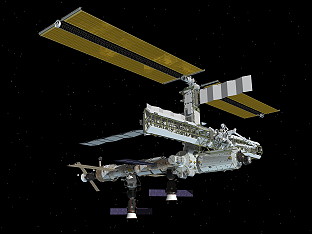
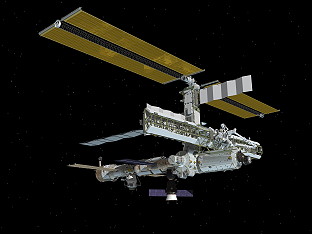
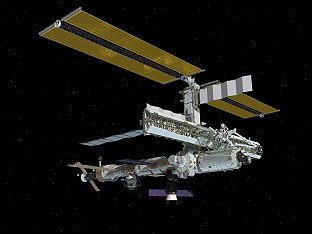
Aufbau der ISS
 |
 |
 |
Fotos / Grafiken
 |
 |
 |
 |
 |
 |
 |
 |
 |
 |
 |
 |
 |
|
mehr Fotos Erdbeobachtung |
|
mehr EVA-Fotos |
|
mehr Fotos von Bord der ISS |
|
| © |  |
Letztes Update am 15. Mai 2025.  |
 |