Human Orbital Spaceflights

International Flight No. 150STS-46Atlantis (12)49th Space Shuttle missionUSA |
 |
 |
 |
||
Launch, orbit and landing data
walkout photo |
 |
||||||||||||||||||||||||||||
alternative crew photo |
|||||||||||||||||||||||||||||
alternative crew photo |
|||||||||||||||||||||||||||||
alternative crew photo |
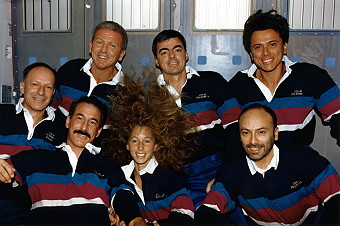
Crew
| No. | Surname | Given names | Position | Flight No. | Duration | Orbits | |
| 1 |  |
Shriver | Loren James | CDR | 3 | 7d 23h 15m 02s | 127 |
| 2 | |
Allen | Andrew Michael "Andy" | PLT | 1 | 7d 23h 15m 02s | 127 |
| 3 |  |
Nicollier | Claude | MS-1, RMS | 1 | 7d 23h 15m 02s | 127 |
| 4 | |
Ivins | Marsha Sue | MS-2, IV-1, FE | 2 | 7d 23h 15m 02s | 127 |
| 5 | |
Hoffman | Jeffrey Alan | MS-3, PLC, EV-1 | 3 | 7d 23h 15m 02s | 127 |
| 6 | |
Chang-Diaz | Franklin Ramon | MS-4, EV-2 | 3 | 7d 23h 15m 02s | 127 |
| 7 |  |
Malerba | Franco Egidio | PS-1 | 1 | 7d 23h 15m 02s | 127 |
Crew seating arrangement
|
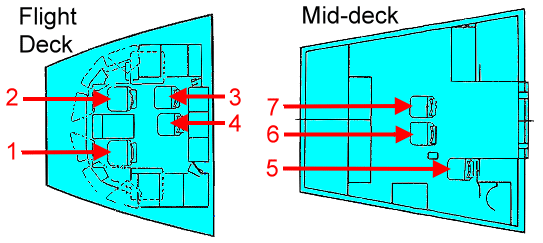 |
|
||||||||||||||||||||||||||||||||
Backup Crew
|
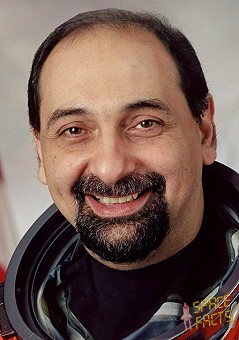 |
||||||||||
Hardware
| Orbiter : | OV-104 (12.) |
| SSME (1 / 2 / 3): | 2032 (1.) / 2033 (1.) / 2027 (8.) |
| SRB: | BI-052 / RSRM 25W |
| ET: | ET-48 (LWT-41) |
| OMS Pod: | Left Pod 01 (18.) Right Pod 01 (18.) |
| FWD RCS Pod: | FRC 4 (12.) |
| RMS: | 201 (9.) |
| EMU: | EMU No. 2018 (PLSS No. 1014) / EMU No. 2021 (PLSS No. 1011) |
Flight
|
Launch from Cape Canaveral (KSC) and
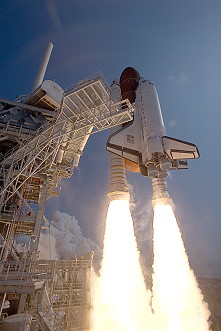
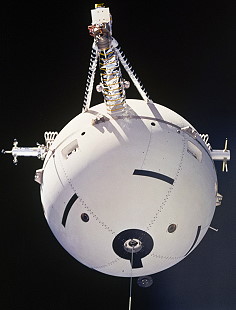
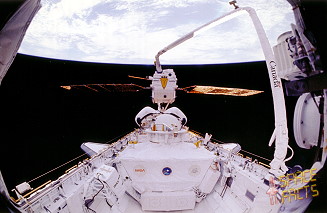
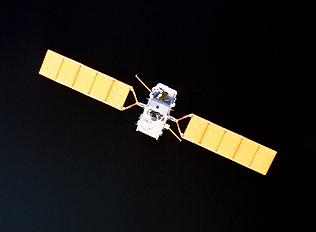
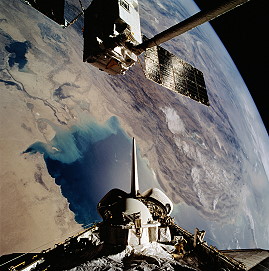
landing on Cape Canaveral (KSC), Runway 33. Mission's primary objectives were the deployment of ESAs EURECA (European Retrievable Carrier) with 70 experiments onboard and the joint NASA/Italian Space Agency Tethered Satellite System (TSS). The first mission (EURECA-1) primarily was devoted to research in the fields of material and life sciences and radiobiology, all of which require a controlled microgravity environment. The selected microgravity experiments were carried out in seven facilities. The remaining payload comprises space science and technology. During the first mission, EURECA's residual carrier accelerations were not exceeding 10-5g. The platform's altitude and orbit control system made use of magnetic torquers augmented by cold gas thrusters to keep disturbance levels below 0.3 Nm during the operational phase. The EURECA structure was made of high strength carbon-fiber struts and titanium nodal points joined together to form a framework of cubic elements. This provided relatively low thermal distortions, allowed high alignment accuracy and simple analytical verification, and was easy to assemble and maintain. Larger assemblies were attached to the nodal points. Instruments weighing less than 100 kg are assembled on standard equipment support panels similar to those on a Spacelab pallet. Thermal control for EURECA combined active and passive heat transfer and radiation systems. Active transfer, required for payload facilities which generated more heat, is achieve by means of a Freon cooling loop which dissipates the thermal load through two radiators into space. The passive system made use of multi-layer insulation blankets combined with electrical heaters. During nominal operations, the thermal control subsystem rejected a maximum heat load of about 2300 w. The electrical power subsystem generated stores, conditions and distributes power to all the spacecraft subsystems and to the payload. The deployable and retractable solar arrays, with a combined raw power output of some 5000 w together with four 40 amp-hour (Ah) nickel-cadmium batteries, provided the payload with a continuous power of 1000 w, nominally at 28 volts, with peak power capabilities of up to 1500 w for several minutes. While EURECA was in the cargo bay, electric power was provided by the Shuttle to ensure that mission critical equipment is maintained within its temperature limits. A modular attitude and orbit control subsystem (AOCS) was used for attitude determination and spacecraft orientation and stabilization during all flight operations and orbit control maneuvers. The AOCS had been designed for maximum autonomy. It ensured that all mission requirements were met even in case of severe on-board failures, including non-availability of the on-board data handling subsystem for up to 48 hours. An orbit transfer assembly, consisting of two redundant sets of four thrusters, was used to boost EURECA to its operation attitude at 515 km and to return it to its retrieval orbit at about 300 km. EURECA was three-axis stabilized by means of a magnetic torque assembly together with a nitrogen reaction control assembly (RCA). This specific combination of actuators was selected because its' control accelerations are well below the microgravity constraints of the spacecraft. The RCA cold gas system could be used during deployment and retrieval operations without creating any hazards for the Shuttle. EURECA remote control and autonomous operations were carried out by means of the data handling subsystem (DHS) supported by the telemetry and telecommand subsystems which provided the link to and from the ground segment. Through the DHS, instructions were stored and executed, telemetry data was stored and transmitted, and the spacecraft and its payload was controlled when EURECA was no longer "visible" from the ground station. EURECA contained several scientific experiments: The Solution Growth Facility (SGF) was a multi-user facility dedicated to the growth of monocrystals from solution, consisting of a set of four reactors and their associated control system. Three of the reactors were used for the solution growth of crystals. These reactors had a central buffer chamber containing solvent and two reservoirs containing reactant solutions. The reservoirs were connected to the buffer chamber by valves which allowed the solutions to diffuse into the solvent and hence, to crystallize. The fourth reactor was divided into twenty individual sample tubes which contained different samples of binary organic mixtures and aqueous electrolyte solutions. This reactor was devoted to the measurement of the Soret coefficient, that was, the ratio of thermal to isothermal diffusion coefficient. The Protein Crystallization Facility (PCF) was a multi-user solution growth facility for protein crystallization in space. The object of the experiments was the growth of single, defect-free protein crystals of high purity and of a size sufficient to determine their molecular structure by x-ray diffraction. This typically requires crystal sizes in the order of a few tenths of a millimeter. The PCF contained twelve reactor vessels, one for each experiment. Each reactor, which was provided with an individually controlled temperature environment, had four chambers - one containing the protein, one containing a buffer solution and two filled with salt solutions. When the reactors had reached their operating temperatures, one of the salt solution chambers, the protein chamber and the buffer solution chamber were opened. Salt molecules diffused into the buffer chamber causing the protein solution to crystallize. At the end of the mission the second salt solution chamber was activated to increase the salt concentration. This stabilized the crystals and prevented them from dissolving when individual temperature control for the experiments ceased and the reactors were maintained at a common storage temperature. The Exobiology and Radiation Assembly (ERA) was a multi-user life science facility for experiments on the biological effects of space radiation. Our knowledge of the interaction of cosmic ray particles with biological matter, the synergism of space vacuum and solar UV, and the spectral effectiveness of solar UV on viability should be improved as a result of experiments carried out in the ERA. The ERA consisted of deployable and fixed experiment trays and a number of cylindrical stacks, known as Biostacks, containing biological objects such as spores, seeds or eggs alternatived with radiation and track detectors. An electronic service module also was included in the facility. The deployable trays carried biological specimens which were exposed to the different components of the space radiation environment for predetermined periods of time. The duration of exposure was controlled by means of shutters and the type of radiation is selected by the use of optical bandpass filters. The Multi-Furnace Assembly (MFA) was a multi-user facility dedicated to material science experiments. It was a modular facility with a set of common system interfaces which incorporates twelve furnaces of three different types, giving temperatures of up to 1400 degrees C. Some of the furnaces were provided by the investigators on the basis of design recommendations made by ESA. The remainder was derived from furnaces flown on other missions, including some from sounding rocket flights. These were being used on EURECA after the necessary modifications and additional qualification. The experiments were performed sequentially with only one furnace operating at any one time. The Automatic Mirror Furnace (AMF) was an optical radiation furnace designed for the growth of single, uniform crystals from the liquid or vapor phases, using the traveling heater or Bridgman methods. The principal component of the furnace was an ellipsoidal mirror. The experimental material was placed at the lower ring focus of the mirror and heated by radiation from a 300-w halogen lamp positioned at the upper focus. Temperatures of up to 1200 degrees C can be achieved, depending on the requirements of individual samples. Seven lamps are available and up to 23 samples can be processed in the furnace. The Surface Forces Adhesion instrument (SFA) has been designed to study the dependence of surface forces and interface energies on physical and chemical-physical parameters such as surface topography, surface cleanliness, temperature and the deformation properties of the contacting bodies. The SFA experiment aimed at refining current understanding of adhesion-related phenomena, such as friction and wear, cold welding techniques in a microgravity environment and solid body positioning by means of adhesion. Very high vacuum dynamic measurements must be performed in microgravity conditions because of the extreme difficulty experienced on Earth in controlling the physical parameters involved. As a typical example, the interface energy of a metallic sphere of 1 g mass contacting a pane target would be of the order of 10-3 erg. corresponding to a potential gravitational energy related to a displacement of 10-5 mm. In the same experiment performed on the EURECA platform, in a 10 to 100,000 times lower gravity environment, this energy corresponded to a displacement of 1 mm, thus considerably improving measurements and reducing error margins. The High Precision Thermostat (HPT) was an instrument designed for long term experiments requiring microgravity conditions and high precision temperature measurement and control. Typical experiments were "caloric", "critical point" or "phase transition" experiments, such as the "Adsorption" experiment designed for the EURECA mission. This experiment studied the adsorption of Sulphur Hexafluoride (SF6), close to its critical point (Tc=45.55 degrees C, pc=0.737 g/cm³) on graphitized carbon. A new volumetric technique was used for the measurements of the adsorption coefficient at various temperatures along the critical isochore starting from the reference temperature in the one-phase region (60x) and approaching the critical temperature. The results will be compared with 1g measurements and theoretical predictions. The Solar Constant and Variability Instrument (SOVA) was designed to investigate the solar constant, its variability and its spectral distribution, and measure: fluctuations of the total and spectral solar irradiance within periods of a few minutes up to several hours and with a resolution of 10-6 to determine the pressure and gravity modes of the solar oscillations which carry information on the internal structure of the sun; short-term variations of the total and spectral solar irradiance within time scales ranging from hours to few months and with a resolution of 10-5 for the study of energy redistribution in the solar convection zone. These variations appear to be associated with solar activities (sun spots); long-term variations of the solar luminosity in the time scale of years (solar cycles) by measuring the absolute solar irradiance with an accuracy of better than 0.1 percent and by comparing it with previous and future measurements on board Spacelab and other space vehicles. This is of importance for the understanding of solar cycles and is a basic reference for climatic research. The Solar Spectrum Instrument (SOSP) has been designed for the study of solar physics and the solarterrestrial relationship in aeronomy and climatology. It measured the absolute solar irradiance and its variations in the spectral range from 170 to 3200 n.m., with an expected accuracy of 1 percent in the visible and infrared ranges and 5 percent in the ultraviolet range. Changes in the solar irradiance mainly relate to the short-term solar variations that have been observed since 1981 by the Solar Maximum spacecraft, the variations related to the 27-day solar rotation period and the long-term variations related to the 11-year sun cycles. While the short term variations can be measured during one single EURECA flight mission, two or three missions are needed to assess the long term variations. The Occultation Radiometer instrument (ORA) was designed to measure aerosols and trace gas densities in the Earth's mesosphere and stratosphere. The attenuation of the various spectral components of the solar radiation as it passes through the Earth's atmosphere enables vertical abundance profiles for ozone, nitrogen dioxide, water vapor, carbon dioxide and background and volcanic aerosols to be determined for altitudes between 20 and 100 km. The Wide-Angle Telescope (WATCH) was designed to detect celestial gamma and x-ray sources with photon energies in the range 5 to 200 keV and determine the position of the source. The major objective of WATCH was the detection and localization of gamma-ray bursts and hard x-ray transients. Persistent x-ray sources also could be observed. The Timeband Capture Cell Experiment (TICCE) was an instrument designed for the study of the microparticle population in near-Earth space - typically Earth debris, meteoroids and cometary dust. The TICCE captured micron dimensioned particles with velocities in excess of 3 km/s and store the debris for retrieval and post-mission analysis. The Radio Frequency Ionization Thruster Assembly (RITA) was designed to evaluate the use of electric propulsion in space and to gain operational experience before endorsing its use for advanced spacecraft technologies. The Inter-Orbit Communication (IOC) instrument was a technological experiment designed to provide a preoperational inflight test and demonstration of the main functions, services and equipment typical of those required for a data relay system, namely: bi-directional, end-to-end data transmission between the user spacecraft and a dedicated ground station via a relay satellite in the 20/30 GHz frequency band; tracking of a data relay satellite; tracking of a user spacecraft; ranging services for orbit determination of a user spacecraft via a relay satellite. The Advanced Solar Gallium Arsenide Array (ASGA) provided valuable information on the performance of gallium arsenide (GaAs) solar arrays and on the effects of the low Earth orbit environment on their components. These solar cells, already being used in a trial form to power the Soviet MIR space station, were expected to form the backbone of the next generation of compact, high power-to-weight ratio European solar energy generators. EURECA was deployed a day later than scheduled because of a problem with its data handling system. Seven and a half hours after deployment, the spacecraft's thrusters were fired to boost EURECA to its planned operating altitude of around 310 miles (498,9 km). However, thruster firing was cut to six minutes from 24 minutes by Mission Control in Darmstadt because of unexpected attitude data from the spacecraft. The problem was resolved and EURECA was successfully boosted to its operational orbit on the mission's sixth day. A year later EURECA was retrieved by the STS-57 mission. The reusable Tethered Satellite System (TSS) was made up of a satellite attached to the Shuttle orbiter by a super strong cord which should be reeled into space from the Shuttle's cargo bay. For the TSS-1 mission, the tether - which looks like a 12-mile-long (19.3 km) white bootlace - was scheduled to have electrically-conducting metal strands in its core. The conducting tether should generate electrical currents at a high voltage by the same basic principle as a standard electrical generator - by converting mechanical energy (the Shuttle's more than 17,000-mile-anhour (27,359 km/h) orbital motion) into electrical energy by passing a conductor through a magnetic field (the Earth's magnetic field lines). Space-based tethers have been studied theoretically since early in this century. More recently, the projected performance of such systems has been modeled extensively on computers. In 1984, the growing interest in tethered system experiments resulted in the signing of an agreement between NASA and the Italian Space Agency (Agenzia Spaziale Italiana - ASI) to jointly pursue the definition and development of a Tethered Satellite System to fly aboard the Space Shuttle. The Tethered Satellite System had five major components: the deployer system, the tether, the satellite, the carriers on which the system was mounted and the science instruments. Under the 1984 memorandum of understanding, the Italian Space Agency agreed to provide the satellite and NASA agreed to furnish the deployer system and tether. The carriers are specially adapted Spacelab equipment, and the science instruments were developed by various universities, government agencies and companies in the United States and Italy. TSS-1 hardware rode on two carriers in the Shuttle cargo bay. The deployer was mounted on a Spacelab Enhanced Multiplexer-Demultiplexer pallet, a general-purpose unpressurized platform equipped to provide structural support to the deployer, as well as temperature control, power distribution and command and data transmission capabilities. The second carrier is the Mission Peculiar Equipment Support Structure, an inverted A-frame truss located immediately aft of the enhanced pallet. The support structure, also Spacelab-provided, held science support equipment and two of the TSS-1 science experiments. The deployer system included the structure supporting the satellite, the deployment boom, which initially lifts the satellite away from the orbiter, the tether reel, a system that distributes power to the satellite before deployment and a data acquisition and control assembly. For the TSS-1 mission, the tether was scheduled to be reeled out to an altitude about 12 miles above the Shuttle, making the TSS-1/orbiter combination 100 times longer than any previous spacecraft. The satellite was planned to be deployed from Atlantis when the cargo bay is facing away from Earth, with the tail slanted upward and nose pitched down. A 39-foot (11.9 meters) long boom, with the satellite at its end, should be raised out of the cargo bay to provide clearance between the satellite and Shuttle during deploy and retrieval operations. The orientation of the payload bay should result in the tethered satellite initially deployed upward but at an angle of about 40 degrees behind Atlantis' path. Using the tether reel's electric motors to unwind the tether, an electric motor at the end of the boom should pull the tether off of the reel and a thruster on the satellite that should push the satellite away from Atlantis, the satellite should move away from the Shuttle. The TSS operations were delayed one day because of the problems with EURECA. During deployment, the satellite reached a maximum distance of only 860 feet (262.1 meters) from the orbiter instead of the planned 12.5 miles (20.1 km) because of a jammed tether line. After numerous attempts over several days to free the tether, TSS operations were curtailed and the satellite was stowed for return to Earth. The reflight of the Tethered Satellite System was STS-75. The Evaluation of Atomic Oxygen Interactions with Materials (EOIM) payload obtained accurate reaction rate measurements of the interaction of space station materials with atomic oxygen. It also measured the local Space Shuttle environment, ambient atmosphere and interactions between the two. This improved the understanding of the effect of the Shuttle environment on Shuttle and payload operations and helped to update current models of atmospheric composition. EOIM also should assess the effects of environmental and material parameters on reaction rates. The Two Phase Mounting Plate Experiment (TEMP 2A-3) had two-phase mounting plates, an ammonia reservoir, mechanical pumps, a flowmeter, radiator and valves, and avionics subsystems. The TEMP was a two-phase thermal control system that utilized vaporization to transport large amounts of heat over large distances. The TEMP experiment was the first demonstration of a mechanically pumped two-phase ammonia thermal control system in microgravity. It also evaluated a propulsion-type fluid management reservoir in a two-phase ammonia system, measured pressure drops in a two-phase fluid line, evaluate the performance of a two-phase cold plate design and measured heat transfer coefficients in a two-phase boiler experiment. On STS-46, two Consortium for Materials Development in Space Complex Autonomous Payload (CONCAP) payloads (CONCAP-II and -III) were flown in 5-foot cylindrical GAS (Get Away Special) canisters. CONCAP-II was designed to study the changes that materials undergo in low-Earth orbit. CONCAP-III was designed to measure and record absolute accelerations (microgravity levels) in one experiment and to electroplate pure nickel metal and record the conditions (temperature, voltage and current) during this process in another experiment. The Limited Duration Space Environment Candidate Materials Exposure (LDCE) payload consisted of three separate experiments, LDCE-1, -2 and -3, which examined the reaction of 356 candidate materials to at least 40 hours exposure in low-Earth orbit. LDCE-1 and -2 was housed in GAS (Get Away Special) canisters with motorized door assemblies. LDCE-3 was located on the top of the GAS canister used for CONCAP-III. Each experiment had a 19.65-inch diameter support disc with a 15.34-inch diameter section which contained the candidate materials. The support disc for LDCE-3 was continually exposed during the mission, whereas LDCE-1 and -2 was exposed only when the GAS canisters' doors were opened by a crew member. Other than opening and closing the doors, LDCE payload operations were completely passive. The doors were opened once the Shuttle achieves orbit and were closed periodically during Shuttle operations, such as water dumps, jet firings and changes in attitude. The objective of the project was to provide engineering and scientific information to those involved in materials selection and development for space systems and structures. By exposing such materials to representative space environments, an analytical model of the performance of these materials in a space environment can be obtained. The Pituitary Growth Hormone Cell Function (PHCF) experiment was a middeck-locker rodent cell culture experiment. It continued the study of the influence of microgravity on growth hormone secreted by cells isolated from the brain's anterior pituitary gland. PHCF was designed to study whether the growth hormone-producing cells of the pituitary gland have an internal gravity sensor responsible for the decreased hormone release observed following space flight. This hormone plays an important role in muscle metabolism and immune-cell function as well as in the growth of children. Growth hormone production decreases with age. The decline is thought to play an important role in the aging process. The IMAX Cargo Bay Camera (ICBC) was aboard STS-46 as part of NASA's continuing collaboration with the Smithsonian Institution in the production of films using the IMAX system. This system, developed by IMAX Corp., Toronto, Canada, uses specially-designed 70 mm film cameras and projectors to produce very high definition motion picture images which, accompanied by six channel high fidelity sound, are displayed on screens up to ten times the size used in conventional motion picture theaters. On this flight, the camera was used primarily to cover the EURECA and Tether Satellite operations, plus Earth scenes as circumstances permit. The footage will be used in a new film dealing with our use of space to gain new knowledge of the universe and the future of mankind in space. The Ultraviolet Plume Experiment (UVPI) was an instrument on the Low-Power Atmospheric Compensation Experiment (LACE) satellite launched by the Strategic Defense Initiative Organization in February 1990. LACE was in a 43-degree inclination orbit of 290 n.m. (537 km) Imagery of Columbia's engine firings or attitude control system firings were taken on a non-interference basis by the UVPI whenever an opportunity was available during the STS-46 mission. The Air Force Maui Optical Site (AMOS) tests allowed ground- based electro-optical sensors located on Mt. Haleakala, Maui, Hawaii, to collect imagery and signature data of the orbiter during cooperative overflights. The scientific observations made of the orbiter, while performing reaction control system thruster firings, water dumps or payload bay light activation, and were used to support the calibration of the AMOS sensors and the validation of spacecraft contamination models. The AMOS tests had no payload unique flight hardware and only required that the orbiter be in predefined attitude operations and lighting conditions. The mission was extended for an extra day to complete scientific objectives. |
Photos / Graphics
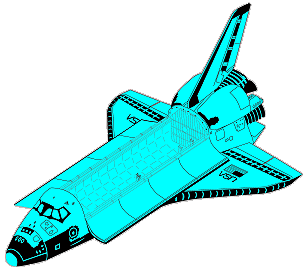 |
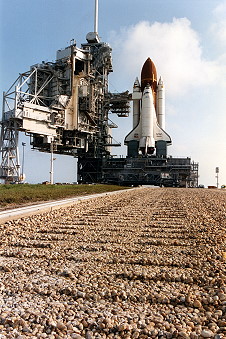 |
|
source of all photos is NASA |
|
 |
 |
 |
 |
 |
 |
 |
 |
 |
 |
 |
 |
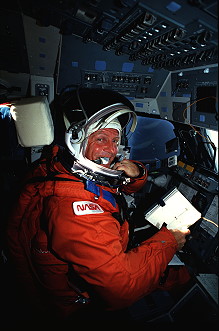 |
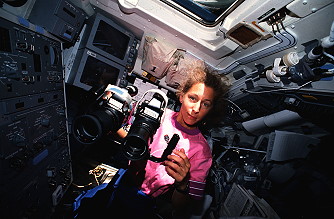 |
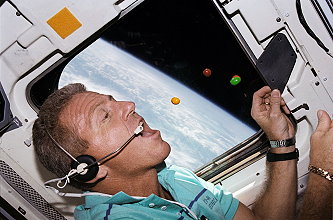 |
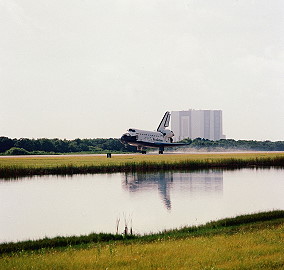 |
more Earth observation photos |
|
| © |  |
Last update on March 27, 2020.  |
 |