Human Orbital Spaceflights

International Flight No. 184STS-75Columbia (19)75th Space Shuttle missionUSA |
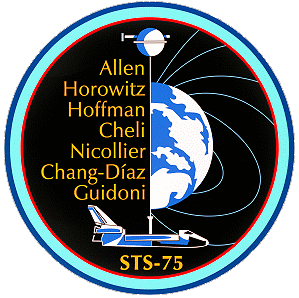 |
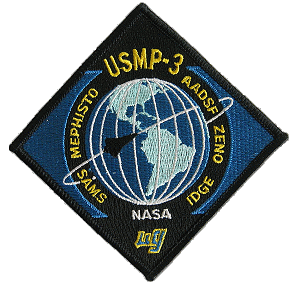 |
|
Source: www.spacepatches.nl |
||
 |
||
Launch, orbit and landing data
walkout photo |
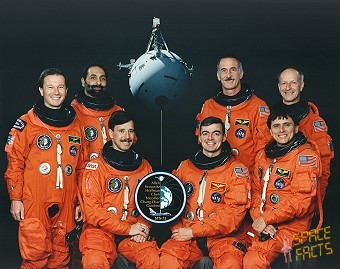 |
||||||||||||||||||||||||||||
alternative crew photo |
Crew
| No. | Surname | Given names | Position | Flight No. | Duration | Orbits | |
| 1 |  |
Allen | Andrew Michael "Andy" | CDR | 3 | 15d 17h 40m 20s | 251 |
| 2 | |
Horowitz | Scott Jay "Doc" | PLT | 1 | 15d 17h 40m 20s | 251 |
| 3 | |
Hoffman | Jeffrey Alan | MS-1, IV-1 | 5 | 15d 17h 40m 20s | 251 |
| 4 |  |
Cheli | Maurizio | MS-2, FE | 1 | 15d 17h 40m 20s | 251 |
| 5 |  |
Nicollier | Claude | MS-3, EV-2 | 3 | 15d 17h 40m 20s | 251 |
| 6 | |
Chang-Diaz | Franklin Ramon | MS-4, PLC, EV-1 | 5 | 15d 17h 40m 20s | 251 |
| 7 | |
Guidoni | Umberto | PS-1 | 1 | 15d 17h 40m 20s | 251 |
Crew seating arrangement
|
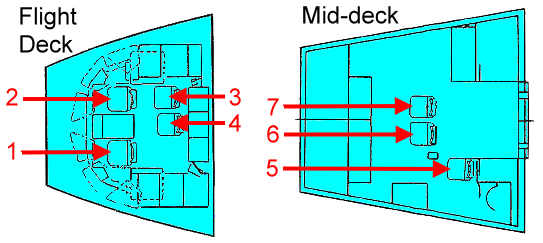 |
|
||||||||||||||||||||||||||||||||
Hardware
| Orbiter : | OV-102 (19) |
| SSME (1 / 2 / 3): | 2029 (13.) / 2034 (7.) / 2017 (13.) |
| SRB: | BI-078 / RSRM 53 |
| ET: | ET-76 (LWT-69) |
| OMS Pod: | Left Pod 05 (8.) / Right Pod 01 (23.) |
| FWD RCS Pod: | FRC 2 (19.) |
| RMS: | - |
| EMU: | EMU No. 2040 (PLSS No. 1014) / EMU No. 2035 (PLSS No. 1015) |
Flight
|
Launch from Cape Canaveral (KSC) and
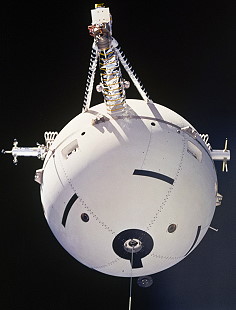
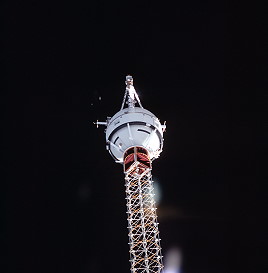
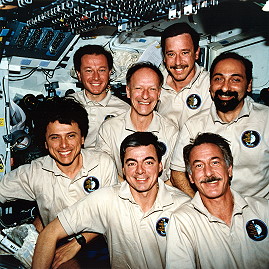
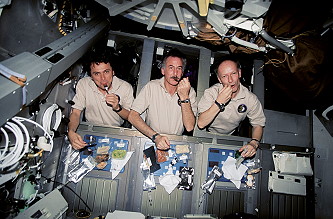
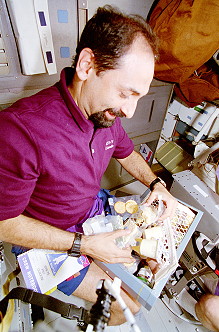
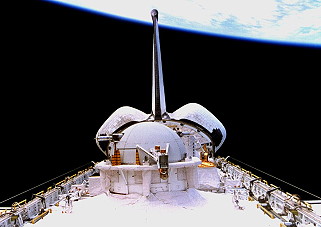
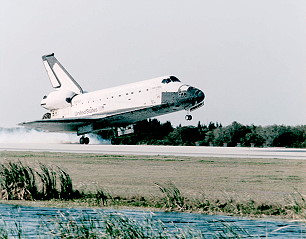
landing on Cape Canaveral (KSC), Runway 33. Six seconds after liftoff, the crew reported that the left main engine chamber pressure tape meter was reading only 40 percent thrust instead of 104 percent prior to throttle-down. Mission controllers in Houston reported telemetry showed all three engines were performing nominally and there was no effect on the ascent phase Problem was later traced to a malfunctioning tape meter mechanism. STS-75 was highlighted by the flight of the Italian Tethered Satellite System designed to investigate new sources of spacecraft power and ways to study Earth's upper atmosphere. STS-75 also saw Columbia's seven-person crew work with the United States Microgravity Payload which continued research efforts into development of new materials and processes that could lead to a new generation of computers, electronics and metals. Experiment operations conducted around the clock on this flight, with the astronauts divided into three teams. Scott Horowitz, Maurizio Cheli and Umberto Guidoni were the "Red Team". Member of the "Blue Team" were Claude Nicollier and Franklin Chang-Diaz. The "White Team" consisted of Andrew Allen and Jeffrey Hoffman. The "White Team" joined the "Blue Team" after the TSS deployment. On flight day two, crew members activated major USMP experiments. Once microgravity experiments were running, most were remotely controlled, a mode of operation known as telescience. Flight days five through 12 were devoted mainly to conducting USMP investigations while the crew carried out combustion experiments in a device known as the glovebox, located in the middeck. During this time, Columbia's position was adjusted periodically to give USMP experiments the best possible conditions based on measurement of microgravity disturbances by on-board sensors. The mission "US Microgravity Payload-3" carried several experiments in different scientific fields. The USMP-3 payload consisted of four major experiments mounted on two Mission Peculiar Experiment Support Structures (MPESS) and three Shuttle Mid-deck experiments. The experiments were: Advanced Automated Directional Solidification Furnace (AADSF), Material pour l'Etude des Phenomenes Interessant la Solidification sur Terre et en Orbite (MEPHISTO), Space Acceleration Measurement System (SAMS), Orbital Acceleration Research Experiment (OARE), Critical Fluid Light Scattering Experiment (ZENO) and Isothermal Dendritic Growth Experiment (IDGE). Advanced Automated Directional Solidification Furnace (AADSF): During USMP-3, the AADSF was used to grow a crystal of lead-tin-telluride (PbSnTe), a material used to make infrared radiation detectors and lasers. This was done by the technique known as directional solidification. This method involves cooling a molten material, causing a solid to form at one end of the sample. The solidification region grows at the point where the solid and liquid meet, known as the solid/liquid interface. This interface is moved from one end of the sample to the other at a controlled rate, resulting in a high degree of crystalline perfection. Critical Fluid Light Scattering Experiment (Zeno): The Zeno investigation, named for the Greek philosopher, explored an unusual state of matter by measuring the density of the element xenon at its critical point, a unique set of conditions when it is literally on the edge of simultaneously being in a gaseous phase and a liquid phase. More precisely, the material rapidly changes back and forth from one state to the other so that one is unable to determine the state of a given volume of material. Aboard the Shuttle, Zeno measured properties of xenon a hundred times closer to its critical point than is possible on Earth. USMP-3 used a refined procedure for approaching the critical point temperature more slowly, gradually scanning from one temperature to the next, taking advantage of the Zeno instrument's sensitivity to minute variations in fluid density that arise in microgravity. This was done by shining laser light on a xenon sample and analyzing the resulting light scattering. At controlled temperatures extremely near the critical temperature, the fluid was a billion times more compressible than water but will have similar density. It changed from a vapor clear as glass to a milky white fluid with a large capacity for absorbing heat, but transported heat very slowly. Accurate measurements of a fluid's physical properties when very close to the critical point cannot be made on Earth because gravity causes the fluid to layer, with respect to density, (vapor on top, liquid below) severely at the temperatures of most significance. The orbital environment permitted measurements to be made within a few millionths of a degree of the critical temperature. Isothermal Dendritic Growth Experiment (IDGE): Metals manufacturing for many industrial and consumer products involves the process of solidification. Industrial materials research traditionally has tried many different things instead of developing a clear understanding of the fundamental processes involved. Microgravity research such as this will lead to manufacturing improvements in metals and alloys that display dendrite formation. As most molten materials solidify, they form tiny pine tree-shaped crystals called dendrites, from the ancient Greek for "tree". The size, shape and direction of these crystals dictate the final properties of the resulting solid material, such as its hardness, its ability to bend without breaking and its electrical properties. On USMP-2, dendrite researchers were able to observe dendrites in the absence of convection at extremely small temperature differences below the freezing point, a phenomenon never seen on Earth. During USMP-3, the experiment was continued to build upon that foundation. Materials for the Study of Interesting Phenomena of Solidification on Earth and in Orbit (MEPHISTO): The investigation known as MEPHISTO was a cooperative program between NASA, the French Space Agency and the French Atomic Energy Commission, with the goal of understanding how gravity-driven convection affects the production of metals, alloys and electronic materials. MEPHISTO flew on both previous USMP missions. Analyses of samples produced on orbit are being conducted by science and technical teams to improve processes for making products ranging from alloys for airplane turbine blades to electronic materials. This third flight of MEPHISTO continued the investigation into how material solidifies in microgravity. Ultimately, the MEPHISTO experiments brought dramatic improvements in materials production. Researchers want to know what happens at the boundary between solid and liquid the solid/liquid interface during solidification of a molten material, to better control this process on Earth. Temperature differences at this boundary can cause fluid movements that affect the structure and properties of the solidified product through convection and sedimentation. In microgravity, sedimentation and buoyancy-induced convection are greatly reduced, so researchers can explore underlying processes that normally are masked by gravity. Space Acceleration Measurement Systems (SAMS): When the Space Shuttle is in orbit, the effects of gravity are reduced by close to one million times. However, disturbances happen when crew members move about and equipment is operated, as well as when the Shuttle maneuvers by firing thrusters and even when it experiences subtle atmospheric drag. USMP-3 scientists depended on measurements of minute changes in the orbital environment to tweak their experiments and improve scientific data collection, as well as to determine how such vibrations or accelerations influence experiment results. Future mission designs also will benefit from Space Acceleration Measurement System data. The system accurately measured the orbital environment via five sensors, called "accelerometers", placed throughout the Shuttle. Microgravity profiles were transmitted to the ground through the Shuttle's communications system. These data also are recorded on optical disks for post-flight analysis. Orbital Acceleration Research Experiment (OARE): In the past, the Orbital Acceleration Research Experiment has helped scientists obtain data to make the best possible use of the low-gravity environment. While the orbiting Shuttle offers a remarkably stable ride for space-based experiments, it does experience some low-level disturbances from the Shuttle's orientation, atmospheric drag and venting of liquids or gases, among others. USMP-3 experiments used this acceleration data to complement the data provided by the Space Acceleration Measurement System and improve research results. The heart of the OARE instrument was a miniature electrostatic accelerometer that accurately measured low-frequency on-orbit acceleration disturbances. The Shuttle's flight attitude can be changed to satisfy the needs of any particular experiment based on information measured, processed, stored and downlinked in near real-time. Three combustion investigations were conducted in the Middeck Glovebox Facility. The glovebox facility was a contained space where potentially hazardous materials can be handled and crew members could perform operations that are impractical in the open cabin environment. This glovebox was developed to provide such capabilities in the Shuttle middeck and for future use on the International Space Station. The facility provided power, air and particle filtration, light, data collection, real-time monitoring, and sensors for gas, temperature, air pressure and humidity. For each experiment, a crew member removed the experiment kit from stowage and placed it through the glovebox door, then tightly sealed the opening. Using gloves that project into the facility, a crew member set up the experiment and conduct it in this safe enclosure. Forced-Flow Flamespreading Test (FFFT): On Earth, gravity causes air motion known as buoyant convection the rising of hot air and falling of cool air. Scientists who study combustion want to know the details of how air motion affects flame spreading, to be able to better control fires that may occur on orbit. When a fire starts on Earth, flames spread due to the movement of air around and through the flames. Air motion provides oxygen for the chemical reactions in the flame, removes combustion products (some toxic), and controls how the heat released in the flame is distributed. A crew member placed small solid fuel samples (flat paper and cellulose cylinders) into the test module; sealed the module in the Middeck Glovebox; establish air flow; heated, then ignited the fuel sample; and recorded the results on video and film for later study. Gas samples were extracted from the combustion products. Researchers on the ground watched downlinked video of the flame and temperature displays to analyze early results and possibly change subsequent test runs. Radiative Ignition and Transition to Spread Investigation (RITSI): Fires in spacecraft pose a significant threat. A short-circuit in an electrical system or overheated electrical components could ignite flammable material. Toxic gases can quickly poison the air, and fire extinguishers can damage critical equipment. To prevent and control fires on orbit, the conditions that lead up to ignition must be understood. The experiment apparatus consisted of a flow duct with screens at both ends and a fan that pulls air through the duct. The clear lid of the duct opened for access to the sample holder to change out samples of ashless filter paper. A high-intensity lamp was focused on the sample to preheat and then ignited it. The crew member used a small control box attached to the outside of the glovebox to perform the experiment. Comparative Soot Diagnostics (CSD): An understanding of soot processes in flames produced in microgravity will contribute to our ability to predict fire behavior on Earth. However, no soot measurements have been made of quasi-steady, microgravity flames. The Comparative Soot Diagnostics experiment will provide the first such measurements and will provide data useful for understanding soot processes on Earth. Since fire detector systems currently flown on the Shuttle and scheduled for use on the international Space Station have not been tested for quasi-steady, low-gravity sources of minute particles, this data will be studied for its applicability to the design and operation of future spacecraft smoke detection systems. The experiment examined particle formation from a variety of sources, including a candle and four overheated materials paper, silicone rubber, and wires coated with Teflon and Kapton. These materials are found in crew cabins, and silicone rubber is an industrial product. The apparatus consisted of two modules, one installed inside the glovebox and the other attached to the outside of the glovebox. After running a self-diagnostic procedure on the smoke detectors in the internal module, the crew member performing this experiment activated a video camera and turned on an igniter. A probe sampled the soot when flames are well developed. STS-75 included a flight of the Commercial Protein Crystal Growth systems identified as CPCG-09. This payload processed nine different proteins seeking the development of new therapeutic treatments for infections, human cancers, diseases caused from hormone disorders, and Chagas disease. Columbia carried into space the first joint U.S.-Latin American experiment in protein crystal growth. The project, conceived in March 1993, brought together a small team of investigators from Costa Rica, Chile and the United States. It involved the crystallization in microgravity of ultrapure samples of Tripanothione Reductase, a DNA-grown protein expressing key features of the Tripanosoma Cruzi, the parasite that causes Chagas Disease. The experiment seeked to determine the structure of this protein through crystallographic studies of the crystals obtained in space. The high resolution resulting from the space grown crystals could pave the way for the development of effective pharmaceuticals to combat this debilitating disease and lead, someday, to an effective vaccine. The primary objective the Tethered Satellite System's flight, designated TSS-1R ("R" for reflight), was a scientific adventure aimed at understanding the possibilities for putting tether technology to work in space for a variety of applications. Tethered systems can be used to generate thrust to compensate for atmospheric drag on orbiting platforms such as the International Space Station. Deploying a tether towards Earth could place movable science platforms in hard-to-study atmospheric zones. Tethers also could be used as antennas to transmit extremely low frequency signals able to penetrate land and sea water, providing for communications not possible with standard radio. Non-electrical tethers can be used to generate artificial gravity and to boost payloads to higher orbits. TSS originally was flown on the Space Shuttle STS-46 mission launched in July 1992. TSS deployment was curtailed when mechanical interference in the deployer reel assembly prevented full deployment of the satellite. The TSS reflight should focus on science objectives not accomplished on the STS-46 mission. TSS-1R experiments were scheduled to support seven mission objectives: Determine the amount of electrical current collected and voltage produced by the Tethered Satellite-Shuttle system as it interacts with Earth's ionospheric environment of charged gas (plasma) and its magnetic and electric fields. Understand how a tethered satellite makes contact with the ionospheric plasma and how an electrical current is extracted. Demonstrate electrical power generation, as a product of current and voltage, to determine how such a system could be used as a space-based power source. Verify tether control and dynamics from short (1.2 mile/2 kilometer) to long (12.8 mile/20.7 kilometer) deployment ranges. Demonstrate how neutral gas affects the satellite's plasma sheath and current collection, possibly enhancing tether-produced current. Determine how electrical current is conducted through the near-Earth plasma by measuring waves broadcast as the tethered satellite passes over a series of ground-based receiving stations, as well as how the tether acts as a low- frequency-band antenna. Learn to control tether motion by collecting data about how current flow produces force. TSS-1R should make use of Earth's magnetic field and electrically charged atmosphere for a variety of experiments. Just as a bar magnet produces invisible lines of force known as "field lines", so does Earth. The Sun is a ball of electrically charged, or ionized, gas known as plasma. Plasma from the Sun, the solar wind, continually rushes past Earth; most is deflected around the planet, but some penetrates Earth's upper atmosphere, creating electric fields. Lightning is a commonly seen form of plasma. More than 99 percent of matter in the universe exists in the plasma state. Speeding through the magnetized ionospheric plasma at almost five miles per second, the Tethered Satellite should create a variety of very interesting plasma-electrodynamic phenomena. These were expected to provide unique experimental opportunities, including the ability to collect an electrical charge and drive a large-current system, generate high voltages (around 5,000 volts) across the tether, control the satellite's electrical potential and its plasma sheath (the layer of charged particles created around the satellite), and generate low-frequency electrostatic and electromagnetic waves. While ground-based scientists are limited to small-scale experiments, Earth's ionosphere offers TSS-1R scientists a vast laboratory for space plasma experiments that cannot be conducted any other way. TSS-1R Science Investigations included: TSS Deployer Core Equipment and Satellite Core Equipment (DCORE/SCORE), Research on Orbital Plasma Electrodynamics (ROPE), Research on Electrodynamic Tether Effects (RETE), Magnetic Field Experiment for TSS Missions (TEMAG), Shuttle Electrodynamic Tether System (SETS), Shuttle Potential and Return Electron Experiment (SPREE), Tether Optical Phenomena Experiment (TOP), Investigation of Electromagnetic Emissions by the Electrodynamic Tether (EMET), Observations at the Earth's Surface of Electromagnetic Emissions by TSS (OESSE), Investigation and Measurement of Dynamic Noise in the TSS (IMDN), Theoretical and Experimental Investigation of TSS Dynamics (TEID) and the Theory and Modeling in Support of Tethered Satellite Applications (TMST). The tether system consisted of a five-foot (1.6-meter) diameter battery-powered satellite secured by a strong, electrically conducting cord, or tether, to the satellite support structure attached to the Shuttle orbiter. Data-gathering instruments were mounted in the Shuttle's cargo bay and middeck area, and on the satellite. During the second day on orbit, the STS-75 crew started reel the satellite out on its tether - which looks like a long white shoelace - to about planned 12.5 miles (20.7 kilometers) away from the Shuttle, into the ionosphere. TSS-1R scientific instruments should allow scientists to examine the electrodynamics of the conducting tether system, as well as clarify the physical processes of the near-Earth space environment and, by extension, throughout the Solar System. The satellite should be deployed from Columbia when the cargo bay is facing away from Earth, with the tail slanted upward and nose pitched down. A 39-foot (11.9 meters) long boom, with the satellite at its end, was raised out of the cargo bay to provide clearance between the satellite and Shuttle during the deploy and the planned retrieval operations. The orbital dynamics should result in the Tethered Satellite initially being deployed upward but at an angle of about 40 degrees behind Columbia's path. As an electric motor at the end of the boom pulled tether off of the reel and a nitrogen gas thruster on the satellite pushed the satellite away from Columbia, the satellite began its journey. The deploy began very slowly, with the satellite eventually moving away from Columbia at about one-half mile per hour. The initial movement of the satellite away from the boom was at less than two-hundredths of one mile per hour. The speed of deploy continued to increase, peaking after one and a half hours from the initial movement to about one mile per hour. At this point, when the satellite was slightly less than one mile from Columbia, the rate of deployment was slowed briefly, a maneuver that reduced the 40-degree angle of the satellite to the Shuttle to five degrees and put the satellite almost directly overhead of Columbia, by the time about three miles of tether has been unwound. When the satellite was almost 2,000 feet, or 600 meters, from Columbia, it was allowed to begin a very slow rotation. Once the satellite reached about 3.7 miles from the Shuttle, about two and a half hours after the start of deployment, the rotation rate was increased by the satellite's attitude control system thrusters to a one-quarter-of-a-revolution-per-minute spin. The slight spin was needed for science operations with the satellite. After this, the speed of deployment again was increased gradually, climbing to a peak separation from Columbia of almost 5 mph about four hours into the deployment, when the satellite was about nine miles away. From this point, the speed with which the tether is fed out will gradually decrease through the rest of the procedure. Over 19 kilometers of the tether were deployed before the tether broke. It remained in orbit for a number of weeks and was easily visible from the ground, appearing something like a small but surprisingly bright fluorescent light traveling through the sky. Excellent scientific data was being gathered when tether snapped on flight day three as the satellite was just short of full deployment of 12.5 miles (20.7 kilometers). The satellite immediately began speeding away from orbiter as a result of orbital forces and the crew was never in any danger. The reason for tether break was not immediately clear and investigative board convened on ground to determine cause. The crew retracted the deployer and remaining tether on the following day. Scientists gathered useful data from curtailed deployment. Currents measured during deployment phase were at least three times greater than predicted by analytical modeling, and amount of power generated was directly proportional to the current. Tether voltages of as high as 3,500 volts were developed across the tether, and current levels of about 480 milliamps were achieved. Researchers were also able to study how gas from satellite's thrusters interacts with ionosphere. Also collected were first-time measurements of ionized shock wave around the TSS satellite, a phenomenon that cannot be studied in the laboratory and is difficult to mathematically model. Another first was the collection of data on the plasma wakes created by moving body through electrically charged ionosphere. Some experiments conducted using free-flying satellite and attached tether before it re-entered Earth's atmosphere and broke up. STS-75 also was the first use of an operating system based on Linux kernel on orbit. An older Digital Unix program, originally on DEC Alpha servers, was ported to run on Linux on a laptop. The next use of Linux was a year later, on STS-83. The mission was extended one day due of bad weather at Cape Canaveral (KSC). |
Photos / Graphics
 |
 |
|
source of all photos is NASA |
|
 |
 |
 |
 |
 |
 |
 |
 |
 |
 |
 |
 |
 |
| © |  |
Last update on March 27, 2020.  |
 |