Human Orbital Spaceflights

International Flight No. 138Soyuz TM-12OzoneUSSR |
 |
 |
Launch, orbit and landing data
walkout photo |
 |
|||||||||||||||||||||||
alternative crew photo |
alternative crew photo |
|||||||||||||||||||||||
alternative crew photo |
||||||||||||||||||||||||
alternative crew photo |
||||||||||||||||||||||||
Crew
| No. | Surname | Given names | Position | Flight No. | Duration | Orbits | |
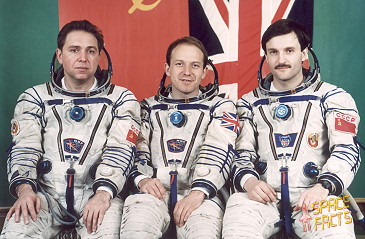
| 1 |  |
Artsebarsky | Anatoli Pavlovich | Commander | 1 | 144d 15h 21m 50s | 2288 |
| 2 | |
Krikalyov | Sergei Konstantinovich | Flight Engineer | 2 | 311d 20h 00m 34s | 4934 |
| 3 |  |
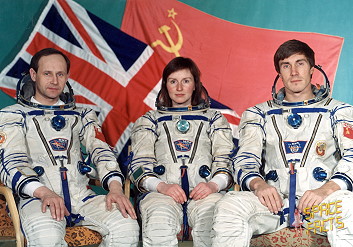
Sharman | Helen Patricia "Lenochka" | Research Cosmonaut | 1 | 7d 21h 13m 45s | 124 |
Crew seating arrangement
|
 |
|
||||||||||||||||
Backup Crew
|
 |
||||||||||||||||||||
Hardware
| Launch vehicle: | Soyuz-U2 (No. R15000-051) |
| Spacecraft: | Soyuz TM-12 (7K-STM No. 62) |
Flight
|
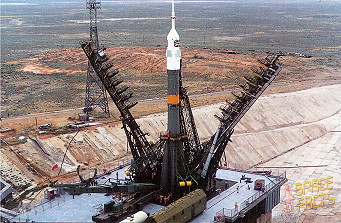
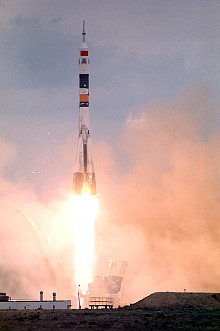
Launch from the Baikonur Cosmodrome and
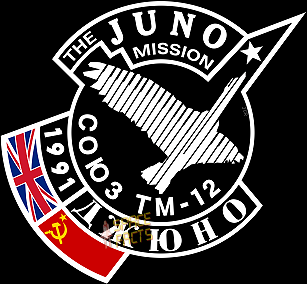
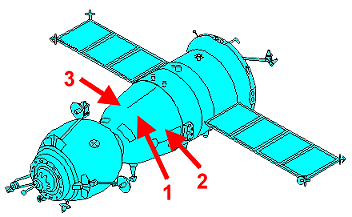
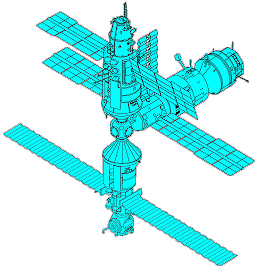
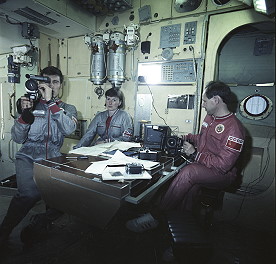
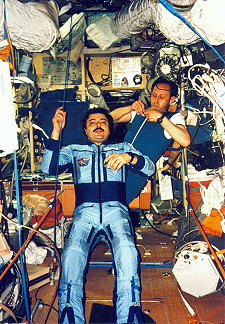
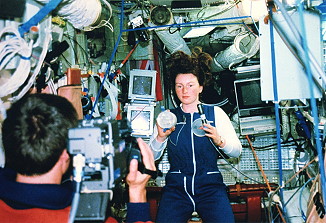
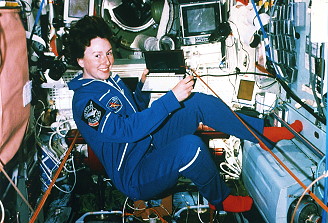
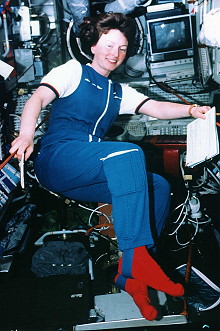
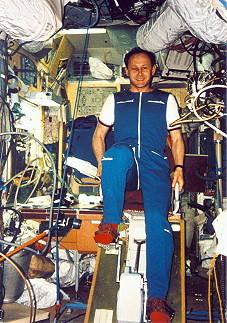
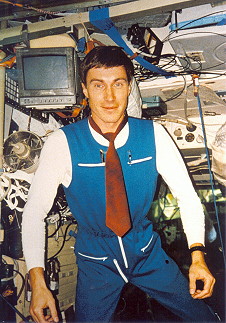
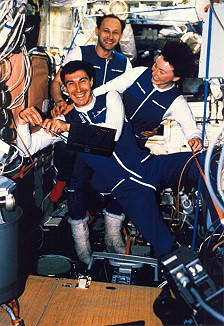
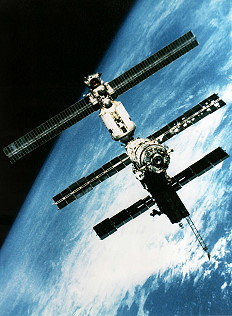
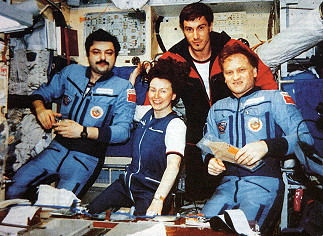
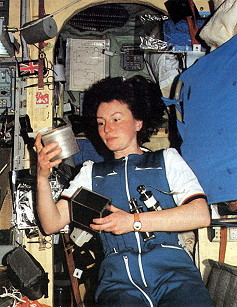
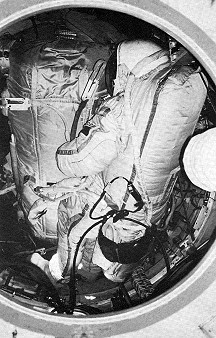
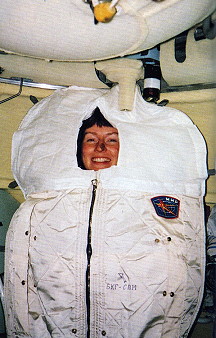
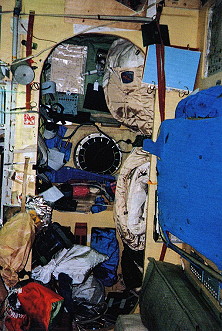
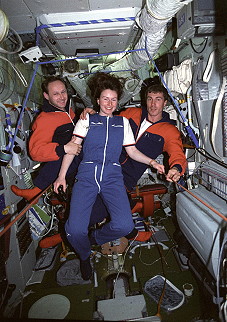
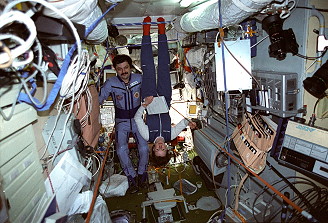
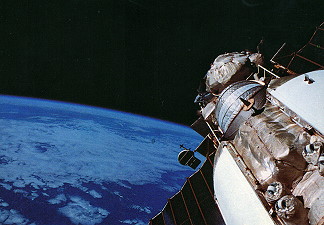
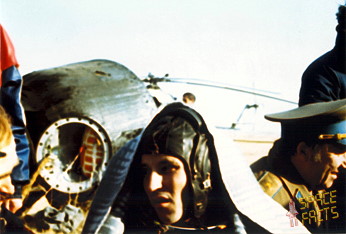
landing 60 km southeast of Arkalyk. Helen Sharman became the first British cosmonaut. Following a two-day solo flight Soyuz TM-12 docked with the Soyuz TM-11-Kvant1-Mir-Kristall-Kvant2 complex on May 20, 1991. The Mir-8 crew welcomed aboard Mir the Mir-9 crew of Anatoli Artsebarsky and Sergei Krikalyov (on his second visit to the station), accompanied by British Research Cosmonaut Helen Sharman. As part of the British Juno program Helen Sharman was involved in scientific experiments, especially life sciences, together with the eighth resident crew. Sharman's experimental program, which was designed by the Soviets, leaned heavily toward life sciences, her speciality being chemistry. A bag of 250,000 pansy seeds was placed in the Kvant2 EVA airlock, a compartment not as protected from cosmic radiation as other Mir compartments. Helen Sharman also contacted nine British schools by radio and conducted high-temperature superconductor experiments with the Elektropograph-7K device. Helen Sharman commented that she had difficulty finding equipment on Mir as there was a great deal more equipment than in the trainer in the cosmonaut city of Zvezdny Gorodok. During a communication session with a British girls' school on May 21, 1991 Helen Sharman commented that Mir was experiencing solar array problems because of the station's changing orientation. Late that day the level of background noise on the station suddenly fell from the customary 75 decibels as fans, circulating pumps, and other equipment shut down. The lights began to fade. A computer in the orientation system had failed, preventing the solar arrays from tracking on the Sun, and causing Mir to drain its batteries. Helen Sharman stated that Viktor Afanasiyev and Musa Manarov told her such power problems had occurred before. When it reentered sunlight, the station was turned to recharge its batteries. Main goal of the mission was to exchange the Mir resident crew. Anatoli Artsebarsky and Sergei Krikalyov became the ninth Mir resident crew. The Mir-8 crew returned uneventfully to earth on May 26, 1991 together with Helen Sharman. The Mir-9 crew first needed to move their spacecraft to Mir's aft port to make way for Progress M-8, which could not dock with the rear port because of the damage to the Kurs approach system antenna there. The move was made on May 28, 1991, and required 42 min. The unmanned freighter Progress M-8 docked with Mir on June 01, 1991 at 09:44:37 UTC, undocked on August 15 1991 at 22:16:59 UTC and was destroyed in reentry on August 16, 1991 at 06:56:32 UTC. The cosmonauts released the small MAK-1 satellite from the Mir base block's experiment airlock on June 17, 1991. It was designed to study Earth's ionosphere. However, a probable power failure prevented its antennas from deploying, and the satellite remained inert. Anatoli Artsebarsky and Sergei Krikalyov performed the first EVA June 24, 1991 (4h 58m). Progress M-8 delivered tools and equipment for the planned 6-hours Kvant1 Kurs antenna repair EVA on June 01, and Anatoli Artsebarsky and Sergei Krikalyov practiced the planned repairs inside Mir on June 14, 1991. The work was considered unusually delicate and complex because it involved small tools, such as a dental mirror, and many small parts not designed for EVA handling. In addition, there were few handholds and footholds at the Kvant1 work site. Getting into proper working position required a full hour when the repair was simulated in the Hydrolaboratory. Anatoli Artsebarsky and Sergei Krikalyov rested during orbital night when visibility was too poor to permit delicate work. After repairing Kurs, the cosmonauts assembled a prototype thermo-mechanical joint outside Kvant2 in preparation for the planned Sofora truss assembly EVAs. The joint had sleeve couplings made of titanium-nickel alloy with "memory effect," which shrank and snugged tight when heated by a hand-held heating and assembly device. Sofora was expected to be more durable than the URS truss tested on Salyut 7 (May 1986), which employed a mechanical hinged joint system. The second EVA occurred on June 28, 1991 (3h 24m). In addition to tools for the Kvant1 Kurs antenna repair, Progress M-8 delivered the 1-m (3.3-ft) TREK panel. The space exposure experiment was devised by the University of California at Berkeley to study cosmic-ray superheavy nuclei by recording their tracks through layers of phosphate glass. TREK was designed to remain outside on Kvant2 for 2 years, then be recovered and returned to Earth for analysis. Anatoli Artsebarsky and Sergei Krikalyov also installed charged particle detectors, retrieved the thermomechanical joint assembled during the previous EVA, and tested a new TV camera. They used the Strela boom to move around Mir's exterior and completed the EVA 2 hours ahead of schedule. On July 15, 1991 (5h 56m) Anatoli Artsebarsky and Sergei Krikalyov went outside the station for the third spacewalk. This was the first of four planned EVAs dedicated to Sofora truss assembly. Sofora, named for a fast-growing central Asian shrub, was developed by NPO Energia. During the EVA, Anatoli Artsebarsky noted unusually heavy air leakage through abrasions in his gloves. This was the eleventh EVA for his suit. The cosmonauts used Strela to move themselves and the Sofora mounting platform from Kvant2 to the worksite on Kvant1. They then attached four heating and assembly devices to exterior electrical power outlets. The fourth EVA was performed on July 19, 1991 (5h 28m). Sergei Krikalyov left the Kvant2 SALC, moved down the module to the base block, and took up the controls of the Strela boom, which he used to transfer Anatoli Artsebarsky and two boxes of Sofora parts to the Kvant1 worksite. He also transferred the first cubical, half-meter-wide Sofora truss section, which the cosmonauts assembled inside Mir before the EVA to serve as a base for the remaining 20 truss sections. The cosmonauts attached the mounting platform moved on the previous EVA to Kvant1's hull, then began Sofora assembly. The truss was put together lying back over Soyuz TM-12 at the aft port, parallel to the long axis of the Mir base block. Sergei Krikalyov and Anatoli Artsebarsky used the four heating and assembly devices to shrink the memory metal sleeves in the truss joints. They had difficulty seeing their work as the lighting changed, but managed to keep working during orbital night. The cosmonauts were unable to use foot restraints provided because the distance between the restraints and their work was different than on Earth, so they relied on their hands and arms to hold position. They recorded their operations on videotape, then transmitted the recordings to specialists in the TsUP during communication sessions after the EVA. Sergei Krikalyov and Anatoli Artsebarsky assembled three Sofora segments before closing out this, their fourth EVA together. Anatoli Artsebarsky and Sergei Krikalyov performed the fifth EVA four days later on July 23, 1991 (5h 42m). The cosmonauts partly assembled Sofora segments inside Mir between EVAs to save time. Anatoli Artsebarsky's liquid cooling garment connector came apart during suit checkout, probably because its operational lifetime had been exceeded. During this EVA they added 11 more segments to Sofora, commenting on how easy it was to assemble. After the EVA, veteran cosmonaut Vitali Sevastiyanov, host of a popular Moscow TV science program, told his viewers that the EVA was performed quickly and smoothly because of intense preparation and training. He added that, "a spacewalk is like a stage performance. And how much work is necessary backstage, before [the curtain goes up]?" In the sixth and final EVA on July 27, 1991 (6h 49m) the crew added 11 segments to the Sofora girder. The EVA began with release into space of the worn-out Orlan-DMA No. 10 suit. The newspaper Pravda lamented the suit's disposal in space, saying that it might have been returned to Earth and sold for profit to a museum. The suit was worn 9 times by different cosmonauts. The three remaining Sofora segments were assembled, then the truss was attached to its mounting platform on Kvant1 and raised so that it was nearly perpendicular to the long axis of the Mir base block. Sofora was sloped 11 deg toward Mir's front to place its top above the station's center-of-gravity. Anatoli Artsebarsky climbed to the top of the truss and attached a Soviet flag mounted in a metal frame. Moscow TV's Vremya news program stated that, "it is not difficult to understand Anatoli Artsebarsky and Sergei Krikalyov, who, on their own initiative, placed a Soviet flag atop the girder. After all, our country has not totally fallen apart yet and there are still things which we do better than anyone else in the world." Anatoli Artsebarsky's helmet visor fogged up because his suit's heat exchanger ran out of water, so Sergei Krikalyov had to guide him back to the Kvant2 SALC. According to cosmonaut Vitali Sevastiyanov, speaking as host of a TV science program, Sofora was as tall as a five-story building and would "be subjected to burning frosts and radiation and . . . left alone for a whole year with only its sensors for company." If it proved able to withstand these conditions, Vitali Sevastiyanov reported, a thruster package for Mir roll control would be placed on top. Sofora had an attachment point on top for receiving the thruster package, and was hinged a third of the way up so its top could be bent down and placed within easy reach. The cosmonauts reported bruises on their hands, elbows, and shoulders after the EVA. On August 23, 1991 at 00:54:17 UTC the unmanned Progress M-9 docked with the station. This resupply vessel to Mir carried a reentry capsule for return of 150 kg of experiment results. It undocked on September 30, 1991 at 01:53:00 UTC. The 350 kg return capsule detached from the Progress' orbital module at an altitude of 110 to 130 km. The capsule underwent a ballistic descent to 15 km, followed by a parachute descent from there to surface. The capsule's beacon began transmitting at 4.5 km. and landed in Kazakhstan on September 30, 1991 at 08:16:24 UTC. Soyuz TM-13 arrived at Mir on October 04, 1991. It carried Austrian Research Cosmonaut Franz Viehböck and Kazakh Research Cosmonaut Toktar Aubakirov. The flight was unusual for carrying no Flight Engineer. Veteran Russian cosmonaut Aleksandr Volkov commanded. The Austrians paid $7 million to fly Franz Viehböck to Mir, and the Kazakh cosmonaut flew partly in an effort to encourage newly-independent Kazakhstan to continue to permit launchings from Baikonur Cosmodrome. The Research Cosmonauts photographed their respective countries from orbit and conducted the usual range of materials processing and medical experiments. Anatoli Artsebarsky traded places with Aleksandr Volkov and returned to Earth in Soyuz TM-12. Sergei Krikalyov remained aboard Mir on his unplanned long-duration mission together with Aleksandr Volkov to make up the Mir-10 crew. The Soyuz spacecraft is composed of three elements attached end-to-end - the Orbital Module, the Descent Module and the Instrumentation/Propulsion Module. The crew occupied the central element, the Descent Module. The other two modules are jettisoned prior to re-entry. They burn up in the atmosphere, so only the Descent Module returned to Earth. The deorbit burn lasted about 240 seconds. Having shed two-thirds of its mass, the Soyuz reached Entry Interface - a point 400,000 feet (121.9 kilometers) above the Earth, where friction due to the thickening atmosphere began to heat its outer surfaces. With only 23 minutes left before it lands on the grassy plains of central Asia, attention in the module turned to slowing its rate of descent. Eight minutes later, the spacecraft was streaking through the sky at a rate of 755 feet (230 meters) per second. Before it touched down, its speed slowed to only 5 feet (1.5 meter) per second, and it lands at an even lower speed than that. Several onboard features ensure that the vehicle and crew land safely and in relative comfort. Four parachutes, deployed 15 minutes before landing, dramatically slowed the vehicle's rate of descent. Two pilot parachutes were the first to be released, and a drogue chute attached to the second one followed immediately after. The drogue, measuring 24 square meters (258 square feet) in area, slowed the rate of descent from 755 feet (230 meters) per second to 262 feet (80 meters) per second. The main parachute was the last to emerge. It is the largest chute, with a surface area of 10,764 square feet (1,000 square meters). Its harnesses shifted the vehicle's attitude to a 30-degree angle relative to the ground, dissipating heat, and then shifted it again to a straight vertical descent prior to landing. The main chute slowed the Soyuz to a descent rate of only 24 feet (7.3 meters) per second, which is still too fast for a comfortable landing. One second before touchdown, two sets of three small engines on the bottom of the vehicle fired, slowing the vehicle to soften the landing. |
EVA data
| Name | Start | End | Duration | Mission | Airlock | Suit | Stripes | |
| EVA | Krikalyov, Sergei | 24.06.1991, 21:11 UTC | 25.06.1991, 02:09 UTC | 4h 58m | Soyuz TM-12 | Mir - Kvant2 | Orlan-DMA No. 14 | blue |
| EVA | Artsebarsky, Anatoli | 24.06.1991, 21:11 UTC | 25.06.1991, 02:09 UTC | 4h 58m | Soyuz TM-12 | Mir - Kvant2 | Orlan-DMA No. 6 | red |
| EVA | Krikalyov, Sergei | 28.06.1991, 19:02 UTC | 28.06.1991, 22:26 UTC | 3h 24m | Soyuz TM-12 | Mir - Kvant2 | Orlan-DMA No. 14 | blue |
| EVA | Artsebarsky, Anatoli | 28.06.1991, 19:02 UTC | 28.06.1991, 22:26 UTC | 3h 24m | Soyuz TM-12 | Mir - Kvant2 | Orlan-DMA No. 6 | red |
| EVA | Krikalyov, Sergei | 15.07.1991, 11:45 UTC | 15.07.1991, 17:41 UTC | 5h 56m | Soyuz TM-12 | Mir - Kvant2 | Orlan-DMA No. 8 | blue |
| EVA | Artsebarsky, Anatoli | 15.07.1991, 11:45 UTC | 15.07.1991, 17:41 UTC | 5h 56m | Soyuz TM-12 | Mir - Kvant2 | Orlan-DMA No. 6 | red |
| EVA | Krikalyov, Sergei | 19.07.1991, 10:11 UTC | 19.07.1991, 16:38 UTC | 5h 28m | Soyuz TM-12 | Mir - Kvant2 | Orlan-DMA No. 8 | blue |
| EVA | Artsebarsky, Anatoli | 19.07.1991, 10:11 UTC | 19.07.1991, 16:38 UTC | 5h 28m | Soyuz TM-12 | Mir - Kvant2 | Orlan-DMA No. 6 | red |
| EVA | Krikalyov, Sergei | 23.07.1991, 09:15 UTC | 23.07.1991, 14:57 UTC | 5h 42m | Soyuz TM-12 | Mir - Kvant2 | Orlan-DMA No. 8 | blue |
| EVA | Artsebarsky, Anatoli | 23.07.1991, 09:15 UTC | 23.07.1991, 14:57 UTC | 5h 42m | Soyuz TM-12 | Mir - Kvant2 | Orlan-DMA No. 6 | red |
| EVA | Krikalyov, Sergei | 27.07.1991, 08:44 UTC | 27.07.1991, 15:33 UTC | 6h 49m | Soyuz TM-12 | Mir - Kvant2 | Orlan-DMA No. 8 | blue |
| EVA | Artsebarsky, Anatoli | 27.07.1991, 08:44 UTC | 27.07.1991, 15:33 UTC | 6h 49m | Soyuz TM-12 | Mir - Kvant2 | Orlan-DMA No. 6 | red |
Note
|
Sergei
Krikalyov landed on March 25, 1992 at 08:51:02
UTC with Soyuz
TM-13 spacecraft. Helen Sharman landed on May 26, 1991 at 10:04:13 UTC with Soyuz TM-11 spacecraft. |
Relocations of Manned Spacecrafts
| Spacecraft | from | Undocking | Time UTC | to | Redocking | Time UTC |
| Soyuz TM-12 | Mir - Baseblock | 28.05.1991 | 10:10:03 | Mir - Kvant | 28.05.1991 | 10:52:11 |
Photos / Graphics
 |
 |
|
source of all photos is Roscosmos |
|
 |
 |
 |
 |
 |
 |
 |
 |
 |
 |
 |
 |
 |
 |
 |
 |
 |
 |
 |
 |
| © |  |
Last update on March 30, 2025.  |
 |