Human Spaceflights to the Moon

International Flight No. 35Apollo 12USA |
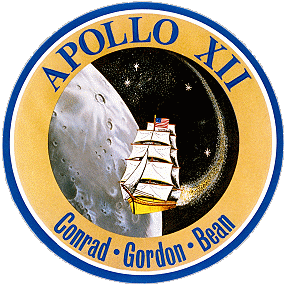 |
 |
Launch, orbit and landing data
walkout photo |
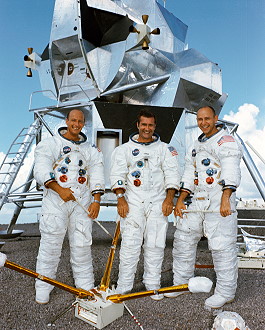 |
|||||||||||||||||||||||||||||||
alternative crew photo |
alternative crew photo |
|||||||||||||||||||||||||||||||
alternative crew photo |
alternative crew photo |
|||||||||||||||||||||||||||||||
alternative crew photo |
alternative crew photo |
|||||||||||||||||||||||||||||||
Crew
| No. | Surname | Given names | Position | Flight No. | Duration | Orbits | |
| 1 |  |
Conrad | Charles, Jr. "Pete" | CDR | 3 | 10d 04h 36m 24s | 1,5 |
| 2 | |
Gordon | Richard Francis, Jr. "Dick" | CMP | 2 | 10d 04h 36m 24s | 1,5 |
| 3 | |
Bean | Alan LaVern | LMP | 1 | 10d 04h 36m 24s | 1,5 |
Crew seating arrangement
|
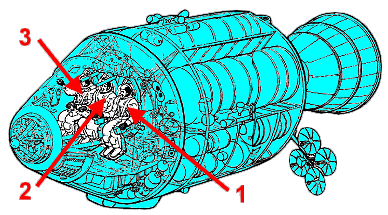 |
|
||||||||||||||||
Backup Crew
|
Support Crew
|
|||||||||||||
Hardware
| Launch vehicle: | Saturn V (SA-507) |
| Spacecraft: | Apollo (CSM-108 „Yankee Clipper“ / LM-6 „Intrepid“) |
Flight
|
Launch from Cape Canaveral (KSC) and
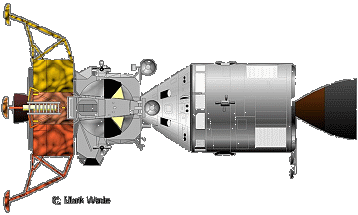
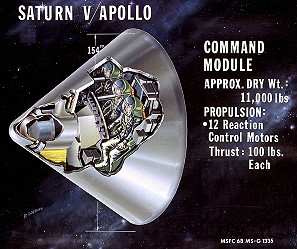
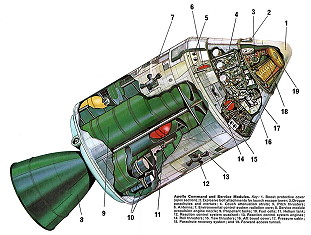
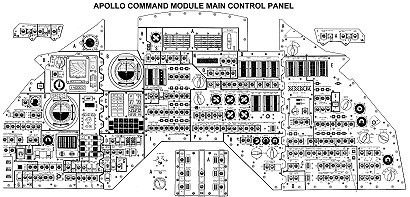
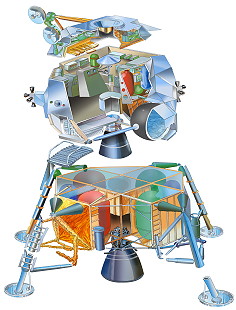
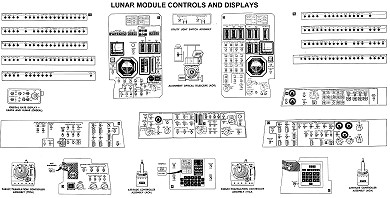
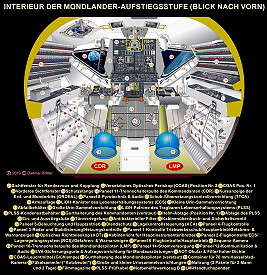
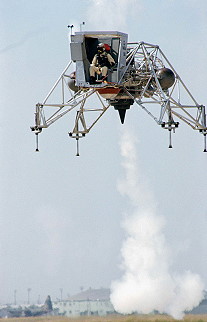
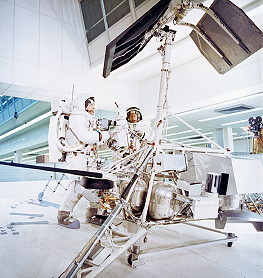
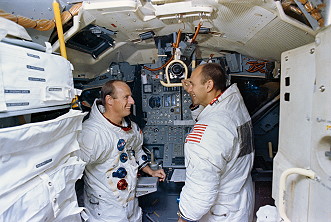
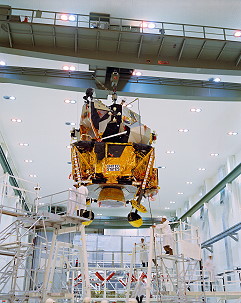
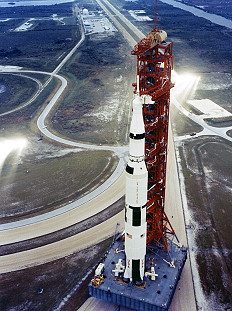
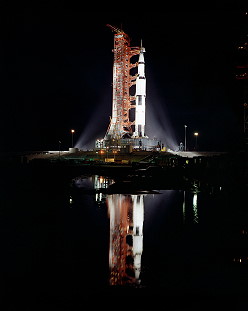
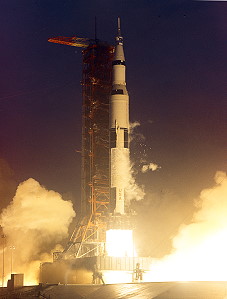
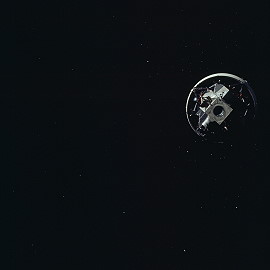
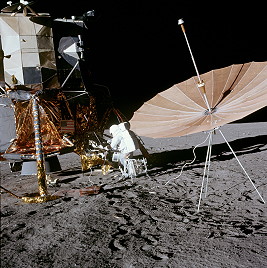
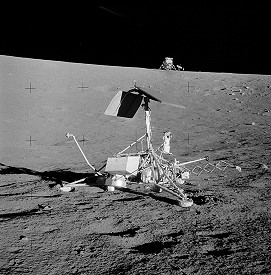
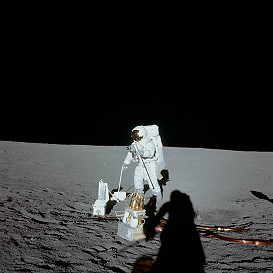
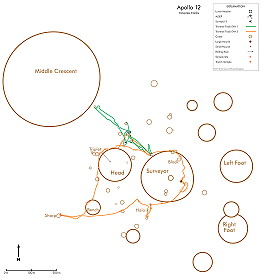
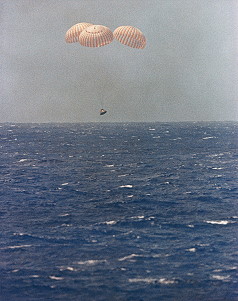
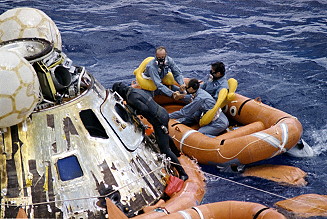
landing 735 km southeast of Pogo-Pogo-Islands in the Pacific Ocean. The Command Module (CM) was a conical pressure vessel with a maximum diameter of 3.9 m at its base and a height of 3.65 m. It was made of an aluminum honeycomb sandwich bonded between sheet aluminum alloy. The base of the CM consisted of a heat shield made of brazed stainless steel honeycomb filled with a phenolic epoxy resin as an ablative material and varied in thickness from 1.8 to 6.9 cm. At the tip of the cone was a hatch and docking assembly designed to mate with the lunar module. The CM was divided into three compartments. The forward compartment in the nose of the cone held the three 25.4 m diameter main parachutes, two 5 m drogue parachutes, and pilot mortar chutes for Earth landing. The aft compartment was situated around the base of the CM and contained propellant tanks, reaction control engines, wiring, and plumbing. The crew compartment comprised most of the volume of the CM, approximately 6.17 cubic meters of space. Three astronaut couches were lined up facing forward in the center of the compartment. A large access hatch was situated above the center couch. A short access tunnel led to the docking hatch in the CM nose. The crew compartment held the controls, displays, navigation equipment and other systems used by the astronauts. The CM had five windows: one in the access hatch, one next to each astronaut in the two outer seats, and two forward-facing rendezvous windows. Five silver/zinc-oxide batteries provided power after the CM and SM detached, three for re-entry and after landing and two for vehicle separation and parachute deployment. The CM had twelve 420 N nitrogen tetroxide/hydrazine reaction control thrusters. The CM provided the re-entry capability at the end of the mission after separation from the Service Module. The Service Module (SM) was a cylinder 3.9 meters in diameter and 7.6 m long which was attached to the back of the CM. The outer skin of the SM was formed of 2.5 cm thick aluminum honeycomb panels. The interior was divided by milled aluminum radial beams into six sections around a central cylinder. At the back of the SM mounted in the central cylinder was a gimbal mounted re-startable hypergolic liquid propellant 91,000 N engine and cone shaped engine nozzle. Attitude control was provided by four identical banks of four 450 N reaction control thrusters each spaced 90 degrees apart around the forward part of the SM. The six sections of the SM held three 31-cell hydrogen oxygen fuel cells which provided 28 volts, two cryogenic oxygen and two cryogenic hydrogen tanks, four tanks for the main propulsion engine, two for fuel and two for oxidizer, and the subsystems the main propulsion unit. Two helium tanks were mounted in the central cylinder. Electrical power system radiators were at the top of the cylinder and environmental control radiator panels spaced around the bottom. The lunar module (LM) was a two-stage vehicle designed for space operations near and on the Moon. The spacecraft mass of 15,065 kg was the mass of the LM including astronauts, propellants and expendables. The dry mass of the ascent stage was 2180 kg and it held 2639 kg of propellant. The descent stage dry mass was 2034 kg and 8212 kg of propellant were onboard initially. The ascent and descent stages of the LM operated as a unit until staging, when the ascent stage functioned as a single spacecraft for rendezvous and docking with the command and service module (CSM). The descent stage comprised the lower part of the spacecraft and was an octagonal prism 4.2 meters across and 1.7 m thick. Four landing legs with round footpads were mounted on the sides of the descent stage and held the bottom of the stage 1.5 m above the surface. The distance between the ends of the footpads on opposite landing legs was 9.4 m. One of the legs had a small astronaut egress platform and ladder. A one meter long conical descent engine skirt protruded from the bottom of the stage. The descent stage contained the landing rocket, two tanks of aerozine 50 fuel, two tanks of nitrogen tetroxide oxidizer, water, oxygen and helium tanks and storage space for the lunar equipment and experiments, and in the case of Apollo 15, 16, and 17, the lunar rover. The descent stage served as a platform for launching the ascent stage and was left behind on the Moon. The ascent stage was an irregularly shaped unit approximately 2.8 m high and 4.0 by 4.3 meters in width mounted on top of the descent stage. The ascent stage housed the astronauts in a pressurized crew compartment with a volume of 6.65 cubic meters which functioned as the base of operations for lunar operations. There was an ingress-egress hatch in one side and a docking hatch for connecting to the CSM on top. Also mounted along the top were a parabolic rendezvous radar antenna, a steerable parabolic S-band antenna, and 2 in-flight VHF antennas. Two triangular windows were above and to either side of the egress hatch and four thrust chamber assemblies were mounted around the sides. At the base of the assembly was the ascent engine. The stage also contained an aerozine 50 fuel and an oxidizer tank, and helium, liquid oxygen, gaseous oxygen, and reaction control fuel tanks. There were no seats in the LM. A control console was mounted in the front of the crew compartment above the ingress-egress hatch and between the windows and two more control panels mounted on the side walls. The ascent stage was launched from the Moon at the end of lunar surface operations and returned the astronauts to the CSM. The descent engine was a deep-throttling ablative rocket with a maximum thrust of about 45,000 N mounted on a gimbal ring in the center of the descent stage. The ascent engine was a fixed, constant-thrust rocket with a thrust of about 15,000 N. Maneuvering was achieved via the reaction control system, which consisted of the four thrust modules, each one composed of four 450 N thrust chambers and nozzles pointing in different directions. Telemetry, TV, voice, and range communications with Earth were all via the S-band antenna. VHF was used for communications between the astronauts and the LM, and the LM and orbiting CSM. There were redundant transceivers and equipment for both S-band and VHF. An environmental control system recycled oxygen and maintained temperature in the electronics and cabin. Power was provided by 6 silver-zinc batteries. Guidance and navigation control were provided by a radar ranging system, an inertial measurement unit consisting of gyroscopes and accelerometers, and the Apollo guidance computer. The Apollo Lunar Surface Experiments Package (ALSEP) consisted of a set of scientific instruments emplaced at the landing site by the astronauts. The instruments were arrayed around a central station which supplied power to run the instruments and communications so data collected by the experiments could be relayed to Earth. The central station was a 25 kg box with a stowed volume of 34,800 cubic cm. Thermal control was achieved by passive elements (insulation, reflectors, thermal coatings) as well as power dissipation resistors and heaters. Communications with Earth were achieved through a 58 cm long, 3.8 cm diameter modified axial-helical antenna mounted on top of the central station and pointed towards Earth by the astronauts. Transmitters, receivers, data processors and multiplexers were housed within the central station. Data collected from the instruments were converted into a telemetry format and transmitted to Earth. The ALSEP system and instruments were controlled by commands from Earth. The SNAP-27 model RTG produced the power to run the ALSEP operations. The generator consisted of a 46 cm high central cylinder and eight radiating rectangular fins with a total tip-to-tip diameter of 40 cm. The central cylinder had a thinner concentric inner cylinder inside, and the two cylinders were attached along their surfaces by 442 spring-loaded lead-telluride thermoelectric couples mounted radially along the length of the cylinders. The generator assembly had a total mass of 17 kg. The power source was an approximately 4 kg fuel capsule in the shape of a long rod which contained plutonium-238 and was placed in the inner cylinder of the RTG by the astronauts on deployment. Plutonium-238 decays with a half-life of 89.6 years and produces heat. This heat would conduct from the inner cylinder to the outer via the thermocouples which would convert the heat directly to electrical power. Excess heat on the outer cylinder would be radiated to space by the fins. The RTG produced approximately 70 W DC at 16 V. (63.5 W after one year.) The electricity was routed through a cable to a power conditioning unit and a power distribution unit in the central station to supply the correct voltage and power to each instrument. Thirty-six-and-a-half seconds after lift-off, the vehicle triggered a lightning discharge through itself and down to the earth through the Saturn's ionized plume. Protective circuits on the fuel cells in the service module falsely detected overloads and took all three fuel cells offline, along with much of the CSM instrumentation. A second strike at 52 seconds after launch knocked out the "8-ball" attitude indicator. The telemetry stream at Mission Control was garbled. However, the Saturn V continued to fly correctly; the strikes had not affected the Saturn V's Instrument Unit. After 1 ½ orbits the S-IVB stage was re-ignited at 19:15:14 UTC for a translunar injection burn of 5 min. 45 sec. putting the spacecraft on course for the Moon. The CSM separated from the S-IVB stage containing the LM 25 minutes later, turned around and docked with the LM at 19:48:53 UTC. The S-IVB stage was then jettisoned into Earth orbit instead of planned heliocentric orbit due to error in the instrument unit. During lunar coast, the LM was checked out to ensure no electrical damage had been caused by the lightning. A midcourse correction was made on November 16, 1969 at 02:15 UTC. A six-minute SPS burn on November 18, 1969 at 03:47:23 UTC put the Apollo 12 into lunar orbit. Two orbits later a second burn circularized the orbit. The LM separated from the Command/Service Module (CSM) at 04:16:03 UTC and landed at 06:54:35 UTC on November, 19 1969 in the Oceanus Procellarum area at 3.0124 S latitude, 23.4216 W longitude (IAU Mean Earth Polar Axis coordinate system) within about 180 meters of the Surveyor 3 spacecraft, which had landed on April 20, 1967. This mission marked the second manned lunar landing. After landing in Ocean of Storm Charles Conrad and Alan Bean performed several scientific works on the lunar surface. When Charles Conrad, who was somewhat shorter than Neil Armstrong, stepped onto the lunar surface, his first words were "Whoopie! Man, that may have been a small one for Neil, but that's a long one for me." This was not an off-the-cuff remark: Charles Conrad had made a $500 bet with reporter Oriana Fallaci he would say these words, after she had queried whether NASA had instructed Neil Armstrong what to say as he stepped onto the Moon. Charles Conrad later said he was never able to collect the money. The astronauts deployed an S-band antenna, solar wind composition experiment, the American flag and most important, the Apollo Lunar Surface Experiments Package (ALSEP) with a SNAP-27 atomic generator. This was done during the first EVA on November 19, 1969 (4h 01m). To improve the quality of television pictures from the Moon, a color camera was carried on Apollo 12 (unlike the monochrome camera that was used on Apollo 11). Unfortunately, when Alan Bean carried the camera to the place near the lunar module where it was to be set up, he inadvertently pointed it directly into the Sun, destroying the SEC tube. Television coverage of this mission was thus terminated almost immediately. The second EVA was performed on November 20, 1969 (3h 49m) in which different samples were collected and photographic panoramas were obtained. Apollo 12 successfully landed within walking distance of the Surveyor 3 probe, which had landed on the lunar surface on April 20, 1967. Charles Conrad and Alan Bean removed pieces of the probe to be taken back to Earth for analysis. It is claimed that the common bacterium Streptococcus mitis was found to have accidentally contaminated the spacecraft's camera prior to launch and survived dormant in this harsh environment for two and a half years. However, this finding has since been disputed: see Reports of Streptococcus mitis on the Moon. All in all, 34.4 kg of material was gathered. The LM lifted off from the Moon on November 20, 1969 at 14:25:47 UTC after 31 hours 31 minutes on the lunar surface. After docking with the CSM at 17:58:22 UTC, the LM was jettisoned at 20:21:30 UTC and intentionally crashed into the Moon creating the first recorded artificial moonquake. Richard Gordon had completed a lunar multispectral photography experiment and photographed proposed future landing sites during that time. Intrepid's ascent stage was dropped (per normal procedures) after Charles Conrad and Alan Bean rejoined Richard Gordon in orbit. It impacted the Moon on November 20, 1969 at 3.94°S 21.20°W. The seismometers the astronauts had left on the lunar surface registered the vibrations for more than an hour. Trans-Earth injection began at 20:49:16 UTC on November 21, 1969 with a firing of the CSM main engine. A mid-course correction was made on November 22, 1969. The crew was recovered by the USS Hornet. |
EVA data
| Name | Start | End | Duration | Mission | Airlock | Suit | |
| EVA | Conrad, Charles | 19.11.1969, 11:30 UTC | 19.11.1969, 15:31 UTC | 4h 01m | Apollo 12 | LM Intrepid | A7L No. 65 |
| EVA | Bean, Alan | 19.11.1969, 11:30 UTC | 19.11.1969, 15:31 UTC | 4h 01m | Apollo 12 | LM Intrepid | A7L No. 67 |
| EVA | Conrad, Charles | 20.11.1969, 03.52 UTC | 20.11.1969, 07:46 UTC | 3h 54m | Apollo 12 | LM Intrepid | A7L No. 65 |
| EVA | Bean, Alan | 20.11.1969, 03.52 UTC | 20.11.1969, 07:46 UTC | 3h 54m | Apollo 12 | LM Intrepid | A7L No. 67 |
| IVA | Conrad, Charles | 20.11.1969, 09:17 UTC | 20.11.1969, 09:25 UTC | 0h 08m | Apollo 12 | LM Intrepid | A7L No. 65 |
| IVA | Bean, Alan | 20.11.1969, 09:17 UTC | 20.11.1969, 09:25 UTC | 0h 08m | Apollo 12 | LM Intrepid | A7L No. 67 |
 |
Photos / Graphics
 |
 |
|
Source: www.astronautix.com/ |
|
 |
 |
 |
 |
 |
 |
|
source of all photos is NASA |
|
 |
 |
 |
 |
 |
 |
 |
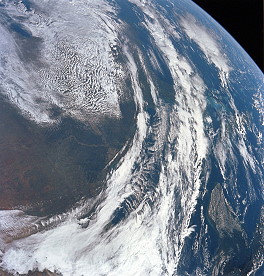 |
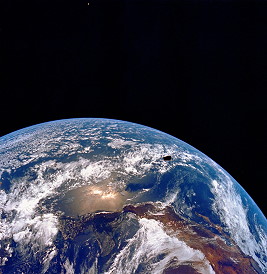 |
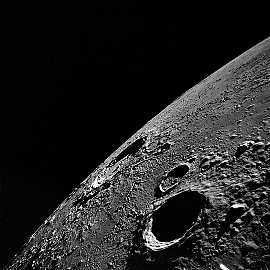 |
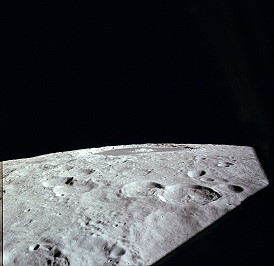 |
 |
 |
 |
 |
 |
 |
 |
more photos from the moon |
|
more Moon observation photos |
|
| © |  |
Last update on March 01, 2026.  |
 |