Human Spaceflights to the Moon

International Flight No. 43Apollo 17USA |
 |
 |
Launch, orbit and landing data
walkout photo |
 |
||||||||||||||||||||||||||||||
alternative crew photo |
|||||||||||||||||||||||||||||||
alternative crew photo |
|||||||||||||||||||||||||||||||
alternative crew photo |
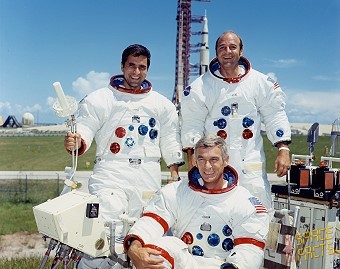
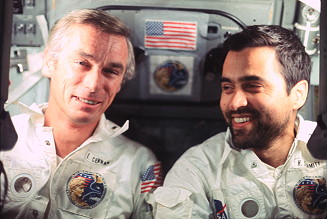
Crew
| No. | Surname | Given names | Position | Flight No. | Duration | Orbits | |
| 1 |  |
Cernan | Eugene Andrew "Gene" | CDR | 3 | 12d 13h 51m 58s | 1,5 |
| 2 | |
Evans | Ronald Ellwin, Jr. "Ron" | CMP | 1 | 12d 13h 51m 58s | 1,5 |
| 3 | |
Schmitt | Harrison Hagan "Jack" | LMP | 1 | 12d 13h 51m 58s | 1,5 |
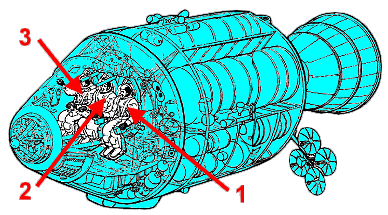
Crew seating arrangement
|
 |
|
||||||||||||||||
Backup Crew
|
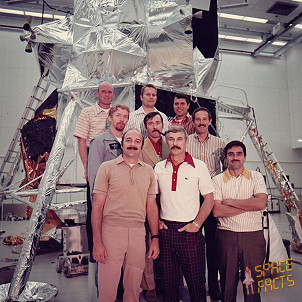 |
Support Crew
|
|||||||||||||
Hardware
| Launch vehicle: | Saturn V (SA-512) |
| Spacecraft: | Apollo (CSM-114 „America“ / LM-12 „Challenger“) |
Flight
|
Launch from Cape Canaveral (KSC). First
night launch of the
Apollo program. The launch had been delayed 2 hours 40
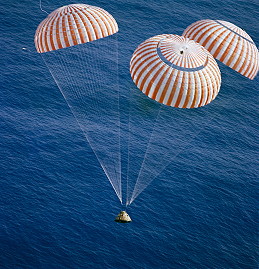
minutes by a countdown sequencer failure. Landing 560 km west of Samoa Islands
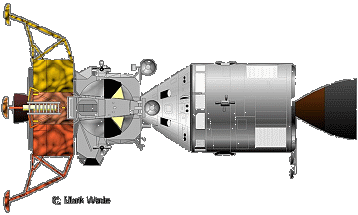
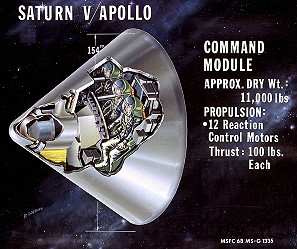
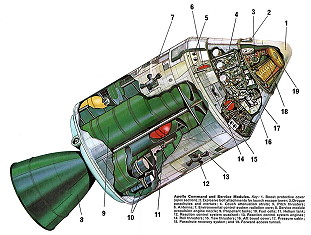
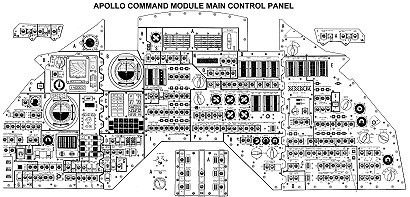
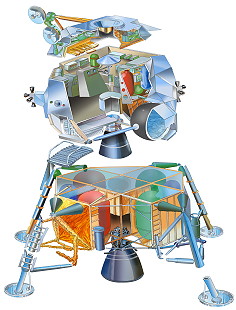
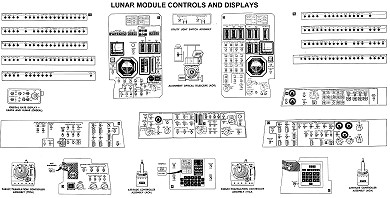
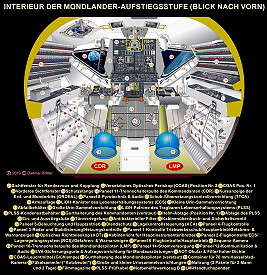
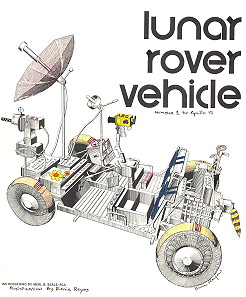
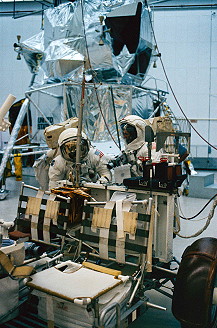
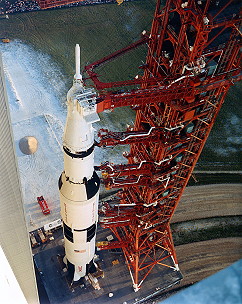
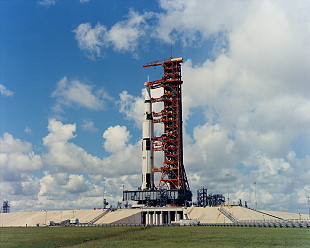
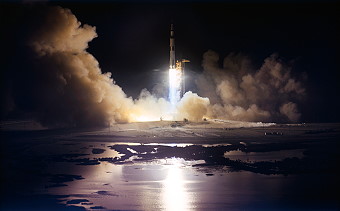
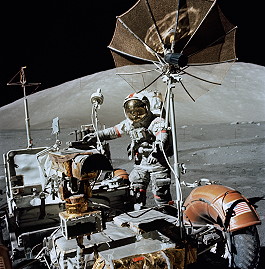
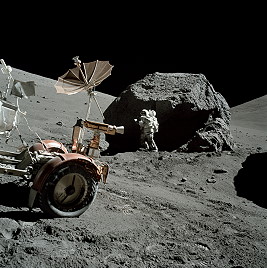
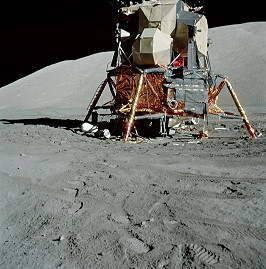
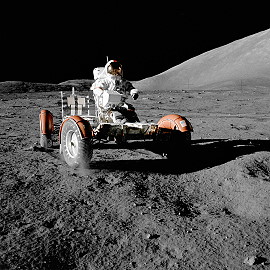
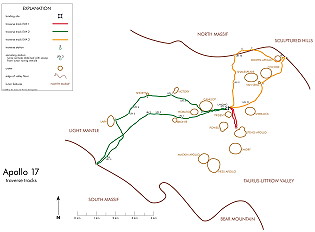
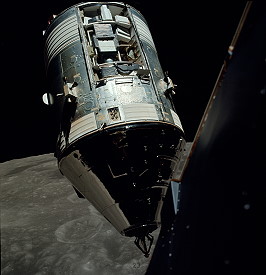
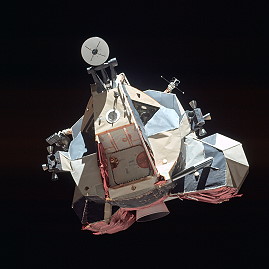
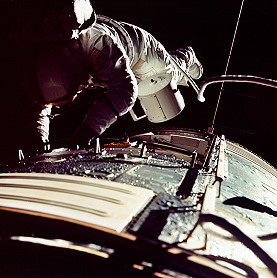
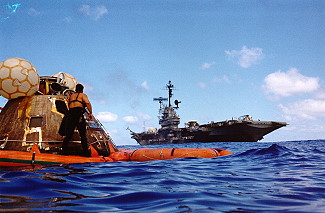
in the Pacific Ocean. The Command Module (CM) was a conical pressure vessel with a maximum diameter of 3.9 m at its base and a height of 3.65 m. It was made of an aluminum honeycomb sandwich bonded between sheet aluminum alloy. The base of the CM consisted of a heat shield made of brazed stainless steel honeycomb filled with a phenolic epoxy resin as an ablative material and varied in thickness from 1.8 to 6.9 cm. At the tip of the cone was a hatch and docking assembly designed to mate with the lunar module. The CM was divided into three compartments. The forward compartment in the nose of the cone held the three 25.4 m diameter main parachutes, two 5 m drogue parachutes, and pilot mortar chutes for Earth landing. The aft compartment was situated around the base of the CM and contained propellant tanks, reaction control engines, wiring, and plumbing. The crew compartment comprised most of the volume of the CM, approximately 6.17 cubic meters of space. Three astronaut couches were lined up facing forward in the center of the compartment. A large access hatch was situated above the center couch. A short access tunnel led to the docking hatch in the CM nose. The crew compartment held the controls, displays, navigation equipment and other systems used by the astronauts. The CM had five windows: one in the access hatch, one next to each astronaut in the two outer seats, and two forward-facing rendezvous windows. Five silver/zinc-oxide batteries provided power after the CM and SM detached, three for re-entry and after landing and two for vehicle separation and parachute deployment. The CM had twelve 420 N nitrogen tetroxide/hydrazine reaction control thrusters. The CM provided the re-entry capability at the end of the mission after separation from the Service Module. The Service Module (SM) was a cylinder 3.9 meters in diameter and 7.6 m long which was attached to the back of the CM. The outer skin of the SM was formed of 2.5 cm thick aluminum honeycomb panels. The interior was divided by milled aluminum radial beams into six sections around a central cylinder. At the back of the SM mounted in the central cylinder was a gimbal mounted re-startable hypergolic liquid propellant 91,000 N engine and cone shaped engine nozzle. Attitude control was provided by four identical banks of four 450 N reaction control thrusters each spaced 90 degrees apart around the forward part of the SM. The six sections of the SM held three 31-cell hydrogen oxygen fuel cells which provided 28 volts, two cryogenic oxygen and two cryogenic hydrogen tanks, four tanks for the main propulsion engine, two for fuel and two for oxidizer, and the subsystems the main propulsion unit. Two helium tanks were mounted in the central cylinder. Electrical power system radiators were at the top of the cylinder and environmental control radiator panels spaced around the bottom. The lunar module (LM) was a two-stage vehicle designed for space operations near and on the Moon. The spacecraft mass of 15,065 kg was the mass of the LM including astronauts, propellants and expendables. The dry mass of the ascent stage was 2180 kg and it held 2639 kg of propellant. The descent stage dry mass was 2034 kg and 8212 kg of propellant were onboard initially. The ascent and descent stages of the LM operated as a unit until staging, when the ascent stage functioned as a single spacecraft for rendezvous and docking with the command and service module (CSM). The descent stage comprised the lower part of the spacecraft and was an octagonal prism 4.2 meters across and 1.7 m thick. Four landing legs with round footpads were mounted on the sides of the descent stage and held the bottom of the stage 1.5 m above the surface. The distance between the ends of the footpads on opposite landing legs was 9.4 m. One of the legs had a small astronaut egress platform and ladder. A one meter long conical descent engine skirt protruded from the bottom of the stage. The descent stage contained the landing rocket, two tanks of aerozine 50 fuel, two tanks of nitrogen tetroxide oxidizer, water, oxygen and helium tanks and storage space for the lunar equipment and experiments, and in the case of Apollo 15, 16, and 17, the lunar rover. The descent stage served as a platform for launching the ascent stage and was left behind on the Moon. The ascent stage was an irregularly shaped unit approximately 2.8 m high and 4.0 by 4.3 meters in width mounted on top of the descent stage. The ascent stage housed the astronauts in a pressurized crew compartment with a volume of 6.65 cubic meters which functioned as the base of operations for lunar operations. There was an ingress-egress hatch in one side and a docking hatch for connecting to the CSM on top. Also mounted along the top were a parabolic rendezvous radar antenna, a steerable parabolic S-band antenna, and 2 in-flight VHF antennas. Two triangular windows were above and to either side of the egress hatch and four thrust chamber assemblies were mounted around the sides. At the base of the assembly was the ascent engine. The stage also contained an aerozine 50 fuel and an oxidizer tank, and helium, liquid oxygen, gaseous oxygen, and reaction control fuel tanks. There were no seats in the LM. A control console was mounted in the front of the crew compartment above the ingress-egress hatch and between the windows and two more control panels mounted on the side walls. The ascent stage was launched from the Moon at the end of lunar surface operations and returned the astronauts to the CSM. The descent engine was a deep-throttling ablative rocket with a maximum thrust of about 45,000 N mounted on a gimbal ring in the center of the descent stage. The ascent engine was a fixed, constant-thrust rocket with a thrust of about 15,000 N. Maneuvering was achieved via the reaction control system, which consisted of the four thrust modules, each one composed of four 450 N thrust chambers and nozzles pointing in different directions. Telemetry, TV, voice, and range communications with Earth were all via the S-band antenna. VHF was used for communications between the astronauts and the LM, and the LM and orbiting CSM. There were redundant transceivers and equipment for both S-band and VHF. An environmental control system recycled oxygen and maintained temperature in the electronics and cabin. Power was provided by 6 silver-zinc batteries. Guidance and navigation control were provided by a radar ranging system, an inertial measurement unit consisting of gyroscopes and accelerometers, and the Apollo guidance computer. The Apollo Lunar Surface Experiments Package (ALSEP) consisted of a set of scientific instruments emplaced at the landing site by the astronauts. The instruments were arrayed around a central station which supplied power to run the instruments and communications so data collected by the experiments could be relayed to Earth. The central station was a 25 kg box with a stowed volume of 34,800 cubic cm. Thermal control was achieved by passive elements (insulation, reflectors, thermal coatings) as well as power dissipation resistors and heaters. Communications with Earth were achieved through a 58 cm long, 3.8 cm diameter modified axial-helical antenna mounted on top of the central station and pointed towards Earth by the astronauts. Transmitters, receivers, data processors and multiplexers were housed within the central station. Data collected from the instruments were converted into a telemetry format and transmitted to Earth. The ALSEP system and instruments were controlled by commands from Earth. The SNAP-27 model RTG produced the power to run the ALSEP operations. The generator consisted of a 46 cm high central cylinder and eight radiating rectangular fins with a total tip-to-tip diameter of 40 cm. The central cylinder had a thinner concentric inner cylinder inside, and the two cylinders were attached along their surfaces by 442 spring-loaded lead-telluride thermoelectric couples mounted radially along the length of the cylinders. The generator assembly had a total mass of 17 kg. The power source was an approximately 4 kg fuel capsule in the shape of a long rod which contained plutonium-238 and was placed in the inner cylinder of the RTG by the astronauts on deployment. Plutonium-238 decays with a half-life of 89.6 years and produces heat. This heat would conduct from the inner cylinder to the outer via the thermocouples which would convert the heat directly to electrical power. Excess heat on the outer cylinder would be radiated to space by the fins. The RTG produced approximately 70 W DC at 16 V. (63.5 W after one year.) The electricity was routed through a cable to a power conditioning unit and a power distribution unit in the central station to supply the correct voltage and power to each instrument. The Lunar Roving Vehicle (LRV) was an electric vehicle designed to operate in the low-gravity vacuum of the Moon and to be capable of traversing the lunar surface, allowing the Apollo astronauts to extend the range of their surface extravehicular activities. Three LRVs were driven on the Moon, one on Apollo 15 by astronauts David Scott and James Irwin, one on Apollo 16 by John Young and Charles Duke, and one on Apollo 17 by Eugene Cernan and Harrison Schmitt. Each rover was used on three traverses, one per day over the three-day course of each mission. On Apollo 15 the LRV was driven a total of 27.8 km in 3 hours, 2 minutes of driving time. The longest single traverse was 12.5 km and the maximum range from the LM was 5.0 km. On Apollo 16 the vehicle traversed 26.7 km in 3 hours 26 minutes of driving. The longest traverse was 11.6 km and the LRV reached a distance of 4.5 km from the LM. On Apollo 17 the rover went 35.9 km in 4 hours 26 minutes total drive time. The longest traverse was 20.1 km and the greatest range from the LM was 7.6 km. The Lunar Roving Vehicle had a mass of 210 kg and was designed to hold a payload of an additional 490 kg on the lunar surface. The frame was 3.1 meters long with a wheelbase of 2.3 meters. The maximum height was 1.14 meters. The frame was made of aluminum alloy 2219 tubing welded assemblies and consisted of a 3-part chassis which was hinged in the center so it could be folded up and hung in the Lunar Module quad 1 bay. It had two side-by-side foldable seats made of tubular aluminum with nylon webbing and aluminum floor panels. An armrest was mounted between the seats, and each seat had adjustable footrests and a velcro seatbelt. A large mesh dish antenna was mounted on a mast on the front center of the rover. The suspension consisted of a double horizontal wishbone with upper and lower torsion bars and a damper unit between the chassis and upper wishbone. Fully loaded the LRV had a ground clearance of 36 cm. The wheels consisted of a spun aluminum hub and an 81.8 cm diameter, 23 cm wide tire made of zinc coated woven 0.083 cm diameter steel strands attached to the rim and discs of formed aluminum. Titanium chevrons covered 50% of the contact area to provide traction. Inside the tire was a 64.8 cm diameter bump stop frame to protect the hub. Dust guards were mounted above the wheels. Each wheel had its own electric drive, a DC series wound 0.25 hp motor capable of 10,000 rpm, attached to the wheel via an 80:1 harmonic drive, and a mechanical brake unit. Maneuvering capability was provided through the use of front and rear steering motors. Each series wound DC steering motor was capable of 0.1 hp. Both sets of wheels would turn in opposite directions, giving a steering radius of 3.1 meters, or could be decoupled so only one set would be used for steering. Power was provided by two 36-volt silver-zinc potassium hydroxide non-rechargeable batteries with a capacity of 121 amp-hr. These were used to power the drive and steering motors and also a 36-volt utility outlet mounted on front of the LRV to power the communications relay unit or the TV camera. Passive thermal controls kept the batteries within an optimal temperature range. A T-shaped hand controller situated between the two seats controlled the four drive motors, two steering motors and brakes. Moving the stick forward powered the LRV forward, left and right turned the vehicle left or right, pulling backwards activated the brakes. Activating a switch on the handle before pulling back would put the LRV into reverse. Pulling the handle all the way back activated a parking brake. The control and display modules were situated in front of the handle and gave information on the speed, heading, pitch, and power and temperature levels. Navigation was based on continuously recording direction and distance through use of a directional gyro and odometer and inputting this data to a computer which would keep track of the overall direction and distance back to the LM. There was also a Sun-shadow device which could give a manual heading based on the direction of the Sun, using the fact that the Sun moved very slowly in the sky. The image at left shows a diagram of the layout of the control and display module, the Sun-shadow device is at top center between the heading and speed readouts. Deployment of the LRV from the LM quad 1 by the astronauts was achieved with a system of pulleys and braked reels using ropes and cloth tapes. The rover was folded and stored in quad 1 with the underside of the chassis facing out. One astronaut would climb the egress ladder on the LM and release the rover, which would then be slowly tilted out by the second astronaut on the ground through the use of reels and tapes. As the rover was let down from the bay most of the deployment was automatic. The rear wheels folded out and locked in place and when they touched the ground the front of the rover could be unfolded, the wheels deployed, and the entire frame let down to the surface by pulleys. The rover components locked into place upon opening. Cabling, pins, and tripods would then be removed and the seats and footrests raised. After switching on all the electronics, the vehicle was ready to back away from the LM. The image at right shows an earlier version of the planned deployment which does not exactly match the final sequence, note for example that the rover is facing away from the LM after deployment. This mission was the final moon landing with the LM Challenger. The landing site were the Taurus Littrow highlands and valley area. The crew performed a heat flow and convection demonstration and an Apollo light flash experiment during the translunar coast. The lunar surface staying time was 75 hours. Apollo 17 lifted off at 05:33:00 UTC on December 07, 1972 after a 2-hour, 40-minute delay due to a malfunction of a launch sequencer. Launch was on Saturn V SA-512 from Pad 39-A at Kennedy Space Center and was the first nighttime launch of an Apollo. The spacecraft began Earth parking orbit at 05:44:53 UTC and translunar injection took place at 08:45:37 UTC. The CSM separated from the S-IVB at 09:15:29 UTC and CSM-LM docking took place at 09:29:45 UTC. The S-IVB was released at 10:18 UTC into a lunar impact trajectory. (It impacted the lunar surface on December 10, 1972 at 20:32:42.3 UTC at 4.21 S, 12.31 W with a velocity of 2.55 km/s at a 55-degree angle from the horizontal.) A single mid-course correction requiring a 1.6 second burn of the Service Propulsion System (SPS) was made at 17:03:00 UTC on December 08, 1972. On December 10, 1972 at 15:05:40 UTC the SIM bay door was jettisoned and a 398 second burn of the SPS was initiated at 19:47:23 UTC to insert Apollo 17 into lunar orbit. Approximately 4 hours 20 minutes later another maneuver lowered the orbit to a perilune of 28 km. At 14:35 UTC on December 11, 1972 Eugene Cernan and Harrison Schmitt entered the LM. The LM separated from the CSM at 17:20:56 UTC on December 11, 1972 and reduced its orbit to 11.5 km perilune at 18:55:42 UTC. The descent burn took place at 19:43 UTC and the LM landed at 19:54:57 UTC on the southeastern rim of Mare Serenitatis in a valley at Taurus-Littrow, at 20.2 N, 30.8 E. After separating from the Command/Service Module, the Lunar Module Challenger and its crew of two, Eugene Cernan and Harrison Schmitt, adjusted their orbit and began preparations for the descent to Taurus-Littrow. While Eugene Cernan and Harrison Schmitt prepared for landing, Command Module Pilot Ronald Evans remained in orbit to take observations, perform experiments and await the return of his crew-mates a few days later. Soon after completing their preparations for landing, Eugene Cernan and Harrison Schmitt began their descent to the Taurus-Littrow valley on the lunar surface. Several minutes after the descent phase was initiated, the Lunar Module pitched over, giving the crew their first look at the landing site during the descent phase and allowing Eugene Cernan to guide the spacecraft to a desirable landing target while Harrison Schmitt provided data from the flight computer essential for landing. The LM touched down on the lunar surface at 02:55 PM EST on December 11, 1972. Shortly thereafter, the two astronauts began re-configuring the LM for their stay on the surface and began preparations for the first moonwalk of the mission, or EVA-1 Three EVAs were performed by Eugene Cernan and Harrison Schmitt. The first EVA was performed on December 11, 1972 (7h 12m). The first moonwalk of the mission began approximately four hours after landing, at about 06:55 PM. The first task of the first lunar excursion was to offload the Lunar Roving Vehicle and other equipment from the Lunar Module. While working near the rover, a fender was accidentally broken off when Eugene Cernan brushed up against it, his hammer getting caught under the right-rear fender, breaking off the rear extension. The same incident had also occurred on Apollo 16 as Commander John Young maneuvered around the rover. Although this was not a mission-critical issue, the loss of the fender caused Eugene Cernan and Harrison Schmitt to be covered with dust thrown up when the rover was in motion. The crew then deployed the Apollo Lunar Surface Experiments Package, or ALSEP, west of the immediate landing site. After completing this, Eugene Cernan and Harrison Schmitt departed on the first geologic traverse of the mission, during which they gathered 14 kilograms (31 lb) of samples; took seven gravimeter measurements; and deployed two explosive packages, which were later detonated remotely to test geophones that had been placed by the astronauts and seismometers that had been placed on previous Apollo missions. The second EVA happened on December 12, 1972 (7h 37m). One of the first tasks of the EVA was repairing the right-rear fender on the LRV, the rearward extension of which had been broken off the previous day. The pair did this by taping together four cronopaque maps with duct tape and clamping the replacement fender extension to the fender, thus providing a means of preventing dust from raining down upon them while in motion. During this EVA, the pair sampled several different types of geologic deposits found in the valley, including orange-colored soil. They collected 34 kilograms (75 lb) of samples, deployed three more explosive packages and took seven gravimeter measurements. The final EVA on the lunar surface for long time was performed on December 13, 1972 (7h 15m). They collected specific samples (basalts, rocks, soil). This time nine traverse gravimeter measurements were taken. At least a plaque on the landing gear of the lunar module, commemorating all of the Apollo lunar landings, was unveiled. All in all, 110.4 kg of lunar samples had been collected. Eugene Cernan became the last man on the moon. Before reentering the LM for the final time, Eugene Cernan expressed his thoughts: "I'm on the surface; and, as I take man's last step from the surface, back home for some time to come — but we believe not too long into the future — I'd like to just [say] what I believe history will record. That America's challenge of today has forged man's destiny of tomorrow. And, as we leave the Moon at Taurus-Littrow, we leave as we came and, God willing, as we shall return: with peace and hope for all mankind. Godspeed the crew of Apollo 17." Eugene Cernan and Harrison Schmitt successfully lifted off from the lunar surface in the ascent stage of the Lunar Module on December 14, 1972, at 22:54:37 UTC. After a successful rendezvous and docking with Ronald Evans in the Command/Service Module in orbit, the crew transferred equipment and lunar samples between the LM and the CSM for return to Earth. Following this, the LM ascent stage was sealed off and jettisoned at 04:51:31 UTC on December 15, 1972. The ascent stage was then deliberately crashed into the Moon at 06:50:20.8 UTC at 19.96 N, 30.50 E, approximately 15 km from the Apollo 17 landing site, with an estimated impact velocity of 1.67 km/s at an angle ~4.9 degrees from horizontal.in a collision recorded by seismometers deployed on Apollo 17 and previous Apollo expeditions While both astronauts were exploring the lunar surface, Ronald Evans was conducting numerous scientific activities in the CSM (America) in lunar orbit, using for example the three new scientific module experiments (infrared radiometer, ultraviolet spectrometer and a lunar sounder). Ronald Evans also performed a trans Earth EVA on December 17, 1972 (1h 06m) to recover several film cassettes, and the crew conducted again several scientific experiments. The recovery ship was the USS Ticonderoga. |
EVA data
| Name | Start | End | Duration | Mission | Airlock | Suit | |
| EVA | Cernan, Eugene | 11.12.1972, 23:55 UTC | 12.12.1972, 07:07 UTC | 7h 12m | Apollo 17 | LM Challenger | A7LB No. 328 |
| EVA | Schmitt, Harrison | 11.12.1972, 23:55 UTC | 12.12.1972, 07:07 UTC | 7h 12m | Apollo 17 | LM Challenger | A7LB No. 329 |
| EVA | Cernan, Eugene | 12.12.1972, 23:28 UTC | 13.12.1972, 07:05 UTC | 7h 37m | Apollo 17 | LM Challenger | A7LB No. 328 |
| EVA | Schmitt, Harrison | 12.12.1972, 23:28 UTC | 13.12.1972, 07:05 UTC | 7h 37m | Apollo 17 | LM Challenger | A7LB No. 329 |
| EVA | Cernan, Eugene | 13.12.1972, 22:26 UTC | 14.12.1972, 05:41 UTC | 7h 15m | Apollo 17 | LM Challenger | A7LB No. 328 |
| EVA | Schmitt, Harrison | 13.12.1972, 22:26 UTC | 14.12.1972, 05:41 UTC | 7h 15m | Apollo 17 | LM Challenger | A7LB No. 329 |
| IVA | Cernan, Eugene | 14.12.1972, 06:44 UTC | 14.12.1972, 06:53 UTC | 0h 09m | Apollo 17 | LM Challenger | A7LB No. 328 |
| IVA | Schmitt, Harrison | 14.12.1972, 06:44 UTC | 14.12.1972, 06:53 UTC | 0h 09m | Apollo 17 | LM Challenger | A7LB No. 329 |
| IVA | Cernan, Eugene | 14.12.1972, 20:55 UTC | 14.12.1972, 21:02 UTC | 0h 06m | Apollo 17 | LM Challenger | A7LB No. 328 |
| IVA | Schmitt, Harrison | 14.12.1972, 20:55 UTC | 14.12.1972, 21:03 UTC | 0h 06m | Apollo 17 | LM Challenger | A7LB No. 329 |
| EVA | Evans, Ronald | 17.12.1972, 20:27 UTC | 17.12.1972, 21:33 UTC | 1h 06m | Apollo 17 | CM America | A7LB No. 404 |
| SEVA | Schmitt, Harrison | 17.12.1972, 20:27 UTC | 17.12.1972, 21:33 UTC | 1h 06m | Apollo 17 | CM America | A7LB No. 329 |
| IVA | Cernan, Eugene | 17.12.1972, 20:27 UTC | 17.12.1972, 21:33 UTC | 1h 06m | Apollo 17 | CM America | A7LB No. 328 |
 |
Photos / Graphics
 |
 |
|
Source: www.astronautix.com/ |
|
 |
 |
 |
 |
 |
 |
 |
 |
 |
 |
 |
 |
 |
 |
 |
 |
 |
 |
 |
 |
 |
 |
 |
 |
 |
 |
 |
 |
 |
 |
 |
 |
 |
|
more photos from the moon |
|
more photos from moon orbit |
|
more photos from the trans-Earth EVA |
|
| © |  |
Last update on March 02, 2026.  |
 |