Resident Crews of Salyut 4

Salyut 4 |
 |
 |
 |
alternative crew photo |
alternative crew photo |
alternative crew photo |
alternative crew photo |
alternative crew photo |
alternative crew photo |
Crew, launch- and landing data
| No. | Nation | Surname | Given names | Position | Spacecraft (launch) |
Launch date |
Launch time |
Spacecraft (landing) |
Landing date |
Landing time |
Mission duration |
Orbits |
| 1 |  |
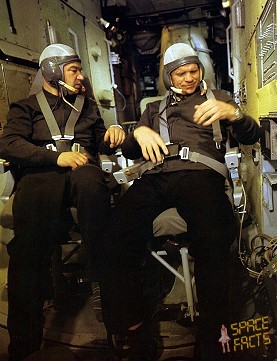
Gubarev | Aleksei Aleksandrovich | Commander | Soyuz 17 | 10.01.1975 | 21:43:37 UTC | Soyuz 17 | 09.02.1975 | 11:03:22 UTC | 29d 13h 19m 45s | 466 |
| 2 | |
Grechko | Georgi Mikhailovich | Flight Engineer | Soyuz 17 | 10.01.1975 | 21:43:37 UTC | Soyuz 17 | 09.02.1975 | 11:03:22 UTC | 29d 13h 19m 45s | 466 |
1st Backup Crew
| No. | Nation | Surname | Given names | Position |
| 1 | |
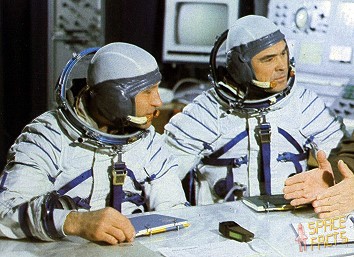
Lazarev | Vasili Grigoriyevich | Commander |
| 2 | |
Makarov | Oleg Grigoriyevich | Flight Engineer |
 |
2nd Backup Crew
| No. | Nation | Surname | Given names | Position |
| 1 | |
Klimuk | Pyotr Iliyich | Commander |
| 2 | |
Sevastiyanov | Vitali Ivanovich | Flight Engineer |
 |
Expedition Report
|
Launch from the Baikonur Cosmodrome and
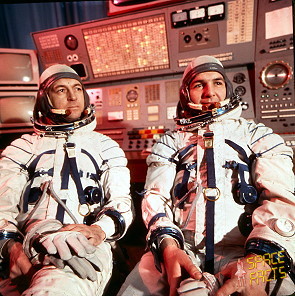
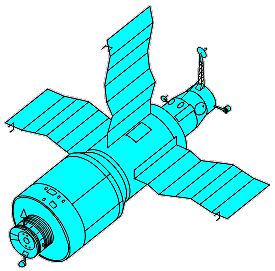
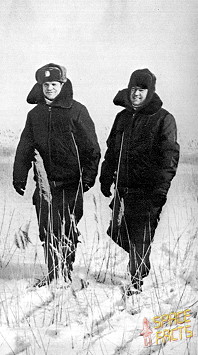
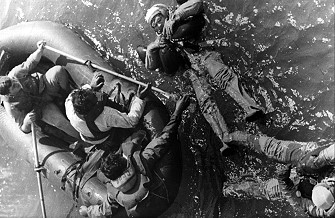
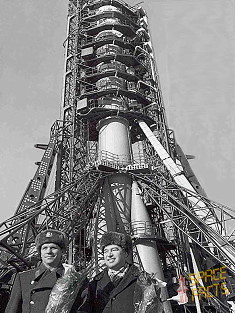
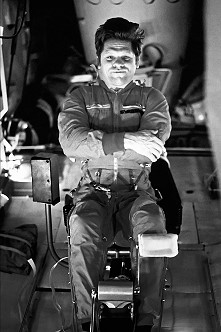
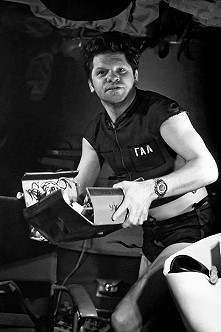
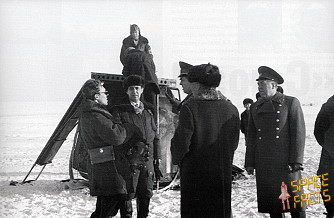
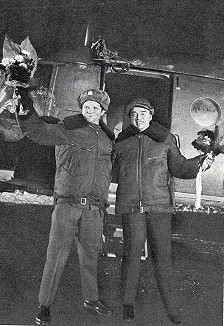
landing 110 km northeast of Tselinograd. Following a one-day solo flight Soyuz 17 docked with the space station Salyut 4 on January 12, 1975. Salyut 4 (DOS 4) was a Salyut space station launched on December 26, 1974 into an orbit with an apogee of 355 km, a perigee of 343 km and an orbital inclination of 51.6 degrees. It was essentially a copy of the DOS 3, and unlike its ill-fated sibling it was a complete success. Salyut 4 was in an unusually high circular orbit of 350 km (220 mi) when Soyuz 17 docked with the station. Salyut designer Konstantin Feoktistov said this was to ensure propellant consumption would be half of what was needed for lower-altitude Salyut's. The crew transferred into space station and stayed there 29 days. The crew worked between 15 and 20 hours a day, including their 2 ½ hour exercise period. One of their activities included testing communication equipment for tracking ships and contacting mission control via a Molniya satellite. Several astronomical experiments were performed. The crew discovered that the main mirror of the solar telescope had been ruined by direct exposure to sunlight when the pointing system failed. They resurfaced the mirror and worked out a way of pointing the telescope using a stethoscope, stopwatch, and the noises the moving mirror made in its casing. On January 14, 1975, a ventilation hose was set up from Salyut 4 to keep the Soyuz ventilated while its systems were shut down. On January 19, 1975 it was announced that ion sensors were being used to orient the station, a system described as being more efficient. A new teleprinter was used for communications from the ground crew, freeing the Salyut crew from constant interruptions during their work. The cosmonauts began powering down the station on February 07, 1975 and they returned to Earth in the Soyuz capsule two days later. The landing occurred in a snowstorm with winds of 72 km/h. The Soyuz spacecraft is composed of three elements attached end-to-end - the Orbital Module, the Descent Module and the Instrumentation/Propulsion Module. The crew occupied the central element, the Descent Module. The other two modules are jettisoned prior to re-entry. They burn up in the atmosphere, so only the Descent Module returned to Earth. Having shed two-thirds of its mass, the Soyuz reached Entry Interface - a point 400,000 feet (121.9 kilometers) above the Earth, where friction due to the thickening atmosphere began to heat its outer surfaces. With only 23 minutes left before it lands on the grassy plains of central Asia, attention in the module turned to slowing its rate of descent. Eight minutes later, the spacecraft was streaking through the sky at a rate of 755 feet (230 meters) per second. Before it touched down, its speed slowed to only 5 feet (1.5 meter) per second, and it lands at an even lower speed than that. Several onboard features ensure that the vehicle and crew land safely and in relative comfort. Four parachutes, deployed 15 minutes before landing, dramatically slowed the vehicle's rate of descent. Two pilot parachutes were the first to be released, and a drogue chute attached to the second one followed immediately after. The drogue, measuring 24 square meters (258 square feet) in area, slowed the rate of descent from 755 feet (230 meters) per second to 262 feet (80 meters) per second. The main parachute was the last to emerge. It is the largest chute, with a surface area of 10,764 square feet (1,000 square meters). Its harnesses shifted the vehicle's attitude to a 30-degree angle relative to the ground, dissipating heat, and then shifted it again to a straight vertical descent prior to landing. The main chute slowed the Soyuz to a descent rate of only 24 feet (7.3 meters) per second, which is still too fast for a comfortable landing. One second before touchdown, two sets of three small engines on the bottom of the vehicle fired, slowing the vehicle to soften the landing. |
Photos / Graphics
 |
 |
 |
 |
 |
 |
 |
 |
| © |  |
Last update on March 26, 2025.  |
 |