Human Orbital Spaceflights

International Flight No. 174STS-67Endeavour (8)68th Space Shuttle missionUSA |
 |
 |
|
Source: www.spacepatches.nl |
||
 |
||
Launch, orbit and landing data
walkout photo |
 |
||||||||||||||||||||||||||||
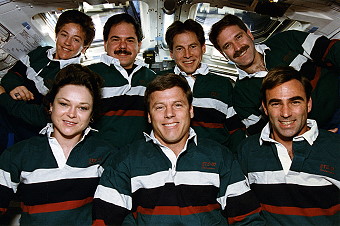
alternative crew photo |
|||||||||||||||||||||||||||||
alternative crew photo |
Crew
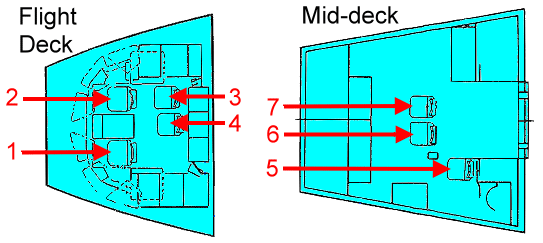
| No. | Surname | Given names | Position | Flight No. | Duration | Orbits | |
| 1 |  |
Oswald | Stephen Scot | CDR | 3 | 16d 15h 08m 46s | 262 |
| 2 | |
Gregory | William George "Borneo" | PLT | 1 | 16d 15h 08m 46s | 262 |
| 3 | |
Grunsfeld | John Mace | MS-1, EV-2 | 1 | 16d 15h 08m 46s | 262 |
| 4 | |
Lawrence | Wendy Barrien | MS-2, FE | 1 | 16d 15h 08m 46s | 262 |
| 5 | |
Jernigan | Tamara Elizabeth "Tammy" | MS-3, PLC, EV-1 | 3 | 16d 15h 08m 46s | 262 |
| 6 | |
Durrance | Samuel Thornton | PS-1 | 2 | 16d 15h 08m 46s | 262 |
| 7 | |
Parise | Ronald Anthony | PS-2 | 2 | 16d 15h 08m 46s | 262 |
Crew seating arrangement
|
 |
|
||||||||||||||||||||||||||||||||
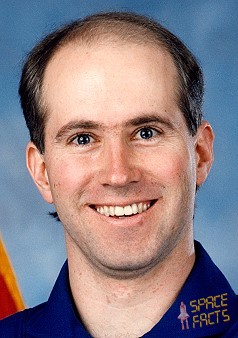
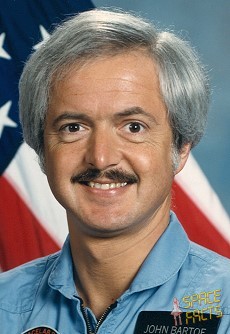
Backup Crew
|
 |
 |
|||||||||||||||
Hardware
| Orbiter : | OV-105 (8.) |
| SSME (1 / 2 / 3): | 2012 (16.) / 2033 (7.) / 2031 (12.) |
| SRB: | BI-071 / RSRM 43 |
| ET: | ET-69 (LWT-62) |
| OMS Pod: | Left Pod 04 (15.) / Right Pod 01 (21.) |
| FWD RCS Pod: | FRC 5 (8.) |
| RMS: | 303 (9.) |
| EMU: | EMU No. 2033 (PLSS No. 1005) / EMU No. 2039 (PLSS No. 1013) |
Flight
|
Launch from Cape Canaveral (KSC) and
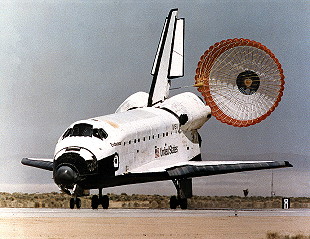
landing on the Edwards
AFB, Runway 22.
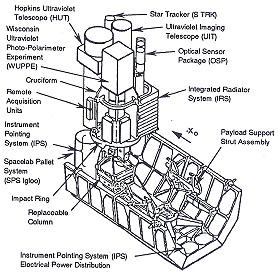
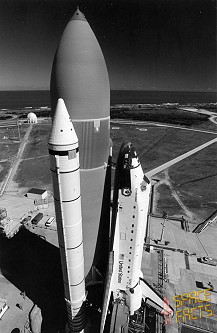
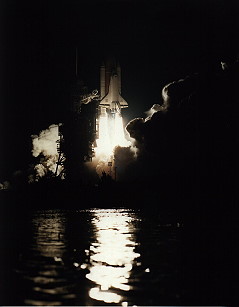
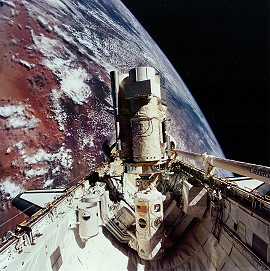
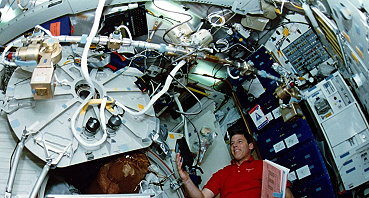
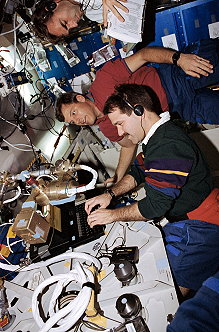
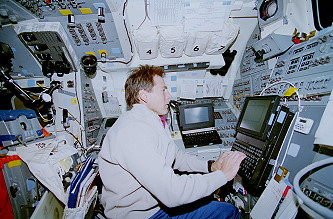
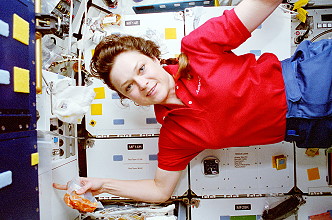
The ASTRO Observatory, making its second flight aboard a Space Shuttle, was a package of three instruments mounted on the Spacelab Instrument Pointing System (IPS). The Hopkins Ultraviolet Telescope (HUT) conducted spectroscopy in the far ultraviolet portion of the electromagnetic spectrum, allowing scientists to learn what elements are present in targeted celestial objects, as well as identify physical processes taking place. The second instrument, the Ultraviolet Imaging Telescope (UIT), took wide-field photographs of objects in ultraviolet light, recording the images on film for processing back on Earth. The third instrument, the Wisconsin Ultraviolet Photo- Polarimeter Experiment (WUPPE), measured the intensity of ultraviolet light and its degree of polarization. The instrument gave astronomers clues to the geometry of a star or the composition and structure of the interstellar medium it illuminates. The flight also saw the continuation of NASA's Get Away Special (GAS) experiments program. Experiment operations conducted around the clock on this flight, with the astronauts divided into two teams. Stephen Oswald, William Gregory, John Grunsfeld and Ronald Parise were the "Red Team". Members of the "Blue Team" were Wendy Lawrence, Tamara Jernigan and Samuel Durrance. ASTRO-2 program aimed at exploring 23 different science programs, and all were achieved. HUT, considered complement to Hubble Space Telescope, completed more than 200 separate observations of more than 100 celestial objects. Investigators believed telescope collected enough data to meet its primary mission objective: detecting presence of intergalactic helium, telltale remnant of theoretical Big Bang explosion that began universe. HUT, in conjunction with Hubble telescope, took ultraviolet measurements of Jupiter's aurora; also studied Jupiter's moon Io, and Venusian and Martian atmospheres. The Hopkins Ultraviolet Telescope (HUT) conducted spectroscopy in the far ultraviolet portion of the electromagnetic spectrum. During ASTRO-2, it studied a wide variety of objects, ranging from our own solar system and galactic neighborhood to very distant objects near the edge of the observable universe. HUT used a 36-inch (0.9 meter) mirror, located in the back of the telescope tube, to focus ultraviolet light from astronomical objects into a spectrograph set in the middle of the telescope. The spectrograph "spreads" ultraviolet light into a spectrum which could be studied in detail, in much the same way as a prism separates visible light into a rainbow of colors. It then measured the brightness of the light at each wavelength. UIT cameras imaged about two dozen large spiral galaxies for inclusion in atlas of such galaxies, and made first ultraviolet images of entire moon. Also studied were rare, hot stars that are 100 times as hot as sun; elliptical galaxies and some of faintest galaxies in universe. Investigators were disappointed upon developing UIT film to learn that one of its two cameras had malfunctioned undetected on orbit, but an initial assessment showed that 80 percent of science objectives still would be met. UIT was a powerful combination of telescope, image intensifier and camera. Unlike data from the other ASTRO instruments, which were electronically transmitted to the ground, UIT images were recorded directly on very sensitive astronomical film. The film was processed and analyzed after Endeavour returned to Earth. Light was reflected from a 15-inch (38-centimeter) primary mirror, at the middle of the telescope tube, to a secondary mirror near the front. The secondary mirror was linked to an image motion compensation system, which adjusted it slightly as necessary to offset any motion or jitter in the spacecraft. This was critical since any motions would blur the resulting photographs. The Wisconsin Ultraviolet Photo-Polarimeter Experiment (WUPPE) measured the polarization and intensity of ultraviolet radiation from celestial objects. A major ASTRO-2 goal for WUPPE was to follow up on ASTRO-1 observations of the interstellar medium. The science team hoped to learn more about the causes of polarization and the nature of "dust" grains in the space between stars. They also followed up on observations of active galaxies and rapidly spinning stars. The telescope was a classical Cassegrain-type, meaning that light enters the tube and strikes a large, parabolic mirror near the back. The light then is reflected forward to a smaller, secondary mirror near the front of the telescope, which focuses the light back through a hole in the center of the large mirror. The secondary mirror can be adjusted in precise increments to refocus the telescope, to allow it to look at objects slightly offset from those other ASTRO instruments are studying, and to perform rapid small corrections to the telescope's pointing direction. Behind the primary mirror, the beam passed through an ultraviolet spectrograph, a device which spreads out the radiation by wavelengths. A beam-splitting prism divided the resulting spectrum into two perpendicular planes of polarization, and the two spectra were recorded simultaneously on two separate detectors. Comparison of the two spectra was then used to study the polarization of the ultraviolet light as a function of wavelength. WUPPE used half a dozen bright stars like flashlights to illuminate the interstellar medium, literally shedding new light on the chemical composition and physical nature of the "dust" between stars in our Milky Way galaxy. Surfaces of these dust grains are thought to provide a safe haven for the formation of molecules, clouds of which are the "womb" for the formation of each generation of new stars. The third in a series of six commercial experiments, known as CMIX, flew aboard Endeavour during STS-67. CMIX-03 included biomedical, pharmaceutical, biotechnology, cell biology, crystal growth and fluids science investigations. These experiments explored ways in which microgravity can benefit drug development and delivery for treatment of cancer, infectious diseases and metabolic deficiencies. These experiments also included protein and inorganic crystal growth, secretion of medically important products from plant cells, calcium metabolism, invertebrate development and immune cell functions. Protein Crystal Growth Experiments: The STS-67 mission carried two systems in Shuttle middeck lockers to continue space-based research into the structure of proteins and other macromolecules. Vapor Diffusion Apparatus trays were housed within a temperature-controlled Thermal Enclosure System, which filled the area normally occupied by two lockers. The Protein Crystallization Apparatus for Microgravity was housed in a Single-locker Thermal Enclosure System. On STS-67, the Vapor Diffusion Apparatus experiments were contained in a Thermal Enclosure System (TES), which had the size of two mid-deck lockers. The TES, set at 72 degrees Fahrenheit (22 degrees Celsius), contained four vapor diffusion apparatus trays, each containing 20 individual crystallization chambers. Each experiment chamber included a double-barreled syringe containing protein solution in one barrel and precipitant solution in the other. A reservoir of concentrated precipitant solution was contained in the wicking material lining the experiment chamber. The Protein Crystallization Apparatus for Microgravity (PCAM) was the second test of a new design for growing large quantities of protein crystals in orbit. It first flew aboard STS-63 in February 1995. The apparatus held more than six times as many samples as are normally accommodated in the same amount of space. A few of the candidate proteins for this flight of the PCAM were human cytomegalovirus assembling (a factor in virus duplication), parathyroid hormone antagonist (a controlling factor in bone growth), pseudoknot 26 (a potential HIV inhibitor), human antithrombin III (a blood clotting factor), and an HIV protease/drug complex (a factor in viral replication). The Middeck Active Control Experiment (MACE) was designed to study the active control of flexible structures in space. In this experiment, a small, multi-body platform was assembled and free-floated inside the Space Shuttle. Tests were conducted on the platform to measure how disturbances caused by a payload impacts the performance of another nearby payload which was attached to the same supporting structure. MACE consisted of three separate hardware elements: The Multi-body Platform, the Experiment Support Module, and the Ku-Band Interface Unit. The Multi-body Platform consisted of a long flexible polycarbonate structure. A two-axis gimbaling payload was located at either end, and a three-axis torque wheel/rate gyro platform is located in the center. By swapping out certain components, the platform could be reconfigured into more complex geometries, thereby increasing the complexity of the control problem. Actuators consisting of 7 motors and two piezoelectric bending elements and sensors, consisting of rate gyros, strain gauges, and encoders, were distributed along the structure to facilitate active control. The Experiment Support Module contained all the electronics necessary to conduct the experiment. The Ku-Band Interface Unit allowed downlink and uplink of data from the middeck. Mission Commander Stephen Oswald and Pilot William Gregory operated the hardware on orbit. As part of the Shuttle Amateur Radio Experiment (SAREX) students in the United States and other countries had a chance to speak via amateur radio with astronauts aboard the Space Shuttle Endeavour during STS-67. Ground-based amateur radio operators ("hams") were able to contact the Shuttle through automated computer-to-computer amateur (packet) radio links. There also were voice contacts with the general ham community as time permitted. Shuttle Commander Stephen Oswald (call sign KB5YSR), pilot William Gregory, (call sign KC5MGA), mission specialists Tamara Jernigan (call sign KC5MGF) and Wendy Lawrence (KC5KII) and Payload Specialists Ronald Parise (WA4SIR) and Samuel Durrance (N3TQA) talked with the students. Two Get Away Special (GAS) payloads were also on board. They were the G-387 and G-388 canisters. This experiment was sponsored by the Australian Space Office and AUSPACE ltd. The objectives were to make ultraviolet observations of deep space or nearby galaxies. These observations were made to study the structure of galactic supernova remnants, the distribution of hot gas in the Magellanic Clouds, the hot galactic halo emission, and emission associated with galactic cooling flows and jets. The two GAS canisters were interconnected with a cable. Canister 1 had a motorized door assembly that exposed a UV telescope to space when opened. UV reflective filters on the telescope's optics determine its UV bandpass. Canister 2 contained two video recorders for data storage and batteries to provide experiment power. The mission was extended one day due of bad weather and so this Shuttle flight became the longest to date. |
Photos / Graphics
 |
 |
 |
 |
 |
 |
 |
 |
 |
 |
 |
 |
 |
 |
 |
 |
Earth observation photos |
|
| © |  |
Last update on June 20, 2023.  |
 |