Human Orbital Spaceflights

International Flight No. 101STS-51DDiscovery (4)16th Space Shuttle missionUSA |
 |
 |
Launch, orbit and landing data
walkout photo |
 |
||||||||||||||||||||||||||||
alternative crew photo |
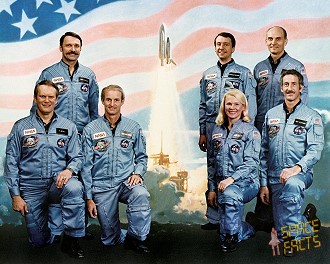
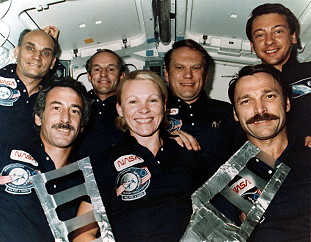
Crew
| No. | Surname | Given names | Position | Flight No. | Duration | Orbits | |
| 1 |  |
Bobko | Karol Joseph "Bo" | CDR | 2 | 6d 23h 55m 23s | 110 |
| 2 | |
Williams | Donald Edward | PLT | 1 | 6d 23h 55m 23s | 110 |
| 3 | |
Seddon | Margaret Rhea | MS-1, RMS | 1 | 6d 23h 55m 23s | 110 |
| 4 | |
Griggs | Stanley David | MS-2, EV-2, FE | 1 | 6d 23h 55m 23s | 110 |
| 5 | |
Hoffman | Jeffrey Alan | MS-3, EV-1 | 1 | 6d 23h 55m 23s | 110 |
| 6 | |
Walker | Charles David | PS-1 | 2 | 6d 23h 55m 23s | 110 |
| 7 | |
Garn | Edwin Jacob "Jake" | PS-2 | 1 | 6d 23h 55m 23s | 110 |
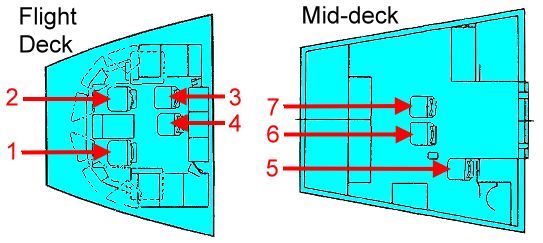
Crew seating arrangement
|
 |
|
||||||||||||||||||||||||||||||||
Hardware
| Orbiter : | OV-103 (4.) |
| SSME (1 / 2 / 3): | 2109 (6.) / 2018 (5.) / 2012 (8.) |
| SRB: | BI-018 |
| ET: | ET-18 (LWT-11) |
| OMS Pod: | Left Pod 03 (5.) / Right Pod 03 (4.) |
| FWD RCS Pod: | FRC 3 (4.) |
| RMS: | 301 (4.) |
| EMU: | EMU No. 1059 (PLSS No. 1007) / EMU No. 1060 (PLSS No. 1010) |
Flight
|
Launch from Cape Canaveral (KSC) and
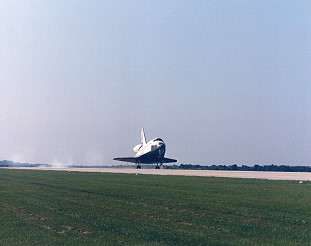
landing in Cape Canaveral (KSC), Runway 33. The launch of Discovery on
STS-51D was delayed by 55 minutes when a boat strayed
into the restricted
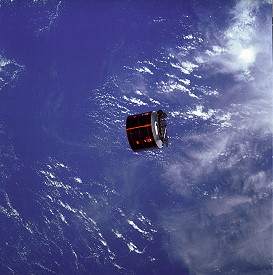
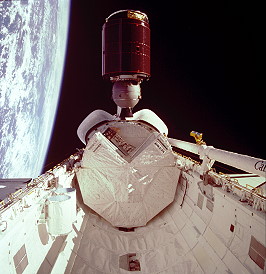
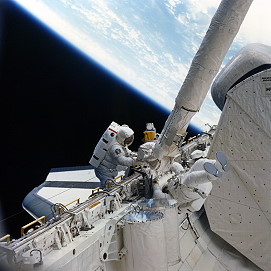
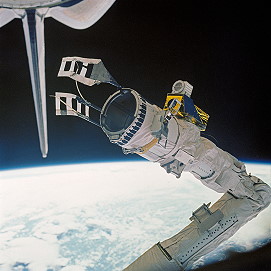
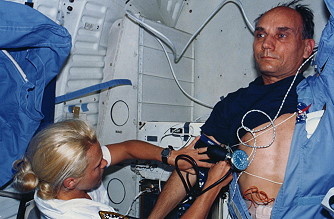
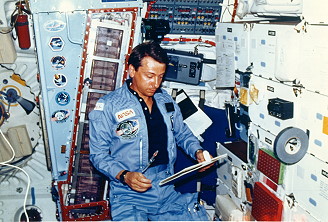
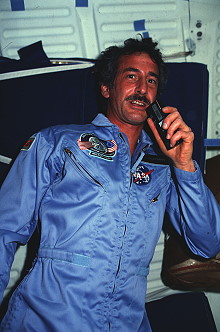
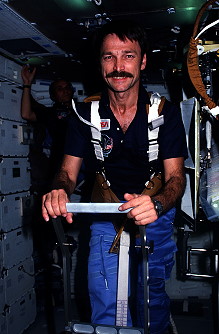
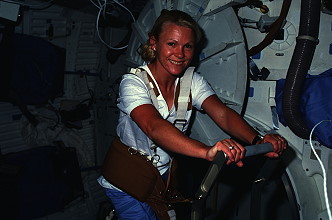
SRB recovery zone. Mission STS-51D was originally set for a March launch and included deployment of the Hughes LEASAT 3 spacecraft and retrieval of NASA's Long Duration Exposure Facility. It was remanifested following the decision to cancel Mission STS-51E, which was to have been flown by orbiter Challenger. The revised STS-51D cargo included the Hughes satellite plus the Canadian communications spacecraft Anik C-1. Other payloads included the Continuous Flow Electrophoresis System, the American Echocardiograph Experiment, two middeck student experiments and two Getaway Special canisters. Also scheduled to fly were a variety of simple toys intended to demonstrate the unique properties of space flight for elementary and junior high school students. The crew deployed the communications satellites TELESAT-1 (ANIK C-1) and SYNCOM IV-3 (LEASAT-3) into Earth orbit. Anik C-1 was owned and operated by Telesat Canada, Ottawa. Anik C-1 was the last of Telesat's trio of 14/12 GHz Anik C satellites. Anik C-1 was the first satellite placed in final orbit using Telesat's new global tracking antenna system. Anik C communications satellites were identical, cylindrical, spin-stabilized spacecraft that operate exclusively in the high frequency (14 and 12 GHz) satellite radio bands, with 16 transponders (communications repeaters) each. Each of these 16 satellite channels was capable of carrying two color TV signals, together with their associated audio and cue and control circuits, for a total TV signal capacity of 32 programs per satellite. Anik C-3 and Anik C-2 were carrying Canadian pay television service, educational broadcasting and long-distance telephone and data traffic. Upon launch from the orbiter by springs, the 2,557-lb. (1,159 kg) satellite began spinning at about 50 rpm for stability. About 45 minutes later, or one-half Earth orbit, its PAM-D boost motor was ignited by an onboard timer, kicking the satellite into an approximately 190-by-23,000-mi. (307.77-by-37,014-km) elliptical orbit. At a selected high point in that orbit, another, smaller rocket motor inside the satellite was fired by ground controllers to increase the satellite's speed and circularize the orbit at geosynchronous altitude of roughly 22,300 mi. (37,497 km). LEASAT 3, also known as Syncom IV-3, was the third of four satellites which will be leased by the Department of Defense to replace older FleetSatCom spacecraft for worldwide UHF communications between ships, planes and fixed facilities. A Hughes HS-381 design, LEASAT spacecraft are designed expressly for launch from the Space Shuttle and use the unique "Frisbee" or rollout method of deployment. The first two spacecraft were deployed during the STS-41D and STS-51A Shuttle missions. Interface between the spacecraft and the payload bay was accomplished with a cradle structure. The cradle permitted the spacecraft to be installed lying on its side, with its retracted antennas pointing toward the nose of the orbiter and its propulsion system pointing toward the back. Mounting the antennas on deployable structures allowed them to be stowed for launch. Five trunnions (four longeron and one keel) were used to attach the cradle to the Shuttle. Five similarly located internal attach points were used to attach the spacecraft to the cradle. Another unique feature of the LEASAT series of satellites was no requirement for a separately purchased upper stage, as have all the other communications satellites launched to date from the Shuttle. The LEASAT satellites contained their own unique upper stage to transfer them from the Shuttle deploy orbit of about 182 mi. (292.9 km) to a circular orbit 22,300 mi. (38,888 km) over the equator. Each satellite was 20 ft. (6.09 meters) long with UHF and omni-directional antennas deployed. Total payload weight in the Shuttle was 17,000 lb. (7,711 kg). The satellite's weight on station at the beginning of its planned 7-year life was nearly 7,900 lb. (3,583 kg). Hughes Space and Communications Group builded the satellites. Ejection of the spacecraft from the Shuttle was initiated when locking pins at the four contact points are retracted. An explosive device then releases a spring that ejects the space craft in a "Frisbee" motion. This gave the satellite its separation velocity and gyroscopic stability. The LEASAT-3 spacecraft sequencer failed and the OMNI antenna was not deployed and the perigee kick motor did not start. The mission was extended two days to make certain the sequencer start lever was in the proper position for deployment of the OMNI antenna. Jeffrey Hoffman and David Griggs performed a not planned spacewalk on April 16, 1985 (3h 06m). One of Discovery's two satellite payloads on mission STS-51D, the Hughes Syncom-IV/Leasat 3 geosynchronous communications satellite, remained inert after deployment on April 13, 1985 and engineers quickly determined that a likely culprit was a faulty switch on the satellite's side. The spate of malfunctions in Shuttle-launched satellites encouraged managers to authorize the first unscheduled EVA of the Shuttle program. Engineers first proposed that an astronaut ride the RMS close to the satellite and trip the switch by hand using an improvised tool. Discovery carried no MFR, however, and astronauts Sherwood Spring and Jerry Ross, working in the WETF, were unable to develop a satisfactory substitute based on materials aboard Discovery. Engineers then hatched a plan in which the EVA astronauts would attach improvised switch-pulling appendages to the RMS end effector. Rhea Seddon would maneuver the RMS so that the appendages snag the switch that started an automatic timer, and Discovery would quickly move away to get clear of the plume from the satellite's kick motor. David Griggs and Jeffrey Hoffman trained for contingency EVAs before they were assigned to STS-51D, so they each had over 50 hours of contingency EVA training - more than four times as much as normal - going into this EVA. EVA operations and in-flight maintenance engineers developed and designed procedures. Jerry Ross and Sherwood Spring simulated the procedure in the WETF, then talked through the planned EVA procedure with David Griggs and Jeffrey Hoffman over the radio. The astronauts discussed the procedures between themselves. Two different switch-pullers (the "lacrosse stick" and the "flyswatter") were manufactured using materials on board Discovery, including tape and plastic book covers. Twenty-four hours ahead of the EVA the crew reduced Discovery's cabin pressure to 70.3 kpascal (10.2 psi) to cut prebreathe time to 1 hour. Jeffrey Hoffman called prebreathing "a miserable experience." The thrill of an unexpected trip into Discovery's payload bay quickly overshadowed his discomfort, however. Before the EVA Rhea Seddon bent the RMS at elbow and wrist to bring the RMS end effector closer to the airlock. The astronauts moved to the end effector, which is about halfway down the payload bay on the starboard side, and attached the switch-pullers with a payload retention strap while EVA CapCom Jerry Ross advised. David Griggs and Jeffrey Hoffman rested while they were out of communication range. Their work completed, David Griggs pushed himself over the starboard payload bay sill toward the orbiter's delicate radiator panels, and Karol Bobko warned him to return to the payload bay. The astronauts then returned to the warmth of Discovery's crew compartment. Rhea Seddon snared the switch repeatedly with the switch-pullers, but Syncom IV/Leasat 3 remained inert. The middeck Continuous Flow Electrophoresis System (CFES) unit made its sixth spaceflight on mission STS-51D. Payload specialist Charles Walker, of McDonnell Douglas, operated the system. This was the second Space Shuttle flight for Charles Walker as a payload specialist. The primary objectives of the flight were to separate and collect a quantity of protein material and to evaluate contamination control and sample stream dynamics. During the STS-41D mission in August/September 1984, the middeck CFES unit separated 83 percent of the concentrated protein material on board. However, post flight assays revealed levels of endotoxin contamination which rendered the hormone unsuitable for animal testing. To prevent a recurrence, stronger sterilizing chemicals will be used preflight to cleanse the middeck unit. Also, procedures have been modified to maintain cooler operating temperatures throughout the course of the mission in an effort to retard bacterial growth. Additionally, the degassing units and sensors which failed during the STS-41D were replaced. Software modifications were made to the system's computer control device to lengthen the unit's response time between commands. Difficulties in the automation software were causing the system to adjust too quickly. Once each day Charles Walker tested for the presence of microbes and endotoxins. These tests were made by withdrawing a small sample of fluid from five locations and incubating them in vials which have been loaded previously with freeze-dried reactants. Protein Crystal Growth Experiment: Detailed knowledge of the composition and structure of proteins is extremely important to the understanding of their nature, chemistry and the ability to manufacture them for medical purposes. However, for most complex proteins, it has not been possible to grow, on Earth, crystals large enough to permit X-ray or neutron diffraction analyses to obtain this information. A device has been developed by Marshall Space Flight Center, Huntsville, Ala., that should enable the growth of such crystals in the weightlessness of orbital spaceflight where gravity-driven convection currents are minimized, and where the crystals do not sediment but remain suspended while they develop optimum size and conformation. The first exploratory flight of such equipment involved the use of a small device that fit within a part of a standard middeck locker. McDonnell Douglas Astronautics had agreed to include this unit in one of the middeck lockers used in conjunction with the flight of the CFES experiment on this flight. The CFES payload specialist, Charles Walker, was trained in the preparation of the unit. A key objective of the overall protein crystal growth program was to enable drug design without the present empirical approach to enzyme engineering and the manufacture of chometherapeutic agents. Two Space Shuttle Student Involvement Program experiments flew aboard Shuttle mission STS-51D. One experiment, proposed by Sean Amberg of Seward, NE., was titled "Statoliths in Corn Root Caps". This experiment looked at the effect of weightlessness on the formation of statoliths (gravity sensing organs) in plants, and was tested by exposing plants with capped and uncapped roots to space flight. The root caps of the flight and control plants were examined post-flight by an electron microscope for statolith changes. The second student experiment was "The Effect of Weightlessness on the Aging of Brain Cells", proposed by Andrew Fras of Binghamton, NY. This experiment (using houseflies) was expected to show accelerated aging in their brain cells, based on an increased accumulation of age pigment in, and deterioration of, the neurons. American Flight Echocardiograph (AFE): Understanding the effects of weightlessness on the cardiovascular system of astronauts is important for both personal and operational safety reasons. The dynamics of the heart pump action is one possible factor in the adaptation of the cardiovascular system to weightlessness. The newly available American Flight Echocardiograph (AFE) instrument was used to acquire in-flight data on these effects during the course of space adaptation for the purpose of developing optimal counter measures to crew cardiovascular changes (particularly during reentry) and to ensure long-term safety to people living in weightlessness. The AFE weighed about 43 lb. and was carried within a standard locker from which it will be operated. One crewmember was trained in the technique of obtaining clinical grade self-administered echocardiograms. The first exploratory flight of Phase Partitioning Experiment (PPE) equipment involved the use of a small, handheld device, a little larger than a cigarette box and weighing about 1 pound. This unit will fit within a small part of a standard middeck locker. On flight STS-51D, it was planned that payload specialist Jake Garn should conduct this experiment in addition to some investigations in the space adaptation syndrome. The unit had 15 chambers to allow the test of different volume ratios and compositions of the phases and differences in wall coatings with in the chambers. Phase partitioning is a selective, yet gentle and inexpensive technique, ideal for the separation of biomedical materials such as cells and proteins. It involves establishing a two-phase system by adding various polymers to a water solution containing the materials to be separated. Two phase systems most familiar to us are oil and water or cream and milk. When two phase polymer systems are established, the biomedical material they contain tend to separate or "partition" into the different phases. Jake Garn, a U.S. Senator from Utah, was the first public official to fly aboard the Space Shuttle. Jake Garn was onboard as a payload specialist and Congressional observer. As payload specialist, he carried out medical physiological tests and measurements. Tests on Jake Garn seeked to detect and record changes the body undergoes in weightlessness, an ongoing program that began with astronauts on the fourth Shuttle flight. The first, during launch, was Jake Garn wearing a waist belt with two stethoscope microphones fastened to an elastic bandage. At main engine cutoff, about 8 ½ minutes into the flight, the belt was plugged into a portable tape recorder stored in the seat flight bag and begins recording bowel sounds to evaluate early inflight changes in gastric mobility. A non-medical activity planned for Jake Garn was the Phase Partitioning Experiment (PPE) in which fluid mixtures of different densities are photographed to analyze the characteristics of their separation during weightlessness. The STS-51D crew demonstrated the behavior of simple toys in a weightless environment. The results, recorded and videotaped, became part of a curriculum package for elementary and junior high students through the Houston Museum of Natural Science. Studies have shown that students can learn physics concepts by watching mechanical systems in action. In an Earth-based classroom, the gravitational field has a constant value of 1-g. Although the gravity force varies greatly throughout the universe and in non-inertial reference frames, students can only experiment in a constant 1-g environment. The filming of simple generic- motion toys in the zero-g environment of the Space Shuttle will enable students of all ages to share a learning experience and discover how the different toy mechanical systems work without gravity. The following members of the STS-51D crew demonstrated the effects of weightlessness on "dime-store" toys: Karol Bobko - a spinning top and three unrestrained gyroscopes Donald Williams - a spring-wound flipping mouse and a paddle ball. He also tried to perform a juggling act in zero-g Rhea Seddon - a ball and jacks and a Slinky David Griggs - a yo-yo Jeffrey Hoffman - a Wheelo, magnetic marbles and a spring-wound. An experiment to test low light level photographic equipment, in preparation for next year's visit by Halley's Comet, was planned. Mission specialist Jeffrey Hoffman, an astronomer and astrophysicist, checked out an image intensifier coupled with a Nikon camera, a combination that intensifies usable light by a factor of about 10,000. During the shuttle's landing at KSC on April 19, 1985, extensive brake damage was suffered, and a landing gear tire ruptured. This prompted future shuttle flights to land at Edwards Air Force Base, California, until effective nose wheel steering could be implemented to reduce risks during landing. |
EVA data
| Name | Start | End | Duration | Mission | Airlock | Suit | Stripes | |
| EVA | Hoffman, Jeffrey | 16.04.1985, 12:3? UTC | 16.04.1985, 15:3? UTC | 3h 06m | STS-51D | Discovery | EMU No. 1059 | red |
| EVA | Griggs, David | 16.04.1985, 12:3? UTC | 16.04.1985, 15:3? UTC | 3h 06m | STS-51D | Discovery | EMU No. 1060 | without |
Photos / Graphics
 |
 |
|
source of all photos is NASA |
|
 |
 |
 |
 |
 |
 |
 |
 |
 |
 |
 |
 |
 |
 |
 |
|
more EVA photos |
|
| © |  |
Last update on March 27, 2020.  |
 |