Human Orbital Spaceflights

International Flight No. 17Gemini 6AUSA |
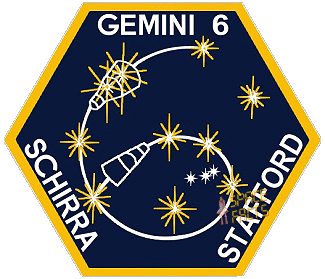 |
 |
Launch, orbit and landing data
walkout photo |
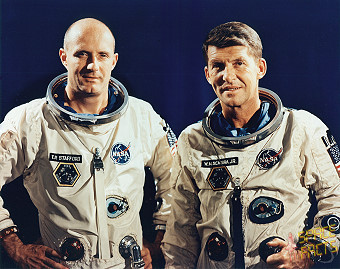 |
|||||||||||||||||||
alternative crew photo |
alternative crew photo |
|||||||||||||||||||
alternative crew photo |
alternative crew photo |
|||||||||||||||||||
alternative crew photo |
alternative crew photo |
|||||||||||||||||||
Crew
| No. | Surname | Given names | Position | Flight No. | Duration | Orbits | |
| 1 |  |
Schirra | Walter Marty, Jr. "Wally" | Command Pilot | 2 | 1d 01h 51m 24s | 16 |
| 2 | |
Stafford | Thomas Patten "Tom" | PLT | 1 | 1d 01h 51m 24s | 16 |
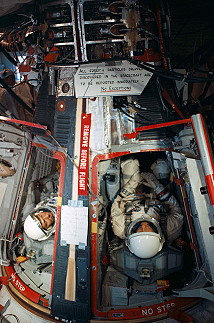
Crew seating arrangement
|
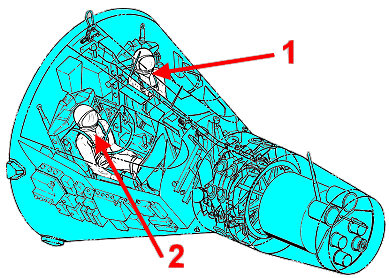 |
Backup Crew
|
 |
Hardware
| Launch vehicle: | Titan II GLV No. GT-6 (62-12561) |
| Spacecraft: | Gemini 6 (S/C-6 No. 1853) |
Flight
|
Launch from Cape Canaveral; landing 1010 km
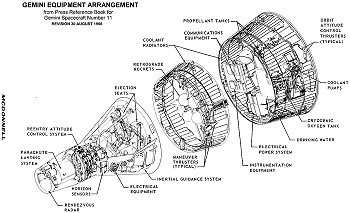
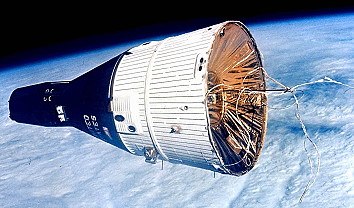
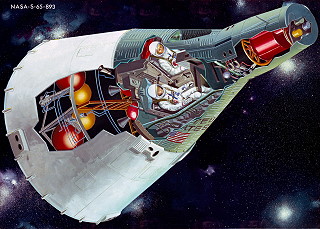
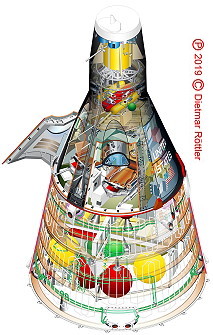
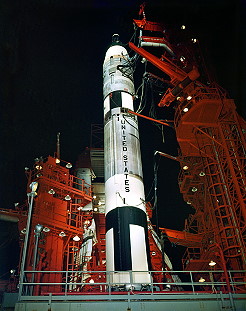
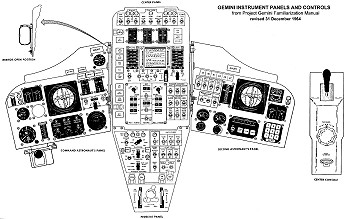
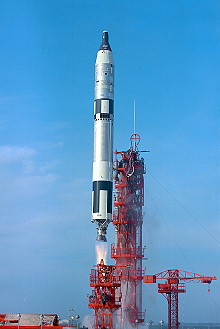
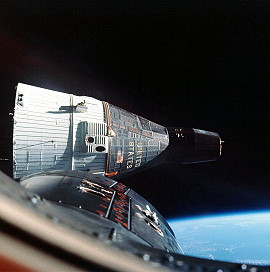
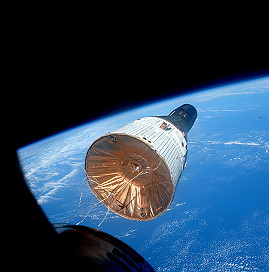
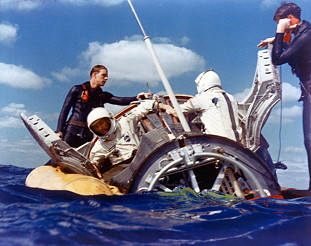
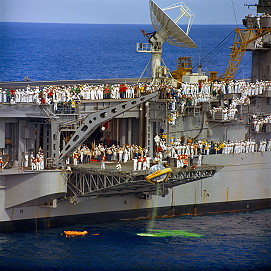
southwest of the Bermuda Islands. The Gemini spacecraft was a cone-shaped capsule consisting of two components, a reentry module and an adaptor module. The adaptor module made up the base of the spacecraft. It was a truncated cone 228.6 cm high, 304.8 cm in diameter at the base and 228.6 cm at the upper end where it attached to the base of the reentry module. The re-entry module consisted of a truncated cone which decreased in diameter from 228.6 cm at the base to 98.2 cm, topped by a short cylinder of the same diameter and then another truncated cone decreasing to a diameter of 74.6 cm at the flat top. The reentry module was 345.0 cm high, giving a total height of 573.6 cm for the Gemini spacecraft. The adaptor module was an externally skinned, stringer framed structure, with magnesium stringers and an aluminum alloy frame. The adaptor was composed of two parts, an equipment section at the base and a retrorocket section at the top. The equipment section held fuel and propulsion systems and was isolated from the retrorocket section by a fiber-glass sandwich honeycomb blast shield. The retrorocket section held the re-entry rockets for the capsule. The reentry module consisted mainly of the pressurized cabin which held the two Gemini astronauts. Separating the reentry module from the retrorocket section of the adaptor at its base was a curved silicone elastomer ablative heat shield. The module was composed predominantly of titanium and nickel-alloy with beryllium shingles. At the narrow top of the module was the cylindrical reentry control system section and above this the rendezvous and recovery section which holds the reentry parachutes. The cabin held two seats equipped with emergency ejection devices, instrument panels, life support equipment, and equipment stowage compartments in a total pressurized volume of about 2.25 cubic meters. Two large hatches with small windows could be opened outward, one positioned above each seat. Attitude control was effected by two translation-maneuver hand controllers, an attitude controller, redundant horizon sensor systems, and reentry control electronics, with guidance provided via an inertial measuring unit and radar system. The orbital attitude and maneuver system used a hypergolic propellant combination of monomethyl hydrazine and nitrogen tetroxide supplied to the engines by a helium system pressurized at 2800 psi. Two 95 lb translation thrusters and eight 23 lb attitude thrusters were mounted along the bottom rim of the adaptor, and two 79 lb and 4 95 lb thrusters were mounted at the front of the adaptor. Power was supplied by 3 silver-zinc batteries to a 22- to 30-volt DC two-wire system. During reentry and post-landing power was supplied by four 45 amp-hr silver-zinc batteries. Voice communications were performed at 296.9 MHz with an output power of 3 W. A backup transmitter-receiver at 15.016 MHz with an output power of 5 W was also available. Two antenna systems consisting of quarter-wave monopoles were used. Telemetry was transmitted via three systems, one for real time telemetry, one for recorder playback, and a spare. Each system was frequency-modulated with a minimum power of 2 W. Spacecraft tracking consisted of two C-band radar transponders and an acquisition-aid beacon. One transponder is mounted in the adaptor with a peak power output of 600 W to a slot antenna on the bottom of the adaptor. The other is in the reentry section, delivering 1000 W to three helical antennas mounted at 120-degree intervals just forward of the hatches. The acquisition-aid beacon was mounted on the adaptor and had a power of 250 mW. At the time of reentry, the spacecraft would be maneuvered to the appropriate orientation and equipment adaptor section would be detached and jettisoned, exposing the retrorocket module. The retrorockets consisted of four spherical-case polysulfide ammonium perchlorate solid-propellant motors mounted near the center of the reentry adaptor module, each with 11,070 N thrust. They would fire to initiate the spacecraft reentry into the atmosphere, with attitude being maintained by a reentry control system of 16 engines, each with 5.2 N thrust. The retrorocket module would then be jettisoned, exposing the heat shield at the base of the reentry module. Along with the ablative heat shield, thermal protection during reentry was provided by thin Rene 41 radiative shingles at the base of the module and beryllium shingles at the top. Beneath the shingles was a layer of MIN-K insulation and thermoflex blankets. At an altitude of roughly 15,000 meters the astronauts would deploy a 2.4-meter drogue chute from the rendezvous and recovery section. At 3230 meters altitude the crew releases the drogue which extracts the 5.5-meter pilot parachute. The rendezvous and recovery section are released 2.5 seconds later, deploying the 25.6-meter main ring-sail parachute which is stored in the bottom of the section. The spacecraft is then rotated from a nose-up to a 35-degree angle for water landing. At this point a recovery beacon is activated, transmitting via an HF whip antenna mounted near the front of the reentry module. The launch was successful after the third attempt. This mission was originally intended to be the first mission to dock with an Agena Target Vehicle, but the Agena exploded 6 minutes after its launch on October 25, 1965 and the mission was cancelled. The plans were changed then. Now the main goal was a rendezvous of two Gemini spacecrafts in space. The flight schedule was changed too, now the next mission was Gemini 7 and Gemini 6 was now named Gemini 6A. But the second launch attempt on December 12, 1965 also failed. The Titan rocket shut down on the pad. The problem was, that the instruments had shown already a launch, when the engines shut down, so normally the crew had to eject. But Walter Schirra didn't with the simple reason, that he didn't felt any motions of the capsule (from which it could have fallen down and exploding). He trusted his senses and that was correct. When the engineers examined the thrust versus time graph, they found that the thrust rose nominally but started to get lower before the plug had fallen out. Through the night, engineers examined the rocket engine piece by piece until they found that a plastic cover had been left in the gas generator port. With this problem solved the rocket and spacecraft were recycled for a launch 72 hours after the first attempt. The third attempt then was successful and the rendezvous maneuver with the earlier launched spacecraft Gemini 7 too. The first burn of Gemini 6A came 94 minutes after launch when they increased their velocity by 16.5 ft/s (5.0 m/s). Due to their lower orbit they were gaining on Gemini 7 and were 634 nautical miles (1,174 km) behind. The next burn was at 2 hours and 18 minutes when Gemini 6A made a phase adjustment to put them on the same orbital inclination as Gemini 7. They now only trailed by 261 nautical miles (483 km). The radar on Gemini 6A first made contact with Gemini 7 at 3 hours and 15 minutes when they were 234 nautical miles (433 km) away. A third burn put them into a 146-by-148-nautical-mile (270 by 274 km) orbit. As they slowly gained, Walter Schirra put Gemini 6A's computer in charge of the rendezvous, and at 5 hours and 4 minutes, he saw a bright object that he at first thought was the star Sirius, but was in fact Gemini 7. During 270 minutes the crews moved as close as 30 centimeters to 90 meters, talking over the radio, while Gemini 7 almost drifted and Gemini 6A made the burns, because they had more fuel. It was the first radar contact between the two spacecraft. The rendezvous maneuver was the only work to do. The flight ended with a nominal reentry and landing in the West Atlantic, just 10 km from the planned landing point. The recovery ship was the USS Wasp. It was the first successfully controlled reentry and they did in full view of live television beamed from the Wasp via satellite transmission. |
Photos / Graphics
 |
 |
 |
 |
 |
 |
 |
 |
 |
 |
 |
 |
 |
 |
 |
 |
 |
| © |  |
Last update on August 11, 2020.  |
 |