Human Orbital Spaceflights

International Flight No. 235Soyuz TMA-2AgatRussia |
 |
 |
Launch, orbit and landing data
walkout photo |
 |
|||||||||||||||||||||||
alternative crew photo |
alternative crew photo |
|||||||||||||||||||||||
alternative crew photo |
||||||||||||||||||||||||
alternative crew photo |
||||||||||||||||||||||||
Crew
| No. | Surname | Given names | Position | Flight No. | Duration | Orbits | |
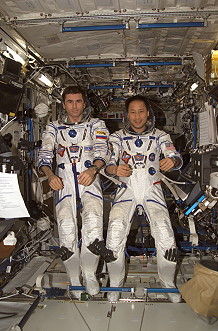
| 1 |  |
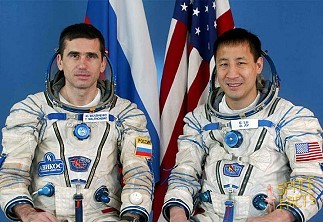
Malenchenko | Yuri Ivanovich | Commander | 3 | 184d 22h 46m 28s | 2890 |
| 2 |  |
Lu | Edward Tsang | Flight Engineer | 3 | 184d 22h 46m 28s | 2890 |
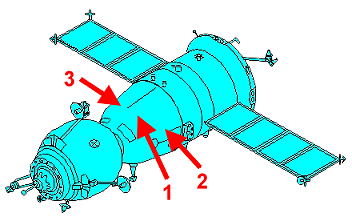
Crew seating arrangement
|
 |
|
||||||||||||||||
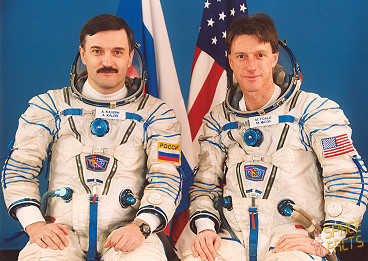
Backup Crew
|
 |
|||||||||||||||
Hardware
| Launch vehicle: | Soyuz-FG (No. 13M132S E15000-006) |
| Spacecraft: | Soyuz TMA-2 (TMA No. 212) |
Flight
|
Launch from the Baikonur Cosmodrome and
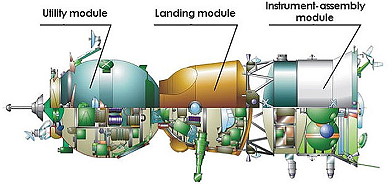
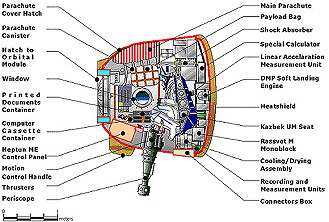
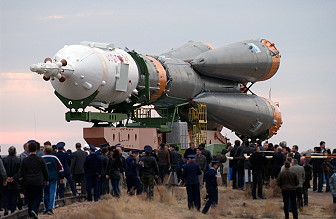
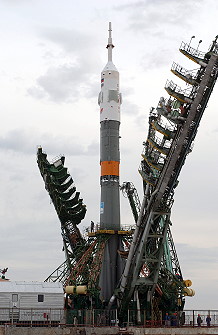
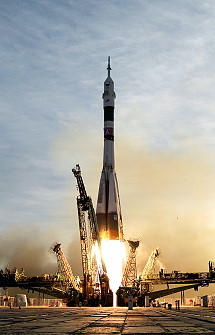
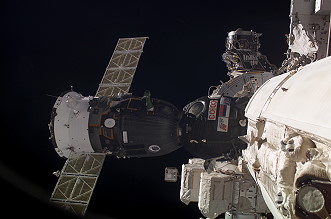
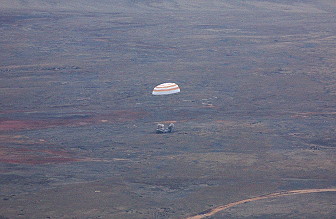
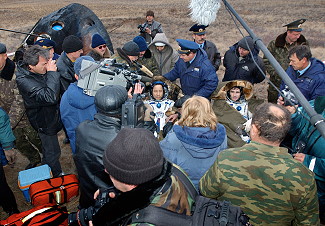
landing 34 km southeast of Arkalyk in Kazakhstan. This spaceflight became the ISS Expedition 7. The mission was called a "caretaker" crew. Following a two-day solo flight Soyuz TMA-2 docked to ISS on April 28, 2003. Yuri Malenchenko and Edward Lu replaced the Expedition 6 crew. Due to the reduced crew size, the scientific work had to be scaled down as well. Only 15 different experiments were conducted during the mission. Yuri Malenchenko and Edward Lu were also tasked with periodic maintenance work on the station, as well as spacewalk training (although no spacewalks were planned. Progress M1-10 was launched at 10:34 UTC on June 08, 2003. The spacecraft docked with the Pirs module at 11:14:53 UTC on June 11, 2003. Progress M1-10 carried supplies to the International Space Station, including food, water and oxygen for the crew and equipment for conducting scientific research. The freighter remained docked for three months before undocking at 19:41:44 UTC on September 04, 2003 to make way for Soyuz TMA-3. Following undocking, it remained in orbit for a month, conducting an earth observation mission. It was deorbited at 11:26 UTC on October 03, 2003, burning up in the atmosphere over the Pacific Ocean, with any remaining debris landing in the ocean at around 12:38:49 UTC. Progress M-48, the next unmanned vessel, was launched at 01:47:59 UTC on August 29, 2003. The spacecraft docked with the Aft port of the Zvezda module at 03:40:45 UTC on August 31, 2003. Progress M-48 carried supplies to the International Space Station, including food, water and oxygen for the crew and equipment for conducting scientific research. The freighter remained docked for five months before undocking at 08:35:56 UTC on January 28, 2004 to make way for Progress M1-11. It was deorbited at 13:11 UTC on the same day. The spacecraft burned up in the atmosphere over the Pacific Ocean, with any remaining debris landing in the ocean at around 13:57:12 UTC. The Soyuz spacecraft is composed of three elements attached end-to-end - the Orbital Module, the Descent Module and the Instrumentation/Propulsion Module. The crew occupied the central element, the Descent Module. The other two modules are jettisoned prior to re-entry. They burn up in the atmosphere, so only the Descent Module returned to Earth. The deorbit burn lasted 256 seconds. Having shed two-thirds of its mass, the Soyuz reached Entry Interface - a point 400,000 feet (121.9 kilometers) above the Earth, where friction due to the thickening atmosphere began to heat its outer surfaces. With only 23 minutes left before it lands on the grassy plains of central Asia, attention in the module turned to slowing its rate of descent. Eight minutes later, the spacecraft was streaking through the sky at a rate of 755 feet (230 meters) per second. Before it touched down, its speed slowed to only 5 feet (1.5 meter) per second, and it lands at an even lower speed than that. Several onboard features ensure that the vehicle and crew land safely and in relative comfort. Four parachutes, deployed 15 minutes before landing, dramatically slowed the vehicle's rate of descent. Two pilot parachutes were the first to be released, and a drogue chute attached to the second one followed immediately after. The drogue, measuring 24 square meters (258 square feet) in area, slowed the rate of descent from 755 feet (230 meters) per second to 262 feet (80 meters) per second. The main parachute was the last to emerge. It is the largest chute, with a surface area of 10,764 square feet (1,000 square meters). Its harnesses shifted the vehicle's attitude to a 30-degree angle relative to the ground, dissipating heat, and then shifted it again to a straight vertical descent prior to landing. The main chute slowed the Soyuz to a descent rate of only 24 feet (7.3 meters) per second, which is still too fast for a comfortable landing. One second before touchdown, two sets of three small engines on the bottom of the vehicle fired, slowing the vehicle to soften the landing. During the stay on board of the ISS the crew of Expedition 7 carried out the following scientific experiments: Acoustika-M (Acoustical Investigation of Voice and Audio Links (Conncections) of the Crew on ISS), ARISS (Amateur Radio on the International Space Station), Biodegradation (Initial stage of Biodegradation and Biodeterioration in Space), Biopsy (Effect of Prolonged Space Flight on Human Skeletal Muscle), Biorisk (Influence of Factors of the Space Environment on the Condition of the System of Microorganisms-Hosts Relating to the Problem of Environmental Safety of Flight Techniques and Planetary Quarantine), Biotest (Biochemical Status of Humans in Long Duration Space Flight), Brados (Acquisition of Data About the Radiological, Electromagnetic and Different Physical Environments on Board ISS, and Their Effects on the Safety of the Crew, Space Equipment and Materials), Cardio-ODNT (Dynamics of the Main Factors of Cardiac Function, of Central and Regional Circulation in Rest and During the Influence of Lower Body Negative Pressure), CBOSS-FDI (Cellular Biotechnology Operations Support Systems: Fluid Dynamics Investigation), CEO (Crew Earth Observations), Chromosome-1 (Chromosomal Aberrations in Blood Lymphocytes of Astronauts-1), Clinical Nutrition Assessment (Clinical Nutrition Assessment of ISS Astronauts, SMO-016E), Conjugation (Development of Methods for Designing New Recombinants Producing Strains of Bacteria in Space Flight), CSLM-2 (Coarsening in Solid Liquid Mixtures-2), Diatomeya (Stability of Geographical Position and Configuration of Borders of Bioproductive Water Zones of the World Oceans, Observations by Orbition Station Crews), Diurez (Fluid and Electrolyte Metabolism and Hormonal Regulaltion of Fluid Volume), EarthKAM (Earth Knowledge Acquired by Middle School Students), Environmental Monitoring (Environmental Monitoring of the International Space Station), EPO (Education Payload Operations), EPO-Demos (Education Payload Operation - Demonstrations), EPO-Scientific Principles-Demos (Education Payload Operations-Scientific Principles-Demonstrations), Farma (Characteristics of Pharmacological Responses (absorption, distribution and elimination of acetominophene) in Long Duration Space Flight), Gematologia (Morphofunctional Characteristic of Blood Cells and the Intensity of Erythropoiesis in Humans by the Influence of Factors of Space Flight), HPA (Hand Posture Analyzer), Identifikatsia (Identification of the Sources of Dynamic Loads on ISS), Inflight Education Downlinks (International Space Station Inflight Education Downlinks), InSPACE (Investigating the Structure of Paramagnetic Aggregates from Colloidal Emulsions), Interactions (Crewmember and Crew-Ground Interaction During International Space Station Missions), Iskazheniye (Determination and Analysis of Magnetic Interference on ISS), ISSI (In Space Soldering Investigation), ISS Acoustics (International Space Station Acoustic Measurement Program), Izgib (Effect of Performance of Flight and Science Activities on the Function of On-Orbit Systems on ISS (Mathematical Model)), JAXA-GCF (Japan Aerospace and Exploration Agency - Granada Crystallization Facility High Quality Protein Crystallization Project), Kromka (Verification of the Effectiveness of Devices for the Protection of the Exterior Surface of ISS from Contaminants Deposited by Pulsed Cycling of Liquid-Jet), Meteoroid (Recording Meteoroidal and Technogenic Particles on the External Surface of the Service Module of the Russian Segment of ISS), Mezhkletochnoe Vzaimodeistvie (Intercellular Interactions in Space Flight), MISSE-1 and 2 (Materials International Space Station Experiment - 1 and 2), Mobility (Promoting Sensorimotor Response Generalizability: A Countermeasure to Mitigate Locomotor Dysfunction After Long-Duration Space Flight), Molniya-SM (Investigation of Lightning Discharges in the Earth's Atmosphere and Lower Ionosphere), MSK (Cultivation of Mesenchymal Stem Cells From Bone Marrow in Space Flight), Paradont (Condition of Peridontal Tissues in Space Flight), PCG-STES-RGE (Protein Crystal Growth-Single Locker Thermal Enclosure System-Regulation of Gene Expression), PCG-STES-SA (Protein Crystal Growth-Single Locker Thermal Enclosure System-Science and Applications of Facility Hardware for Protein Crystal Growth), PFMI (Toward Understanding Pore Formation and Mobility During Controlled Directional Solidification in a Microgravity Environment), Pilot (Individual Characteristics of Psychophysiological Regulatory Status and Reliaility of Professional Activities of Cosmonauts in Long Duration Space Flight), Plasma Crystal (Dusty and Liquid Plasma Crystals in Conditions of Microgravity), Platan (Search for Low Energy Heavy Particles of Solar and Galactic Origin), Poligen (Revealing Genotypical Characteristics, Defining Individual Differences in Resistance of Biological Oranisms to Factors of Long Duration Space Flight), Privyazka (Development of High Precision Orientation of Scientific Devices in Space with Reports of Deformation of the ISS Hull), Profilaktika (Mechanisms of Action and Influence, and Effectiveness of Various Methods of Phrophylaxis Directed Toward Prevention of Disturbances of the Human Locomotion System in Weightlessness), Prognoz (Development of a Method of Operational Prediction of Work Load on Crew Piloting Objectives), Pulse (Vegatative (Autonomic) Regulation of the Cardio-Respiratory System of Humans in Conditions of Weightlessness), Rastenia (Growth and Development of Higher Plants through Multiple Generations), SKR (Skorpion: Development and Acquisition of Multifunctional Control-Measurement Device for Controlling the Environment of Scientific Experiments Inside a Pressurized Station), Sprut-MBI (Determination of Intracellular and Extracellular Fluid Volume in Humans in Space Flight), Starmail (ISS Russian Segment Downlink of Text Messages and Earth Pictures), Subregional Bone (Subregional Assessment of Bone Loss in the Axial Skeleton in Long-term Space Flight), Tenzor (Definition of Dynamic Characteristics of ISS), Uragan (Hurricane: Experimental Development of Groundbased System of Monitoring and Predicting the Progression of a Naturally Occurring Technogenic Catastrophe), Vektor-T (Study of a High Precision System for Prediction Motion of ISS). |
Photos / Graphics
 |
 |
 |
 |
 |
 |
 |
 |
 |
 |
| © |  |
Last update on August 13, 2020.  |
 |