Human Orbital Spaceflights

International Flight No. 163Soyuz TM-18DerbentRussia |
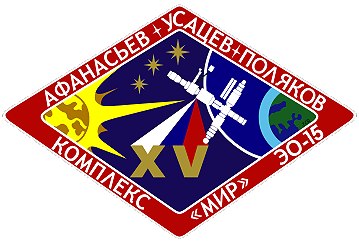 |
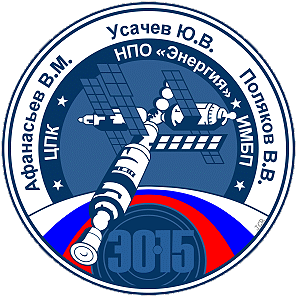 |
Launch, orbit and landing data
walkout photo |
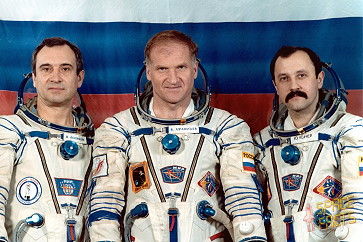 |
||||||||||||||||||||||
alternative crew photo |
Crew
| No. | Surname | Given names | Position | Flight No. | Duration | Orbits | |
| 1 |  |
Afanasiyev | Viktor Mikhailovich | Commander | 2 | 182d 00h 27m 02s | 2880 |
| 2 | |
Usachyov | Yuri Vladimirovich | Flight Engineer | 1 | 182d 00h 27m 02s | 2880 |
| 3 | |
Polyakov | Valeri Vladimirovich | Doctor Cosmonaut | 2 | 437d 17h 58m 17s | 6927 |
Crew seating arrangement
|
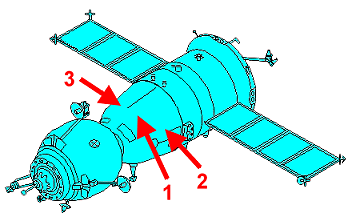 |
|
||||||||||||||||
Backup Crew
|
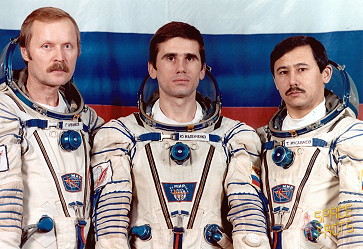 |
||||||||||||||||||||
Hardware
| Launch vehicle: | Soyuz-U2 (No. N15000-071) |
| Spacecraft: | Soyuz TM-18 (7K-STM No. 67) |
Flight
|
Launch from the Baikonur Cosmodrome and
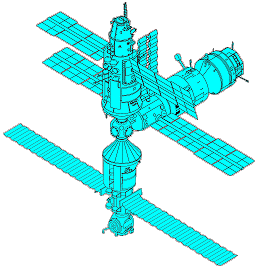
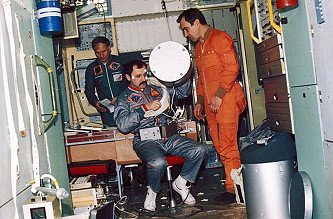
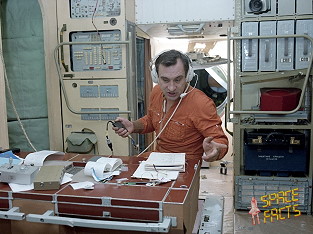
landing 113 km north of Arkalyk. Following a two-day solo flight Soyuz TM-18 docked with the Mir space station on January 10, 1994. The three cosmonauts became the 15th resident crew of the Mir. Research work by Valeri Polyakov during his long-term flight was done. He accomplished 25 different experiments in space flight medicine. The experiments concerned mainly the diet, the function of the muscular system, the lungs and the immune system. Changes of the blood and the nervous system were analyzed, too. Furthermore, problems with the metabolism (red blood cell, erythrocite), alterations of the blood volume and the function of the sense of balance in the middle ear were examined. One used the experiment called VOG (Video OkluGraphie), which the German mission brought on board of the space station in 1992. The Russian flight control center transmitted the data to Oberpfaffenhofen Germany, from where the specialists could influence the experiment. Another subject of investigation was the depletion of calcium in the bones during a long-term stay in zero gravity. It is unknown whether the depletion of calcium stops at certain level. Scientifics believe that a depletion of 20% is highly dangerous. In order to counteract the negative alterations of the tissue of muscles and bones the advanced vacuum trousers KARKAS were used. Those trousers suck the blood in the abdomen. Thus, the situation of a higher blood volume in the abdomen due to gravity on earth is simulated. The measurement of the enlargement of the circumference of the leg, the blood pressure, the cardiac output, the change of position of the heart in the thorax and the noises of the blood stream were taken. The two guinea pigs Viktor Afanasiyev and Yuri Usachyov underwent this procedure every third day. The sleep of the cosmonauts and the coordination of cognition and movement were also examined. The spacemen got fixed on the floor but could still move their heads and arms. A monitor screen transmitted different visual appeals and four infrared cameras recorded the reactions. The results of the tests are believed to be important for movement disorders on earth. In the psychological experiment PSY the mental and psychomotor ability of Valeri Polyakov were tested over several months. Reaction rate, short-term memory, attention and manual skills were tested. There were also nonmedical researches on the field of material sciences. There was a research concerning the behavior of undercooled melting (experiment TES). Eleven samples, which were enclosed in a shell of glass, were first melted and then refrigerated. Because of the lack of crystal nuclei the liquid state can be kept below the usual temperature of solidification. Depending on the temperature the samples solidify with different microstructures. The data of the experiments were evaluated via the system DataMir and transmitted to earth. The system DataMir was developed in Austria and is on board of the station since 1991. DataMir controls the experiment, records the data, visualizes the results und forwards them to the system of telemetry at the space station. The possibility of mould formation at non-metallic materials was investigated. Earth exploration, astrophysics and biotechnology were very important, too. The multichannel spectrometer MKS-MS and FASA came into operation. Hundreds of pictures of the earth were taken with the multichannel camera MKF-6MA. The intensity of the radiation of energy and particles was measured in and about the space station. As far as astronomic objects were concerned, their x-radiation and their gamma radiation were especially interesting. In the experiment RESONANZ the stability of the station complex was estimated. Viktor Afanasiyev, Yuri Usachyov, and Valeri Polyakov examined Kristall when they repositioned their spacecraft at the Mir forward port on January 24, 1994. They detected no damage from the Soyuz TM-17 recontact. The freighter Progress M-21 was launched from Baikonur on January 28, 1994 at 02:13 UTC. Progress M-21 delivered supplies, food, water, fuel, equipment, spare parts and post to the Mir complex. Progress M-21 did not carry a VBK (ballistic return capsule). On January 30, 1994 Progress M-21 arrived at the station and remained docked until March 23, 1994. A new, camera-based navigation system was tested on the unmanned transport space ship Progress M-21. The new system works even if the navigation system Kurs does not work. The Flight Engineer receives a complete picture of the approach via three cameras and is able to dock the space ship by a manual control. Launch of Progress M-22 was delayed to March 22, 1994 from March 19, 1994 by heavy snowfall at Baikonur Cosmodrome. The rails used to transport Progress M-22 to its launch pad were covered in snowdrifts up to 7 m deep, so the spacecraft and booster could not be moved from their assembly building. The freighter finally docked with Mir on March 23, 1994. The week of March 28, 1994, Mir cosmonauts fired an electron beam gun at the Swedish Freja plasma and magnetospheric physics satellite to study space plasmas and Earth's magnetosphere. At the time Mir was 383 km above the Pacific, south of Alaska, while the 214-kg Freja satellite was 1770 km above the southeast Alaskan coast. A Canadian ground station monitored the test, which resembled one conducted on the STS-45 Space Shuttle mission (March 24, 1992 - April 02, 1992). The unmanned resupply vessel Progress M-23 was launched to Mir on May 22, 1994 at 04:30 UTC. It carried a Raduga return capsule. Progress M-23 docked with Mir on May 24, 1994 at 06:18:35 UTC and undocked on July 02, 1994 at 08:46:49 UTC. The braking engine was ignited at 14:44 UTC, and the Raduga VBK reentry capsule was ejected at 14:55:45 UTC. The Progress burnt up in the atmosphere at 14:57 UTC. The Raduga deployed its parachute after reentry and landed on July 02, 1994 at 15:09:00 UTC at 51 deg 41 min N, 59 deg 21 min E, in the Orenburg region. Soyuz TM-19 arrived at Mir with the Mir-16 crew of Yuri Malenchenko and Talgat Musabayev on July 03, 1994. Valeri Polyakov, who had arrived on Mir with the Mir-15 crew, remained aboard on his long-duration mission. The Mir-15 crew returned uneventfully aboard Soyuz TM-18 on July 09, 1994. Before Soyuz TM-19 could dock to the aft docking port the freighter Progress M-23 had to undock from there. Together with the new cosmonauts Soyuz TM-19 delivered to Mir hard- and software for experiments during the EuroMir'94 mission of Ulf Merbold in October 1994. In September 1994 Yuri Malenchenko and Talgat Musabayev have to make 4 EVA's (spacewalks) aimed at the transfer of the solar panels from Kristall to Kvant1, maintenance and inspections of the outer surface of the complex and the replacement of containers (among other things the American Trek-experiment) with experiments exposed to open space. The Soyuz spacecraft is composed of three elements attached end-to-end - the Orbital Module, the Descent Module and the Instrumentation/Propulsion Module. The crew occupied the central element, the Descent Module. The other two modules are jettisoned prior to re-entry. They burn up in the atmosphere, so only the Descent Module returned to Earth. The deorbit burn lasted about 240 seconds. Having shed two-thirds of its mass, the Soyuz reached Entry Interface - a point 400,000 feet (121.9 kilometers) above the Earth, where friction due to the thickening atmosphere began to heat its outer surfaces. With only 23 minutes left before it lands on the grassy plains of central Asia, attention in the module turned to slowing its rate of descent. Eight minutes later, the spacecraft was streaking through the sky at a rate of 755 feet (230 meters) per second. Before it touched down, its speed slowed to only 5 feet (1.5 meter) per second, and it lands at an even lower speed than that. Several onboard features ensure that the vehicle and crew land safely and in relative comfort. Four parachutes, deployed 15 minutes before landing, dramatically slowed the vehicle's rate of descent. Two pilot parachutes were the first to be released, and a drogue chute attached to the second one followed immediately after. The drogue, measuring 24 square meters (258 square feet) in area, slowed the rate of descent from 755 feet (230 meters) per second to 262 feet (80 meters) per second. The main parachute was the last to emerge. It is the largest chute, with a surface area of 10,764 square feet (1,000 square meters). Its harnesses shifted the vehicle's attitude to a 30-degree angle relative to the ground, dissipating heat, and then shifted it again to a straight vertical descent prior to landing. The main chute slowed the Soyuz to a descent rate of only 24 feet (7.3 meters) per second, which is still too fast for a comfortable landing. One second before touchdown, two sets of three small engines on the bottom of the vehicle fired, slowing the vehicle to soften the landing. The relieved cosmonauts Viktor Afanasiyev and Yuri Usachyov landed with the Descent Module of the Soyuz TM-18 at 112 km NE of Arkalyk on July 09, 1994 at 10:32 UTC. |
Note
Relocations of Manned Spacecrafts
| Spacecraft | from | Undocking | Time UTC | to | Redocking | Time UTC |
| Soyuz TM-18 | Mir - Kvant | 24.01.1994 | 03:12:00 | Mir - Baseblock | 24.01.1994 | 05:01:04 |
Photos / Graphics
 |
 |
|
source of all photos is Roscosmos |
|
 |
 |
 |
 |
 |
| © |  |
Last update on September 03, 2021.  |
 |