Human Orbital Spaceflights

International Flight No. 20Gemini 10USA |
 |
 |
Launch, orbit and landing data
walkout photo |
 |
||||||||||||||||||
alternative crew photo |
|||||||||||||||||||
alternative crew photo |
Crew
| No. | Surname | Given names | Position | Flight No. | Duration | Orbits | |
| 1 |  |
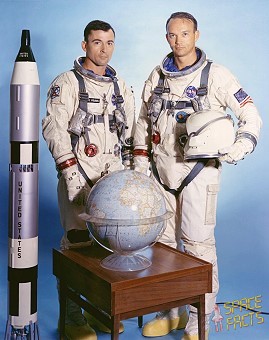
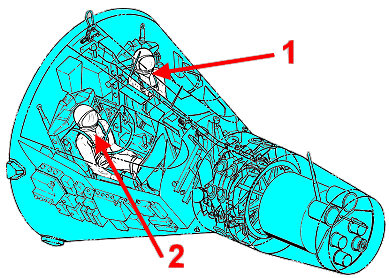
Young | John Watts | Command Pilot | 2 | 2d 22h 46m 39s | 43 |
| 2 | |
Collins | Michael | PLT | 1 | 2d 22h 46m 39s | 43 |
Crew seating arrangement
|
 |
Backup Crew
|
 |
|||||||||||||||
Hardware
| Launch vehicle: | Titan II GLV No. GT-10 (62-12565) |
| Spacecraft: | Gemini 10 (S/C-10 No. 1857) |
Flight
|
Launch from Cape Canaveral and landing 850 km
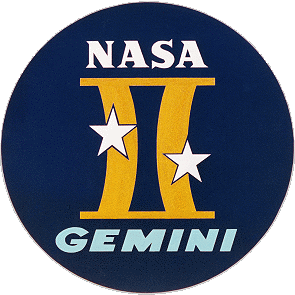
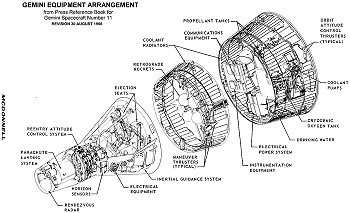
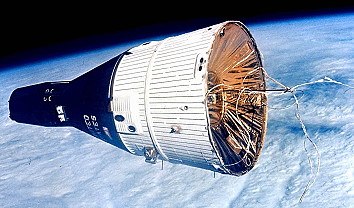
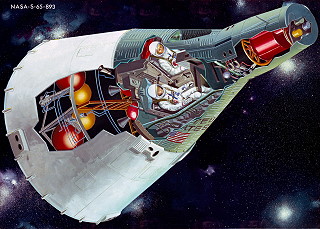
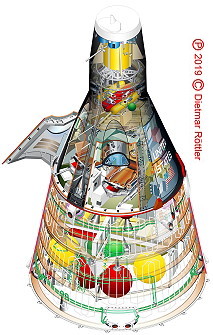
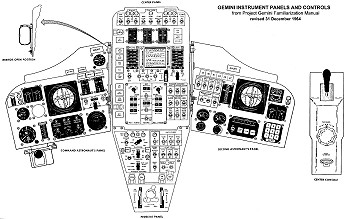
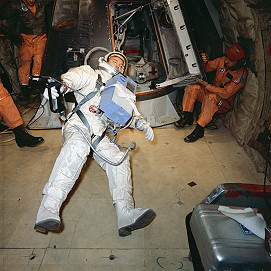
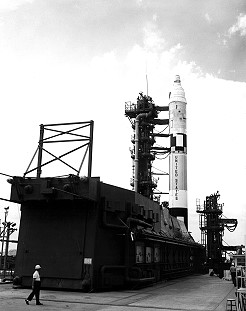
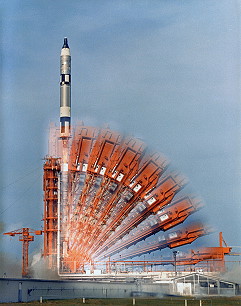
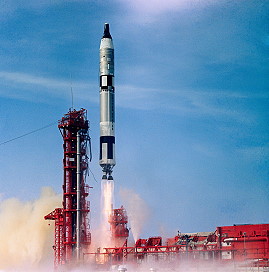
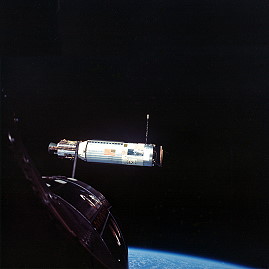
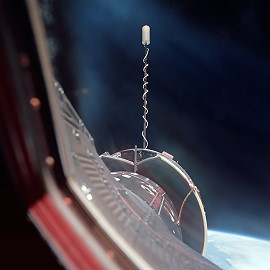
east of Florida in the Atlantic Ocean. The Gemini spacecraft was a cone-shaped capsule consisting of two components, a reentry module and an adaptor module. The adaptor module made up the base of the spacecraft. It was a truncated cone 228.6 cm high, 304.8 cm in diameter at the base and 228.6 cm at the upper end where it attached to the base of the reentry module. The re-entry module consisted of a truncated cone which decreased in diameter from 228.6 cm at the base to 98.2 cm, topped by a short cylinder of the same diameter and then another truncated cone decreasing to a diameter of 74.6 cm at the flat top. The reentry module was 345.0 cm high, giving a total height of 573.6 cm for the Gemini spacecraft. The adaptor module was an externally skinned, stringer framed structure, with magnesium stringers and an aluminum alloy frame. The adaptor was composed of two parts, an equipment section at the base and a retrorocket section at the top. The equipment section held fuel and propulsion systems and was isolated from the retrorocket section by a fiber-glass sandwich honeycomb blast shield. The retrorocket section held the re-entry rockets for the capsule. The reentry module consisted mainly of the pressurized cabin which held the two Gemini astronauts. Separating the reentry module from the retrorocket section of the adaptor at its base was a curved silicone elastomer ablative heat shield. The module was composed predominantly of titanium and nickel-alloy with beryllium shingles. At the narrow top of the module was the cylindrical reentry control system section and above this the rendezvous and recovery section which holds the reentry parachutes. The cabin held two seats equipped with emergency ejection devices, instrument panels, life support equipment, and equipment stowage compartments in a total pressurized volume of about 2.25 cubic meters. Two large hatches with small windows could be opened outward, one positioned above each seat. Attitude control was effected by two translation-maneuver hand controllers, an attitude controller, redundant horizon sensor systems, and reentry control electronics, with guidance provided via an inertial measuring unit and radar system. The orbital attitude and maneuver system used a hypergolic propellant combination of monomethyl hydrazine and nitrogen tetroxide supplied to the engines by a helium system pressurized at 2800 psi. Two 95 lb translation thrusters and eight 23 lb attitude thrusters were mounted along the bottom rim of the adaptor, and two 79 lb and 4 95 lb thrusters were mounted at the front of the adaptor. Power was supplied by 3 silver-zinc batteries to a 22- to 30-volt DC two-wire system. During reentry and post-landing power was supplied by four 45 amp-hr silver-zinc batteries. Voice communications were performed at 296.9 MHz with an output power of 3 W. A backup transmitter-receiver at 15.016 MHz with an output power of 5 W was also available. Two antenna systems consisting of quarter-wave monopoles were used. Telemetry was transmitted via three systems, one for real time telemetry, one for recorder playback, and a spare. Each system was frequency-modulated with a minimum power of 2 W. Spacecraft tracking consisted of two C-band radar transponders and an acquisition-aid beacon. One transponder is mounted in the adaptor with a peak power output of 600 W to a slot antenna on the bottom of the adaptor. The other is in the reentry section, delivering 1000 W to three helical antennas mounted at 120-degree intervals just forward of the hatches. The acquisition-aid beacon was mounted on the adaptor and had a power of 250 mW. At the time of reentry, the spacecraft would be maneuvered to the appropriate orientation and equipment adaptor section would be detached and jettisoned, exposing the retrorocket module. The retrorockets consisted of four spherical-case polysulfide ammonium perchlorate solid-propellant motors mounted near the center of the reentry adaptor module, each with 11,070 N thrust. They would fire to initiate the spacecraft reentry into the atmosphere, with attitude being maintained by a reentry control system of 16 engines, each with 5.2 N thrust. The retrorocket module would then be jettisoned, exposing the heat shield at the base of the reentry module. Along with the ablative heat shield, thermal protection during reentry was provided by thin Rene 41 radiative shingles at the base of the module and beryllium shingles at the top. Beneath the shingles was a layer of MIN-K insulation and thermoflex blankets. At an altitude of roughly 15,000 meters the astronauts would deploy a 2.4-meter drogue chute from the rendezvous and recovery section. At 3230 meters altitude the crew releases the drogue which extracts the 5.5-meter pilot parachute. The rendezvous and recovery section are released 2.5 seconds later, deploying the 25.6-meter main ring-sail parachute which is stored in the bottom of the section. The spacecraft is then rotated from a nose-up to a 35-degree angle for water landing. At this point a recovery beacon is activated, transmitting via an HF whip antenna mounted near the front of the reentry module. The Gemini Agena Target Vehicle (GATV) was designed to be launched into Earth orbit prior to a Gemini mission and used for rendezvous and docking practice. The GATV had a docking cone at the forward end into which the nose of the Gemini spacecraft could be inserted and held with docking latches. The GATV was a 6-meter-long cylinder with a diameter of 4.9 meters. The primary and secondary propulsion systems were at the back end of the target vehicle with the attitude control gas tanks and the main propellant tanks. The docking cone was connected to the front end by shock absorbing dampers. Acquisition running lights and target vehicle status display indicators were situated on the front end. A 2.1-meter-long retractable L-band boom antenna extended from the side of the cylinder near the front. Tracking and command of the GATV were also aided by a rendezvous beacon, two spiral L-band antennas, two tracking antennas (C-band and S-band), two VHF telemetry antennas, and a UHF command antenna. Micrometeoroid packages and other experiments could also be mounted on the GATV. The Gemini 10 Agena Target Vehicle (GATV-10) was successfully launched from Cape Kennedy on July 18, 1966 at 20:39:46.131 UTC into a near-circular 300 km orbit. Gemini 10 was launched on July 18, 1966 from Complex 19 at 22:20:26.648 UTC and inserted into a 159.9 x 268.9 km orbit. At orbit insertion Gemini 10 was about 1600 km behind the Gemini Agena Target Vehicle 10 (GATV-10) which had been launched into a near circular orbit about 100 minutes earlier. The main objectives of this mission were to dock with the Agena target vehicle GATV-10 and to dock with the Agena Target Vehicle from the Gemini 8 mission (GATV-8). After docking with GATV-10 in low orbit, John Young and Michael Collins should use it to climb to a high orbit to meet with the dead, drifting Agena left over from the aborted Gemini 8 flight - thus executing the program's first double rendezvous. With no electricity on board the second Agena the rendezvous was accomplished with eyes only - no radar. In addition, Michael Collins was scheduled to perform a spacewalk. The mission patch was drawn by Barbara Young (John Young's wife at the time). The docking with the unmanned Agena target vehicle GATV-10 was successful (04:13:02 UTC), even it was need more fuel than planned. Michael Collins learned that he was unable to use the sextant for navigation as it did not seem to work as expected. At first, he mistook airglow as the real horizon when trying to make some fixes on stars. Then the image didn't seem right. He tried another instrument that they had on board but this was not practical to use as it had a very small field of view. They fortunately had a backup in the form of the computers on the ground. To save fuel, planned more docking and redocking maneuvers were not performed. During the docking the GATV-10 primary propulsion system was used to raise the dual spacecraft apogee to 764 km (a new record). The first burn of the Agena engine they made was 80 seconds long and put them in a 294 by 764 kilometers orbit. This was the highest a person had ever been (until the next mission when Gemini 11 went to over 1,000 kilometers (620 mi)). This burn was quite a ride for the crew. Because the Gemini and Agena docked nose to nose, the forces experienced were "eyeballs out" as opposed to "eyeballs in" for a launch from Earth. Two EVAs were performed by Michael Collins. The first was a standup-EVA on July 19, 1966 (0h 49m), He used a 70-mm camera to snap 22 images of the southern Milky Way in the ultraviolet part of the spectrum. As the docked Gemini 10 and Agena 10 spacecraft passed into daylight Michael Collins took photos of a colored plate to determine if film accurately captured colors in space. Michael Collins and John Young then experienced eye irritation and smelled a strange odor in their suits. This was apparently caused by lithium hydroxide leaking into their helmets when both suit fans operated simultaneously. Lithium hydroxide in the Gemini life support system absorbed exhaled carbon dioxide. After more 44 hours the Gemini spacecraft separated from the GATV-10 at 19:00:42 UTC. The Gemini used its own thrusters to complete the second rendezvous some three hours later with the GATV-8 target vehicle. After a couple more correction burns, they were station keeping 3 meters away from the Agena. Then the second EVA on July 20, 1966 (0h 39m) was performed by Michael Collins. His second EVA was scheduled to last 90 minutes. He left the cabin, unfolded a handrail, and removed a micrometeoroid package attached to Gemini 10. He had to avoid the 16 thrusters John Young used to keep the spacecraft close to Agena 8. The Gemini 10 hand controllers were modified to make piloting the spacecraft easier during EVA proximity operations while in a pressurized suit with restricted wrist mobility. This modification was later applied to the Apollo lunar rover. Michael Collins then prepared to move to Agena 8 to retrieve a micrometeoroid package. He plugged a line hanging loose from his umbilical into the nitrogen connector on Gemini 10's adapter section. Michael Collins guided John Young as he maneuvered Gemini 10 to within 3 m of the Agena, then Michael Collins jumped to it. He gripped the Agena docking cone, dislodging a sharp-edged electric discharge ring which he feared might tear his suit or cut his umbilical. John Young meanwhile kept track of a "3- body problem" involving Gemini 10, Michael Collins, and Agena 8, all the while trying to keep sunlight from falling on Michael Collin's ejection seat. The seat might have fired - taking Gemini 10's hatches with it - if it had been heated by the Sun for too long. Reaching the micrometeoroid package, Michael Collins attempted to stop his forward motion, but his lower body momentum left him "turning lazy cartwheels somewhere above and to the left of everything that matters." He used the HHMU to stop his rotation, landed among the thrusters behind the Gemini 10 cockpit, and caught himself on his open hatch door. He then used the HHMU to move to the Agena. He retrieved the micrometeoroid package, but set the Agena gyrating, making it more difficult for John Young to keep Gemini 10 close. He elected not to install a replacement package as planned. Gemini 10's fuel supply dropped dangerously low, forcing John Young to call Michael Collins back inside and cut short the EVA. Michael Collins discovered that he had lost his camera, then the long umbilical caused problems again, preventing John Young from seeing the control panel so he could report fuel usage to Houston and causing Michael Collins to accidentally shut off the radio. They herded the umbilical into a bag with empty food containers and disused equipment and opened the hatch just long enough to toss it out. There were 10 other experiments that the crew performed during the mission. Three were interested in radiation. MSC-3 was the Tri-Axis Magnetometer which measured levels in the South Atlantic Anomaly. There was also MSC-6, a beta spectrometer, measured potential radiation doses for Apollo missions, and MSC-7, a bremsstrahlung spectrometer which detected radiation flux as a function of energy when the spacecraft passed through the South Atlantic Anomaly. More experiments were about the Zodiacal light, about the ion and electron wake of the spacecraft and a navigation experiment. The reentry was performed without any problems. Gemini 10 landed only 5.6 kilometers away from the intended landing site. The recovery ship was the USS Guadalcanal. |
EVA data
| Name | Start | End | Duration | Mission | Airlock | Suit | Stripes | |
| SEVA | Collins, Michael | 19.07.1966, 21:44 UTC | 19.07.1966, 22:33 UTC | 0h 49m | Gemini 10 | G4C No. 36 | without | |
| IVA | Young, John | 19.07.1966, 21:44 UTC | 19.07.1966, 22:33 UTC | 0h 49m | Gemini 10 | G4C No. 19 | without | |
| EVA | Collins, Michael | 20.07.1966, 23:01 UTC | 20.07.1966, 23:40 UTC | 0h 39m | Gemini 10 | G4C No. 36 | without | |
| IVA | Young, John | 20.07.1966, 23:01 UTC | 20.07.1966, 23:40 UTC | 0h 39m | Gemini 10 | G4C No. 19 | without | |
| IVA | Collins, Michael | 21.07.1966, 00:53 UTC | 21.07.1966, 00:54 UTC | 0h 01m | Gemini 10 | G4C No. 36 | without | |
| IVA | Young, John | 21.07.1966, 00:53 UTC | 21.07.1966, 00:54 UTC | 0h 01m | Gemini 10 | G4C No. 19 | without | |
Photos / Graphics
 |
 |
 |
 |
 |
 |
 |
 |
 |
 |
 |
 |
 |
 |
 |
 |
 |
 |
 |
 |
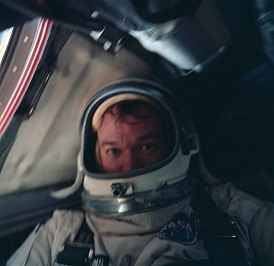 |
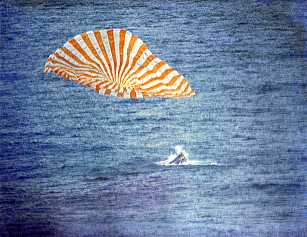 |
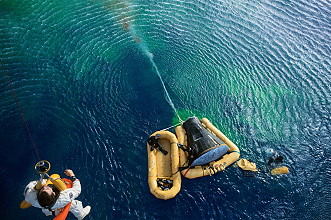 |
| © |  |
Last update on August 11, 2020.  |
 |