Human Orbital Spaceflights

International Flight No. 21Gemini 11USA |
 |
 |
Launch, orbit and landing data
walkout photo |
 |
||||||||||||||||||
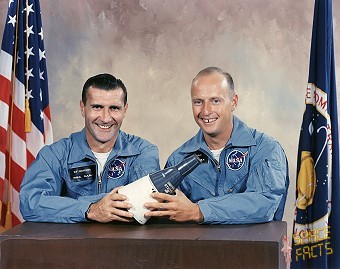
Crew
| No. | Surname | Given names | Position | Flight No. | Duration | Orbits | |
| 1 |  |
Conrad | Charles, Jr. "Pete" | Command Pilot | 2 | 2d 23h 17m 08s | 44 |
| 2 | |
Gordon | Richard Francis, Jr. "Dick" | PLT | 1 | 2d 23h 17m 08s | 44 |
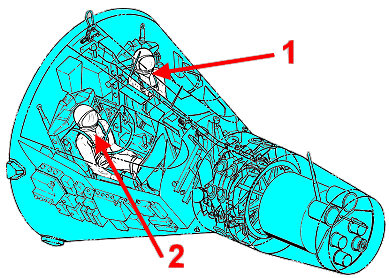
Crew seating arrangement
|
 |
Backup Crew
|
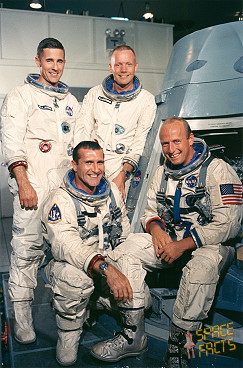
alternative crew photo |
|||||||||||||||
 |
||||||||||||||||
Hardware
| Launch vehicle: | Titan II GLV No. GT-11 (62-12566) |
| Spacecraft: | Gemini 11 (S/C-11 No. 1848) |
Flight
|
Launch from Cape Canaveral and landing 1330 km
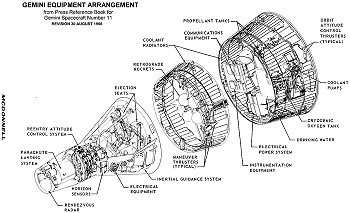
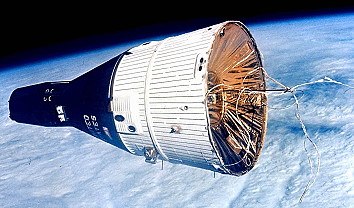
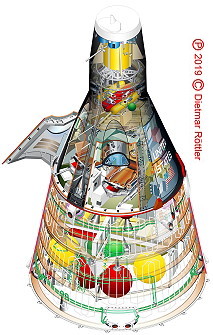
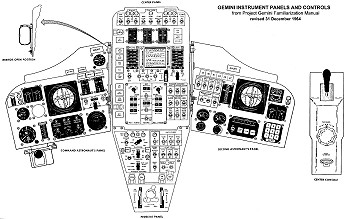
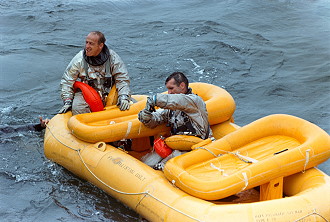
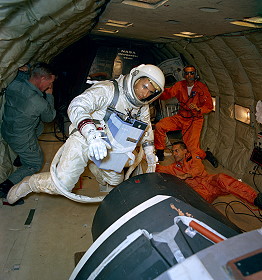
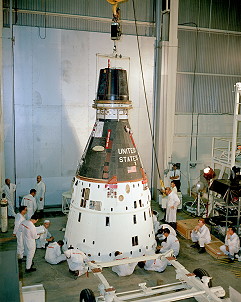
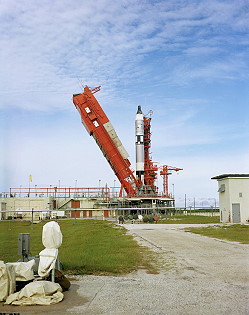
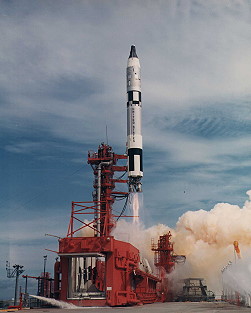
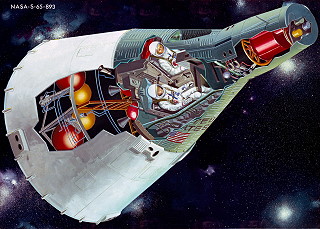
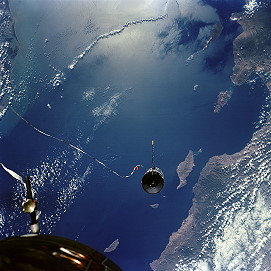
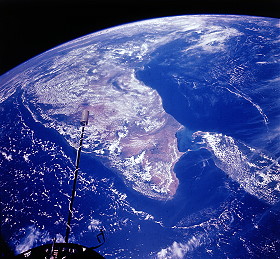
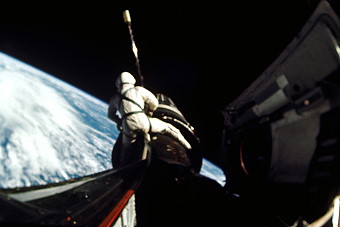
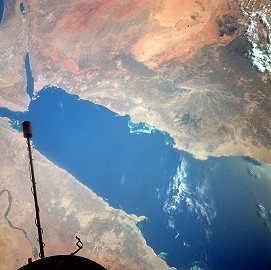
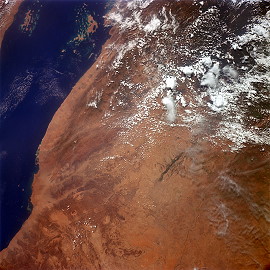
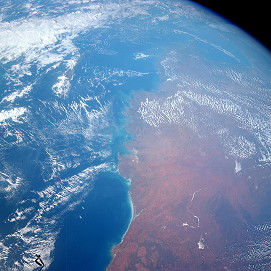
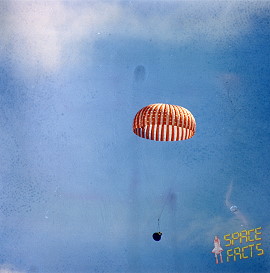
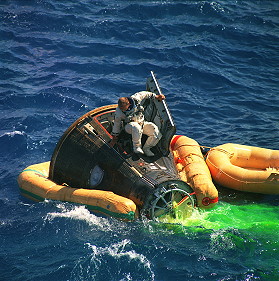
southeast from Cape Canaveral in the Atlantic Ocean. The Gemini spacecraft was a cone-shaped capsule consisting of two components, a reentry module and an adaptor module. The adaptor module made up the base of the spacecraft. It was a truncated cone 228.6 cm high, 304.8 cm in diameter at the base and 228.6 cm at the upper end where it attached to the base of the reentry module. The re-entry module consisted of a truncated cone which decreased in diameter from 228.6 cm at the base to 98.2 cm, topped by a short cylinder of the same diameter and then another truncated cone decreasing to a diameter of 74.6 cm at the flat top. The reentry module was 345.0 cm high, giving a total height of 573.6 cm for the Gemini spacecraft. The adaptor module was an externally skinned, stringer framed structure, with magnesium stringers and an aluminum alloy frame. The adaptor was composed of two parts, an equipment section at the base and a retrorocket section at the top. The equipment section held fuel and propulsion systems and was isolated from the retrorocket section by a fiber-glass sandwich honeycomb blast shield. The retrorocket section held the re-entry rockets for the capsule. The reentry module consisted mainly of the pressurized cabin which held the two Gemini astronauts. Separating the reentry module from the retrorocket section of the adaptor at its base was a curved silicone elastomer ablative heat shield. The module was composed predominantly of titanium and nickel-alloy with beryllium shingles. At the narrow top of the module was the cylindrical reentry control system section and above this the rendezvous and recovery section which holds the reentry parachutes. The cabin held two seats equipped with emergency ejection devices, instrument panels, life support equipment, and equipment stowage compartments in a total pressurized volume of about 2.25 cubic meters. Two large hatches with small windows could be opened outward, one positioned above each seat. Attitude control was effected by two translation-maneuver hand controllers, an attitude controller, redundant horizon sensor systems, and reentry control electronics, with guidance provided via an inertial measuring unit and radar system. The orbital attitude and maneuver system used a hypergolic propellant combination of monomethyl hydrazine and nitrogen tetroxide supplied to the engines by a helium system pressurized at 2800 psi. Two 95 lb translation thrusters and eight 23 lb attitude thrusters were mounted along the bottom rim of the adaptor, and two 79 lb and 4 95 lb thrusters were mounted at the front of the adaptor. Power was supplied by 3 silver-zinc batteries to a 22- to 30-volt DC two-wire system. During reentry and post-landing power was supplied by four 45 amp-hr silver-zinc batteries. Voice communications were performed at 296.9 MHz with an output power of 3 W. A backup transmitter-receiver at 15.016 MHz with an output power of 5 W was also available. Two antenna systems consisting of quarter-wave monopoles were used. Telemetry was transmitted via three systems, one for real time telemetry, one for recorder playback, and a spare. Each system was frequency-modulated with a minimum power of 2 W. Spacecraft tracking consisted of two C-band radar transponders and an acquisition-aid beacon. One transponder is mounted in the adaptor with a peak power output of 600 W to a slot antenna on the bottom of the adaptor. The other is in the reentry section, delivering 1000 W to three helical antennas mounted at 120-degree intervals just forward of the hatches. The acquisition-aid beacon was mounted on the adaptor and had a power of 250 mW. At the time of reentry, the spacecraft would be maneuvered to the appropriate orientation and equipment adaptor section would be detached and jettisoned, exposing the retrorocket module. The retrorockets consisted of four spherical-case polysulfide ammonium perchlorate solid-propellant motors mounted near the center of the reentry adaptor module, each with 11,070 N thrust. They would fire to initiate the spacecraft reentry into the atmosphere, with attitude being maintained by a reentry control system of 16 engines, each with 5.2 N thrust. The retrorocket module would then be jettisoned, exposing the heat shield at the base of the reentry module. Along with the ablative heat shield, thermal protection during reentry was provided by thin Rene 41 radiative shingles at the base of the module and beryllium shingles at the top. Beneath the shingles was a layer of MIN-K insulation and thermoflex blankets. At an altitude of roughly 15,000 meters the astronauts would deploy a 2.4-meter drogue chute from the rendezvous and recovery section. At 3230 meters altitude the crew releases the drogue which extracts the 5.5-meter pilot parachute. The rendezvous and recovery section are released 2.5 seconds later, deploying the 25.6-meter main ring-sail parachute which is stored in the bottom of the section. The spacecraft is then rotated from a nose-up to a 35-degree angle for water landing. At this point a recovery beacon is activated, transmitting via an HF whip antenna mounted near the front of the reentry module. The Gemini Agena Target Vehicle (GATV) was designed to be launched into Earth orbit prior to a Gemini mission and used for rendezvous and docking practice. The GATV had a docking cone at the forward end into which the nose of the Gemini spacecraft could be inserted and held with docking latches. The GATV was a 6-meter-long cylinder with a diameter of 4.9 meters. The primary and secondary propulsion systems were at the back end of the target vehicle with the attitude control gas tanks and the main propellant tanks. The docking cone was connected to the front end by shock absorbing dampers. Acquisition running lights and target vehicle status display indicators were situated on the front end. A 2.1-meter-long retractable L-band boom antenna extended from the side of the cylinder near the front. Tracking and command of the GATV were also aided by a rendezvous beacon, two spiral L-band antennas, two tracking antennas (C-band and S-band), two VHF telemetry antennas, and a UHF command antenna. Micrometeoroid packages and other experiments could also be mounted on the GATV. The Gemini 11 Agena Target Vehicle (GATV-11) was launched from Cape Canaveral at 13:05:01.725 UTC on September 12, 1966 using an Atlas-Agena D rocket into a near-circular 300 km orbit. The main goal of this flight was to dock with an Agena target vehicle on a direct-ascent rendezvous. Secondary objectives included docking practice, two EVAs, 12 scientific experiments, docked maneuvers, a tethered vehicle test, demonstrating automatic reentry, and parking the GATV. The launch was postponed twice: On September 09, 1966 due to a small leak in the first stage oxidizer tank of the GLV, and on September 10, 1966 due to a suspected malfunction of the autopilot on the Agena capsule. Gemini 11 was launched on September 12, 1966 at 14:42:26.546 UTC from Complex 19 and inserted into a 160.5 x 279.1 km Earth orbit at 14:48:28 UTC. The docking with the unmanned Agena target vehicle GATV-11 was completed after five flight maneuvers and only 94 minutes after the launch (16:16:33 UTC). There were no fuel problems and the crew began docking practice (two dockings and re-dockings of both astronauts). The first EVA on September 13, 1966 (0h 33m) was performed by Richard Gordon. During the planned 107-minutes spacewalk, Richard Gordon would attach a 30-m (100-ft) tether stowed on Agena 11 to Gemini 11's nose for an artificial gravity experiment. Also, he would retrieve the S9 nuclear emulsion package from Gemini 11's adapter section, and test the "golden slipper" foot restraint, an HHMU, and a torqueless power tool. Poor planning ensured that Richard Gordon's EVA started badly. As dictated in the mission plan, he commenced EVA preparations 4 hours before scheduled EVA start. These required only 50 minutes. Richard Gordon tested oxygen flow from the suit life support system and became uncomfortably warm because the life support oxygen cooling system heat exchanger could not be used - it was designed for vacuum operation. Just before opening the hatch he worked up a sweat trying to attach a visor to his helmet. Later he said that "I was pretty tired and had a pretty high heart rate before I ever opened the hatch." He then attempted a leap to Agena 11, missing and swinging on his 30-ft umbilical to Gemini 11's adapter section. Using the umbilical, Charles Conrad pulled him back to the hatch for another try. This time Richard Gordon succeeded in grasping handrails on the Agena docking adapter added following Michael Collins' difficulties. However, Richard Gordon still needed both hands to secure the tether to Gemini 11. He straddled the spacecraft nose as he had in zero-g aircraft simulations, but in space the suit's internal pressure forced his legs together, pushing him away from the nose. He secured the tether while holding onto the handrail with one hand. Richard Gordon moved back to the cockpit area to rest and Charles Conrad ordered him back inside. An hour later, the astronauts opened the hatch and jettisoned loose equipment. The whole complex of two spacecrafts was then brought up to a high apogee record of 1.360 km, using the boosters of the Agena target vehicle. The second EVA on September 14, 1966 (2h 08m) was in fact a SEVA. Richard Gordon opened the hatch just before orbital sunset, installed the S13 ultraviolet astronomical camera, and took pictures of Orion and Antares. A short tether held him in the cabin, permitting him to use both hands. During the daylight pass Richard Gordon performed "general photography", which included snapping pictures of Houston and Florida. During their pass over the Atlantic they had no photographic targets, so both astronauts fell asleep - a testimony to the relaxed pace of this SEVA. The spacecraft again moved into darkness, and Richard Gordon snapped more pictures of astronomical targets. Experiment S13 closeout and hatch closure were uneventful. After two orbits the Agena was fired again for 22.5 seconds to lower the Gemini-Agena back down to a 287 x 304 km orbit. The spacecrafts were then redocked and the joined pair was brought into a rotation to build a small gravity in the spacecrafts. The rotation rate checked out at 55 degrees per minute, and the crew could test for a minute amount of artificial gravity, but they did not sense any physiological effect of gravity. 12 experiments were performed by the astronauts (9 scientific and 3 technological), but only two photograph experiments were new. The other seven - weather, terrain, and airglow horizon photography, radiation and zero-g effects, ion-wake measurement, nuclear emulsion, and the ultraviolet astronomical camera - and all three technological experiments - mass determination, night image intensification, and power tool evaluation - had already been assigned to previous missions. The night image intensification was enjoyed by the astronauts, but was also a little bit handicapped due to a dirty window on Charles Conrad's site. At the end of the mission the first fully automatic controlled reentry was performed. Gemini 11 splashed down 2.8 miles (4.5 km) from its recovery ship. The recovery ship was the USS Guam. |
EVA data
| Name | Start | End | Duration | Mission | Airlock | Suit | Stripes | |
| EVA | Gordon, Richard | 13.09.1966, 14:44 UTC | 13.09.1966, 15:17 UTC | 0h 33m | Gemini 11 | G4C No. 40 | without | |
| IVA | Conrad, Charles | 13.09.1966, 14:44 UTC | 13.09.1966, 15:17 UTC | 0h 33m | Gemini 11 | G4C No. 39 | without | |
| IVA | Gordon, Richard | 13.09.1966, 16:19 UTC | 13.09.1966, 16:21 UTC | 0h 02m | Gemini 11 | G4C No. 40 | without | |
| IVA | Conrad, Charles | 13.09.1966, 16:19 UTC | 13.09.1966, 16:21 UTC | 0h 02m | Gemini 11 | G4C No. 39 | without | |
| SEVA | Gordon, Richard | 14.09.1966, 12:49 UTC | 14.09.1966, 14:57 UTC | 2h 08m | Gemini 11 | G4C No. 40 | without | |
| IVA | Conrad, Charles | 14.09.1966, 12:49 UTC | 14.09.1966, 14:57 UTC | 2h 08m | Gemini 11 | G4C No. 39 | without | |
Photos / Graphics
 |
 |
 |
 |
 |
 |
 |
 |
 |
 |
 |
 |
 |
 |
 |
 |
 |
 |
more Earth observation photos |
|
| © |  |
Last update on March 01, 2026.  |
 |