Resident Crews of the Mir

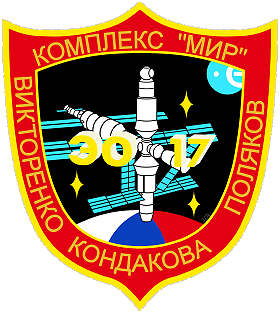
Mir: Expedition 17 |
 |
 |
|
Crew, launch- and landing data
| No. | Nation | Surname | Given names | Position | Spacecraft (launch) |
Launch date |
Launch time |
Spacecraft (landing) |
Landing date |
Landing time |
Mission duration |
Orbits |
| 1 |  |
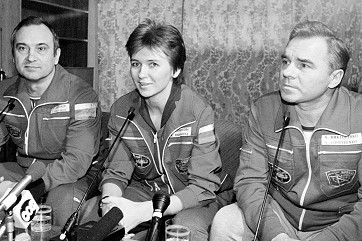
Viktorenko | Aleksandr Stepanovich | Commander | Soyuz TM-20 | 03.10.1994 | 22:42:29.947 UTC | Soyuz TM-20 | 22.03.1995 | 04:03:50 UTC | 169d 05h 21m 20s | 2677 |
| 2 | |
Kondakova | Yelena Vladimirovna | Flight Engineer | Soyuz TM-20 | 03.10.1994 | 22:42:29.947 UTC | Soyuz TM-20 | 22.03.1995 | 04:03:50 UTC | 169d 05h 21m 20s | 2677 |
| 3 | |
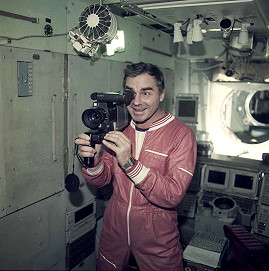
Polyakov | Valeri Vladimirovich | Doctor Cosmonaut | Soyuz TM-18 | 08.01.1994 | 10:05:34.081 UTC | Soyuz TM-20 | 22.03.1995 | 04:03:50 UTC | 437d 17h 58m 17s | 6927 |
Backup Crew
| No. | Nation | Surname | Given names | Position |
| 1 | |
Gidzenko | Yuri Pavlovich | Commander |
| 2 | |
Avdeyev | Sergei Vasiliyevich | Flight Engineer |
| 3 | |
Arzamazov | German Semyonovich | Doctor Cosmonaut |
Expedition Report
|
Launch from the Baikonur Cosmodrome and
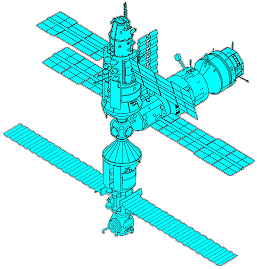
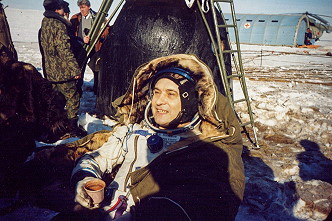
landing 54 km northeast of Arkalyk. Following a two-day solo flight Soyuz TM-20 docked with the Mir space station on October 06, 1994. Main goal of the mission was to exchange the resident crew partly. Aleksandr Viktorenko, Yelena Kondakova and long-term cosmonaut Valeri Polyakov became the 17th resident crew of the station. On October, 06, 1994, Mir-17 (Aleksandr Viktorenko and Yelena Kondakova) arrived at Mir together with ESA astronaut Ulf Merbold aboard Soyuz TM-20, Valeri Polyakov was again to remain aboard on his record duration flight. During final approach, Soyuz TM-20 yawed unexpectedly. He assumed manual control and completed docking without incident. Yelena Kondakova, the mission rookie, was the third Russian female cosmonaut and the first female to take part in a long-duration flight. Ulf Merbold was a physicist and veteran of two U.S. Space Shuttle missions. The month-long EuroMir 94 experiment program was considered a precursor to the ESA Columbus module planned for the joint U.S.-Russia-ESA-Japan-Canada space station. Ulf Merbold's program was planned rapidly, final agreement between ESA and Russian having been concluded in November 1992. It was also constrained by funding limitations - ESA budgeted only about $60 million for EuroMir 94. Because of these limitations, Ulf Merbold relied heavily on equipment left on Mir by earlier French, Austrian, and German visitors to the station, as well as the Czech-built CSK-1 materials processing furnace. He also used equipment delivered by Progress M-24 and Soyuz TM-20. Ulf Merbold's experiment program included 23 life sciences, 4 materials sciences, and 3 technology experiments. As part of the program EuroMir 94 Ulf Merbold and the resident crew performed a scientific research program to test organism in weightlessness and long duration missions. Ulf Merbold's experiment program included 23 life sciences, 4 materials sciences, and 3 technology experiments. On October 11, 1994 the six cosmonauts aboard Mir were unable to activate a video camera and TV lights while recharging Soyuz TM-20's batteries. A short circuit had disabled the computer which guided Mir's solar arrays, forcing the station to drain its batteries. The cosmonauts used reaction control thrusters on the Soyuz TM-spacecraft docked to the station to orient it so its solar arrays would point toward the Sun, and switched on a backup computer. Normal conditions were restored by October 15, 1994. Ground teams rescheduled Ulf Merbold's experiments to allow completion of those interrupted by the power problems, and moved experiments using large amounts of electricity to the end of Ulf Merbold's stay. In addition, the Czech-built CSK-1 furnace malfunctioned, forcing postponement of five of Ulf Merbold's experiments until after his return to Earth. On November 03, 1994 Talgat Musabayev, Yuri Malenchenko, and Ulf Merbold undocked in Soyuz TM-19 and backed 190 m from Mir. They then activated the Kurs automatic approach system, which successfully redocked the spacecraft. The cosmonauts then transferred back to Mir. The test was related to the difficulties Soyuz TM-20 and Progress M-24 experienced during their automatic approaches. Final undocking and reentry the following day occurred without incident. On November 04, 1994 Ulf Merbold again squeezed into the Soyuz TM-19 descent module, together with the Mir-16 crew of Yuri Malenchenko and Talgat Musabayev, and 16 kg of the life sciences samples he collected during his stay on the station. Additional samples - including materials processing samples to be produced when the Mir-17 cosmonauts carry out the experiments Ulf Merbold was to have conducted during his stay - were to be returned to Earth by Space Shuttle Atlantis in mid-1995. Soyuz TM-19 undocking, deorbit burn, reentry, and landing occurred without significant incident. The freighter Progress M-25 blasted off from Baikonur on November 11, 1994 at 07:21 UTC for a flight of two days to the Mir station. On November 13, 1994 Progress M-25 arrived. Aleksandr Viktorenko stood by at the remote-control panel on Mir during approach, but manual intervention was unnecessary. Valeri Polyakov, veteran of the Progress M-24 problems, called Progress M-25 "an ideal freighter". Among other cargoes, Progress M-25 delivered replacement parts for the failed CSK-1 materials processing furnace. Progress M-25 docked with Mir on November 13, 1994 at 09:04:29 UTC, undocked on February 16, 1995 at 13:03:00 UTC and was destroyed in reentry on February 16, 1995 at 16:45:00 UTC. On January 11, 1995 between 09:00 and 09:27 UTC the Soyuz TM-20 flew autonomously to test the Kurs approach and docking system at the forward transition section of the Mir complex. Problems during some docking operations in August/September 1994 (Progress M-24) and on October 06, 1994 (Soyuz TM-20) made this operation necessary. Long before Soyuz TM-20 separated from the complex the whole crew was on board of that ship and thoroughly tested all systems. According to the plan the Soyuz TM-20 executed the approach and docking fully automatically by use of the Kurs system. Aleksandr Viktorenko, assisted by Yelena Kondakova, was ready to take over manually if something went wrong or in case of a too high fuel consumption. Soyuz TM-20 perfectly linked to the station at 09:24:57 UTC, the aberrations remained far within the limits, just before docking less than 0.5 degrees. The good functioning of the Kurs systems is indispensable for the execution of the program for this year. They had to cope with technical problems with the heating, drinking-water, pressure control and with a leakage of water in the Kristall module. With the help of advice from experts on earth they solved the problems. On January 23, 1995 TsUP gave Aleksandr Viktorenko attitude control data to adjust the attitude of the complex in such a way that the solar panels of the Kristall module could deliver a maximum of energy. Valeri Polyakov continued his medical checks and experiments. On request by experts on earth the crew filmed and observed the areas of Kobe in Japan and Grozny. On January 21, 1995 they transmitted these images to earth. It was not always possible to do this due to clouds and bad weather in the areas of interest. Also, on January 21, 1995 Valeri Polyakov gave a lecture for Russian children, members of an organization for young people interested in spaceflight. During a long TV-session via Altair Valeri Polyakov explained how the systems in the base block worked. Extensively he explained all about the production and delivery of oxygen for the complex and the purification of the air on board. He emphasized the necessity of the permanent survey of the life systems and a regular maintenance. Space Shuttle STS-63 performed the first rendezvous maneuver with the Mir space station. After extensive negotiations and technical information exchanges between U.S. and Russian space teams, Russians concluded close approach could be safely achieved and the STS-63 crew was given 'go' to proceed. R1U thruster manifold was closed and the backup thruster was selected for the approach. Ship-to-ship radio contact with Mir was achieved well ahead of time, and Vladimir Titov, who had previously lived on Mir for more than a year, communicated excitedly with the three cosmonauts aboard the space station: Mir-17 Commander Aleksandr Viktorenko; Flight Engineer Yelena Kondakova; and Valeri Polyakov, a physician who had broken Vladimir Titov's record for extended time in space. After stationkeeping at a distance of 122 meters (400 ft) from Mir and with James Wetherbee manually controlling the orbiter, Discovery was flown to 11 meters (36 ft) from the Russian space station. "As we are bringing our spaceships closer together, we are bringing our nations closer together", James Wetherbee said after Discovery was at point of closest approach. "The next time we approach, we will shake your hand and together we will lead our world into the next millennium." The closest approach to Mir of 11 meters (36 ft) occurred on February 06, 1995 at 19:23:20 UTC. "We are one. We are human", Aleksandr Viktorenko responded. James Wetherbee then backed away to 122 meters (400 ft) and performed one and a quarter-loop flyaround of Mir while station was filmed and photographed. The Mir crew reported no vibrations or solar array movement as result of the approach. The freighter Progress M-26 was launched from Baikonur on February 15, 1995 at 16:48:27 UTC and docked at the aft (Kvant1) docking port of the Mir complex on February 17, 1995 at 18:21:36 UTC. Progress M-26 had to deliver new supplies to the Mir station, i.e. water, fuel, oxygen, oxidizers, food, but also materials for the extension of the on board systems, repair material for the drinking water installation, post and a new board documentation, medical goods, underwear etc. and an amount of 132 KG hard- and software for the experiments of the American Norman Thagard. The enormous cargo made it impossible to equip Progress M-26 with a VBK (ballistic return capsule). The vessel undocked on March, 15, 1995 at 02:26:38 UTC and was destroyed in reentry over the Pacific Ocean on March, 15, 1995 at 06:15:00 UTC. On March 16, 1995 the relief crew onboard Soyuz TM-21 docked with the station. The crew consisted of Commander Vladimir Dezhurov, Flight Engineer Gennadi Strekalov and the American Research Cosmonaut Norman Thagard. The Soyuz spacecraft is composed of three elements attached end-to-end - the Orbital Module, the Descent Module and the Instrumentation/Propulsion Module. The crew occupied the central element, the Descent Module. The other two modules are jettisoned prior to re-entry. They burn up in the atmosphere, so only the Descent Module returned to Earth. Having shed two-thirds of its mass, the Soyuz reached Entry Interface - a point 400,000 feet (121.9 kilometers) above the Earth, where friction due to the thickening atmosphere began to heat its outer surfaces. With only 23 minutes left before it lands on the grassy plains of central Asia, attention in the module turned to slowing its rate of descent. Eight minutes later, the spacecraft was streaking through the sky at a rate of 755 feet (230 meters) per second. Before it touched down, its speed slowed to only 5 feet (1.5 meter) per second, and it lands at an even lower speed than that. Several onboard features ensure that the vehicle and crew land safely and in relative comfort. Four parachutes, deployed 15 minutes before landing, dramatically slowed the vehicle's rate of descent. Two pilot parachutes were the first to be released, and a drogue chute attached to the second one followed immediately after. The drogue, measuring 24 square meters (258 square feet) in area, slowed the rate of descent from 755 feet (230 meters) per second to 262 feet (80 meters) per second. The main parachute was the last to emerge. It is the largest chute, with a surface area of 10,764 square feet (1,000 square meters). Its harnesses shifted the vehicle's attitude to a 30-degree angle relative to the ground, dissipating heat, and then shifted it again to a straight vertical descent prior to landing. The main chute slowed the Soyuz to a descent rate of only 24 feet (7.3 meters) per second, which is still too fast for a comfortable landing. One second before touchdown, two sets of three small engines on the bottom of the vehicle fired, slowing the vehicle to soften the landing. The Soyuz TM-20 made a safe landing at about 50 km from the city Arkalyk in Kazakhstan on March 22, 1995 at 04:04 UTC. Soyuz TM-20 landed only 10 km from the estimated aiming point. The return operation was executed as planned: On March 21, 1995 at 21:35 UTC closing of the hatches, March 22, 1995 at 00:40 UTC separation from the Mir station, 03:15 UTC starting engines to reduce speed to start descent and a safe landing at 04:04 UTC. In the hour before the landing (between 03:06 and 03:49 UTC) radio traffic of Soyuz TM-20 with TsUP via Mir and Altair could be monitored. Aleksandr Viktorenko and Yelena Kondakova reported the operational data. Separation of motor compartment and life compartment occurred at 03:39:55 UTC. From 03:40 UTC radio silence caused by the plasma-heath. When the crew landed, Valeri Polyakov was onboard and became the world record holder (438 days in space in one flight). |
Relocations of Manned Spacecrafts
| Spacecraft | from | Undocking | Time UTC | to | Redocking | Time UTC |
| Soyuz TM-20 | Mir - Baseblock | 11.01.1995 | 09:00:22 | Mir - Baseblock | 11.01.1995 | 09:27:55 |
Photos / Graphics
 |
 |
 |
 |
 |
 |
 |
 |
 |
 |
 |
| © |  |
Last update on August 26, 2024.  |
 |