Resident Crews of Salyut 7

Salyut 7 |
 |
 |
|
alternative crew photo |
alternative crew photo |
alternative crew photo |
alternative crew photo |
alternative crew photo |
alternative crew photo |
Crew, launch- and landing data
| No. | Nation | Surname | Given names | Position | Spacecraft (launch) |
Launch date |
Launch time |
Spacecraft (landing) |
Landing date |
Landing time |
Mission duration |
Orbits |
| 1 |  |
Dzhanibekov | Vladimir Aleksandrovich | Commander | Soyuz T-13 | 06.06.1985 | 06:39:51.932 UTC | Soyuz T-13 | 26.09.1985 | 09:51:58 UTC | 112d 03h 12m 07s | 1774 |
| 2 | |
Savinykh | Viktor Petrovich | Flight Engineer | Soyuz T-13 | 06.06.1985 | 06:39:51.932 UTC | Soyuz T-14 | 21.11.1985 | 10:31:00 UTC | 168d 03h 51m 09s | 1774 |
Backup Crew
| No. | Nation | Surname | Given names | Position |
| 1 | |
Popov | Leonid Ivanovich | Commander |
| 2 | |
Aleksandrov | Aleksandr Pavlovich | Flight Engineer |
 |
alternative crew photo |
Expedition Report
|
Launch from the Baikonur Cosmodrome and
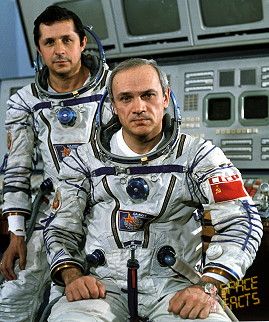
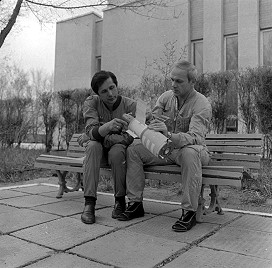
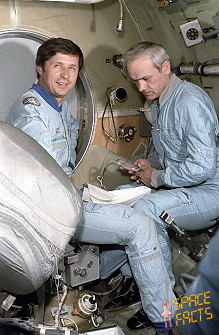
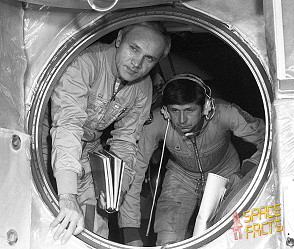
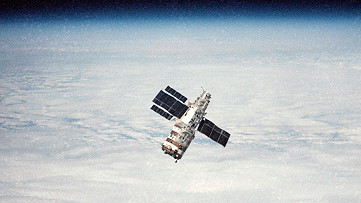
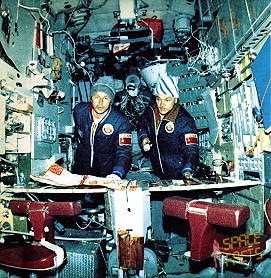
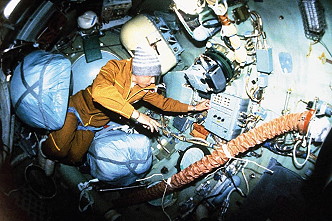
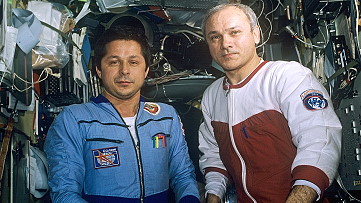
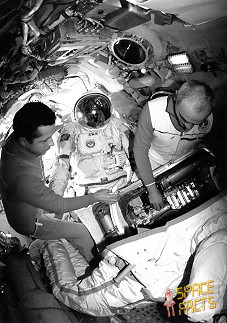
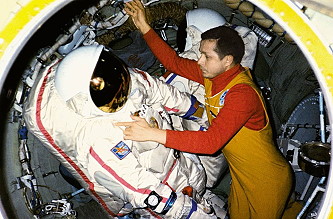
landing 220 km northeast of Dzheskasgan. Following a two-day solo flight Soyuz T-13 docked with Salyut 7 on June 08, 1985. Vladimir Dzhanibekov piloted his ship to intercept the forward port of Salyut 7, matched the station's rotation and achieved soft dock with the station. The cosmonauts became the fourth resident crew of the station. When arriving on the space station, the station had been vacant for eight months and it had been crippled by a solar array problem. Soyuz T-13 was the first Soyuz to dock manually with an inert Salyut. For the purpose it was slightly modified to include control levers in the descent module for proximity operations. This mission became one of the most impressive feats of in-space repairs in history. As the crew approached the inert station, they saw that its solar arrays were pointing randomly as it rolled slowly about its long axis. They used a handheld laser rangefinder to judge their distance, and conducted a fly-around inspection to be certain the exterior was intact. Vladimir Dzhanibekov noted that the thermal blankets on the transfer compartment had turned a dull gray from prolonged exposure to sunlight. Upon achieving hard dock, the crew confirmed through the electrical connectors in the docking collars that the Salyut 7 electrical system was dead. They carefully sampled the air in the station before opening the hatch. The station air was very cold, but breathable. Frost covered the walls and apparatus. The cosmonauts wore winter garb, including fur-lined hats, as they entered the station. The first order of business was to restore electric power. Of the eight batteries, all were dead, and two were destroyed. Vladimir Dzhanibekov determined that a sensor had failed in the solar array pointing system, preventing the batteries from recharging. A telemetry radio problem prevented the TsUP from detecting the problem. Salyut 7 had quickly run down its batteries, shutting down all its systems and accounting for the break in radio contact. The cosmonauts set about recharging the batteries. They used Soyuz T-13 to turn the station to put its solar arrays in sunlight. On June 10, 1985 they turned on the air heaters. The cosmonauts relied on the Soyuz T-13 air regeneration system until they could get the Salyut 7 system back in order. Three days later the attitude control system was successfully reactivated. That was necessary, because now a Progress bearing replacement parts could dock with Salyut 7. Wall heaters were turned on only after all the frost had evaporated, in order to prevent water from entering equipment. Normal atmospheric humidity was achieved only at the end of July 1985. The station's water tanks thawed by the end of June 1985. Freezing destroyed the water heater, so the cosmonauts used a powerful television light to heat fluids. After that scientific work was performed, including medical and astronomical research and work with the ASTRA apparature. Approaching and docking systems were tested. Progress 24 was docked to the station from June 23, 1985 - July 15, 1985. The freighter delivered propellant, solar array extensions, a new water heater, three new batteries, and about 40 kg of other replacement parts. It was followed by Kosmos 1669 from July 21, 1985 - August 29, 1985. This was a Progress spacecraft incorporating upgrades for use with MIR. A difficult EVA was conducted by Vladimir Dzhanibekov and Viktor Savinykh on August 02, 1985 (4h 58m). This EVA marked the first use of the Orlan-DM space suit designed for deployment on the Mir space station. Orlan-DM featured many improvements over the Orlan-D, including bright lights at the temples of the "headset" for illuminating suit control dials; improved controls; sturdier construction, including rubberized fabric shoulder belts in place of the Orlan-D's rubber belts; and greater mobility. The suits reached Salyut 7 aboard Cosmos 1669 (July 21, 1985), a prototype Progress freighter improved for Mir. During this EVA, Viktor Savinykh and Vladimir Dzhanibekov augmented the port side solar array using two extension panels delivered by Progress 24 (docked June 23, 1985). One extension had an experimental design. This completed the series of solar array augmentation spacewalks planned at Salyut 7's launch to occur over the station's occupancy. Moscow TV showed portions of the EVA live. The cosmonauts used the Orlan-DM's headset lights to continue work during orbital night. They left a small piece of solar cell material outside as an exposure experiment. Before closing out the EVA, they installed a Soviet/French experiment for collecting meteoritic dust (it was expected to gather dust from Halley's Comet) and changed space exposure cassettes near the transfer compartment hatch. Soyuz T-14 arrived at the station on September 17, 1985. It brought up two new station residents (Vladimir Vasyutin and Aleksandr Volkov) together with senior cosmonaut Georgi Grechko. After Georgi Grechko had inspected the repairs and condition of the station, he and Vladimir Dzhanibekov, from Soyuz T-13, returned to earth aboard Soyuz T-13 on September 26, 1985. Viktor Savinykh continued his work on the space station. The Soyuz spacecraft is composed of three elements attached end-to-end - the Orbital Module, the Descent Module and the Instrumentation/Propulsion Module. The crew occupied the central element, the Descent Module. The other two modules are jettisoned prior to re-entry. They burn up in the atmosphere, so only the Descent Module returned to Earth. Having shed two-thirds of its mass, the Soyuz reached Entry Interface - a point 400,000 feet (121.9 kilometers) above the Earth, where friction due to the thickening atmosphere began to heat its outer surfaces. With only 23 minutes left before it lands on the grassy plains of central Asia, attention in the module turned to slowing its rate of descent. Eight minutes later, the spacecraft was streaking through the sky at a rate of 755 feet (230 meters) per second. Before it touched down, its speed slowed to only 5 feet (1.5 meter) per second, and it lands at an even lower speed than that. Several onboard features ensure that the vehicle and crew land safely and in relative comfort. Four parachutes, deployed 15 minutes before landing, dramatically slowed the vehicle's rate of descent. Two pilot parachutes were the first to be released, and a drogue chute attached to the second one followed immediately after. The drogue, measuring 24 square meters (258 square feet) in area, slowed the rate of descent from 755 feet (230 meters) per second to 262 feet (80 meters) per second. The main parachute was the last to emerge. It is the largest chute, with a surface area of 10,764 square feet (1,000 square meters). Its harnesses shifted the vehicle's attitude to a 30-degree angle relative to the ground, dissipating heat, and then shifted it again to a straight vertical descent prior to landing. The main chute slowed the Soyuz to a descent rate of only 24 feet (7.3 meters) per second, which is still too fast for a comfortable landing. One second before touchdown, two sets of three small engines on the bottom of the vehicle fired, slowing the vehicle to soften the landing. |
EVA data
| Name | Start | End | Duration | Mission | Airlock | Suit | Stripes | |
| EVA | Savinykh, Viktor | 02.08.1985, 07:15 UTC | 02.08.1985, 12:13 UTC | 4h 58m | Soyuz T-13 | Salyut 7 | Orlan-DM No. 8 | blue |
| EVA | Dzhanibekov, Vladimir | 02.08.1985, 07:15 UTC | 02.08.1985, 12:13 UTC | 4h 58m | Soyuz T-13 | Salyut 7 | Orlan-DM No. 10 | red |
Photos / Graphics
 |
 |
|
source of all photos is Roscosmos / TASS |
|
 |
 |
 |
 |
 |
 |
 |
 |
 |
 |
 |
 |
| © |  |
Last update on March 10, 2025.  |
 |