Human Orbital Spaceflights

International Flight No. 210STS-93Columbia (26)95th Space Shuttle missionUSA |
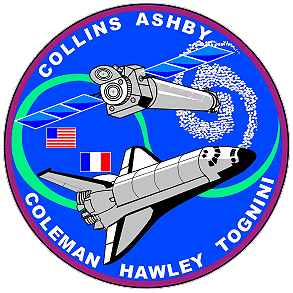 |
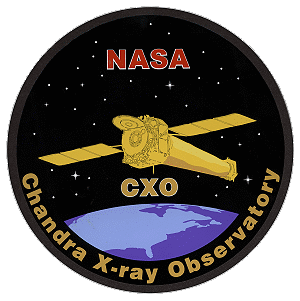 |
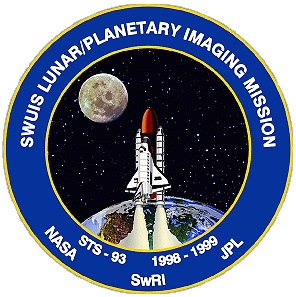 |
||
Launch, orbit and landing data
walkout photo |
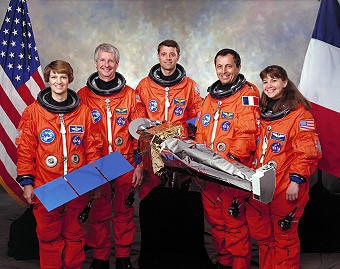 |
||||||||||||||||||||||||||||
alternative crew photo |
|||||||||||||||||||||||||||||
alternative crew photo |
|||||||||||||||||||||||||||||
alternative crew photo |
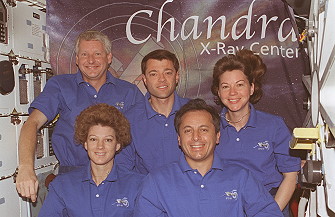
Crew
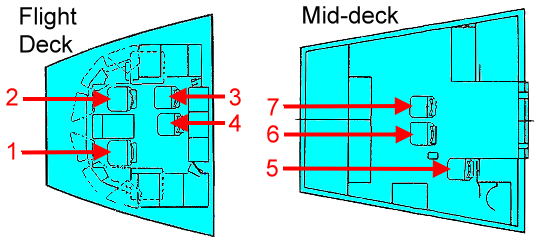
| No. | Surname | Given names | Position | Flight No. | Duration | Orbits | |
| 1 |  |
Collins | Eileen Marie "MOM" | CDR | 3 | 4d 22h 49m 34s | 80 |
| 2 | |
Ashby | Jeffrey Shears "Bones" | PLT, IV-1 | 1 | 4d 22h 49m 34s | 80 |
| 3 | |
Coleman | Catherine Grace "Cady" | MS-1, EV-2 | 2 | 4d 22h 49m 34s | 80 |
| 4 | |
Hawley | Steven Alan | MS-2, FE | 5 | 4d 22h 49m 34s | 80 |
| 5 |  |
Tognini | Michel Ange-Charles | MS-3, EV-1 | 2 | 4d 22h 49m 34s | 80 |
Crew seating arrangement
|
 |
|
||||||||||||||||||||||||
Hardware
| Orbiter : | OV-102 (26.) |
| SSME (1 / 2 / 3): | 2012 (22.) / 2031 (17.) / 2019 (19.) |
| SRB: | BI-097 / RSRM 69 |
| ET: | ET-99 (SLWT-5) |
| OMS Pod: | Left Pod 05 (15.) / Right Pod 05 (14.) |
| FWD RCS Pod: | FRC 2 (26.) |
| RMS: | - |
| EMU: | EMU No. 3003 (PLSS No. 1003) / EMU No. 3014 (PLSS No. 1014) |
Flight
|
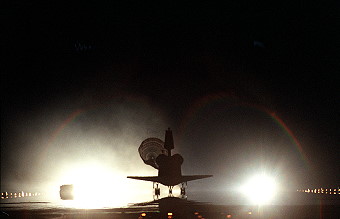
Launch from Cape Canaveral (KSC) and
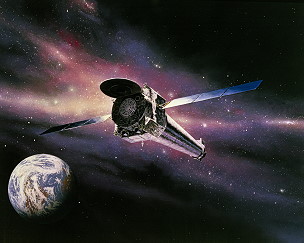
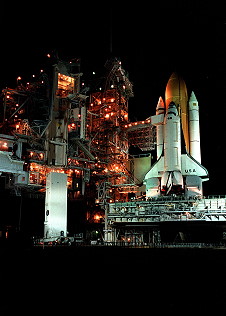
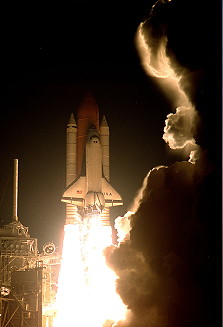
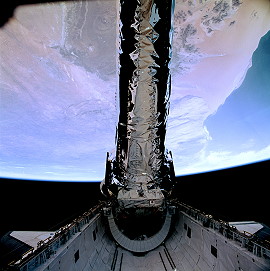
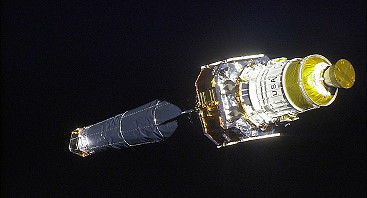
landing on Cape Canaveral (KSC), Runway 33. The first launch attempt was on July 20, 1999, but controllers aborted the launch at T-6 seconds, just before main engine ignition, due to a data spike in hydrogen pressure data. This problem was determined to be due to a faulty sensor and a second attempt was on July 22, 1999. A lightning storm prevented launch during the 46-minute window, and the launch was again scrubbed. The again used super lightweight external tank (SLWT) made its first Shuttle flight June 02, 1998, on mission STS-91. The SLWT is 7,500 pounds (3,402 kg) lighter than the standard external tank. The lighter weight tank allowed the shuttle to deliver International Space Station elements (such as the service module) into the proper orbit. The SLWT had the same size as the previous design. But the liquid hydrogen tank and the liquid oxygen tank were made of aluminum lithium, a lighter, stronger material than the metal alloy used for the Shuttle's current tank. The tank's structural design had also been improved, making it 30% stronger and 5% less dense. Columbia did not reach the planned orbit. Five seconds after liftoff, an electrical short disabled one primary and one secondary controller on two of the three main engines. In this event, the engines automatically switched to their backup controllers. The engine igniters were on, due to an excess build-up of hydrogen in the main engines. It was the furthest in the countdown that a Space Shuttle launch countdown has ever been held before engine ignition, which would have resulted in an abort by the RSLS system. The short was later discovered to have been caused by poorly routed wiring which had rubbed on an exposed screw head. This wiring issue led to a program-wide inspection of the wiring in all orbiters. Concurrently, an oxidizer post, which had been intentionally plugged, came loose inside one of the main engine's main injector and impacted the engine nozzle inner surface rupturing a hydrogen cooling line allowing a small leak. Because of the leak, the engine's controller saw an increase in use rate of hydrogen. The controller assumed the extra hydrogen was being burned in the engine (rather than being leaked overboard as it actually was) and increased the oxidizer flow to maintain the presumptive mixture ratio, resulting in a premature engine shutdown near the end of the projected burn due to low liquid oxygen level. Despite the premature shutdown, the vehicle safely achieved a slightly lower orbit and was able to complete the mission as planned. This incident brought on a maintenance practice change which required damaged oxidizer posts to be removed and replaced as opposed to being intentionally plugged, as was the practice beforehand. Backup controllers took over, but a further failure on the backup controller bus would have resulted in engine shutdown and the first ever attempt at an RTLS (Return To Launch Site) abort. To further complicate matters engine 3 (SSME 2019) had a hydrogen leak throughout the ascent, causing the engine to run hot. Controllers sweated as temperatures neared redline. The hot engine's controller compensated as programmed by using additional liquid oxygen propellant. The final result was that the shuttle ran out of gas - main engine cut-off (MECO) was at 04:39 UTC, putting Columbia into a 78 km x 276 km x 28.5-degree transfer orbit. Columbia was 1,700 kg short of oxygen propellant and 5 meters/sec slower than planned. The OMS-2 engine burn at 05:12 UTC circularized the orbit 10 km lower than planned. The RTLS abort mode was designed to allow the return of the orbiter, crew, and payload to the launch site, Kennedy Space Center, approximately 25 minutes after lift-off. The RTLS profile was designed to accommodate the loss of thrust from one space shuttle main engine between lift-off and approximately four minutes 20 seconds, at which time not enough main propulsion system propellant remains to return to the launch site. An RTLS can be considered to consist of three stages-a powered stage, during which the space shuttle main engines are still thrusting; an ET separation phase; and the glide phase, during which the orbiter glides to a landing at the Kennedy Space Center. The powered RTLS phase begins with the crew selection of the RTLS abort, which is done after solid rocket booster separation. The crew selects the abort mode by positioning the abort rotary switch to RTLS and depressing the abort push button. The time at which the RTLS is selected depends on the reason for the abort. For example, a three-engine RTLS is selected at the last moment, approximately three minutes 34 seconds into the mission; whereas an RTLS chosen due to an engine out at lift-off is selected at the earliest time, approximately two minutes 20 seconds into the mission (after solid rocket booster separation). After RTLS is selected, the vehicle continues downrange to dissipate excess main propulsion system propellant. The goal is to leave only enough main propulsion system propellant to be able to turn the vehicle around, fly back towards the Kennedy Space Center and achieve the proper main engine cutoff conditions so the vehicle can glide to the Kennedy Space Center after external tank separation. During the downrange phase, a pitch-around maneuver is initiated (the time depends in part on the time of a space shuttle main engine failure) to orient the orbiter/external tank configuration to a heads-up attitude, pointing toward the launch site. At this time, the vehicle is still moving away from the launch site, but the space shuttle main engines are now thrusting to null the downrange velocity. In addition, excess orbital maneuvering system and reaction control system propellants are dumped by continuous orbital maneuvering system and reaction control system engine thrustings to improve the orbiter weight and center of gravity for the glide phase and landing. The vehicle will reach the desired main engine cutoff point with less than 2 percent excess propellant remaining in the external tank. At main engine cutoff minus 20 seconds, a pitch-down maneuver (called powered pitch-down) takes the mated vehicle to the required external tank separation attitude and pitch rate. After main engine cutoff has been commanded, the external tank separation sequence begins, including a reaction control system translation that ensures that the orbiter does not recontact the external tank and that the orbiter has achieved the necessary pitch attitude to begin the glide phase of the RTLS. After the reaction control system translation maneuver has been completed, the glide phase of the RTLS begins. From then on, the RTLS is handled similarly to a normal entry. Eileen Collins became the first female Shuttle commander. The primary objective of the STS-93 mission was to deploy the Chandra X-ray Observatory (formerly the Advanced X-ray Astrophysics Facility) with its Inertial Upper Stage (IUS) booster. At its launch, Chandra was the most sophisticated X-ray observatory ever built. It is designed to observe X-rays from high energy regions of the universe, such as hot gas in the remnants of exploded stars. In addition, crew members operated the Southwest Ultraviolet Imaging System, a small telescope which was mounted at the side hatch window in Columbia's middeck to collect data on ultraviolet light originating from a variety of planetary bodies. The Chandra X-Ray Observatory was composed of three major assemblies: the spacecraft, telescope and science instrument module. The spacecraft module contained computers, communication antennas and data recorders to transmit and receive information between the observatory and ground stations. The on-board computers and sensors - with ground-based control center assistance - command and control the observatory and monitor its health during its expected five-year lifetime. The spacecraft module also provides rocket propulsion to move and aim the entire observatory. It contains an aspect camera that tells the observatory its position and orientation relative to the stars, and a Sun sensor that protects it from excessive light. Two three-panel solar arrays provide the observatory with 2,350 watts of electrical power and charge three nickel-hydrogen batteries that provide backup power. At the heart of the telescope system is the high-resolution mirror assembly. Since high-energy X-Rays would penetrate a normal mirror, special cylindrical mirrors were created. The two sets of four nested mirrors resemble tubes within tubes. Incoming X-Rays will graze off the highly polished mirror surfaces and be funneled to the instrument section for detection and study. The mirrors of the X-Ray observatory are the largest of their kind and the smoothest ever created. If the state of Colorado were the same relative smoothness, Pike's Peak would be less than one inch tall. The largest of the eight mirrors is almost four feet in diameter and three feet long. Assembled, the mirror group weighs more than one ton. The High-Resolution Mirror Assembly is contained in the cylindrical "telescope" portion of the observatory. The entire length of the telescope is covered with reflective multi-layer insulation that will assist heating elements inside the unit in keeping a constant internal temperature. By maintaining a precise temperature, the mirrors within the telescope will not be subjected to expansion and contraction - thus ensuring greater accuracy in observations. The High-Resolution Camera will record X-Ray images, giving scientists an unequaled look at violent, high-temperature occurrences like the death of stars or colliding galaxies. The High-Resolution Camera is composed of two clusters of 69 million tiny lead-oxide glass tubes. The tubes are only one-twentieth of an inch long and just one-eighth the thickness of a human hair. When X-Rays strike the tubes, particles called electrons are released. As the electrons accelerate down the tubes - driven by high voltage - they cause an avalanche of about 30 million more electrons. A grid of electrically charged wires at the end of the tube assembly detects this flood of particles and allows the position of the original X-Ray to be precisely determined. By electronically determining the entry point of the original X-Ray, the camera can reproduce a high-resolution image of the object that produced the X-Rays. The High-Resolution Camera will complement the Charge-Coupled Device Imaging Spectrometer, also contained in the science instrument module. The AXAF CCD Imaging Spectrometer (ACIS) is capable of recording not only the position, but also the color, or energy, of the X-Rays. The ACIS is made up of 10 charge-coupled device arrays. These detectors are similar to those used in home video recorders and digital cameras, but are designed to detect X-Rays. The ACIS can distinguish up to 50 different energies within the range that the observatory operates. In order to gain even more energy information, two screen-like instruments - called diffraction gratings - can be inserted into the path of the X-Rays between the telescope and the detectors. The gratings change the path of the X-Ray depending on its energy and the X-Ray cameras record the color and position. One grating concentrates on the higher and medium energies and uses the imaging spectrometer as a detector. The other grating disperses low energies and is used in conjunction with the High-Resolution Camera. Commands from the ground allow astronomers to select which grating to use. On STS-93, the Inertial Upper Stage helped propel the Chandra X-Ray Observatory from low Earth orbit into an elliptical orbit reaching one-third of the way to the Moon. The Inertial Upper Stage is a two stage, inertially guided, three-axis stabilized, solid fuel booster used to place spacecraft into a high-Earth orbit or boost them away from the Earth on interplanetary missions. It is approximately 17 feet (5.2 meters) long and 9.25 feet (2.8 meters) in diameter, with an overall weight of approximately 32,500 pounds (14,714 kg). Once on orbit, the Shuttle crew activated the spacecraft power system, and controllers at the Chandra X-Ray Observatory Control Center in Cambridge, MA, began activating and checking out key observatory systems. Chandra controllers activated and checked out the observatory's computers, activate heaters to control the temperature of observatory systems and initiated venting of Chandra's imaging spectrometer. Controllers also tested the system that would have placed Chandra in a safe mode should an anomaly occurred after deployment and test communications links between the observatory and the ground through Chandra's upper antenna. Approximately five-and-a-half hours after launch, the Shuttle crew tilts the Chandra and its Inertial Upper Stage up to 29 degrees. Chandra controllers then checked radio communications links between the observatory and the ground through Chandra's lower antenna. Following initial activation and checkout of Chandra by the Operations Control Center, the Columbia crew configured the Inertial Upper Stage for deployment, disconnected umbilicals between the orbiter and payload, and raised the payload to its deployment attitude of 58 degrees above the payload bay. Catherine Coleman then deployed the observatory and its upper stage a little over seven hours after launch before maneuvering the Shuttle to a safe distance from Chandra. About an hour later the Inertial Upper Stage will fire its first stage solid rocket motor for about two minutes, then coast through space for about two minutes more. The first stage separated, and the second stage fired for almost two additional minutes. This placed the observatory into a temporary, or transitional, elliptical orbit peaking at 37,200 miles (59,854 km) above the Earth and approaching the Earth to within 174 miles (280 km). Chandra's twin solar arrays then were unfolded, allowing Chandra to begin converting sunlight into 2,350 watts of electrical power to run the observatory's equipment and charge its batteries. Next, the Inertial Upper Stage separated from the observatory and Chandra's own propulsion system gradually moved the observatory to its final working orbit of approximately 6,214 by 86,992 miles (10,000 by 140,000 km) in altitude. It took approximately 10 days and five firings of Chandra's own propulsion system to reach its operating orbit. Other payloads on STS-93 included the Midcourse Space Experiment (MSX), the Shuttle Ionospheric Modification with Pulsed Local Exhaust (SIMPLEX), the Southwest Ultraviolet Imaging System (SWUIS), the Gelation of Sols: Applied Microgravity Research (GOSAMR) experiment, the Space Tissue Loss – B (STL-B) experiment, a Light Weight Flexible Solar Array Hinge (LFSAH), the Cell Culture Module (CCM), the Shuttle Amateur Radio Experiment – II (SAREX – II), EarthKAM, Plant Growth Investigations in Microgravity (PGIM), the Commercial Generic Bioprocessing Apparatus (CGBA), the Micro-Electrical Mechanical System (MEMS), and the Biological Research in Canisters (BRIC). The Southwest Ultraviolet Imaging system (SWUIS) was based around a Maksutov-design ultraviolet (UV) telescope and a UV-sensitive, image-intensified Charge-Coupled Device (CCD) camera that frames at video frame rates. The Southwest Ultraviolet Imaging System (SWUIS) was an innovative telescope/charge-coupled device (CCD) camera system that operated from inside the shuttle cabin. SWUIS was used to image planets and other solar system bodies in order to explore their atmospheres and surfaces in the ultraviolet (UV) region of the spectrum, which astronomers value for its diagnostic power. SWUIS made its first flight on STS-85 in August 1997. On that mission, SWUIS obtained over 400,000 images of the Hale-Bopp Comet at a time when the Hubble Space Telescope could not observe the comet because it was lost in the glare of the sun. These images have already revealed important insights into the comet's water and dust production rates as it left the sun on its return to the Oort Cloud of comets, 10,000 times as far away as Pluto. The Shuttle Ionespheric Modification with Pulsed Local Exhaust (SIMPLEX) payload activity researched the source of Very High Frequency (VHF) radar echoes caused by the orbiter and its OMS engine firings. The Principal Investigator (PI) used the collected data to examine the effects of orbital kinetic energy on ionospheric irregularities and to understand the processes that take place with the venting of exhaust materials. The Shuttle Amateur Radio Experiment (SAREX-II) demonstrated the feasibility of amateur short-wave radio contacts between the shuttle and ground-based amateur radio operators. SAREX also served as an educational opportunity for schools around the world to learn about space by speaking directly to astronauts aboard the shuttle via amateur radio. The EarthKAM payload conducted Earth observations using the Electronic Still Camera (ESC) installed in the overhead starboard window of the Aft Flight Deck. The Plant Growth Investigations in Microgravity (PGIM) payload experiment used plants to monitor the space flight environment for stressful conditions that affect plant growth. Because plants cannot move away from stressful conditions, they have developed mechanisms that monitor their environment and direct effective physiological responses to harmful conditions. The Commercial Generic Bioprocessing Apparatus (CGBA) payload hardware allows for sample processing and stowage functions. The Generic Bioprocessing Apparatus – Isothermal Containment Module (GBA-ICM) is temperature controlled to maintain a preset temperature environment, controls the activation and termination of the experiment samples, and provides an interface for crew interaction, control and data transfer. The Micro-Electrical Mechanical System (MEMS) payload examines the performance, under launch, microgravity, and reentry conditions of a suite of MEMS devices. These devices include accelerometers, gyroscopes, and environmental and chemical sensors. The MEMS payload is self-contained and requires activation and deactivation only. The Biological Research in Canisters (BRIC) payload was designed to investigate the effects of space flight on small arthropod animals and plant specimens. The flight crew was available at regular intervals to monitor and control payload/experiment operations. The objective of BRIC-11 was to investigate gravity-regulated gene expression by using Earth- and space-grown seedlings. These studies represent a first step toward understanding the effects of gravity on gene regulation. Arabidopsis was chosen because it offers a number of advantages for molecular genetic studies. It also allows the investigator to analyze the expression of thousands of genes simultaneously by using a DNA "chip" technology. The objectives of Cell Culture Model, Configuration C (CCM-C) were to validate cell culture models for muscle, bone, and endothelial cell biochemical and functional loss induced by microgravity stress; to evaluate cytoskeleton, metabolism, membrane integrity, and protease activity in target cells; and to test tissue loss pharmaceuticals for efficacy. The experiment unit fitted into a single standard middeck locker with the door panels removed. The unit took in and vented air to the cabin via the front panel. The experiment was powered and functioned continuously from prelaunch through postlanding. The analysis module for STS-93 was CCM Configuration C. It had a hermetically sealed fluid path assembly containing the cells under study, all media for sustained growth, automated drug delivery provisions to test candidate pharmaceuticals, in-line vital activity and physical environment monitors, integral fraction collection capabilities, and cell fixation facilities. The fluid path and media were cooled by a 4-degree Celsius active cooling chamber and associated cabling and driver circuitry. (This payload was formerly called Space Tissue Loss, Configuration A.) The GOSAMR experiment attempted to form precursors for advanced ceramic materials by using chemical gelation (disrupting the stability of a sol and forming a semi-solid gel). These precursor gels will be returned to 3M Science Research Laboratories, dried, and fired to temperatures ranging from 900 to 2,900 degrees F (482 to 1,593 degrees Celsius) to complete the fabrication of the ceramic composites. These composites will then be evaluated to determine if processing in space resulted in better structural uniformity and superior physical properties. The Lightweight Flexible Solar Array Hinge (LFSAH) consisted of several hinges fabricated from shape-memory alloys, which allow controlled, shockless deployment of solar arrays and other spacecraft appendages. LFSAH should demonstrate the deployment capability of a number of hinge configurations on STS-93. |
Photos / Graphics
 |
 |
 |
 |
 |
 |
 |
 |
 |
 |
 |
 |
 |
 |
 |
 |
 |
 |
| © |  |
Last update on April 18, 2021.  |
 |