Human Orbital Spaceflights

International Flight No. 203STS-90Columbia (25)90th Space Shuttle missionUSA |
 |
 |
 |
||
Launch, orbit and landing data
walkout photo |
 |
|||||||||||||||||||||||||||||
alternative crew photo |
alternative crew photo |
|||||||||||||||||||||||||||||
alternative crew photo |
alternative crew photo |
|||||||||||||||||||||||||||||
alternative crew photo |
||||||||||||||||||||||||||||||
Crew
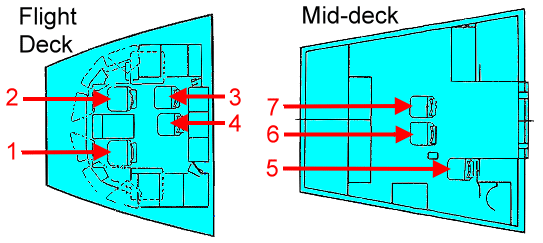
| No. | Surname | Given names | Position | Flight No. | Duration | Orbits | |
| 1 |  |
Searfoss | Richard Alan | CDR | 3 | 15d 21h 49m 58s | 256 |
| 2 | |
Altman | Scott Douglas "Scooter" "Bear" | PLT | 1 | 15d 21h 49m 58s | 256 |
| 3 | |
Linnehan | Richard Michael | MS-1, PLC, EV-1 | 2 | 15d 21h 49m 58s | 256 |
| 4 | |
Hire | Kathryn Patricia "Kay" | MS-2, IV-1, FE | 1 | 15d 21h 49m 58s | 256 |
| 5 |  |
Williams | Dafydd Rhys "Dave" | MS-3, EV-2 | 1 | 15d 21h 49m 58s | 256 |
| 6 | |
Buckey | Jay Clark, Jr. | PS-1 | 1 | 15d 21h 49m 58s | 256 |
| 7 | |
Pawelczyk | James Anthony "Jim" | PS-2 | 1 | 15d 21h 49m 58s | 256 |
Crew seating arrangement
|
 |
|
||||||||||||||||||||||||||||||||
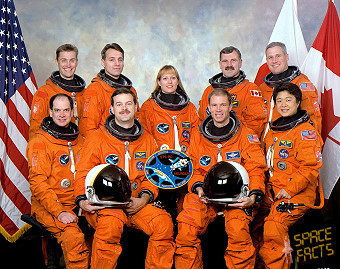
Backup Crew
|
 |
|||||||||||||||

Hardware
| Orbiter : | OV-102 (25.) |
| SSME (1 / 2 / 3): | 2041-1 (4.) / 2032 (7.) / 2012 (21.) |
| SRB: | BI-094 / RSRM 65 |
| ET: | ET-91 (LWT-84) |
| OMS Pod: | Left Pod 05 (14.) / Right Pod 05 (13.) |
| FWD RCS Pod: | FRC 2 (25.) |
| RMS: | - |
| EMU: | EMU No. 3017 (PLSS No. 1017) / EMU No. 3008 (PLSS No. 1008) |
Flight
|
Launch from Cape Canaveral (KSC) and
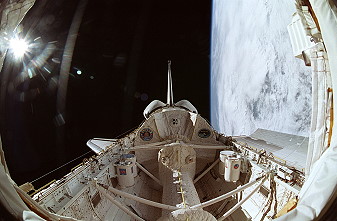
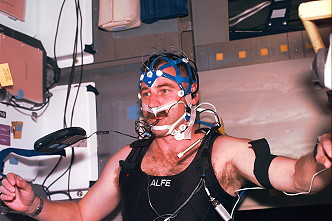
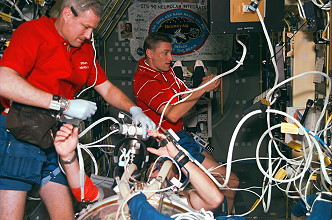
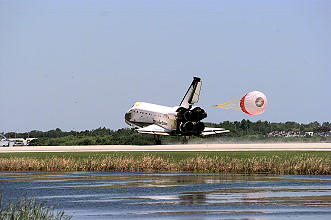
landing on Cape Canaveral (KSC), Runway 33. The launch was postponed on April 16, 1998 for 24 hours due to difficulty with one of Columbia's two network signal processors, which format data and voice communications between the ground and the Space Shuttle. The network signal processor 2 was replaced. STS-90 became the final mission of Spacelab, the mission Neurolab. The goals of Neurolab are to study basic research questions and to increase the understanding of the mechanisms responsible for neurological and behavioral changes in space. Specifically, experiments will study the adaptation of the vestibular system and space adaptation syndrome, the adaptation of the central nervous system and the pathways which control the ability to sense location in the absence of gravity, and the effect of microgravity on a developing nervous system. Neurolab’s 26 experiments targeted one of the most complex and least understood parts of the human body – the nervous system. Primary goals were to conduct basic research in neurosciences and expand understanding of how the nervous system develops and functions in space. Test subjects were rats, mice, crickets, snails, two kinds of fish and the crew members themselves. Cooperative effort of NASA, several domestic partners and the space agencies of Canada (CSA), France (CNES) and Germany (DARA), as well as the European Space Agency (ESA) and the National Space Development Agency of Japan (NASDA). Most experiments conducted in pressurized Spacelab long module located in Columbia’s payload bay. This was 16th and last scheduled flight of the ESA developed Spacelab module although Spacelab pallets will continue to be used on the International Space Station. The experiments have been grouped into eight teams. Four teams (with a combined total of 11 experiments) used crewmembers as subjects, and 4 teams (with 15 experiments) studied research animals. The teams studying human subjects were the Autonomic Nervous System, Sensory Motor and Performance, Vestibular, and Sleep teams. Teams with animal subjects were the Neuronal Plasticity, Mammalian Development, Aquatic, and Neurobiology teams. Autonomic Nervous System Team An elderly man stands up quickly after awakening, feels dizzy, and falls. A fighter pilot forces his plane into a tight turn and nearly passes out. What links these two causes? In both situations the cardiovascular system (the heart and blood vessels) is stressed by gravity. Since the head is above the heart when we stand or sit, the cardiovascular system must work against gravity to maintain blood flow to the brain. A person whose cardiovascular system is having trouble providing blood flow to the brain when standing is said to have orthostatic intolerance. Why is orthostatic intolerance a concern for Neurolab? Once back on Earth, astronauts also experience orthostatic intolerance. Results from experiments carried out on previous life sciences Spacelab missions show that while all crew-members could easily stand quietly for 10 minutes before flight, after flight 60 percent needed to sit down before the 10 minutes were up. Some showed significant decreases in blood pressure, while others needed to sit despite an apparently normal, though low, blood pressure. The Autonomic Nervous System Team on Neurolab wanted to uncover what changes in the control of blood pressure during space flight lead to the problems astronauts encounter after flight. Sensory Motor Performance Team On Earth, when humans make simple, everyday movements like pointing or catching a ball, the nervous system takes gravity into account. The brain processes information from the eyes and inner ear, as well as from nerves in the joints and muscles, to make smooth, accurate movements. In space, the inner ear no longer provides the brain with useful information about 'up' or 'down.' The nerves in the joints are sensing the movements of weightless limbs. The nervous system must adapt so astronauts can function effectively. The Sensory Motor and Performance Team wanted to measure this adaptation and understand how it takes place. How does a simple task like catching a ball change without the influence of gravity? Will the muscles tense and prepare for a falling ball prematurely, based on experience in Earth's gravity? Or will the system accommodate the change rapidly? Will vision become more important in determining body position since cues from the inner ear are no longer present? Previous space flights have shown that crewmembers can experience visual illusions in space particularly when determining what is "up" and what is "down." Is "down" always where the brain determines the "floor" to be? Without gravity as a guide, the brain can interpret a floor as a ceiling or vice versa. Vestibular Team The Space Shuttle commander brings the orbiter to a smooth landing. The crew now feels gravity for the first time in days, perhaps weeks. They may feel unsteady on their feet and have trouble with balance. Simple tasks like walking down stairs or turning corners now may be difficult. The crew is experiencing the consequences of a successful adaptation to space. Their symptoms persist until their vestibular system - the balance organs in the ear and all the connections they make to the eyes, brain, and muscles - readapt to Earth. What changes have taken place in the inner ear? How has the brain learned to ignore some information form the inner ear and reinterpret other signals to allow the astronaut to be productive in space? Special techniques are necessary to answer these questions. The inner ear resides in the densest bone in the body and does not give up its secrets easily. On Neurolab, the vestibular team used noninvasive, but powerful, techniques to bring those answers to light. Earth Benefits - Clinical tests of inner ear function often measure eye movements in only two directions: up-down and right-left. The eye movement system developed for Neurolab by the European Space Agency allowed for measuring eye movements in all directions, allowing for more sensitive tests of inner ear performance. Experiment results may also contribute to the design of more effective rehabilitation procedures for patients with severe inner ear diseases. Sleep Team Astronauts often sleep poorly on Space Shuttle missions. Crewmembers on Shuttle missions have reported an average sleep period of 5 to 6 hours, compared with the typical period of 7 to 8 hours on Earth. Some sleeping difficulties are expected, as astronauts often work in shifts to handle full mission schedules. There is little privacy, quarters are confined, and noises or other interruptions may occur. One survey shows that more than 50 percent of crewmembers use sleeping medication at some point during a mission. Crewmembers also face the cumulative effects of sleep loss or the carry-over effects of a sleeping pill-a deterioration in alertness and cognitive performance during the active hours of the workday. Although sleep difficulty in space has been studied before, a clear understanding of the problem, as well as a solution, remain as missing pieces in the puzzle of how the body works in space. With frequent extended missions and the advent of the Space Station on the horizon, the issue becomes even more important. The team evaluated the normal sleep patterns of crew members before, during and after space flight to identify the factors which contribute to sleep disturbances associated with space flight. Included in these studies was the use of melatonin as a hypnotic agent for the treatment of sleep disturbances that occur during space flight, and the potential improvement of mood and performance of the crewmembers receiving melatonin as compared to receiving a placebo. The team also examined crew respiration both during sleep and wakefulness. Mammalian Development Team A surgeon successfully removes a cataract from one eye of a 50-year-old man who has been blind since birth because of cataracts. When the bandages are removed, an examination reveals that the eye functions acceptably, and, more importantly, the overjoyed patient announces he can see. It soon becomes apparent, however that what the patient sees is strikingly different from what would be seen by a person with normal vision. For example, he cannot perceive size or distance. He cannot identify a face until he hears the voice to which it belongs. He sees colors and shapes, but they confuse him. What he sees makes no sense. A second operation removes the cataract from the other eye, but his vision does not improve. Why can't the patient see? Neuroscientists find increasing evidence that if the nervous system is not exposed to normal forms of stimuli, such as vision, at specific periods during development, the nervous system will not develop properly. In the case mentioned above, the patient's eyes functioned well; however, without the stimulation normally experienced in early childhood, the visual cortex remained underdeveloped. The eyes could see, but the brain did not get the message. Experiments on previous space life sciences missions indicate that gravity, an ever-present stimulus in our environment on earth, may also be essential to normal development. For example, in microgravity, quail chicks failed to develop the necessary motor skills for feeding themselves. Gravity isn't essential to all development, however. Tadpoles that hatch and develop in microgravity show normal swimming behavior. The identification of "sensitive" and "critical" periods of development will add a vital piece to the life sciences puzzle. On Neurolab, in a series of experiments that can be performed only without the influence of gravity, investigators will study the development of muscles, the vestibular system, the cardiovascular system, and many parts of the brain. The Mammalian Development Team will use rats and mice at various stages of development. The aim of these experiments was to provide information for understanding the effects of space flight on the normal development of the nervous system. The series of experiments used anatomical, physiological, molecular, electrophysiological, behavioral and biochemical approaches to investigate the processes crucial for central nervous system development from shortly after the closure of the neural tube through the establishment of complex behaviors. Earth Benefit - Just as we have the ability at birth to learn whatever language we are exposed to, we may also have the ability to adapt to whatever gravitational field we experience in early life. These abilities often exist only during a "critical period". Afterward, our potential is limited. Understanding the nature of these critical periods is important in pediatrics. Knowledge of the critical period for developing normal vision has already changed how strabismus ("lazy eye") is treated in children. The Neurolab mammalian development experiments will expand this knowledge to the control of movement, regulation of blood pressure and maintaining balance. The experiments explore the great potential of our nervous system to adapt to whatever environmental conditions are found at birth. Information from these studies can also be applied to the development of treatments for individuals suffering from childhood neuromuscular diseases, such as muscular dystrophy, or from sustained trauma to their nerves, muscles or spinal cord. Neuronal Plasticity Team Life evolved in earth's gravitational field, and animals learn tasks, such as walking, under the force of gravity. When the gravity load is reduced, as it is in space, the nervous system is challenged. The inner ear, which senses gravity, no longer provides meaningful information identifying "up" or "down". Because the body is weightless, nerves in the joints no longer sense the weight of a limb. When a person is floating, walking is not necessary, and maintaining balance is not important. The brain must relearn many tasks to compensate for this new environment. The fact that people can function well in space shows that the nervous system can compensate effectively. This is accomplished through neuronal plasticity, a phenomenon in which neurons react to changed conditions by making new connections or using existing connections in different ways. At the cellular level, neuronal plasticity is learning. How plasticity takes place is a significant question in neuroscience. On Neurolab, investigators studied neuronal plasticity to understand how balance, daily rhythms (such as sleep/wake cycles), and the control of movement change in microgravity. Using rats as subjects, Neurolab investigators will explore how learning occurs in space by measuring changes that take place in the central nervous system. The science in this team examined the neural and physiological changes during and following space flight to address the response of the adult rodent central nervous system to altered gravity. Earth Benefits - Experiments on vestibular adaptation will yield a better understanding of balance disorders, which affect more than 90 million Americans. Experiments on circadian rhythms could yield valuable data to researchers seeking the causes of jet lag, insomnia and mental disorders such as winter depression. This data is also applicable to aging populations and shift workers, both of whom experience changes in circadian rhythms. Reconstructing the images from one of these experiments has already led to the development of a Biocomputation Center at the Ames Research Center. The computers there now are also being used to develop vital surgery techniques, a key application and NASA spin-off for the three-dimensional reconstruction software developed there. Aquatic Team How does the vestibular system adjust to the microgravity of space? Do physiological changes occur in the components of the gravity sensors? Are the signals sent from the inner ear to the brain altered? If alterations occur, does behavior change? Neurolab seeked answers to these questions through a series of experiments that focus on the gravity sensing system in snails and fish. The gravity-sensing system in vertebrates from fish to humans has the same basic structure. In humans, this system is a component of the inner ear. An even simpler system, which is easier to analyze and develops faster, exists in snails. The gravity-sensing component is lined with hair cells that send signals to the brain when they are as triggered. The 'triggers' are small rock-like particles of calcium carbonate, referred to the statoliths in snails and otoliths in fish and humans. With the tug of gravity, these triggers weigh down upon and bend different groups of hair cells. Activated by this 'bending,' the hair cells then send orientation signals to the brain. The Aquatic discipline team was made up of two investigations using aquatic species as experimental subjects. The investigations used different species, housed in separate facilities. Earth Benefits - Data from the aquatic experiments on Neurolab may disclose the mechanisms at work in various forms of motion sickness experienced by many people on Earth. The studies may also help explain why aging otoliths become smaller. Further benefits include the use and perfection of the sieve or wafer electrode that is used to record nerve impulses. This electrode offers potential use as a connection to the nervous system in people with deafness caused by hair cell damage. It also could be used as an interface to signal motor prostheses how and when to move. Neurobiology Team In any of the experiments on Neurolab, investigators are searching for pieces to one particular space life sciences puzzle - the puzzle of how much of normal development is preprogrammed in genes, and how much depends on cues from the environment (like gravity). As it turns out, the familiar domestic cricket (Acheta domesticus) can help. Crickets have simple gravity sensors connected to a simple and well-studied nervous system. This means that development of the gravity sensors and connections they make to the nervous system can be studied comprehensively both with and without gravity. The crickets develop rapidly, making them ideal for studies on a 16-day flight. Also, the cricket has another sensory system located next to gravity receptors. This system is comprised of wind (or air current) receptors, and there is no reason to expect that these should change without gravity. So, by comparing the development of the gravity receptors and their connections, the effect of microgravity will be revealed. After the flight, the consequence of developing in space could be measured. Crickets roll their heads when tilted, and this reflex is activated by the gravity sensing system. By studying head rolling after the flight, investigators can measure the behavioral consequences of having a nervous system that was built in space. The Shuttle Vibration Forces (SVF) experiment measured the dynamic forces acting between the Space Shuttle and a canister attached to the Shuttle sidewall during two upcoming Shuttle flights: STS-90 and STS-96. In previous Shuttle flights, the vibration motion at various positions in the cargo bay has been measured, but the SVF experiment provided the very first measurements of the dynamic forces acting on Shuttle equipment. The SVF data, together with a new vibration testing method, enabled NASA to fly more sophisticated equipment on the Shuttle, at less cost. The powerful rocket engines used on the Space Shuttle, and other launch vehicles, generate a great deal of noise and vibration at lift-off. All of the Shuttle equipment must be designed for this severe environment, and most of the cargo is subjected to very severe vibration testing to insure that it will survive. Although aerospace equipment has become increasingly sophisticated, vibration testing methods have not changed substantially in 50 years. As a result, conventional vibration testing methods are not well suited to lightweight, and sometimes delicate, aerospace equipment. Equipment which could survive space flight just fine, often fails during vibration testing, which leads to a waste of effort and money because redesign and retesting must be performed. The Bioreactor Demonstration System-04 (BDS-04) / Biotechnology Specimen Temperature Controller (BSTC) were a reconfigurable, multichamber, temperature-controlled, static tissue culture apparatus. On the STS-90 mission the BDS system housed two experiments, the Human Renal Cell experiment and The Microgravity Induced Differentiation of HL-60 Promyelocytic Leukemia cells. The BDS-04 was a single chassis that is divided into two sections. The first section contained the control computer, power supplies, signal conditioners and interface electronics. The second section contained four insulated incubation/refrigeration modules. These modules were heated and cooled via Thermoelectric Coolers. Each module could hold up to three tissue culture bags containing media and cells. These tissue culture bags which held 25 ml media and cells per section, had two septums for sampling and fixing or inoculating the contents. BDS-04 temperature control range is from 4° to 50° C. BDS-04 was operated at 17° C to 36° C during the STS-90 mission. STS-90 was the first mission to make an Orbital Maneuvering System (OMS) assist burn during the ascent. Three sevenths of the STS-90 crew (Dafydd Williams, James Pawelczyk and Jay Buckey) appeared on the Canadian television series Popular Mechanics for Kids. Working with engineers on the ground a week into the flight, the on-orbit crew used aluminum tape to bypass a suspect valve in the Regenerative Carbon Dioxide Removal System that had threatened to cut short the mission. Other payloads were three Get-Away Special (GAS) canister investigations. Mission Management Team considered, but decided against, extending the mission one day because the science community indicated an extended flight was not necessary and weather conditions were expected to deteriorate after planned landing on May 03, 1998. |
Photos / Graphics
 |
 |
|
source of all photos is NASA |
|
 |
 |
 |
 |
 |
 |
 |
 |
 |
 |
Earth observation photos |
|
| © |  |
Last update on March 27, 2020.  |
 |