Human Orbital Spaceflights

International Flight No. 137STS-39Discovery (12)40th Space Shuttle missionUSA |
 |
 |
 |
 |
|
Launch, orbit and landing data
walkout photo |
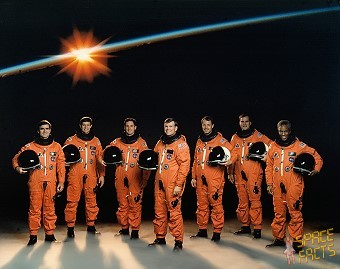 |
||||||||||||||||||||||||||||
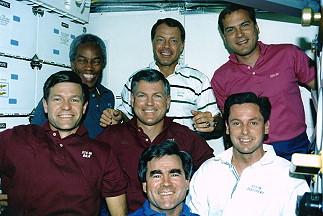
alternative crew photo |
Crew
| No. | Surname | Given names | Position | Flight No. | Duration | Orbits | |
| 1 |  |
Coats | Michael Lloyd | CDR | 3 | 8d 07h 22m 21s | 134 |
| 2 | |
Hammond | Lloyd Blaine, Jr. | PLT | 1 | 8d 07h 22m 21s | 134 |
| 3 | |
Harbaugh | Gregory Jordan | MS-1, EV-1 | 1 | 8d 07h 22m 21s | 134 |
| 4 | |
McMonagle | Donald Ray | MS-2, EV-2, FE | 1 | 8d 07h 22m 21s | 134 |
| 5 | |
Bluford | Guion Stewart, Jr. "Guy" | MS-3, IV-1 | 3 | 8d 07h 22m 21s | 134 |
| 6 | |
Veach | Charles Lacy | MS-4 | 1 | 8d 07h 22m 21s | 134 |
| 7 | |
Hieb | Richard James | MS-5, RMS | 1 | 8d 07h 22m 21s | 134 |
Crew seating arrangement
|
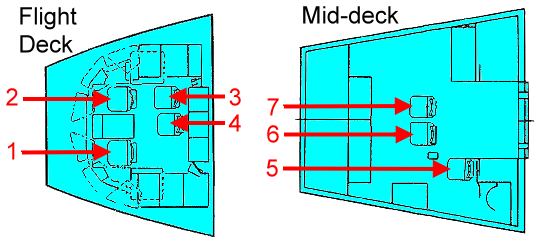 |
|
||||||||||||||||||||||||||||||||
Backup Crew
|
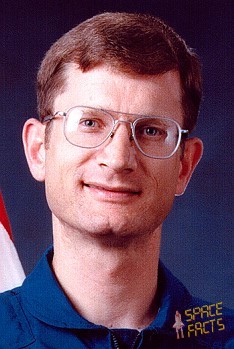 |
||||||||||
Hardware
| Orbiter : | OV-103 (12.) |
| SSME (1 / 2 / 3): | 2026 (1.) / 2030 (5.) / 2029 (4.) |
| SRB: | BI-043 / RSRM 15K |
| ET: | ET-46 (LWT-39) |
| OMS Pod: | Left Pod 04 (9.) / Right Pod 03 (13.) |
| FWD RCS Pod: | FRC 3 (12.) |
| RMS: | 301 (9.) |
| EMU: | EMU No. 2008 (PLSS No. 1011) / EMU No. 2013 (PLSS No. 1005) |
Flight
|
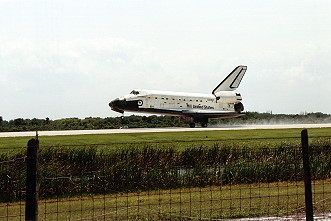
Launch from Cape Canaveral (KSC) and
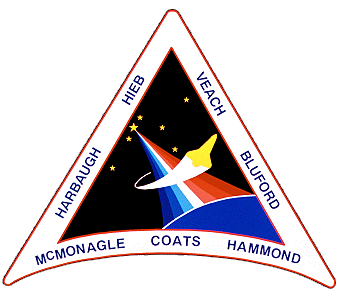
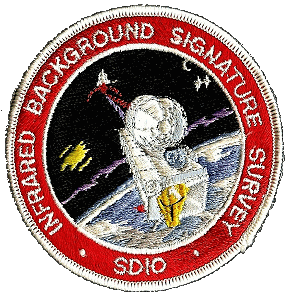
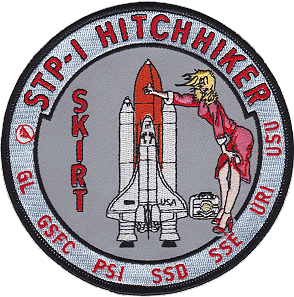
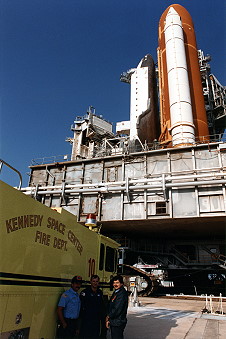
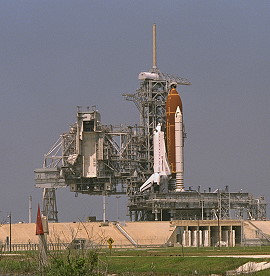
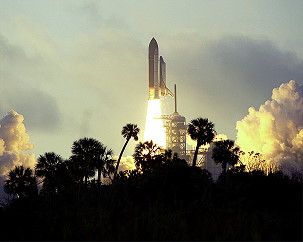
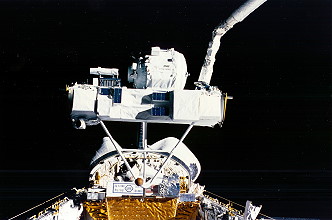
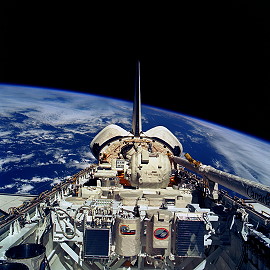
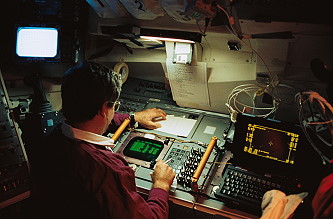
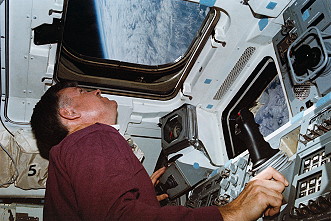
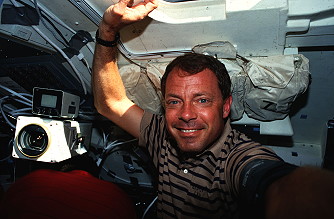
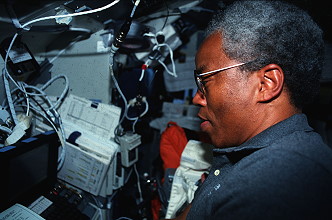
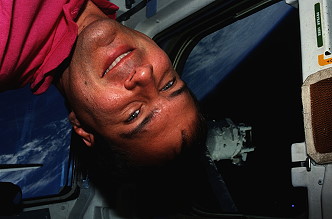
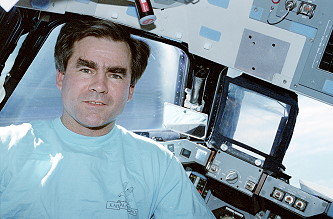
landing on Cape Canaveral (KSC), Runway 15. The launch was originally scheduled for March 09, 1991, but during processing work at Pad A, significant cracks were found on all four lug hinges on the two external tank umbilical door drive mechanisms. The shuttle was rolled back to the VAB for repair work. The faulty hinges were replaced with units taken from orbiter Columbia, and reinforced. Discovery was returned to the launching pad on April 01, 1991, and the launch was rescheduled for April 23, 1991. The mission was again postponed when, during prelaunch external tank loading, a transducer on high-pressure oxidizer turbopump for main engine number three showed readings out of specification. The transducer and its cable harness were replaced and tested. The launch was rescheduled for April 28, 1991. Robert Crombie trained as backup PSP for the MSP astronauts Guion Bluford, Richard Hieb and Charles Veach. Mission STS-39 was the first unclassified Department of Defense-dedicated Space Shuttle mission, highlighted by around-the-clock observations of the atmosphere, gas releases, Shuttle engine firings, subsatellite gas releases and the Shuttle's orbital environment in wavelengths ranging from infrared to the far ultraviolet. Unclassified payload included Air Force Program-675 (AFP-675); Infrared Background Signature Survey (IBSS) with Critical Ionization Velocity (CIV), Chemical Release Observation (CRO) and Shuttle Pallet Satellite-II (SPAS-II) experiments; and Space Test Payload-1 (STP-1). Classified payload consisted of Multi-Purpose Release Canister (MPEC). Also, on board was Radiation Monitoring Equipment III (RME III) and Cloud Logic to Optimize Use of Defense Systems-IA (CLOUDS-I). AFP-675 was a collection of scientific instruments to observe targets such as the atmosphere, the aurora and stars in infrared, far ultraviolet, ultraviolet and X-ray wavelengths. AFP-675 instruments also will analyze the spectrum of various targets and gases released from or around the Shuttle. AFP-675 is sponsored by the U.S. Air Force's Space Systems Division and may provide a better understanding of the difficulties in identifying spacecraft with remote sensors and distinguishing those spacecraft from naturally occurring phenomena. The AFP-675 instruments also are to study several astronomical targets of interest. The Strategic Defense Initiative Organization's IBSS experiment, mounted on the SPAS-II platform, was deployed and retrieved by Discovery so that SPAS-II could observe the Shuttle's engine firings from afar. IBSS observed and recorded the infrared signature of these firings and also will perform infrared observations of other targets, including three CRO subsatellites to be released from Discovery. IBSS observed common rocket fuels nitrogen tetroxide, monomethyl hydrazine and dimethyl hydrazine released from the three CRO subsatellites after they were deployed by Discovery. IBSS also observed releases of the gases xenon, neon, carbon dioxide and nitric oxide from canisters in Discovery's payload bay. These gases are part of the CIV experiment, which, with instruments in the payload bay, will observe the releases simultaneously with IBSS. IBSS is sponsored by SDIO and information from its studies may assist in developing remote sensors that can identify missiles. CIRRIS-1A was the highest priority experiment being flown on the AFP-675 space vehicle. The experiment was designed to be operated by Discovery's crew from a command panel in the aft flight deck. The experiment operated in the infrared portion of the electromagnetic spectrum (wavelength between 2.5 to 25 micro-meters). The experiment obtained simultaneous spectral and spatial measurements of airglow and auroral emissions. The Remote Manipulator System arm in the payload bay was used to deploy the Shuttle Pallet Satellite-II (SPAS-II), on which the IBSS was mounted. Following the deployment of the SPAS/IBSS imaging platform, the crew performed an acceleration, or posigrade burn, firing Discovery's reaction control system (RCS) thrusters to raise Discovery's orbit about 1 statute mile above the SPAS. The effect of this maneuver drifted Discovery to a point about 6 1/2 statute miles behind the SPAS, the required distance for far-field observations. Arriving at that point one orbit after the separation burn, the crew fired the RCS to brake Discovery and place it again in the same orbit with the SPAS. After separating to more than 9 statute miles (14.5 km) and with both crew shifts awake again, a retrograde burn slightly lowered Discovery's orbit to overtake the SPAS/IBSS. Several course adjustment burns may be conducted as Discovery neared it's target, in order to arrive directly in front of the SPAS on the same flight path. The crew then manually maneuvered Discovery to within range of the remote manipulator system for capture. Among other observations, the SPAS-II/IBSS watched Discovery as it performed some orbital maneuvers including the "Malarkey Milkshake". The deployment of IBSS was delayed a day, until Flight Day Four, to give priority to the completion of the CIRRIS (Cryogenic Infrared Radiance Instrumentation for Shuttle) experiment which was depleting its liquid helium coolant supply faster than expected while making observations of auroral and airglow emissions. The STP-1 experiment was a varied collection of scientific instruments, including one that will observe the luminous "airglow" effect of atomic oxygen on Discovery; one that will test a new method of flowing rocket propellants in weightlessness to assist in the design of future engines; and another to observe the fringes of Earth's atmosphere at various times, including sunrise and sunset, in ultraviolet wavelengths. STP-1 is sponsored by the Air Force's Space Systems Division. After the Shuttle was in orbit and the payload bay doors were open, the crew powered on the payload. The payload then was commanded from the ground by a control center located at GSFC. The Ascent Particle Monitor (APM), sponsored by USAF Space Systems Division's Operating Location detachment in Houston Texas, consisted of a small box with a fixed door and a movable door mounted in a clamshell arrangement atop an aluminum housing. Each door contained six coupon holders into which selected passive witness samples are installed. The door was closed preflight to protect the coupons from the environment. It was opened after ground operations are completed and the payload bay doors are about to be closed in preparation for launch. A motor/gearbox assembly, two battery packs, launch detection circuitry and door opening circuitry are contained within the aluminum housing of the unit. The electric motor was used to open and close the door so that particles could be collected at specific times during Shuttle ascent. An internal timing circuit set prior to installation of the APM into the orbiter payload bay to control the door movement. The timer circuit is acoustically actuated by orbiter main engine start. The Multi-Purpose Experiment Canister (MPEC) carried a classified experiment sponsored by the USAF Space Systems Division (SSD). The canister, a modified Get Away Special (GAS) container, was mounted on a beam attached to the starboard sidewall of orbiter cargo bay 6. The modified canister included a 9-inch (22.9 centimeters) extension containing an ejection kit, electronics and a full diameter motorized door assembly. The crew provided power to the MPEC via the standard switch panel located in the crew compartment. Guion Bluford sent a command to open the canister door and, after verifying that the door is open, armed the ejection mechanism and sent the deployment command. The experiment was ejected with a relative velocity of about 2.7 ft/sec (0.8 m/sec) by a spring mechanism. After ejection, the canister door was closed and power removed from the canister. Radiation Monitoring Equipment-III (RME-III) measured the rate and dosage of ionizing radiation to the crew at different locations throughout the orbiter cabin. The hand-held instrument measured gamma ray, electron, neutron and proton radiation and calculates the amount of exposure. The information was stored in memory modules for postflight analysis. The crew was divided into two teams for around-the-clock operations. On the Red Team were Blaine Hammond, Charles Veach and Richard Hieb. On the Blue Team were Gregory Harbaugh, Donald McMonagle and Guion Bluford. Michael Coats kept his own hours, independent of any assigned shift. Among other activities, the crew made observations of the atmosphere and gas releases, Discovery’s orbital environment, and firings of the orbiter's engines, in wavelengths ranging from infrared to far ultraviolet. As part of the sophisticated experiments, five spacecraft or satellites were deployed from the payload bay, and one was retrieved later during the mission. As usual, crew members faced some unexpected challenges during the mission. After working only about four hours, two tape recorders could not be reactivated. The tape recorders were designed to record observations made by three instruments on AFP-675. In a complicated two-hour bypass repair operation, the astronauts had to route wires and attach a splice wire to a Ku-band antenna system so the data could be sent directly to a ground station. The high orbital inclination of the mission, 57 degrees with respect to the equator, allowed the crew to fly over most of Earth's large land masses and observe and record environmental resources and problem areas. The landing was diverted to the KSC, Florida, because of unacceptably high winds at the planned landing site, Edwards AFB. |
Photos / Graphics
 |
 |
|
source of all photos is NASA |
|
 |
 |
 |
 |
 |
 |
 |
 |
 |
 |
 |
 |
 |
|
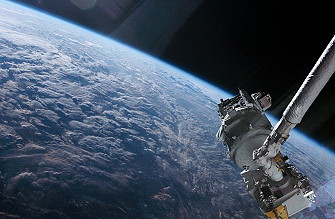
more Earth observation photos |
|
| © |  |
Last update on March 26, 2020.  |
 |