Human Orbital Spaceflights

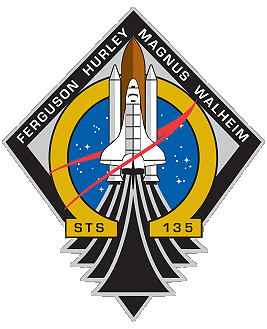
International Flight No. 281STS-135Atlantis (33)135th Space Shuttle missionUSA |
 |
 |
 |
 |
|
 |
 |
Launch, orbit and landing data
walkout photo |
 |
|||||||||||||||||||||||||||||||||
alternative crew photo |
alternative crew photo |
|||||||||||||||||||||||||||||||||
alternative crew photo |
alternative crew photo |
|||||||||||||||||||||||||||||||||
alternative crew photo |
alternative crew photo |
|||||||||||||||||||||||||||||||||
alternative crew photo |
alternative crew photo |
|||||||||||||||||||||||||||||||||
Crew
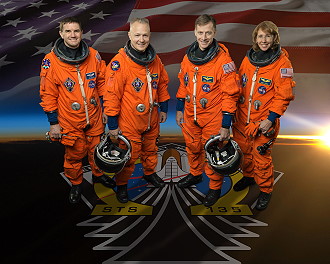
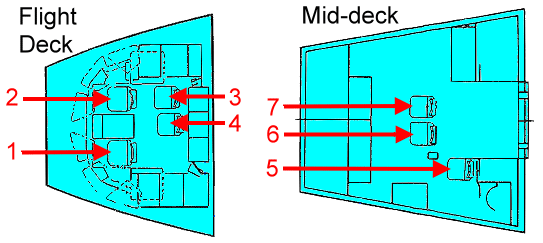
| No. | Surname | Given names | Position | Flight No. | Duration | Orbits | |
| 1 |  |
Ferguson | Christopher John | CDR | 3 | 12d 18h 27m 52s | 200 |
| 2 | |
Hurley | Douglas Gerald | PLT | 2 | 12d 18h 27m 52s | 200 |
| 3 | |
Magnus | Sandra Hall | MS-1, EV-2 | 3 | 12d 18h 27m 52s | 200 |
| 4 | |
Walheim | Rex Joseph | MS-2, EV-1, FE | 3 | 12d 18h 27m 52s | 200 |
Crew seating arrangement
|
 |
|
||||||||||||||||||||||||||||||||
Hardware
| Orbiter : | OV-104 (33.) |
| SSME (1 / 2 / 3): | 2047-2 (15.) / 2060-2 (3.) / 2045-2 (12.) |
| SRB: | BI-146 / RSRM 114 |
| ET: | ET-138 (SLWT-43) |
| OMS Pod: | Left Pod 04 (33.) / Right Pod 01 (40.) |
| FWD RCS Pod: | FRC 4 (33.) |
| RMS: | 301 (30.) |
| EMU (launch): | EMU No. 3006 (PLSS No. 1006) / EMU No. 3015 (PLSS No. 1015) |
| EMU (landing): | EMU No. 3006 (PLSS No. 1006) / EMU No. 3009 (PLSS No. 1009) |
Flight
|
Launch from Cape Canaveral (KSC) and
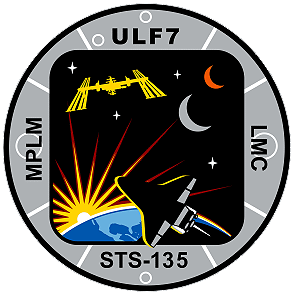
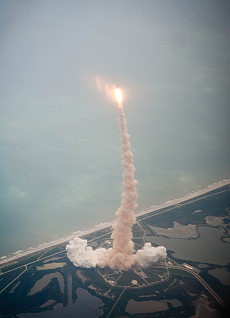
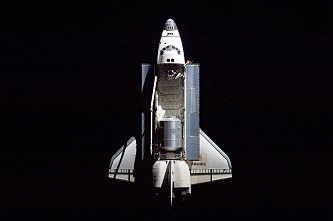
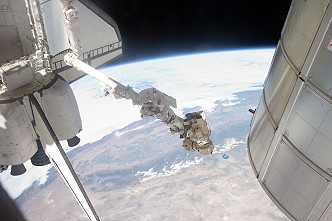
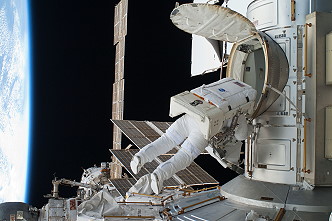
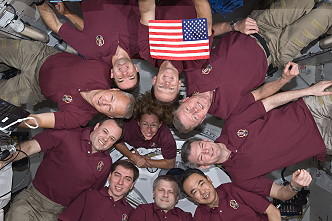
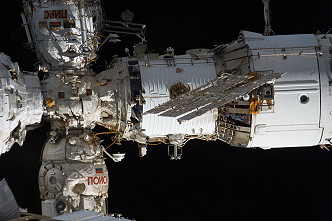
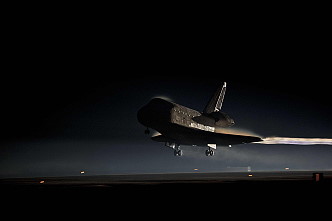
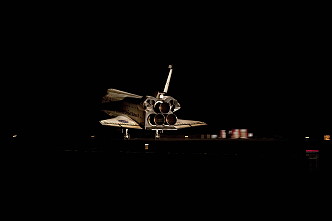
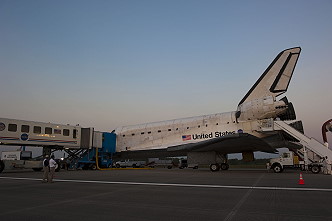
landing at Cape Canaveral (KSC), Runway 15. The STS-135 (ISS ULF-7 MPLM Raffaello) mission's primary cargo was the Multi-Purpose Logistics Module (MPLM) Raffaello and a Lightweight Multi-Purpose Carrier (LMC), which were delivered to the International Space Station (ISS). The flight of Raffaello marked the only time that Atlantis carried an MPLM. The module was filled with supplies and spare parts to sustain station operations once the shuttles are retired, transport of the Robotic Refueling Mission (RRM), an experiment designed to demonstrate and test the tools, technologies and techniques needed to robotically refuel satellites in space, even satellites not designed to be serviced. Among the objectives was the returning of an ammonia pump that recently failed on the station. Engineers want to understand why the pump failed and improve designs for future spacecraft. This is the final flight for shuttle Atlantis and the Space Shuttle Program. The Raffaello Multi-Purpose Logistics Module (MPLM) is one of three differently named large, reusable pressurized elements, carried in the space shuttle's cargo bay, used to ferry cargo back and forth to the station. Raffaello includes components that provide life support, fire detection and suppression, electrical distribution and computers when it is attached to the station. The cylindrical logistics module acts as a pressurized "moving van" for the Space Station, carrying cargo, experiments and supplies for delivery to support the six-person crew on board the station. The module also returns spent Orbital Replacement Units (ORUs) and components. Each MPLM module is 21 feet (6.4 meters) long and 15 feet (4.6 meters) in diameter - the same size as the European Space Agency's (ESA's) Columbus module. On the STS-135 mission, Raffaello will carry eight Resupply Stowage Platforms (RSPs), two Intermediate Stowage Platforms (ISPs), and six Resupply Stowage Racks (RSRs) and one Zero Stowage Rack. There are no system or express racks flying up on this MPLM. All the racks are stowage racks (RSRs, RSPs, ISPs) so NASA can carry the maximum cargo (spare units, spare parts, food, etc.) up to keep the station stocked up for one year. Located behind Raffaello in the space shuttle payload bay is the Lightweight Multi-Purpose Experiment Support Structure Carrier (LMC), a non-deployable cross-bay carrier providing launch and landing transportation. The LMC is a light-weight shuttle stowage platform that only weighs 946 pounds (429 kg). The launch weight of the LMC is 2,918 pounds (1,324 kg) and the return weight with the pump module will be 3,530 pounds (1,601 kg). STS-135 will be the last of seven missions for the workhorse LMC carriers. The LMCs were developed for use by station from existing Space Shuttle Multi-Purpose Equipment Support Structure, MPESS, hardware to carry Launch-On-Need, LON, and Orbital Replacement Units, ORUs, for space station. GSFC and ATK have provided the sustaining engineering support for all the LMC missions, including carrier management, refurbishment, analysis, documentation and safety. During ascent, the LMC will be carrying a Robotic Refueling Mission (RRM) on the bottom. During descent, the LMC will be carrying an ammonia pump that will be analyzed to determine its cause for failure. A special adapter plate, built by Boeing, had to be installed on the LMC so the large pump could be carrier on the top of the LMC. Additional modifications had to be made to accommodate the Pump Module Assembly (PMA) which included removing the aft winch, the wireless video antenna, and all handrails in the aft bulkhead of the space shuttle cargo bay. This will be first time that a pump module has been carried on an LMC. The PMA will be removed from External Storage Platform 2 where it has been stored. NASA's Robotic Refueling Mission (RRM) is an external International Space Station experiment designed to demonstrate and test the tools, technologies and techniques needed to robotically refuel and repair satellites in space, especially satellites that were not designed to be serviced. A joint effort between NASA and the Canadian Space Agency (CSA), RRM will be the first in-orbit attempt to test robotic refueling and repair techniques for spacecraft not built with in-orbit servicing in mind. It is expected to reduce risks and lay the foundation for future robotic servicing missions. RRM also marks the first use of Dextre beyond the planned maintenance of the space station for technology research and development. After Atlantis docks with station, RRM will be transferred during a spacewalk to Dextre's Enhanced Orbital Replacement Unit Temporary Platform (EOTP). Following the shuttle's departure, RRM will remain on the EOTP, and Dextre and Canadarm2 will transfer RRM to its permanent location ExPRESS Logistics Carrier 4 (ELC-4). The ELC will provide command, telemetry and power support for the experiment. RRM operations will be entirely remotely controlled by flight controllers at NASA's Goddard Space Flight Center in Greenbelt, Md., Johnson Space Center in Houston, Marshall Space Flight Center in Huntsville, Ala., and the CSA's control center in St. Hubert, Quebec. Once the RRM module is securely mounted to the space station's ELC-4 platform, mission controllers will direct the Dextre robot, the space station's Canadian, twin-armed "handyman", to retrieve RRM tools from the module and perform a full set of refueling tasks. Dextre will use the RRM tools to cut and manipulate protective blankets and wires, unscrew caps and access valves, transfer fluid, and leave a new fuel cap in place. At one stage of the mission, Dextre will use RRM tools to open up a fuel valve, similar to those commonly used on satellites today, and transfer liquid ethanol across a robotically mated interface via a sophisticated robotic fueling hose. Each task will be performed using the components and activity boards contained within and covering the exterior of the RRM module. The experiment will also demonstrate general space robotic repair and servicing operations. Completing the demonstration will validate the tool designs (complemented with cameras), the fuel pumping system, and robotic task planning, all of which will be used during the design of a potential future refueling spacecraft. The Pump Module (PM) is part of the station's complex Active Thermal Control System (ATCS), which provides vital cooling to avionics, crew members and payloads. The station has two independent cooling loops. The external loops use an ammonia-based coolant and the internal loops use a water-based coolant. At the heart of the ATCS is the Pump Module, which provides circulation, loop pressurization, and temperature control of the ammonia. The PM pumps the ammonia through the external system to provide cooling. Heat is generated by the electronic boxes throughout the station and eventually rejected into space via the radiators. The major components in the PM include a Pump and Control Valve Package (PCVP), an accumulator, isolation and relief valves, and temperature, flow, and pressure sensors. The accumulator within the PM works in concert with the Ammonia Tank Assembly (ATA) accumulators to compensate for expansion and contraction of ammonia caused by the temperature changes and keeps the ammonia in the liquid phase via a fixed charge of pressurized nitrogen gas on the backside of its bellows. Manufactured by Boeing, the pump module weighs 780 pounds (354 kg) and measures approximately 5 ½ feet (69 inches = 1.7 meters) long by 4 feet (50 inches = 1.2 meters) wide with a height of 3 feet (36 inches = 0.9 meters). On this mission, the PM is being returned for further analysis and investigation of the failure that occurred on July 31, 2010. A new PM was installed on August 16, 2010, and has been performing well. The failed PM will undergo extensive testing and evaluation in Houston. The PCVP will be sent to Hamilton Sundstrand for thorough testing and evaluation. The current theory for the cause of the failure is an electrical issue within the PCVP unit. After the root cause is determined to be either systemic to the PM or specific to this unit, NASA will determine the follow-on actions, if any. The space station has three spare pump modules in orbit. Only four astronauts were assigned to this mission, versus the normal six or seven, because there were no other shuttles available for a rescue following the retirement of Discovery and Endeavour. If the shuttle was seriously damaged in orbit, the crew would have moved into the International Space Station and returned in Russian Soyuz capsules, one at a time, over the course of a year. All STS-135 crew members were custom-fitted for a Russian Sokol space suit and molded Soyuz seat liner for this possibility. The reduced crew size also allowed the mission to maximize the payload carried to the ISS. It was the only time that a Shuttle crew of four flew to the ISS. The last shuttle mission to fly with just four crew members occurred 28 years earlier: STS-6 on April 04, 1983 aboard Space Shuttle Challenger. At T-31 seconds, just before Atlantis's computers were supposed to take control of the flight, the launch countdown clock stopped. This was because of a lack of an indication that the Gaseous Oxygen Vent Arm had retracted and properly latched, a problem that had never occurred during previous launches in the program's history. Soon the launch team was able to verify the Vent Arm's position with the help of a closed-circuit camera, and the countdown clock resumed. The main objective of the flight day 2 was to inspect Atlantis's thermal protection system, using the shuttle's robotic arm and the Orbiter Boom Sensor System (OBSS) to look for any signs of launch damage. To do so, Commander Christopher Ferguson, Pilot Douglas Hurley and Mission Specialist Sandra Magnus used the shuttle's robotic arm and the OBSS to get a close up look at reinforced carbon–carbon wing leading edges and the nose cap of the shuttle. The robotic arm grappled the OBSS at 10:58 UTC. After raising out the arm-boom assembly, the crew activated the camera and laser sensor package on the boom to first scan the starboard wing. The nose cap was surveyed next followed by the port wing. The gathered visual and electronic data were downlinked during numerous Ku band communication opportunities to the ground. With imagery on their hand, experts began to review the data. The heat shield survey started around 11:00 UTC, was wrapped about five hours later. While the TPS survey was under way, Mission Specialist Rex Walheim spent much of his afternoon on the shuttle's middeck. He worked to prepare items carried into orbit there for transfer to the space station. Later in the day, Rex Walheim worked with Douglas Hurley to check out the rendezvous tools that would be used during Atlantis's docking with the ISS on Flight Day 3. Meanwhile, Christopher Ferguson and Sandra Magnus installed the center-line camera in the window of the shuttle's hatch for a view that would help them align Atlantis with the space station. Atlantis's launch for the STS-135 mission was timed to lead to a link up with the International Space Station about 220 miles (354 km) above Earth. A series of engine firings during the first two days of the mission brought the shuttle to a point about 50,000 feet (15,240 meters) behind the station. Once there, Atlantis started its final approach. About 2.5 hours before docking, the shuttle's jets were fired during what is called the terminal initiation burn. The shuttle covered the final miles to the station during the next orbit. As Atlantis moved closer to the station, its rendezvous radar system and trajectory control sensor provided the crew with range and closing-rate data. Several small correction burns placed the shuttle about 1,000 feet (304.8 meters) below the station. Commander Christopher Ferguson, with help from Pilot Douglas Hurley and other crew members, manually flew the shuttle for the remainder of the approach and docking. Christopher Ferguson stopped Atlantis about 600 feet (182.9 meters) below the station. Timing the next steps to occur with proper lighting, he maneuvered the shuttle through an approximate eight-minute back flip called the Rendezvous Pitch Maneuver, also known as the R-bar Pitch Maneuver (RPM) since Atlantis was in line with an imaginary vertical R-bar directly below the station. During this maneuver, station crew members Michael Fossum and Satoshi Furukawa photographed Atlantis's upper and lower surfaces through windows of the Zvezda Service Module. They used digital cameras equipped with an 800 mm lens to provide up to one-inch (2.5 centimeters) resolution and a 400 mm lens providing three-inch (7.6 centimeters) resolution. The photography was one of several techniques used to inspect the shuttle's thermal protection system for possible damage. Areas of special interest included the thermal protection tiles, the reinforced carbon-carbon panels along the wing leading edges and the nosecap, landing gear doors and the elevon cove. The photos were downlinked through the station's Ku-band communications system for analysis by imagery experts in Mission Control. When Atlantis completed its back flip, it was back where it started with its payload bay facing the station. Christopher Ferguson then flew the shuttle through a quarter circle to a position about 400 feet (121.9 meters) directly in front of the station. From that point, he began the final approach to docking to the Pressurized Mating Adapter 2 at the forward end of the Harmony node. The shuttle crew members operated laptop computers that process the navigational data, the laser range systems and Atlantis' docking mechanism. Using a video camera mounted in the center of the Orbiter Docking System, Christopher Ferguson lined up the docking ports of the two spacecraft. He pause the shuttle 30 feet (9.14 meters) from the station to ensure proper alignment of the docking mechanisms. He maintained the shuttle's speed relative to the station at about one-tenth of a foot per second (3 centimeters per second), while both Atlantis and the station were moving at about 17,500 mph (28,163 km/h). Christopher Ferguson kept the docking mechanisms aligned to a tolerance of three inches (7.6 centimeters). When Atlantis made contact with the station on July 10, 2011, preliminary latches automatically linked the two spacecraft. The shuttle's steering jets were deactivated to reduce the forces acting at the docking interface. Shock absorber springs in the docking mechanism dampened any relative motion between the shuttle and station. Once motion between the shuttle and the station had stopped, the docking ring was retracted to close a final set of latches between the two vehicles. Atlantis docked with the ISS Pressurized Mating Adapter-2 at 15:07 UTC as the two orbited 220 miles (350 km) over the South Pacific Ocean east of New Zealand. This was Atlantis's 19th docking to a Space Station. "Houston, station, Atlantis, capture confirmed and we see free drift", radioed Douglas Hurley, confirming the successful docking. In reply, "Atlantis arriving", said Ronald Garan after the ceremonial ringing of the station's bell. "Welcome to the International Space Station for the last time". A series of leak checks were done on both sides of the hatches, before they were opened at 16:47 UTC. Shortly afterwards, the shuttle crew floated into the station's Harmony module at 16:55 UTC. After a brief welcoming ceremony by the station crew of Expedition 28, Atlantis's astronauts received the standard station safety briefing. The crew then got to work with Christopher Ferguson and Douglas Hurley using the shuttle arm to take its OBSS from the station's Canadarm2 operated by Ronald Garan and Satoshi Furukawa. The station arm had plucked the OBSS from its stowage position on the shuttle cargo bay sill. The handoff was to prepare to use the boom for any shuttle heat shield late inspections if required. Sandra Magnus worked with TV setup and Rex Walheim transferred spacewalk gear. On flight day 4 working at the International Space Station’s cupola robotic workstation, Atlantis Pilot Douglas Hurley and Mission Specialist Sandra Magnus used Canadarm2 to grapple the 12.5-ton, 21 foot (6.4 meters) long, 15 foot (4.6 meters) wide Raffaello multi-purpose logistics module, which was nestled in the shuttle cargo bay. They lifted Raffaello out and attached it to the Earth-facing port of the station's Harmony node. Raffaello was packed with more than 8,000 pounds (3,629 kg) of spare parts, spare equipment, food and other supplies that will sustain space station operations through 2012. Raffaello carried eight Resupply Stowage Platforms (RSPs), two Intermediate Stowage Platforms (ISPs), six Resupply Stowage Racks (RSRs) and one Zero Stowage Rack. Because Atlantis launched on time with a full load of onboard consumables for its electricity-generating fuel cells, and due to power saving operations employed during the first three days, on Flight Day 4, NASA's managers approved a one-day mission extension. According to NASA, the mission was extended primarily to allow the crew spent more time on cargo transfers. While the docking of Atlantis an EVA by ISS Expedition 28 crew members Michael Fossum and Ronald Garan was performed on July 12, 2011 (6h 31m). Mail goals of this spacewalk were: transfer of a failed ammonia pump to the shuttle cargo bay, transfer of the Robotic Refueling Mission (RRM) to the station and place an experiment on ELC-2 for long-duration exposure. Michael Fossum and Ronald Garan began the STS-135 spacewalk with the highest priority task - retrieval of the failed pump module. The equipment was prepared for return to Earth during previous spacewalks, and was stored on external stowage platform 2 at the Quest airlock. Michael Fossum made his way to the platform and installed two backup tools, called Contingency Operations Large Adapter Assembly Tools - or COLTs - onto the hardware that held the pump module in place. The COLTs allowed the crew to access contingency bolts on the back of the hardware, in case the spacewalkers run into problems using the primary bolt to install the pump module in the shuttle's cargo bay. While Michael Fossum worked with the COLTs, Ronald Garan met the station's robotic arm at the stowage platform, and installed a foot restraint on it so that he could climb into it and free up his hands to carry the pump module back to Atlantis. To remove the pump module from the stowage platform, Ronald Garan grabbed onto the pump module, while Michael Fossum released the bolt holding it in place. That allowed Ronald Garan to lift the module off of the stowage platform and fly it to the shuttle's cargo bay. Once there, Ronald Garan drove the same bolt to attach the module to the carrier inside the cargo bay, securing it for the return to Earth. Michael Fossum and Ronald Garan then switched places, giving Michael Fossum a turn on the end of the robotic arm. Then Michael Fossum held the Robotic Refueling Mission experiment, while Ronald Garan released the bolt attaching it to the cargo bay. Michael Fossum lifted it out, and flew it via robotic arm to the Special Purpose Dexterous Manipulator, or Dextre, as the robot is called, on the Destiny laboratory. He bolted the experiment onto platform on Dextre used to hold equipment and spare parts that Dextre is working with. Ronald Garan assisted. With those major tasks done, Michael Fossum climbed off of the robotic arm and removed MISSE foot restraint that Ronald Garan installed, while Ronald Garan deployed a segment on the Materials International Space Station Experiment 8 (or MISSE 8), which was installed during STS-134. Because that experiment was situated near the Alpha Magnetic Spectrometer (AMS), which was also installed on STS-134, and the thermal covers on the AMS were expected to need some time to air out once the experiment was installed, the STS-134 crew was asked not to expose this segment of the experiment until the gases in the AMS cover had some time to dissipate. To deploy it now, Ronald Garan installed an Optical Reflector Materials Experiment that was brought up on Endeavour's middeck during STS-134 into a socket on MISSE 8 and remove its protective cover. On flight day 6 Atlantis's crew focused on unpacking supplies from the Raffaello MPLM. The crew started the day 26 percent through the combined 15,069 pounds (6,835 kg) of cargo to transfer in or out of Raffaello. The MPLM was launched with 9,403 pounds (4.265 kg) of cargo and it was expected to return 5,666 (2,570 kg) pounds when Atlantis landed. The supplies and equipment that Atlantis astronauts delivered to the orbiting outpost was expected to keep the station well supplied through 2012. The crew had some help from the station crew of Andrei Borisenko, Sergei Volkov and Satoshi Furukawa in the transfer operations. Crew members also opened the Pressurized Mating Adapter (PMA-3), attached to the Tranquility node, and stored some of the material from Raffaello there. On flight day 7 the shuttle astronauts went to sleep as planned but were awakened by the sound of a master alarm on board Atlantis at 22:07 UTC. The tone signaled a failure with one of Atlantis's five IBM AP-101 General Purpose Computers (GPCs) No. 4. The alarm prompted Commander Christopher Ferguson to head to Atlantis and evaluate the issue. GPC-4 was running system management software at the time of failure. Christopher Ferguson with the help of Ground Control later transferred the failed GPC's programs onto GPC-2. The transfer took about 45 minutes, bypassing an expected period of loss of signal by utilizing communications at White Sands, New Mexico. After activating GPC-2 and with Atlantis in good shape, Christopher Ferguson and other crew members went back to sleep. Early on the next day, Atlantis commander Christopher Ferguson and pilot Douglas Hurley re-loaded software and successfully restarted the GPC-4. Flight controllers in Houston also downloaded data dumps to carefully monitor the computer to make sure that it was running normally. While Christopher Ferguson and Douglas Hurley focused on computer troubleshooting, Mission Specialists Sandra Magnus and Rex Walheim together with the station crew continued to work on cargo transfers between Atlantis the Space Station. Rex Walheim also transferred EMU/airlock items to Atlantis that won't be needed in the post-shuttle era. Early on the flight day 9, Commander Christopher Ferguson and Pilot Douglas Hurley also spent some time working to successfully repair the door that gives the crew access to the LiOH canisters. Mission Specialist Sandra Magnus spent about an hour and a half in the morning taking microbial air samples on various locations in the space station. The collected samples will be returned for study and further analysis. Sandra Magnus also worked the Japanese Experiment Module Remote Manipulator System (JEM RMS). Mission Specialist Rex Walheim along with station crew member Michael Fossum continued work with spacewalking equipment in the Quest airlock. Some of them will be left on the station, and will be utilized during an upcoming Russian spacewalk on August 03, 2011. Douglas Hurley working with station crew member Ronald Garan stored some of the cargo in Atlantis's middeck to be returned. Since no astronaut was riding in the mid-deck, on the way back, it was expected to be fully packed with 1564 pounds (709 kg) of cargo. Among cargo brought to the space station, 2281 pounds (1,035 kg) were also in the mid-deck. After their midday meal on flight day 10, Mission Specialist Sandra Magnus and Commander Christopher Ferguson worked a little over an hour continuing to move experiments and equipment to and from Atlantis's middeck. At the end 84% of middeck transfers were completed. The crew transferred a new science refrigerator (GLACIER) from the Shuttle's middeck to the Space Station. Another couple of noteworthy middeck payloads that were transferred included the mass spectrometer in the mass constituent analyzer, a device in the U.S. segment that samples air from different parts of the station to determine its constituents. Flight Engineer Ronald Garan removed the broken spectrometer and moved it to Atlantis's middeck for return. The suspect gyroscope in the TVIS treadmill located in the Russian segment removed by Flight Engineer Sergei Volkov was also placed in the middeck. The STS-135 crew returned the MPLM back to Atlantis's payload bay on flight day 12, closed the hatches between the Space Station and the Shuttle and prepared for next day's undocking. Beginning at 05:03 UTC, the hatches separating Raffaello MPLM and the ISS were closed. With station's Canadarm2 locked onto Raffaello, commands were issued at 10:14 UTC to begin the releasing operations of the 16 motorized bolts holding the MPLM in place on the station's Node 2. Arm operators, Mission Specialist Sandra Magnus and Pilot Douglas Hurley working inside the Cupola, un-berthed Raffaello at 10:48 UTC and moved it back to Atlantis's payload bay. The move was completed by around 11:48 UTC. The securing of the Raffaello in the shuttle's payload bay marked the 10th and final transfer of an MPLM in the history of the Space Shuttle program. Shortly after hatches between the two spacecraft were closed, the crew returned to Atlantis. They carried out tasks to prepare for the undocking from the Space Station. Christopher Ferguson and Douglas Hurley installed the centerline camera while hatch leak checks were still under way. Douglas Hurley and Rex Walheim also checked out the rendezvous tools. At undocking time, the hooks and latches were opened and springs pushed the shuttle away from the station. Atlantis's steering jets were shut off to avoid any inadvertent firings during the initial separation. Once the shuttle was about two feet (61 centimeters) from the station and the docking devices were clear of one another, Douglas Hurley turned the steering jets back on and manually control Atlantis within a tight corridor as the shuttle separated from the station. Atlantis moved to a distance of about 450 feet (137.2 meters), where Douglas Hurley began to fly around the station. Atlantis circled the shuttle around the station at a distance of about 600 feet (183 meters). The shuttle crew took detailed photographs of the external structure of the station, which served as important documentation for the ground teams in Houston to monitor the orbiting laboratory. Once the shuttle completed 1.5 revolutions of the complex, Douglas Hurley fired Atlantis's jets to leave the area. Nearly two hours after undocking a second firing of the engines took Atlantis farther away from the station. Space Shuttle Atlantis carried a miniaturized satellite also known as PSSC-2, or Picosatellite Solar Cell Testbed 2 into orbit. PSSC-2 was successfully deployed from the shuttle's cargo bay on flight day 13. This mission is the third flight of the TriDAR sensor package designated DTO-701A (Detailed Test Objective), a 3D dual-sensing laser camera, intended for potential use as an autonomous rendezvous and docking sensor. It was developed by Neptec Design Group and funded by NASA and the Canadian Space Agency. Previously TriDAR was flown twice on STS-128 and STS-131, aboard Space Shuttle Discovery. TriDAR provides guidance information that can be used for rendezvous and docking operations in orbit, planetary landings and vehicle inspection/navigation of unmanned rovers. TriDAR does not rely on any reference markers, such as reflectors, positioned on the target spacecraft. To achieve this, it relies on a laser-based 3D sensor and a thermal imager. Geometric information contained in successive 3D images is matched against the known shape of the target object to calculate its position and orientation in real-time. |
EVA data
| Name | Start | End | Duration | Mission | Airlock | Suit | Stripes | |
| EVA | Fossum, Michael | 12.07.2011, 13:22 UTC | 12.07.2011, 19:53 UTC | 6h 31m | STS-135 | ISS - Quest | EMU No. 3010 | unknown |
| EVA | Garan, Ronald | 12.07.2011, 13:22 UTC | 12.07.2011, 19:53 UTC | 6h 31m | STS-135 | ISS - Quest | EMU No. 3009 | unknown |
Photos / Graphics
 |
 |
 |
 |
 |
 |
 |
 |
 |
 |
 |
 |
 |
 |
 |
 |
 |
| © |  |
Last update on March 05, 2025.  |
 |