Human Orbital Spaceflights

International Flight No. 119Soyuz TM-7DonbassUSSR |
 |
 |
Launch, orbit and landing data
walkout photo |
 |
|||||||||||||||||||||||
alternative crew photo |
alternative crew photo |
|||||||||||||||||||||||
alternative crew photo |
alternative crew photo |
|||||||||||||||||||||||
alternative crew photo |
alternative crew photo |
|||||||||||||||||||||||
Crew
| No. | Surname | Given names | Position | Flight No. | Duration | Orbits | |
| 1 |  |
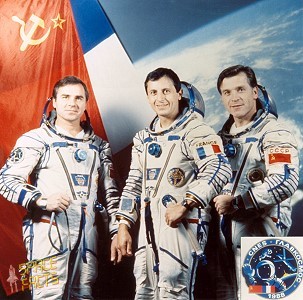
Volkov | Aleksandr Aleksandrovich | Commander | 2 | 151d 11h 08m 24s | 2396 |
| 2 | |
Krikalyov | Sergei Konstantinovich | Flight Engineer | 1 | 151d 11h 08m 24s | 2396 |
| 3 |  |
Chrétien | Jean-Loup Jacques Marie | Research Cosmonaut | 2 | 24d 18h 07m 06s | 395 |
Crew seating arrangement
|
 |
|
||||||||||||||||
Backup Crew
|
 |
||||||||||||||||||||
alternative crew photo |
Hardware
| Launch vehicle: | Soyuz-U2 (No. 15M118S Ye15000-028) |
| Spacecraft: | Soyuz TM-7 (7K-STM No. 57) |
Flight
|
Launch from the Baikonur Cosmodrome and
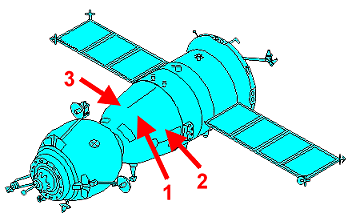
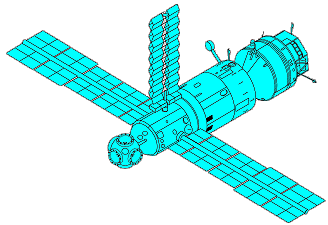
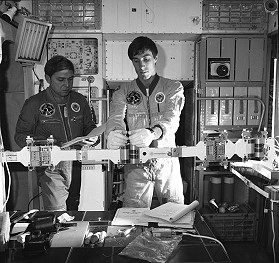
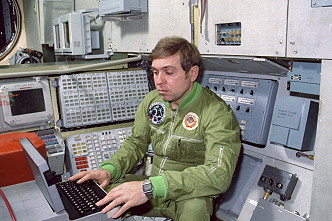
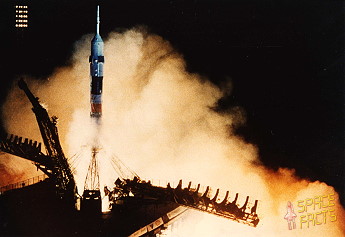
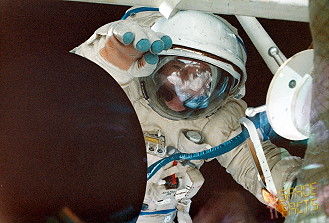
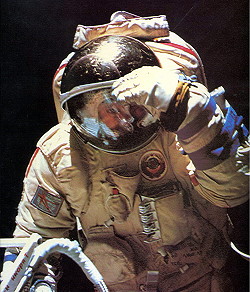
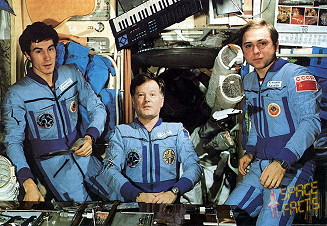
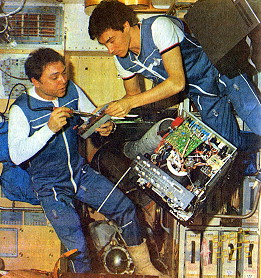
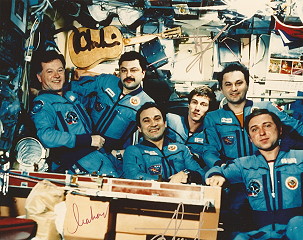
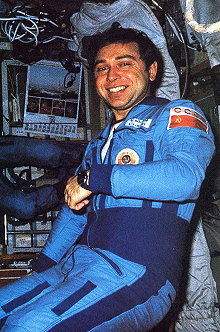
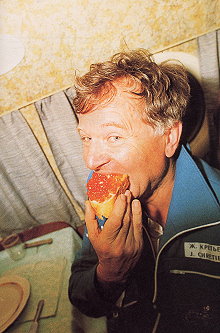
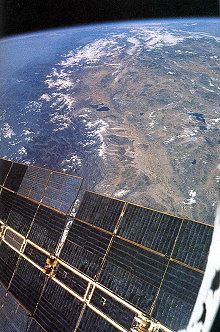
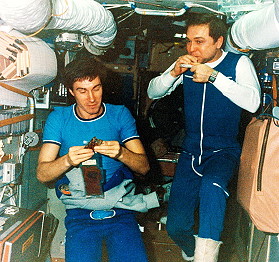
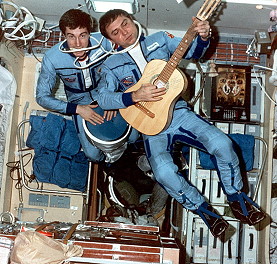
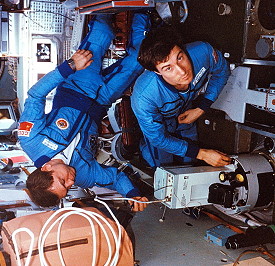
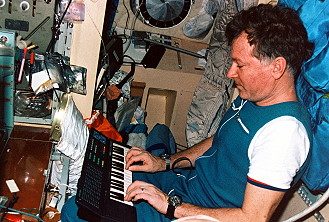
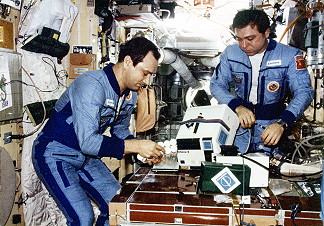
landing 140 km northeast of Dzheskasgan. The original launch date November 21, 1988 was moved back to permit French president François Mitterrand to attend the launch. Soyuz TM-7 carried the second joined mission USSR - France. Following a two-day solo flight Soyuz TM-7 docked with the Mir-Kvant complex on November 28, 1988. Mir-4 crew members Aleksandr Volkov and Sergei Krikalyov were delivered to Mir together with French Aragatz cosmonaut Jean-Loup Chrétien aboard Soyuz TM-7. The initial orbit of the Soyuz was 194 x 235 km. Thereafter the spacecraft maneuvered to a rendezvous orbit of 256 x 291 km before docking with Mir in 337 x 369 km at 17:16 UTC November 28, 1988. Jean-Loup Chrétien returned together to Earth together with the Mir-3 crew on December 21, 1988. The Mir-4 mission was curtailed when delays in launching the Kvant2 and Kristall modules to Mir led to the decision to leave the station uninhabited until the add-on modules were ready. Soyuz-TM 7 arrived at Mir on November 28, 1988 on the Franco-Soviet Aragatz mission with French cosmonaut Jean-Loup Chrétien (on his second mission to a Soviet space station) and Soviet cosmonauts Aleksandr Volkov and Sergei Krikalyov. This increased Mir's population to six. According to Sergei Krikalyov, this was the 'worst-case scenario' as far as crowding on the station was concerned. Not only were there more cosmonauts than usual aboard Mir; the station was also full of equipment and life support supplies delivered by Progress freighters for the joint Franco-Soviet mission. The crowding was exacerbated because there was no docking port free for a Progress freighter. Therefore, the crew could not use a Progress as a 'pantry' or 'storage room' for the station. The large joint experiment manifest - mostly medical and technology experiments chosen to support the French-led European Space Agency Hermes shuttle project - strained Mir's electricity supply. The total mass of the experiments was 580 kg. Aleksandr Volkov and Sergei Krikalyov together with Valeri Polyakov became the fourth resident crew. An EVA by Aleksandr Volkov and Jean-Loup Chrétien was performed on December 09, 1988 (6h 00m). The cosmonauts depressurized the multiport docking adapter and clambered outside Mir. Jean-Loup Chrétien was first out. He installed handrails, then attached the 15.5 kg (34 lb) Échantillons experiment rack to the handrails by springs and hooks. He also attached electrical wires leading from the rack to Mir’s power supply. Échantillons carried five technological experiments with applications to the Hermes shuttle program. Aleksandr Volkov and Jean-Loup Chrétien then assembled the 240 kg (530 lb) ERA experiment. They attached a mount to handrails on the frustum linking the multiport docking unit to the small-diameter portion of the work compartment. After resolving problems with cables linking ERA to a control panel inside Mir, they attached the folded ERA structure to a support arm on the platform. The structure was designed to unfold to form a flat six-sided structure 1 meter deep by 3.8 meters across. From inside Mir, Sergei Krikalyov commanded the structure to unfold, but to no avail. Aleksandr Volkov then kicked ERA, causing it to unfold properly. According to Sergei Krikalyov, taking the ERA outside helped relieve the crowding problems. Jean-Loup Chrétien became the first non-American and non-Soviet cosmonaut to perform a spacewalk. Musa Manarov, Vladimir Titov, and Jean-Loup Chrétien boarded Soyuz TM-6 and undocked at 03:33 UTC on December 21, 1989, but revised software installed as a result of the Soyuz TM-5 abort overloaded the spacecraft's computer. The landing planned for 06:48 was aborted. A backup software program was used and the Soyuz orbital module was retained through retrofire. The crew finally landed safely on December 21, 1988. The Progress 39 freighter arrived at the station and remained docked to the aft port from December 27, 1988 - February 7, 1989. Progress 39 was used to boost Mir's orbit, necessary because of greater than normal atmospheric drag. This in turn was caused by atmospheric expansion produced by atmospheric heating, the result of solar activity during the solar maximum period. According to Sergei Krikalyov, it was not possible to visually detect any difference in the station's altitude after the reboost was completed. Sergei Krikalyov, Aleksandr Volkov, and Valeri Polyakov then cleaned Mir and loaded Progress 39's orbital module with waste and excess equipment used on the joint Franco-Soviet Aragatz mission. In mid-February the Soviets announced that launch of the D-module (also called the augmentation module, or Kvant2) was the victim of delays in the production of the module to be added after it, the T-module (technology module, or Kristall). The D-module had been at Baikonur, awaiting launch, since July 1988, but the Kristall module would not be ready until December 1989, and the Soviets did not wish to let 3 months go by with Mir in an asymmetrical configuration (that is, with only one lateral port filled). Rather than handing over to another resident crew, the Mir-4 cosmonauts would mothball Mir and return to Earth at the end of their stint. Sergei Krikalyov and Aleksandr Volkov had been trained to perform a total of six EVAs during Mir-4. Sergei Krikalyov was to have been the first cosmonaut to fly the Soviet equivalent of the NASA manned maneuvering unit (MMU), the YMK. But delay of Kvant2, which carried the YMK, pushed back the EVAs to the next resident crew, the crew for which would consist of Sergei Krikalyov and Aleksandr Volkov's backups. In February 1989 the cosmonauts extended a 10-m pole from the Mir base block's small airlock. It carried sensors used as part of the Diagramma program to characterize the environment around Mir. On March 03, 1989 when Progress 40 backed away from Mir, it deployed an antenna consisting of two loops of wire, each 20 m across, from a pair of containers on either side of the Progress cargo module. The cosmonauts observed the deployment. During the two days before its destructive reentry, Progress 40 continued in free flight while characteristics of the antenna were assessed by the TsUP. During this mission experiments in 16 different fields were performed as topografic and spectrografic research of the Earth surface, biological and medical research (incl. blood and heart tests). Progress 41 arrived at the station and remained docked from March 18, 1989 - April 21, 1989. On April 10, 1989 Soviet reports had the cosmonauts beginning the process of preparing Mir for unmanned operation. Also during this period, the cosmonauts replaced power supply units which were nearing the end of their design lives. Heightened solar activity led to some concern over the cosmonauts' safety, but Soviet sources stated that radiation levels were not hazardous. The engine on Soyuz TM-7 was used to boost the Mir complex to a new record mean altitude of 410 km in mid-April. Aleksandr Volkov, Sergei Krikalyov, and Valeri Polyakov then loaded Soyuz TM-7 with experiment results and film and returned to Earth. The landing was unusually rough because of high winds in the recovery zone. Sergei Krikalyov sustained a minor knee injury, though he downplayed its importance. The Soyuz spacecraft is composed of three elements attached end-to-end - the Orbital Module, the Descent Module and the Instrumentation/Propulsion Module. The crew occupied the central element, the Descent Module. The other two modules are jettisoned prior to re-entry. They burn up in the atmosphere, so only the Descent Module returned to Earth. The deorbit burn lasted about 240 seconds. Having shed two-thirds of its mass, the Soyuz reached Entry Interface - a point 400,000 feet (121.9 kilometers) above the Earth, where friction due to the thickening atmosphere began to heat its outer surfaces. With only 23 minutes left before it lands on the grassy plains of central Asia, attention in the module turned to slowing its rate of descent. Eight minutes later, the spacecraft was streaking through the sky at a rate of 755 feet (230 meters) per second. Before it touched down, its speed slowed to only 5 feet (1.5 meter) per second, and it lands at an even lower speed than that. Several onboard features ensure that the vehicle and crew land safely and in relative comfort. Four parachutes, deployed 15 minutes before landing, dramatically slowed the vehicle's rate of descent. Two pilot parachutes were the first to be released, and a drogue chute attached to the second one followed immediately after. The drogue, measuring 24 square meters (258 square feet) in area, slowed the rate of descent from 755 feet (230 meters) per second to 262 feet (80 meters) per second. The main parachute was the last to emerge. It is the largest chute, with a surface area of 10,764 square feet (1,000 square meters). Its harnesses shifted the vehicle's attitude to a 30-degree angle relative to the ground, dissipating heat, and then shifted it again to a straight vertical descent prior to landing. The main chute slowed the Soyuz to a descent rate of only 24 feet (7.3 meters) per second, which is still too fast for a comfortable landing. One second before touchdown, two sets of three small engines on the bottom of the vehicle fired, slowing the vehicle to soften the landing. |
EVA data
| Name | Start | End | Duration | Mission | Airlock | Suit | |
| EVA | Chrétien, Jean-Loup | 09.12.1988, 09:57 UTC | 09.12.1988, 15:57 UTC | 6h 00m | Soyuz TM-7 | Mir | Orlan-DMA No. 10 |
| EVA | Volkov, Aleksandr | 09.12.1988, 09:57 UTC | 09.12.1988, 15:57 UTC | 6h 00m | Soyuz TM-7 | Mir | Orlan-DMA No. 6 |
Note
Relocations of Manned Spacecrafts
| Spacecraft | from | Undocking | Time UTC | to | Redocking | Time UTC |
| Soyuz TM-7 | Mir - Kvant | 22.12.1988 | 06:44:50 | Mir - Baseblock | 22.12.1988 | 06:59:02 |
Photos / Graphics
 |
 |
 |
 |
 |
 |
 |
 |
 |
 |
 |
 |
 |
 |
 |
 |
 |
 |
 |
 |
 |
 |
 |
 |
 |
|
more EVA photos |
|
| © |  |
Last update on March 30, 2025.  |
 |