Human Orbital Spaceflights

International Flight No. 217Soyuz TM-31STS-102UranRussia |
 |
 |
Launch, orbit and landing data
walkout photo |
 |
|||||||||||||||||||||||||||||||
alternative crew photo |
alternative crew photo |
|||||||||||||||||||||||||||||||
alternative crew photo |
alternative crew photo |
|||||||||||||||||||||||||||||||
alternative crew photo |
alternative crew photo |
|||||||||||||||||||||||||||||||
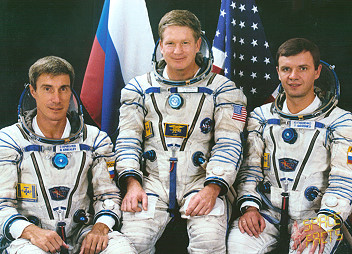
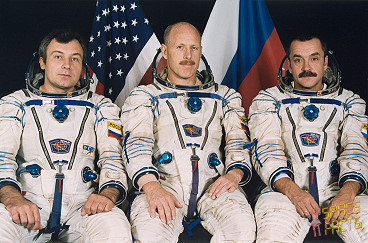
Crew
| No. | Surname | Given names | Position | Flight No. | Duration | Orbits | |
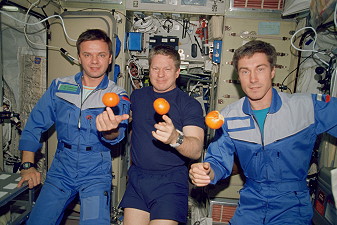
| 1 |  |
Gidzenko | Yuri Pavlovich | Commander | 2 | 140d 23h 38m 54s | 2226 |
| 2 | |
Krikalyov | Sergei Konstantinovich | Flight Engineer | 5 | 140d 23h 38m 54s | 2226 |
| 3 |  |
Shepherd | William McMichael | Flight Engineer | 4 | 140d 23h 38m 54s | 2226 |
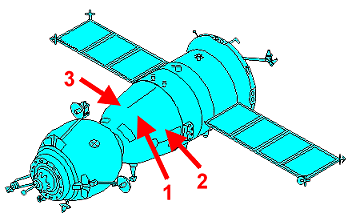
Crew seating arrangement
|
 |
|
||||||||||||||||
Backup Crew
|
 |
||||||||||||||||||||
alternative crew photo |
Hardware
| Launch vehicle: | Soyuz-U (No. 25M130S A15000-666) |
| Spacecraft: | Soyuz TM-31 (7K-STM No. 205) |
Flight
|
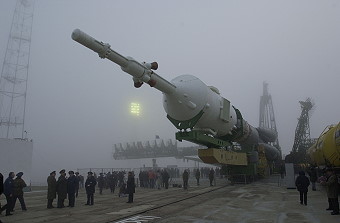
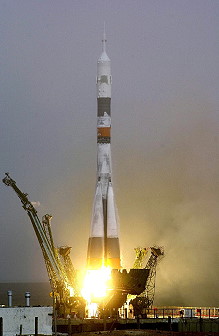
Launch from the Baikonur Cosmodrome. This
flight was the historic mission
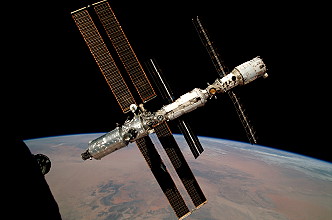
ISS Expedition One. Following a two-day solo flight Soyuz TM-31 docked with the ISS on November 02, 2000. They activated the life support systems of the station and performed first repairing works. The unloading supplies and equipment from a Progress supply ship (Progress M1-3) was done. The first four science experiments were started: Protein Crystal Growth - Enhanced Gaseous Nitrogen in the aera of physical sciences and also Middeck Active Control Experiment II (MACE II), Crew Earth Observations (CEO), Space Exposed Experiment Developed for Students (Education-SEEDS). Progress M1-4 was launched at 01:32:36 UTC on November 16, 2000. The freighter docked with the Nadir port of the Zarya module at 03:47:42 UTC on November 18, 2000. The Kurs docking system failed during docking, and the manual backup, TORU, was used for the docking. Progress M1-4 remained docked for two weeks before undocking at 16:22:52 UTC on December 01, 2000. Following its undocking, Progress M1-4 spent 25 days in free flight, prior to redocking with the same port on December 26, 2000 at 11:03:13 UTC. Like the original docking, the TORU system was used, as although the fault with the Kurs system had been resolved, the procedure used to abort the original Kurs docking attempt was irreversible due to the retraction of an antenna that could not be redeployed. It remained docked for six weeks before undocking again at 11:26:04 UTC on February 08, 2001. It was deorbited at 12:59 UTC on the same day. The spacecraft burned up in the atmosphere over the Pacific Ocean, with any remaining debris landing in the ocean at around 13:50 UTC. On December 02, 2000 the Expedition One crew received the first visiting crew. Space Shuttle STS-97 docked with the International Space Station. The primary objective was to deliver and connect the first set of U.S.-provided solar arrays to the International Space Station. The astronauts completed three spacewalks, during which they prepared a docking port for arrival of the Destiny Laboratory Module, installed Floating Potential Probes to measure electrical potential surrounding the station, installed a camera cable outside the Unity Module, and transferred supplies, equipment and refuse between Endeavour and the station. After the orbiter docked with the ISS, the crew entered PMA-3 to install ground straps, and perform a pressure leak check and center disk removal to prepare for their later entry into the Unity module of the ISS for supply transfer. After Endeavour docked to the International Space Station, Marc Garneau used the Shuttle's robot arm to lift the P6 structure out of the payload bay where it remained attached overnight. Prior to the start of the first spacewalk, he used the arm to move the 35,000-pound (15,876 kg) assembly to the "low hover" position adjacent to Endeavour's payload bay. The first EVA by Joseph Tanner and Carlos Noriega was performed on December 03, 2000 (7h 33m). They performed preparation work for the mount of the energy module and checked the docking to P6/Z1. Once the P6 was in its low hover position, the EVA crew exited Endeavour's air lock and began assembling the tools and hardware they used during the spacewalk. Joseph Tanner and Carlos Noriega took positions on the forward and aft sides of the Z1 truss, respectively, to provide robot arm operator Marc Garneau with visual cues as he unberthed the P6 structure. Marc Garneau's primary cues came from the Space Vision System that provided him with a closed-circuit television view of targets located on the P6 and the ISS, but Joseph Tanner and Carlos Noriega provided verbal confirmation and additional visual cues throughout the unberthing process. Once Marc Garneau moved the P6 within its capture envelope, Joseph Tanner and Carlos Noriega verified the ready-to-latch position and activated the capture latches on the Z1 truss, initiating a coarse alignment between the P6 and Z1 truss. Carlos Noriega then drove the capture latch assembly to bring the P6 into fine alignment. After the structure was secured in place - by 127 turns of the Capture Latch Assembly (CLA) - Joseph Tanner and Carlos Noriega began securing bolts on each of the four corners of the P6 before releasing the capture latch to allow loads to be carried through the primary bolts. At that point, Marc Garneau released the robot arm's grip on the P6 structure and maneuvered it into position to allowed Carlos Noriega to attach an articulating portable foot restraint. At this point in the spacewalk, Pilot Michael Bloomfield assumed responsibility for operating the robot arm using it to maneuver Carlos Noriega as he connected the nine power, command and data umbilicals from Z1 to the forward face of the P6 that will provide power to the Orbital Replacement Units in anticipation of the deployment of the large solar arrays. Marc Garneau, the back-up EVA crew member, then turned his full attention to acting as the on-board choreographer for the remainder of the EVA's. As Carlos Noriega connected the umbilicals, Joseph Tanner set to work releasing first the starboard and then the port Solar Array Blanket Boxes (SABB) by releasing a series of 5/8" bolts - two on the nadir and six on the zenith ends of each SABB. Carlos Noriega's next task was to release the starboard Solar Array Wing (SAW) Beta Gimbal launch restraint (BGA) by releasing a pair of retention bolts and allowing the BGA to swing outward and upward or downward into its deployed position. Following the release of the starboard SAW BGA, Joseph Tanner performed a similar function on the port side of the structure. Both Joseph Tanner and Carlos Noriega then began deploying the SABBs by releasing a pip pin on the mast canister and then rotating the boxes 90 degrees from their launch position to their deployable position. Once in the deploy position, a locking arm holds each box in position. The spacewalkers then released three bolts that hold the mast tip fitting releasing it from the top of the mast canister. At that point, Brent Jett commanded the mast to deploy, beginning the unfolding of the large solar arrays. One of the solar arrays failed to unfold in a first attempt. A second attempt was need to unfold the solar array properly. The second EVA by Joseph Tanner and Carlos Noriega occurred on December 05, 2000 (6h 37m). The astronauts connected electric power cables between the new P6/Z1 and the module Unity. The second spacewalk was designed to reconfigure electrical connections so that power from the newly-installed P6 solar arrays can be distributed to the U.S. elements of the ISS. Carlos Noriega worked on the port side of the truss structure reconfiguring cables and moving them from one connector to the other to support the transfer of power and then removing a thermal shroud from a DC to DC Conversion Unit (DDCU). Joseph Tanner removed a similar shroud from a baseband signal processor (BSP) and prepared to relocate the S-Band Antenna Subassembly (SASA) from its location on the Z1 truss where it was temporarily stowed by the STS-92 crew in October 2000. The thermal shrouds were removed to allow the DDCU and BSP to dissipate heat as they began operating off of power generated by the P6 arrays. One of the major elements of this second EVA was the relocation of the SASA as Joseph Tanner and Carlos Noriega moved it from a temporary stowage location on the starboard side of the Z1 truss to its new location on the top of the P6 array. Joseph Tanner removed the power connections that provide maintenance power to the Z1 truss as he unbolted the SASA. Michael Bloomfield maneuvered the arm to Carlos Noriega's location tethered to the Integrated Equipment Assembly (IEA) where, in a series of "leap frog" like exchanges, Joseph Tanner and Carlos Noriega did alternative possession of the SASA until the antenna assembly was installed in its operating position on the IEA. They removed its thermal shroud and gimbal locks, readying the SASA for operation. Joseph Tanner then descended from the truss assembly to connect thermal system umbilicals between the Z1 and P6 truss assemblies, while Carlos Noriega resumed work mating umbilical cables to the Z1 patch panel. The remaining EVA tasks were designed to pave the way for the arrival of the U.S. Laboratory Destiny early 2001. Joseph Tanner mounted the robotic arm to mate a prerouted cable for the centerline berthing camera to the early communications system antenna to provide the STS-98 crew with camera views to aid them in attaching the large lab module. Joseph Tanner and Carlos Noriega then removed umbilicals from Pressurized Mating Adapter-2 (PMA-2) connecting them to a dummy panel located on that docking port preparing it for relocation to the aft end of the Destiny module during the STS-98 mission. The third and final EVA was conducted by Joseph Tanner and Carlos Noriega on December 07, 2000 (5h 10m). First, they had to repair a solar array wing. Later they installed Floating Potential Probes to measure electrical potential surrounding the station, installed a camera cable outside the Unity Module. After that the crew of the Endeavour turned over to the ISS and its current resident crew (December 08, 2000). Until then the shuttle and the station had kept one hatch closed to maintain respective atmospheric pressures, allowing the shuttle crew to conduct their spacewalks and mission goals. After a welcome ceremony and briefing, the eight spacefarers conducted structural tests of the station and its solar arrays, transferred equipment, supplies and refuse back and forth between the spacecraft, and checked out the television camera cable installed by Joseph Tanner and Carlos Noriega for the upcoming mission. On December 09, 2000 the two crews completed final transfers of supplies to the station and other items being returned to Earth. The Endeavour crew bade farewell to the first expedition at 15:51 UTC and closed the hatches between the spacecraft. Following its undocking from the ISS on December 09, 2001, Pilot Michael Bloomfield slowly backed Endeavour away from the ISS at the rate of about 1/10th of a foot-per-second (3 centimeters per second) before beginning a flyaround of ISS. Endeavour moved to a point about 450 feet (137.2 meters) below the station before beginning a tail-forward circuit of the station, arriving once again at a position approximately 600 feet (182.9 meters) below the ISS. At that point, Michael Bloomfield performed a final separation burn to move Endeavour away from the station. Once Endeavour was about 30 feet (9.14 meters) away from the station, the Expedition One crew activated the station's attitude control systems. The Zvezda module then maneuvered station to is normal orientation for orbital operations, the solar arrays were commanded to resume sun tracking, and the station docking system and lights were deactivated. With STS-98 a second Space Shuttle docked with the International Space Station on February 09, 2001 and became the second visiting crew to Expedition One. The primary objective of STS-98 (ISS-06-5A Lab "Destiny"), International Space Station Assembly Mission 5A, was to deliver and install the U.S. Destiny Laboratory onto the ISS. The centerpiece of research on this world-class scientific orbiting outpost, this workshop in space support experiments and studies in cancer, diabetes and materials, just to name a few. The aluminum U.S. laboratory module is 28 feet (8.5 meters) long and 14 feet (4.3 meters) wide. It is comprised of three cylindrical sections and two endcones that contain the hatch openings through which astronauts can enter and exit the module. Destiny was mated to the forward port of Unity. In Destiny are five systems racks that provide life-sustaining functions on board including electrical power, cooling water, air revitalization, and temperature and humidity control. Each rack weighs about 1,200 pounds (544 kg). Six additional racks were flown to Destiny on STS-102. Four standoffs provide raceways for module utilities - interfaces for ducting, piping, and wiring to be run to/from the individual racks and throughout the Lab. Twelve racks that provide platforms for a variety of scientific experiments will follow on subsequent missions. In total, Destiny hold 23 racks - six each on the port and starboard sides and overhead, and five on the deck. Astronauts can work inside the pressurized facility to conduct research in numerous scientific fields. Scientists throughout the world can use the results to enhance their studies in medicine, engineering, biotechnology, physics, materials science, and Earth science. Each of the two berthing ports on Destiny contains a hatch. The aft hatch (hatch to Unity) was opened and remain open (unless a situation arises requiring a module to be isolated). The forward hatch is used as the main access to the orbiter on future missions until Node 2 arrives. Each hatch has a window. The hatches can be opened or closed from either side. The hatches have a pressure interlock feature, which prevents the hatch from being opened if there is a negative pressure across the hatch (higher pressure on the outside of the hatch). Hatches between Atlantis and the ISS were opened about two hours after docking on February 09, 2001 to allow the Expedition One and STS-98 crews to greet one another. After the greeting and some initial cargo transfer, the hatches were closed and Atlantis' cabin pressure was lowered in preparation for the spacewalks, which began the next day. Throughout a week of docked operations, the hatches were opened and closed to support the transfer of supplies and three scheduled spacewalks to outfit the Destiny laboratory module. Mission Specialist Marsha Ivins used the shuttle's robotic arm to attach Destiny to the forward port of Unity. Over the course of three scheduled spacewalks, Mission Specialists Thomas Jones and Robert Curbeam performed external outfitting and connect umbilical cables to provide power and data capability between Destiny and the space station. Following Destiny's installation to Unity, Marsha Ivins once again used the robot arm to relocate Pressurized Mating Adapter 2 (PMA-2), which was moved to a temporary location to allow the installation of Destiny. She then removed PMA-2 from its temporary location on the Z1 Truss and attached it to Destiny's forward Common Berthing Mechanism (CBM). At that point, Commander Kenneth Cockrell issued a series of computer commands from the aft flight deck of Atlantis to command the final latching and berthing operations. The first EVA was performed by Thomas Jones and Robert Curbeam on February 10, 2001 (7h 34m). They went to the payload bay of Atlantis where they disconnected cables and removed protective covers from the outside hatch of Destiny. Once at the installation site and after Destiny had been securely installed, the pair began connecting power and data cables. The overall objective was to mechanically attach the Destiny laboratory to the station and then connect electrical, computer and cooling lines between the lab module and station. The spacewalk was planned to prepare the laboratory to be entered by both the shuttle and station crews for the first time on the following day to begin its activation. Shortly before Thomas Jones and Robert Curbeam began the spacewalk, astronaut Marsha Ivins latched Atlantis' robotic arm onto a capture fixture on one of the station's cone-shaped shuttle docking ports, called Pressurized Mating Adapter 2 (PMA-2), which occupied the berthing mechanism to which the Destiny lab must be attached. Before the spacewalkers left the airlock, the shuttle crew sent commands to release the bolts holding PMA-2 to the station, and Marsha Ivins moved it from its berth, clearing the way for attaching Destiny to that berthing mechanism on the station's Unity connecting module. Thomas Jones and Robert Curbeam began the spacewalk working in separate locations. Robert Curbeam's first task was to disconnect umbilicals between Atlantis and Destiny that had powered heaters on the module while in the shuttle payload bay. Next, he removed covers, in place to prevent contamination during launch, from the Destiny lab's berthing mechanism at the aft end of Atlantis' payload bay. Meanwhile, Thomas Jones climbed up the station to the first truss segment, called the Z1 Truss, almost 40 feet (12.2 meters) above Atlantis' cargo bay. On the Z1 Truss, Thomas Jones guided Marsha Ivins' work with the robotic arm, providing verbal cues to assist in aligning PMA-2 with a temporary storage location on the truss. Once properly aligned, Thomas Jones then manually latched PMA-2 in place to the truss, temporarily out of the way of ongoing activities to attach the Destiny lab. Next, as Marsha Ivins latched the arm onto Destiny, lifted it from the shuttle cargo bay and rotated it into position to be attached to the station, the two spacewalkers worked farther up the station truss to prepare the station's starboard early cooling system radiator to be outstretched later in the mission. Then, they released gimbal locks on a station communications antenna in preparation for the later activation of that system. When Marsha Ivins maneuvered Destiny to its berthing port on Unity and the crew sent commands for the berthing system to bolt together, Thomas Jones and Robert Curbeam stand by to assist if needed. Upon successful activation of Destiny's systems, both the STS-98 crew and the Expedition One crewmembers entered Destiny and began outfitting the lab. The second EVA by Thomas Jones and Robert Curbeam occurred on February 12, 2001 (6h 50m). They went outside and assisted the robot arm operator with removing the Pressurized Mating Adapter 2 (PMA-2) from the Z1 Truss segment and installing it onto the forward end of the Destiny laboratory. Once that task was complete Thomas Jones and Robert Curbeam moved to a location on the Destiny lab and installed a Power Data and Grapple fixture and video signal converter, to be used with the Canadarm2. During the second spacewalk the PMA-2 shuttle docking port was relocated from the temporary position on the station truss where it was placed during the first spacewalk to a permanent location at the forward end of the Destiny lab. Thomas Jones and Robert Curbeam also attached various equipment and fixtures to the exterior of the new module. After Marsha Ivins had latched Atlantis robotic arm onto PMA-2, Thomas Jones manually loosened the latch that held it to the temporary stowage location on the station. While Thomas Jones was working at the point on the station truss, Robert Curbeam's first task was to remove covers from the berthing mechanism at the forward end of the lab. Once Thomas Jones had released the temporary latch, Marsha Ivins maneuvered PMA-2 to the lab's forward berthing mechanism and attached it there, where it will serve as the primary shuttle docking location for most missions to come. Next, Thomas Jones installed thermal covers on the Destiny's four trunnions, the pins which held the module in the shuttle cargo bay during launch, and attached the exterior portion of a vent that will be used by the station's life support systems. Robert Curbeam installed a slidewire along the length of the lab's exterior that was used to ease the tether work required by future spacewalkers as they move up and down the length of the lab. Robert Curbeam also installed several foot platform mounts and handrails. Thomas Jones installed a non-propulsive vent to Destiny's Pressure Control Assembly (PCA), part of its environmental control and life support system. The next major task for both spacewalkers was to install the future connection point for the station's robotic arm to Destiny's exterior, preparing for the launch of that arm on shuttle mission STS-100 later in 2001. Marsha Ivins maneuvered the robotic arm into position for Thomas Jones to install a foot platform at its end in preparation for his work with the arm connection point, called a Power and Data Grapple Fixture (PDGF). Then, working from the arm foot platform, Thomas Jones released the PDGF from its launch location in Atlantis' cargo bay and carried it to the position where it was attached to Destiny. Meanwhile, Robert Curbeam was working at the attachment location on Destiny, removing two portions of the modules debris shielding to prepare to make electrical and computer connections for the PDGF. Thomas Jones then installed the fixture and both spacewalkers replaced the lab debris shields. The third and final EVA by Thomas Jones and Robert Curbeam was conducted on February 14, 2001 (5h 25m). Both spacewalkers attached a spare communications antenna to the International Space Station's exterior. They also double-checked connections between the Destiny lab and its docking port, released a cooling radiator on the station, inspected solar array connections at the top of the station and tested the ability of a spacewalker to carry an immobile crew member back to the shuttle airlock. The third spacewalk attached a spare S-band communications antenna and equipment, called the S-Band Antenna Support Assembly (SASA), to the station; installed an exterior shutter on the Destiny lab window; and connected electrical and data lines between the PMA-2 shuttle docking port and Destiny. The first task on the third spacewalk was to remove the spare SASA from Atlantis' cargo bay and attach it to a stowage location on the exterior of the station's lower truss segment, the Z1 Truss. For that task, Robert Curbeam was in a foot platform at the end of the shuttle's robotic arm and Thomas Jones assisted from the station and shuttle exterior. Next, the two spacewalkers worked together to install an outside shutter on the Destiny lab window. The two spacewalkers installed the shutter and its associated gearbox and then removed a soft cover of insulation that protected the window during launch. They then attached electrical and data connections between the PMA-2 shuttle docking port and the Destiny module. The connections will allow shuttle power and commands to reach the station on future missions, when PMA-2 becomes the primary shuttle docking location. The ISS crew and ground controllers performed some activation and checkout tasks of the laboratory after the orbiter crew ingress is complete. The ground commanded a checkout of the Internal Video Distribution Subsystem Orbital Replacement Units (ORUs). As there is no video capability on this mission, this will be a functional checkout of the equipment to verify that it survived launch in good shape. The ground also performed a health and status check of the Ku-band radio frequency group. Once again, this was a health check of the ORUs because there was not any Ku-band capability until Mission 5A.1. The ISS crew inspected the wastewater tank in Destiny to verify there are no leaks. Other activation procedures that were performed by the ISS crew after Atlantis left, included the activation and checkout of the water vent system, inhibiting the water vent system, and activation and checkout of the vacuum vent system. The ISS crew also installed a Pressure Control System extension duct to assist the flow of air through the PCA. The second in a series of low-cost biological protein crystal growth experiments was transferred to, and conducted aboard, the International Space Station, again used the Enhanced Gaseous Nitrogen Dewar (EGN). Scientists anticipate that analysis of the human and other proteins that make up the payload may contribute to their understanding of gene function and help uncover the genetic roots of diseases. As part of a pilot education program, the payload also contains protein samples loaded by high school students and teachers from Alabama, California, Florida, Michigan, Tennessee and Texas. STS-98 undocked on February 16, 2001. Following its undocking, Pilot Mark Polansky slowly backed Atlantis away from the ISS at the rate of about 1/10 of a foot-per-second (3 centimeters per second) before beginning a flyaround. Atlantis was moved to a point about 450 feet (137.2 meters) below the station before beginning a tail-forward circuit of the station, arriving once again at a position approximately 450 feet (137.2 meters) below the station. At that point, Mark Polansky performed a final separation burn to move Atlantis away from the station. Once Atlantis was about 30 feet (9.14 meters) away from the station, the Expedition One crew activated the station's attitude control systems. The Zvezda module then maneuvered station to its normal orientation for orbital operations, the solar arrays were commanded to resume sun tracking, and the station docking system and lights were deactivated. On February 24, 2001 the crew took a short flight of 30 minutes around the ISS to repositioning their Soyuz capsule (Yuri Gidzenko at the controls) from the docking port of the Zvezda module to the docking port of the Zarya module. Progress M-44 was launched at 08:09:35 UTC on February 26, 2001. The spacecraft docked with the Aft port of the Zvezda module at 09:49:47 UTC on February 28, 2001. Progress M-44 carried supplies to the International Space Station, including food, water and oxygen for the crew and equipment for conducting scientific research. It was the first Progress-M spacecraft to visit the ISS, previous resupply missions having used the Progress-M1. It remained docked for one and a half months before undocking at 08:48 UTC on April 16, 2001. It was deorbited at 13:23 UTC the same day. The spacecraft burned up in the atmosphere over the Pacific Ocean, with any remaining debris landing in the ocean at around 14:11 UTC. The plasma crystal experiment, known as PKE-Nefedov, was one of the first natural science experiments conducted on the space station. It was a collaboration between the Max Planck Institute for Extraterrestrial Physics in Germany, and the Institute for High Energy Densities (part of the Russian Academy of Sciences). An example of a low-maintenance experiment was the protein crystal growth experiment, which had also been flown on previous shuttle missions. The goal was to produce better protein crystallizations than those produced on the Earth, and hence allowing for a more accurate model of protein structures. Of the 23 proteins and viruses attempted during Expedition 1, only four resulted in successful crystallizations, which was a lower success rate than predicted. Of those successful was the low-calorie sweetener Thaumatin, whose crystals diffracted at a higher resolution than Earth-grown crystal, which resulted in a more accurate protein structure model. Another research activity was measuring the crew's heart rates and the station's carbon dioxide levels to determine the effect of exercise on the station. The crew returned to Earth with STS-102. During her stay on board of the ISS the crew of Expedition 1 carried out the following scientific experiments: ARISS (Amateur Radio on the International Space Station), Brados (Acquisition of Data About the Radiological, Electromagnetic and Different Physical Environments on Board ISS, and Their Effects on the Safety of the Crew, Space Equipment and Materials), Cardio-ODNT (Dynamics of the Main Factors of Cardiac Function, of Central and Regional Circulation in Rest and During the Influence of Lower Body Negative Pressure), CEO (Crew Earth Observations), Clinical Nutrition Assessment (Clinical Nutrition Assessment of ISS Astronauts, SMO-016E), Education-SEEDS (Space Exposed Experiment Developed for Students), Environmental Monitoring (Environmental Monitoring of the International Space Station), Identifikatsia (Identification of the Sources of Dynamic Loads on ISS), Inflight Education Downlinks (International Space Station Inflight Education Downlinks), Iskazheniye (Determination and Analysis of Magnetic Interference on ISS), ISS Acoustics (International Space Station Acoustic Measurement Program), Izgib (Effect of Performance of Flight and Science Activities on the Function of On-Orbit Systems on ISS (Mathematical Model)), Latent Virus (Incidence of Latent Virus Shedding During Space Flight), MACE-II (Middeck Active Control Experiment-II), Paradont (Condition of Peridontal Tissues in Space Flight), PCG-EGN (Protein Crystal Growth-Enhanced Gaseous Nitrogen Dewar), Plasma Crystal (Dusty and Liquid Plasma Crystals in Conditions of Microgravity), Privyazka (Development of High Precision Orientation of Scientific Devices in Space with Reports of Deformation of the ISS Hull), Prognoz (Development of a Method of Operational Prediction of Work Load on Crew Piloting Objectives), Sprut-MBI (Determination of Intracellular and Extracellular Fluid Volume in Humans in Space Flight), Tenzor (Definition of Dynamic Characteristics of ISS), Uragan (Hurricane: Experimental Development of Groundbased System of Monitoring and Predicting the Progression of a Naturally Occurring Technogenic Catastrophe). |
EVA data
| Name | Start | End | Duration | Mission | Airlock | Suit | Stripes | |
| EVA | Tanner, Joseph | 03.12.2000, 18:35 UTC | 04.12.2000, 02:08 UTC | 7h 33m | STS-97 | Endeavour - ISS | EMU No. 3011 | red |
| EVA | Noriega, Carlos | 03.12.2000, 18:35 UTC | 04.12.2000, 02:08 UTC | 7h 33m | STS-97 | Endeavour - ISS | EMU No. 3013 | without |
| EVA | Noriega, Carlos | 05.12.2000, 17:21 UTC | 05.12.2000, 23:58 UTC | 6h 37m | STS-97 | Endeavour - ISS | EMU No. 3013 | without |
| EVA | Tanner, Joseph | 05.12.2000, 17:21 UTC | 05.12.2000, 23:58 UTC | 6h 37m | STS-97 | Endeavour - ISS | EMU No. 3011 | red |
| EVA | Tanner, Joseph | 07.12.2000, 16:13 UTC | 07.12.2000, 21:23 UTC | 5h 10m | STS-97 | Endeavour - ISS | EMU No. 3011 | red |
| EVA | Noriega, Carlos | 07.12.2000, 16:13 UTC | 07.12.2000, 21:23 UTC | 5h 10m | STS-97 | Endeavour - ISS | EMU No. 3013 | without |
| Name | Start | End | Duration | Mission | Airlock | Suit | Stripes | |
| EVA | Jones, Thomas | 10.02.2001, 15:50 UTC | 10.02.2001, 23:24 UTC | 7h 33m | STS-98 | Endeavour - ISS | EMU No. 3005 | without |
| EVA | Curbeam, Robert | 10.02.2001, 15:50 UTC | 10.02.2001, 23:24 UTC | 7h 33m | STS-98 | Endeavour - ISS | EMU No. 3009 | red |
| EVA | Curbeam, Robert | 12.02.2001, 15:59 UTC | 12.02.2001, 22:49 UTC | 6h 50m | STS-98 | Endeavour - ISS | EMU No. 3009 | red |
| EVA | Jones, Thomas | 12.02.2001, 15:59 UTC | 12.02.2001, 22:49 UTC | 6h 50m | STS-98 | Endeavour - ISS | EMU No. 3005 | without |
| EVA | Jones, Thomas | 14.02.2001, 14:48 UTC | 14.02.2001, 20:13 UTC | 5h 25m | STS-98 | Endeavour - ISS | EMU No. 3005 | without |
| EVA | Curbeam, Robert | 14.02.2001, 14:48 UTC | 14.02.2001, 20:13 UTC | 5h 25m | STS-98 | Endeavour - ISS | EMU No. 3009 | red |
Relocations of Manned Spacecrafts
| Spacecraft | from | Undocking | Time UTC | to | Redocking | Time UTC |
| Soyuz TM-31 | ISS - Zvezda | 24.02.2001 | 10:06:40 | ISS - Zarya | 24.02.2001 | 10:35:44 |
| Soyuz TM-31 | ISS - Zarya | 18.04.2001 | 12:40:20 | ISS - Zvezda | 18.04.2001 | 13:00:50 |
Photos
 |
 |
 |
 |
 |
 |
 |
 |
 |
 |
 |
 |
| © |  |
Last update on April 02, 2025.  |
 |